3-day itinerary · Norway

3 Days in Bergen

A plan that walks the Hanseatic wharf and the passages behind it, takes both mountain railways on separate evenings, and fits a real fjord into one afternoon without the twelve-hour Nutshell day. Official opening hours, closures and 2026 fares are in the stops, including the ones that are shut for renovation.

  • 3days
  • 14sights
  • 0.0 kmon foot between sights

Updated 12 September 2026 · 7 official sources checked · report an error

Bryggen
Photo: JoachimKohler-HB, CC BY-SA 4.0

Bryggen and Fløyen, then Grieg, the art museums and Ulriken, then the wooden city, the fjord and Nordnes

Bergen is a city of about 290,000 on the west coast of Norway, built on a narrow shelf between a deep harbour and seven mountains, and it rains here on roughly 230 days a year, which the city has long since decided to be proud of. It was founded around 1070, was the country's capital for most of the thirteenth century, and from 1360 housed one of the four overseas trading posts of the Hanseatic League, whose German merchants controlled the export of dried cod from the Arctic and lived in the wooden tenements of Bryggen under their own law until the eighteenth century. That wharf is a UNESCO site and the anchor of any visit. Beyond it the city is a compact centre of wooden lanes, two funicular and cable railways into the mountains above, one of the largest art collections in Scandinavia, and the quay from which the fjord boats and the coastal steamer leave. The airport is 12 km south with a light rail line straight into town.

At a glance

Ways to use these days

If it rains
4 of the stops are indoors — Bryggens Museum · St Mary's Church · Kode art museums
For the view
Ulriken
Lightest day on foot
Day 1 — 2.1 km between stops
Most walking
Day 3 — 44.5 km

Day 1

Bryggen, the medieval town and the funicular up Fløyen

Walk the Hanseatic wharf and the passages behind it, go down to the excavation that explains it, look into the oldest building in the city, cross to the royal fortress, and ride up the mountain for the evening.

  • 5 sights
  • Transport between sights
12345250 mN
Stops in order, straight-line distancesWalking route in Google Maps ↗

Morning

Bryggen
Photo: JoachimKohler-HB, CC BY-SA 4.0
1Historic wharf

Bryggen

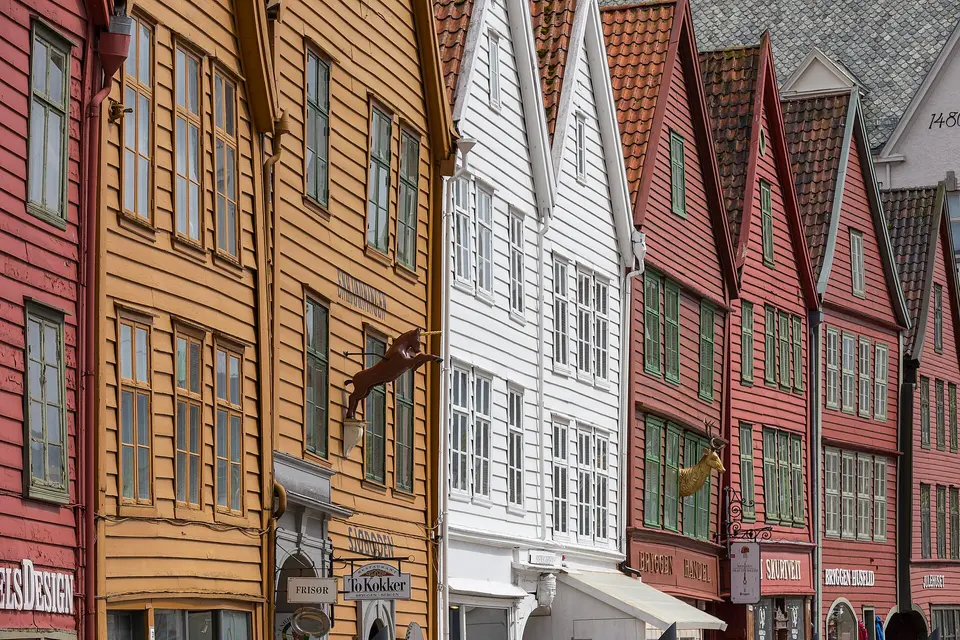
The German merchants of the Hanseatic League ran the dried-cod trade out of Bergen for four hundred years from a row of wooden gabled houses standing gable-end to the water, and what you see is the same row rebuilt after the fire of 1702 on foundations that go back to the twelfth century. Sixty-one buildings survive of the several hundred that once lined the whole harbour, and behind their painted fronts they are not really houses at all but tenements of narrow passages, wooden galleries and storerooms, leaning at angles no builder intended, with beams and hoisting doors still in place. Craftsmen and shops occupy the ground floors now. UNESCO listed Bryggen in 1979, and the timber is being replaced piece by piece as it rots, which is why there is usually scaffolding somewhere along it.

  • Plan about 1 h 30 min
  • The passages are public and free to walk into, and they are the point; go at either end of the day when the tour groups from the cruise ships are not on the quay
At the far end of Bryggen, two minutes on foot
Bryggens Museum
Photo: Erik den yngre, CC BY-SA 3.0
2Museum

Bryggens Museum

When a third of Bryggen burnt in 1955 the ground under it was excavated for thirteen years, and the several hundred thousand objects that came out of the waterlogged soil are the best record of everyday medieval life anywhere in northern Europe. The museum was built in 1976 directly on top of the oldest foundations, which are still there in the middle of the floor, and the exhibition is built round them: leather shoes, combs, imported ceramics from England and the Rhineland, and above all the runic sticks, several hundred pieces of wood on which ordinary people scratched business notes, love messages, insults and charms in a script most of us were taught died with the Vikings. The Guddal garment, a nearly thousand-year-old piece of Norwegian medieval clothing, is here too.

  • Plan about 1 h 15 min
  • Open daily 10:00 to 17:00 from 12 January to 30 December, closed 17 May and 23 to 26 and 31 December; 170 NOK for adults, 85 for students, free under 18, half price with the Bergen Card
100 m uphill behind the museum, two minutes on foot
St Mary's Church
Photo: Bjoertvedt, CC BY-SA 4.0
3Church

St Mary's Church

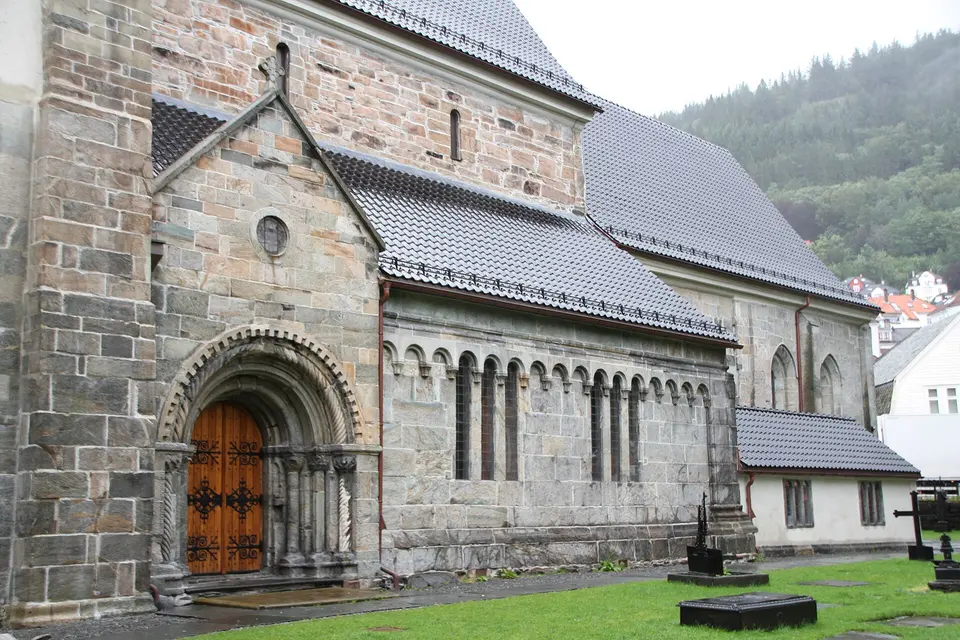
The oldest building still standing in Bergen, begun around 1130 in the Romanesque manner with two square west towers and finished with a Gothic choir, survived every fire that took the wooden city around it. From 1408 to 1766 it was the German church of the Hanseatic merchants of Bryggen, which is why the furnishings inside are so unexpectedly lavish for a small stone church: a late-fifteenth-century Lübeck altarpiece of carved and gilded figures, a pulpit of 1676 given by the German traders and covered in inlay and allegorical carving, and painted epitaphs on the walls. A long restoration finished a few years ago and the interior is now brighter than it has been in centuries.

  • Plan about 45 min
  • Open to visitors on weekday afternoons in summer with shorter hours the rest of the year and a small entry charge; services are in Norwegian; it is two minutes uphill from Bryggen

Midday

LunchLunch is at the fish market or just behind it. The outdoor stalls at Torget sell king crab, prawns and salmon at prices set for cruise passengers; the indoor Mathallen next door is where people from Bergen actually buy and is better value. The city's own dishes are worth ordering somewhere sitting down: persetorsk, pressed cod; raspeballer, potato dumplings served on Thursdays; and fiskesuppe, a creamy fish soup that every restaurant in town claims to make best.

Afternoon

600 m north-west round the headland, about 8 minutes on foot
Bergenhus Fortress
Photo: Sveter, CC BY-SA 3.0
4Fortress

Bergenhus Fortress

The headland at the mouth of the harbour was the royal seat of Norway when Bergen was its capital, and two medieval buildings survive inside the later ramparts. Håkon's Hall is the banqueting hall Håkon Håkonsson built between 1247 and 1261 for his son's wedding, the largest secular medieval building in the country, gutted when a German ammunition ship blew up in the harbour in 1944 and rebuilt afterwards. Next to it the Rosenkrantz Tower was raised in the 1560s by the governor Erik Rosenkrantz around an older keep and a thirteenth-century royal residence, and it is a warren of spiral stairs, chambers and gun positions that comes out on a roof looking over the whole harbour. The grounds are a public park and the Norwegian army still has offices behind the walls.

  • Plan about 2 h
  • Håkon's Hall is open daily 10:00 to 16:00 from 2 January to 20 December with scattered closures for events, 120 NOK and free with the Bergen Card; the Rosenkrantz Tower is 170 NOK, is not on the Bergen Card, and stays open until 19:00 on summer weekdays

Evening

1.2 km back through the centre to the Fløibanen station behind the fish market, then six minutes up by funicular
Fløyen
Photo: Diego Delso, CC BY-SA 4.0
5Mountain viewpoint

Fløyen

Bergen sits in a bowl ringed by seven mountains and Fløyen is the one with a funicular running up it from the middle of town. The Fløibanen has climbed the 320 metres since 1918 and takes six minutes, and at the top there is a terrace looking straight down on the harbour, the roofs and the fjord beyond, a restaurant, a café, a playground, a small herd of goats that keeps the scrub down, and the start of a network of gravel paths through pine forest that runs for kilometres across the plateau. The walk to Skomakerdiket lake takes twenty minutes and empties out completely. Walking back down to the city takes about forty-five minutes on a well-made zigzag path.

  • Plan about 2 h
  • The funicular runs 07:30 to midnight on weekdays and from 08:00 at weekends, every 10 to 15 minutes; a summer return is 200 NOK bought online or from a machine and 220 at the counter, a winter return 145; 10:00 to 14:00 is the queue

Day 2

Grieg's villa, a stave church and the art museums, then the cable car up Ulriken

Take the light rail south to the composer's house on the lake and the reconstructed stave church in its pine wood, come back for the four art museums in a row along the water, and finish 643 metres up with the whole coast below you.

  • 5 sights
  • Transport between sights
123452 kmN
Stops in order, straight-line distancesDriving route in Google Maps ↗

Morning

Troldhaugen
Photo: Holger Uwe Schmitt, CC BY-SA 4.0
1Composer's home

Troldhaugen

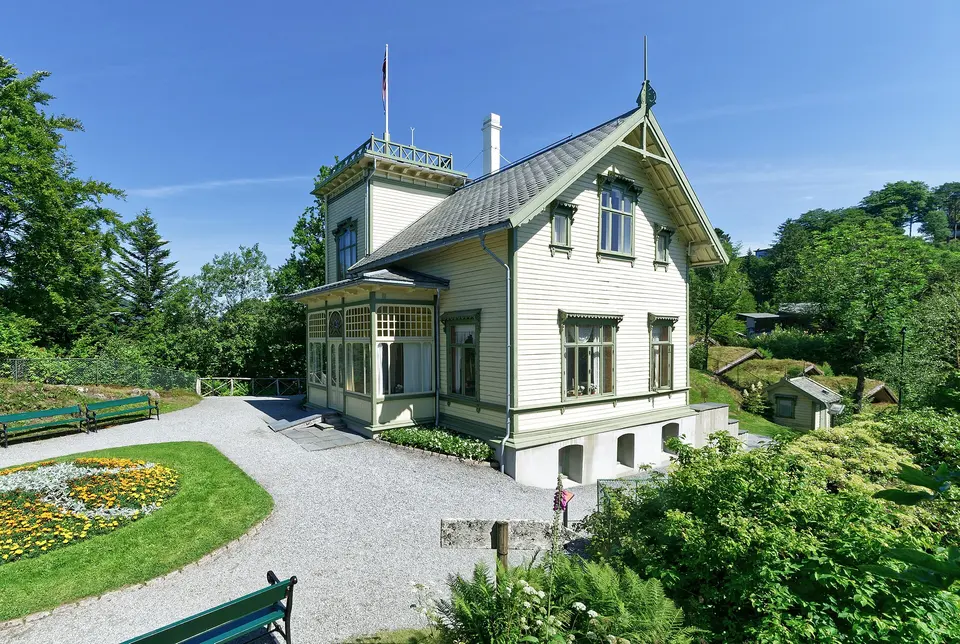
Edvard Grieg built this yellow wooden villa above Nordnåsvannet lake in 1885 and lived in it for the last twenty-two years of his life, and it is still furnished as he left it, down to the 1892 Steinway that was a silver-wedding present to him and his wife Nina. The reason to come is not really the house but the arrangement of the place: a path leads down through the birches to a one-room hut on the shore where he actually composed, with a piano, a desk and a view of nothing but water, and further along the rock face is the tomb where he and Nina are buried in a niche. A small concert hall built into the hillside below the villa puts on recitals through the summer with the lake behind the pianist.

  • Plan about 2 h
  • Open 2 May to 13 September, Tuesday to Sunday 10:00 to 16:00; the villa itself is closed for renovation and the garden, museum and café are open; 200 NOK covers every Kode museum, free under 18, and the audio guide is included
Bybanen back two stops to Fantoft and 10 minutes uphill on foot
Fantoft Stave Church
Photo: Erniee_jo, CC BY-SA 4.0
2Stave church

Fantoft Stave Church

A stave church is a medieval timber building held up by corner posts standing on sills rather than sunk in the ground, which is why a handful of them survived eight hundred years when everything else wooden rotted. This one was built about 1150 at Fortun in Sogn, moved here in 1883 to save it from demolition, burnt to the ground in 1992 in the first of a series of arson attacks by the Norwegian black-metal scene, and rebuilt over the next five years as an exact copy using the same joinery. So it is a reconstruction, and the guidebooks are right to say so; it is also black with tar, spiky with dragon heads and standing in a pine wood with a stone cross beside it, and it shows you the form better than the photographs of the originals do.

  • Plan about 45 min
  • Open daily from mid-May to mid-September, roughly 10:30 to 18:00, with a small entry charge and card payment only; take the Bybanen light rail to Fantoft and walk ten minutes uphill

Midday

LunchTroldhaugen has a café by the museum doing a simple lunch and the Grieg buns it is known for, which saves a detour. Back in the centre, the Kode buildings have three places to eat, from the café at Stenersen to the Michelin-starred Lysverket in the old power-company building, and the streets around Torgallmenningen have the usual range. Skostredet, five minutes north, is the small-street quarter for coffee, second-hand shops and a cheaper lunch.

Afternoon

Bybanen to Byparken, about 20 minutes; the four buildings stand in a row on Rasmus Meyers allé
Kode art museums
Photo: HMPinnsvinet, CC BY-SA 3.0
3Art museum

Kode art museums

Four buildings in a row along the Lille Lungegårdsvannet lake hold one of the largest art collections in Scandinavia, and a single ticket covers all of them. Lysverket, the old power-company headquarters, takes the story from medieval altar fronts to Norwegian romanticism; the Rasmus Meyer collection is the one to see if you only see one, a shipping fortune spent between 1905 and 1916 on Norwegian painting and holding a body of Edvard Munch second only to Oslo's, including The Woman in Three Stages and Melancholy; Stenersen runs modern and contemporary work with Klee, Picasso and Miró; and Permanenten, a neo-Gothic pile of 1896, holds decorative art including a startling collection of Chinese marble and bronze brought back by a Norwegian general in the 1900s.

  • Plan about 2 h 30 min
  • Open Tuesday to Friday 10:00 to 18:00 and weekends 10:00 to 16:00 from 19 May to 14 September, and Wednesday to Friday 11:00 to 18:00 with weekends 11:00 to 16:00 the rest of the year; 200 NOK for all four, free under 18
500 m up the hill from Kode, about 8 minutes on foot
University Museum of Bergen
Photo: HMPinnsvinet, Public domain
4Museum

University Museum of Bergen

Two nineteenth-century buildings on the hill above the city hold the university's collections, and both reopened after long restorations that left them looking like what they are: Victorian teaching museums, restored rather than modernised. The natural history building of 1865 has its original cabinets, a whale hall, and a stair hall with taxidermied birds hanging from the ceiling, and behind it is the botanical garden. The cultural history building holds Norway's second collection of Viking-age and medieval material, along with ethnographic collections from the Arctic and the Pacific brought back by Bergen ships. Almost nobody visits, which is a pity, and both are five minutes' walk from the Kode museums.

  • Plan about 1 h 30 min
  • Open Tuesday to Sunday, roughly 10:00 to 16:00 with longer summer hours, with one ticket covering both buildings and the botanical garden free; closed on Mondays

Evening

5 km east, about 15 minutes by taxi, or the Ulriken Express bus from Torgallmenningen every 30 minutes
Ulriken
Photo: trolvag, CC BY-SA 3.0
5Mountain

Ulriken

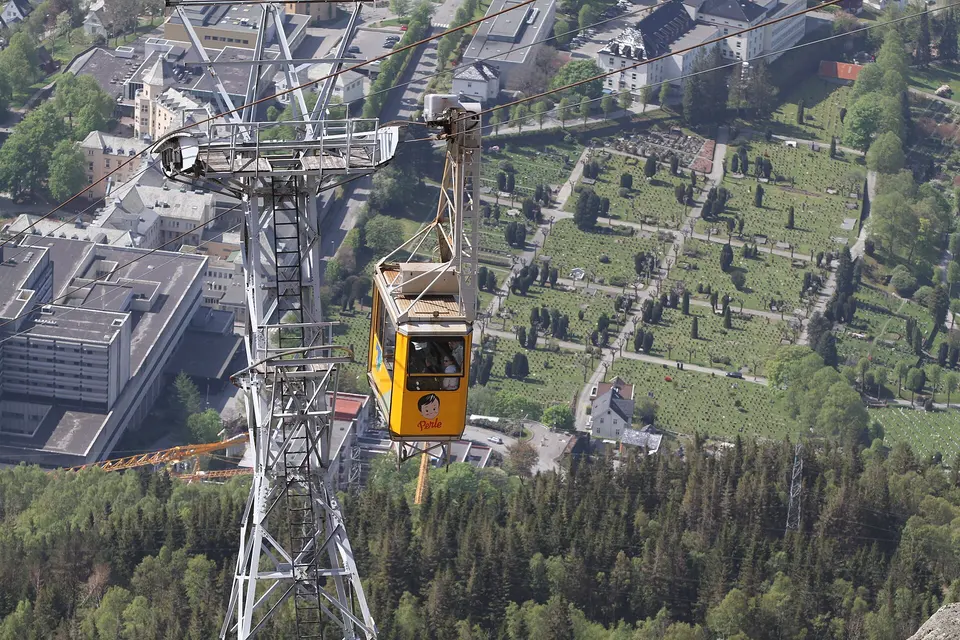
At 643 metres Ulriken is the highest of Bergen's seven mountains and a cable car has run to the summit since 1961, taking seven minutes to lift you above the fjord, the city, the islands and, on a clear day, a long way out into the North Sea. The top is bare rock with a television mast, a restaurant and a viewing platform, and it is where the serious walking starts: the Vidden trail runs fifteen kilometres north across an open plateau to Fløyen and takes five to six hours in good weather, with no shelter and weather that changes fast. Below the cable car station the Oppstemten is a staircase of nine hundred steps that fit Bergensers climb for exercise.

  • Plan about 3 h
  • The cable car runs daily 09:00 to 23:00 from April to September and Tuesday to Sunday in winter with Mondays closed; a return is 435 NOK for adults and 180 for children, and the whole cableway is closed for five-year maintenance in January 2027

Day 3

The wooden city, a fjord in an afternoon, and the old quarter on the point

Start at the open-air museum where fifty-five rescued wooden houses were reassembled into streets, take the three-hour boat up the fjord to the narrows at Mostraumen, and spend the evening walking the lanes of Nordnes and the wide square that a fire created.

  • 4 sights
  • Transport between sights
12345 kmN
Stops in order, straight-line distancesDriving route in Google Maps ↗

Morning

Old Bergen Museum
Photo: Sveter, CC BY-SA 3.0
1Open-air museum

Old Bergen Museum

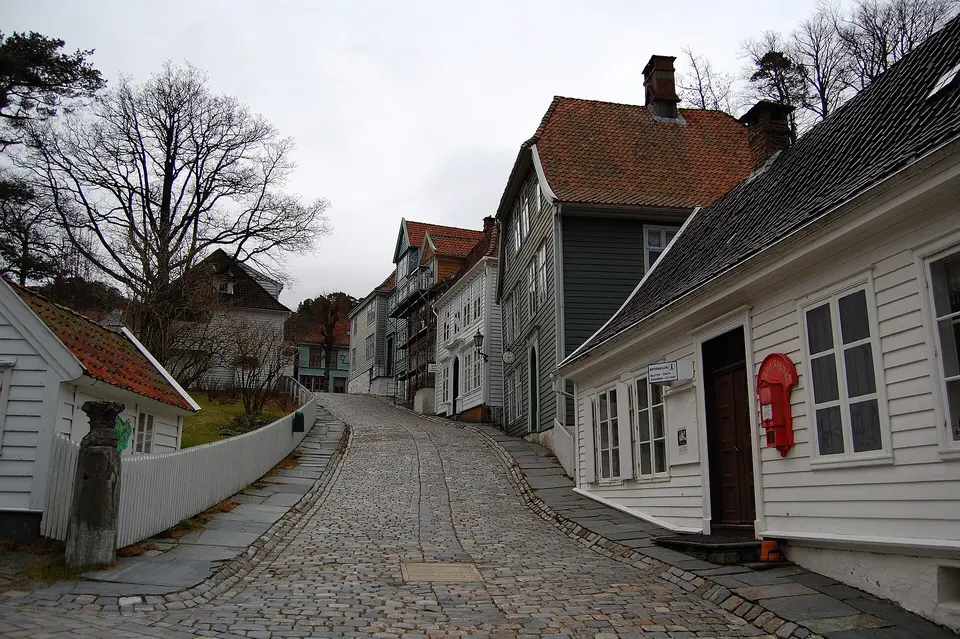
Bergen was the largest wooden city in Europe in the nineteenth century and most of it has since burnt or been cleared, so from 1949 the houses that were about to go were taken down and re-erected on a headland at Sandviken around an old shipbuilder's summer villa. There are now fifty-five of them arranged as cobbled streets and squares with a dentist's surgery, a bakery, a photographer's studio, a sailmaker and merchants' parlours, furnished to particular years. Actors in period dress play out short scenes in the square and will talk to you in character, which sounds unbearable and is in fact rather good, particularly with children. The English park and the shore around it are open all year and free.

  • Plan about 2 h
  • The houses are open daily 10:00 to 16:00 from 20 May to 13 September and cost 170 NOK for adults; allow two hours; the park and the waterfront are open year-round without a ticket

Midday

LunchOld Bergen has a café on its square, and the Sandviken shore below it has a couple of places by the water. If you are going straight to the boat, eat at the Mathallen at Torget, which is two minutes from the quay and does open sandwiches, fish soup and shellfish without the outdoor market's prices. The boat itself has a small bar but nothing that counts as a meal.

Afternoon

Back to the city centre, about 15 minutes; the boat leaves from Zachariasbryggen beside the fish market
Osterfjord and Mostraumen
Photo: Frokor, CC BY-SA 3.0
2Fjord

Osterfjord and Mostraumen

Bergen's own fjord trip leaves from the quay in the middle of the city and does not require a day. The boat runs north up the Byfjord and into the Osterfjord, past farms on ledges and waterfalls coming straight off the rock, and narrows steadily until it reaches Mostraumen, a strait a few dozen metres wide where the tide runs like a river and the skipper takes the boat close enough to the falls to fill a cup. The mountains here rise more than five hundred metres out of the water on both sides and the whole thing takes about three hours including the return. It is not Geiranger or Nærøyfjord, but those are a long day away and this leaves from the city centre.

  • Plan about 3 h 30 min
  • Boats leave from Zachariasbryggen beside the fish market, usually once or twice a day between spring and autumn and less often in winter; three hours, book online in summer, and dress warmer than the town requires

Evening

The peninsula starts across the harbour from the fish market, about 10 minutes on foot
Nordnes
Photo: patano, CC BY-SA 3.0
3Peninsula quarter

Nordnes

The long finger of land on the west side of the harbour is the part of central Bergen that fire mostly spared, and walking it is the best hour in the city that costs nothing. The lanes run between small wooden houses painted white, ochre and red, with roses and window boxes and the occasional glimpse down to the water, and they are narrow enough that cars have largely given up. At the tip there is a park with big trees, a heated outdoor seawater pool open in summer, and a view across the fjord mouth to the islands; on the way there are the aquarium, a couple of good bakeries and the old customs house. It is residential rather than preserved, which is exactly the difference from Bryggen.

  • Plan about 1 h 30 min
  • Free, always open; walk out along one side of the peninsula and back along the other, allow an hour and a half; the Nordnes seawater pool is open and heated through the summer for a small charge
700 m back east into the centre, about 10 minutes on foot
Torgallmenningen
Photo: Bjørn Christian Tørrissen, CC BY-SA 4.0
4Square

Torgallmenningen

The main square of Bergen is not a square at all but a very wide street, and it is wide for a reason: after the fire of 1916 the city cleared a firebreak across its centre and then made a public space of it, lined with granite-faced blocks in the restrained classicism of the 1920s. At the western end the Seafarers' Monument of 1950 is a granite column with bronze reliefs of a thousand years of Norwegian seafaring on four sides, from the Viking age to the merchant navy of the Second World War. The square runs from here down to the fish market at Torget, where the outdoor stalls sell shellfish through the summer and the indoor Mathallen stays open all year, and it is where every parade and demonstration in Bergen ends up.

  • Plan about 1 h
  • Free and open; the outdoor fish market runs roughly 10:00 to 18:00 from May to September and the indoor hall year-round; the stalls are expensive and aimed at visitors, and the hall is where locals buy

Good to know in Bergen

Fløibanen and Ulriken: hours and fares

  • Fløibanen runs from 07:30 to 24:00 on weekdays and from 08:00 to 24:00 at weekends and public holidays, with departures every 10 to 15 minutes and as often as every 5 minutes when busy; before 10:00 and after 19:00 it runs on the hour and half hour. The last departure from both the city station and Fløyen is at midnight. The busiest period is 10:00 to 14:00, when the operator warns of a 15 to 20 minute wait.Source: Fløibanen — Opening hours · checked Sep 2026
  • From 1 April to 30 September a Fløibanen return from the city centre to Fløyen costs 200 NOK for adults bought through the app, website or a ticket machine and 220 NOK otherwise, with children aged 4 to 15 at 100 or 120 NOK; from 1 October to 31 March the return is 145 NOK for adults, 70 for children and 100 for seniors. Children under 4 travel free with an adult, and senior tickets are not sold between 1 April and 30 September.Source: Fløibanen — Prices and ticket types · checked Sep 2026
  • The Ulriken cable car and its café run daily 09:00 to 23:00 from April to September; from October to March they are closed on Mondays, open 09:00 to 19:00 on Tuesday and Wednesday and Sunday, and 09:00 to 23:00 from Thursday to Saturday. A return costs 435 NOK for adults, 180 for children aged 4 to 16 and 1,050 for a family of two adults and up to three children, and the Ulriken Express bus from Torgallmenningen 1A runs about every 30 minutes between 09:00 and 18:30. The whole cableway is closed for the duration of January 2027 for its five-year maintenance.Source: Ulriken643 — Opening hours and prices · checked Sep 2026

Kode museums and the Grieg house

  • The four Kode art museums are open Tuesday to Friday 10:00 to 18:00 and Saturday and Sunday 10:00 to 16:00 between 19 May and 14 September, and Wednesday to Friday 11:00 to 18:00 with Saturday and Sunday 11:00 to 16:00 between 15 September and 18 May. They close on 1 January, 1 May, 17 May, 24 and 25 December and 31 December. One 200 NOK ticket gives same-day entry to all four, visitors under 18 are free, and the Bergen Card gives free admission from October to April and a 25 per cent discount from May to September.Source: Kode — Opening hours and info · checked Sep 2026
  • Troldhaugen, Edvard Grieg's villa, is open 2 May to 13 September, Tuesday to Sunday 10:00 to 16:00, with the garden, museum and café open and outdoor guided tours and daily concerts from 9 June; the villa itself is closed for renovation. From 14 September to 1 May the park is open at all times and the museum and café only on days with events or concerts. The same 200 NOK Kode ticket applies, an entrance ticket is needed even for the garden during opening hours, and a free audio guide is available at reception.Source: Kode — Troldhaugen · checked Sep 2026
  • Two of Kode's other composer homes are affected in 2026. Lysøen, Ole Bull's villa on its island, is closed for refurbishing and there is no museum boat from Buena to the island this year, though the island itself can be reached by private boat. Siljøstøl is open on Sundays 10:00 to 16:00 between 14 June and 13 September and otherwise only during selected concerts, with its grounds open all year.Source: Kode — Lysøen and Siljøstøl · checked Sep 2026

Bergenhus and the city museums

  • Håkon's Hall is open daily 10:00 to 16:00 from 2 January to 20 December, with closures on scattered dates for events, and costs 120 NOK for adults, 60 for students, free for under-18s and free with the Bergen Card. The Rosenkrantz Tower is open daily 10:00 to 16:00 from 2 January to 30 June and again from 16 September to 20 December, and 10:00 to 19:00 Monday to Friday with weekends 10:00 to 16:00 from 1 July to 15 September; it costs 170 NOK for adults and 85 for students, children under 18 are free, and it is not included in the Bergen Card. The tower opens on the dates the hall is closed, except public holidays.Source: Bymuseet i Bergen — Håkon's Hall and the Rosenkrantz Tower · checked Sep 2026
  • Bryggens Museum is open daily 10:00 to 17:00 from 12 January to 30 December and closed on 17 May, 23 to 26 December and 31 December. Adults pay 170 NOK, students 85, children under 18 are free, the Bergen Card gives a 50 per cent discount and groups of 15 or more get 20 per cent off.Source: Bymuseet i Bergen — Bryggens Museum · checked Sep 2026
  • The Old Bergen open-air museum opens for the season from 20 May to 13 September, daily 10:00 to 16:00, at 170 NOK for adults; the museum recommends at least an hour and says two to three is normal. Its English park and the shore around it are open to everyone all year without a ticket.Source: Bymuseet i Bergen — Old Bergen Museum · checked Sep 2026

3 days in Bergen: quick answers

Is 3 days enough for Bergen?

Three days fits the city and one fjord trip comfortably: the medieval harbour and Fløyen, the composer's house and the art museums with Ulriken, and a day for the wooden city, a fjord and the old quarter. Two days means dropping either the fjord or the museums. If you have a fourth, use it for the longer fjord day to Nærøyfjord and Flam by the Norway in a Nutshell route, or for a hike across the Vidden plateau from Ulriken to Fløyen, which takes five to six hours and needs settled weather.

What is the best time of year to visit Bergen?

May to September, with June and July the warmest at about 17 to 19°C, and late May and early September the best compromise between open attractions and empty streets. Bergen is one of the wettest cities in Europe with rain on roughly 230 days a year, so pack for it whenever you go and do not plan around a forecast. Winter is dark and mild rather than freezing, the Christmas market and the gingerbread town run in December, but the fjord boats thin out, Troldhaugen and Old Bergen close, and the Ulriken cable car shuts entirely for maintenance in January 2027.

Is the Bergen Card worth it?

It depends almost entirely on how many museums you intend to enter. It gives free travel on the light rail and city buses, free entry to Håkon's Hall and a long list of other museums, half price at Bryggens Museum, free Kode entry from October to April and 25 per cent off from May to September, and 10 per cent off Ulriken tickets. It does not cover the Rosenkrantz Tower. If your plan is three or four museums plus transport it pays; if you are mostly walking and looking at Bryggen and the fjord, it does not.

How much does Bergen cost per day?

Norway is expensive and Bergen is not the cheap part of it. A hostel bed runs 400 to 600 NOK, a mid-range hotel room 1,300 to 2,200, and a good one considerably more. Eating out is the shock: a café lunch is 200 to 280 NOK, a main course at dinner 320 to 450, and a beer 110 to 140. Self-catering from a Rema or Kiwi supermarket halves it. The set attractions add up fast too: Fløibanen and Ulriken together are more than 600 NOK in summer before you have entered a museum.

Can you see a real fjord from Bergen in one day?

Yes, in two ways. The three-hour Mostraumen boat from the city centre goes up the Osterfjord to a narrow strait with waterfalls and 500-metre walls and is back in time for dinner. For the famous, deeper fjords you need the full day: the Norway in a Nutshell route takes the train to Voss and Myrdal, the Flåm Railway down to the fjord, a boat through Nærøyfjord, which is on the UNESCO list, and a bus and train back, and it runs about twelve hours from Bergen.

Do you need a car in Bergen?

No, and it is a liability in the centre, where parking is expensive and much of the old town is closed to traffic. The Bybanen light rail runs from the centre south past Fantoft and Hop to the airport, and it reaches most of what is outside walking distance, including Troldhaugen with a walk at the end. Buses cover the rest, and single tickets run from about 51 NOK for one zone. A car only makes sense if you are driving on to the fjords afterwards.

Other Bergen itineraries

Keep exploring

Where this connects

THE TRIPWOA APP

Go somewhere.
Make it yours.

Build days around what you love. Follow your route, find your next stop and keep the moments along the way.

Get it on Google PlayAvailable for Android
Free to start
Tripwoa home with a Paris trip and nearby places to explore
Tripwoa day plan for New York with a route map and Times Square stop

A day that feels like you.

Sources and method

Places and coordinates: Wikidata and Tripwoa's open-data place catalog (Overture Maps Foundation, © OpenStreetMap contributors). Photos: Wikimedia Commons, credited on each image. Practical rules: the official sources linked in each note, checked in September 2026.

How this plan was made: Tripwoa's planner drafted the day order from real coordinates and typical visit times. Each stop was then reviewed, reordered where needed and rewritten with AI assistance. Walking distances are straight-line estimates, so allow a little extra time on real streets.