3-day itinerary · United Kingdom

3 Days in Brighton

A plan that walks the Pavilion estate and the seafront on the first day, the two shopping quarters on the second, and gets out to the marina and the South Downs on the third. The i360's change of owner and website is in the stops.

  • 3days
  • 14sights
  • 0.0 kmon foot between sights

Updated 13 September 2026 · 3 official sources checked · report an error

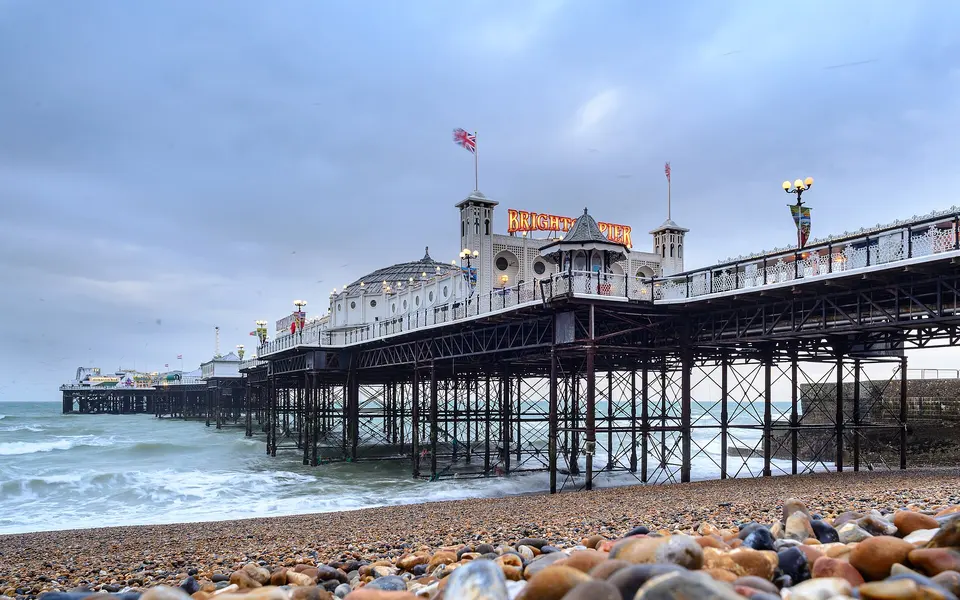
Brighton Palace Pier
Photo: Arild Vågen, CC BY-SA 4.0

The Royal Pavilion and the pier, then North Laine and the Lanes, then Volk's Railway and Devil's Dyke

Brighton was a fishing town called Brighthelmstone, in decline and half washed away by storms, until a doctor published a book in 1750 arguing that sea water cured things and the Prince of Wales arrived in 1783 to test the theory. He built a palace, the railway arrived in 1841, and the town has been London's seaside ever since — genteel in the morning, disreputable by evening, and quietly proud of both. It is now a city of about 280,000 with Hove, the most secular and one of the most liberal places in Britain, with two universities, a famously independent high street and a chalk ridge of downland immediately behind it. Almost everything worth seeing is within twenty minutes' walk of the pier.

At a glance

Ways to use these days

If it rains
4 of the stops are indoors — Royal Pavilion · Brighton Museum & Art Gallery · Brighton Toy and Model Museum
For the view
Brighton i360
Lightest day on foot
Day 1 — 1.8 km between stops
Most walking
Day 3 — 12.7 km

Day 1

A prince's Indian palace, the museum in its stables, and the pier

Give the morning to the oddest royal building in Britain and the museum across its garden, look into the riding house where ABBA won Eurovision, then go down to the sea for the pier and the tower on the ruined one.

  • 5 sights
  • Transport between sights
12345250 mN
Stops in order, straight-line distancesWalking route in Google Maps ↗

Morning

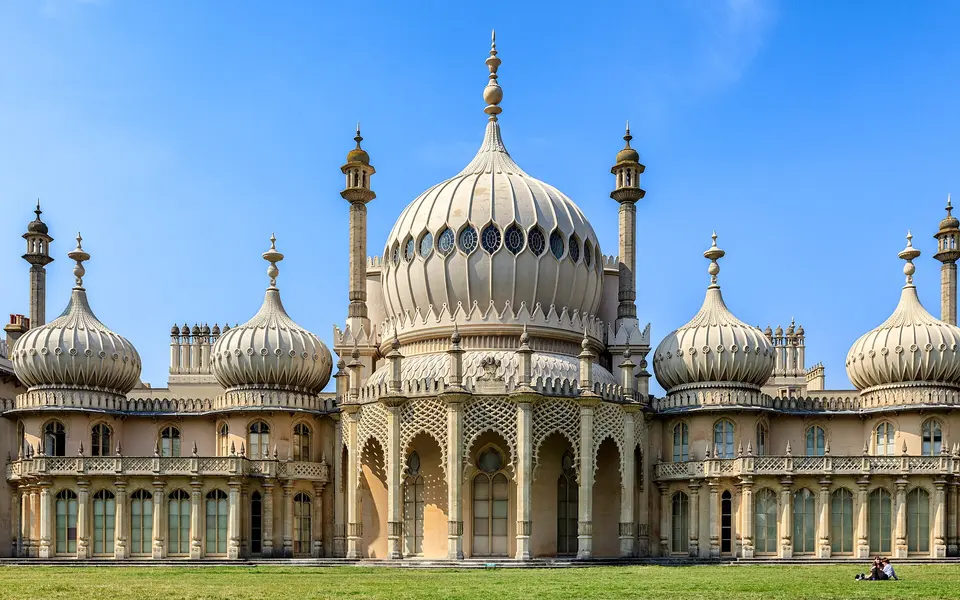
Royal Pavilion
Photo: Qmin, CC BY-SA 3.0
1Palace

Royal Pavilion

George, Prince of Wales, rented a farmhouse here in 1787 to be near the sea, his mistress and the racing, and over thirty-five years turned it into the strangest palace in Britain. John Nash gave it an Indian outside — onion domes, minarets, pierced stone screens — and the inside is Chinese: a banqueting room lit by a chandelier hung from a silvered dragon, a music room of lotus lamps and hand-painted canvases, and a Great Kitchen whose iron columns end in copper palm leaves. Victoria disliked it and sold it to the town in 1850 for £53,000, which is why a seaside borough owns a royal palace.
  • Plan about 2 h
  • Ticketed, open daily with seasonal hours; the official guided tour runs every Saturday at 14:00. Allow two hours, and the Great Kitchen and the music room are the two rooms not to rush
100 m across the Pavilion garden, two minutes on foot
Brighton Museum & Art Gallery
Photo: PAUL FARMER, CC BY-SA 2.0
2Museum

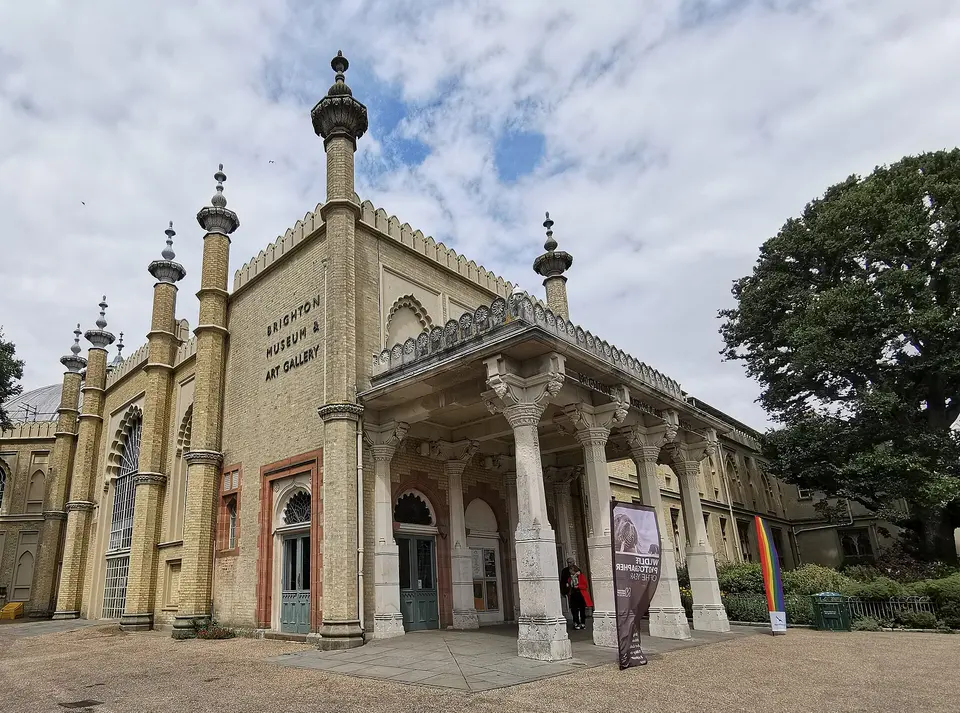
Brighton Museum & Art Gallery

In the Pavilion's former riding house and stables, a few steps across the garden, and much better than a municipal museum has any right to be. The twentieth-century decorative art collection is the draw: Art Nouveau and Art Deco furniture, and Salvador Dalí's Mae West Lips Sofa, which is exactly as odd in person as in photographs. Beyond that there is a fashion and style gallery drawn from the town's own wardrobes, a room on Brighton's history that is honest about the smuggling and the dirty weekends, and an Egyptian and world art collection assembled by Victorian collectors with money and no restraint.

  • Plan about 1 h 30 min
  • Ticketed, and a combined ticket with the Royal Pavilion is cheaper than the two separately; it is two minutes from the Pavilion across the garden and generally open Tuesday to Sunday

Midday

LunchBrighton eats better than almost any English town its size and the reason is the number of people who moved here to open something. It is also the most vegetarian city in the country by some distance — Terre à Terre has been doing it since 1993 — and the seafood is landed on the beach. Fish and chips on the pier is the obligatory version; the better version is a plate of Sussex-landed mackerel or a fish shack under the arches, or one of the small restaurants in Kemptown.

Afternoon

50 m west, one minute on foot
Brighton Dome
Photo: Tony Hisgett from Birmingham, UK, CC BY 2.0
3Concert hall

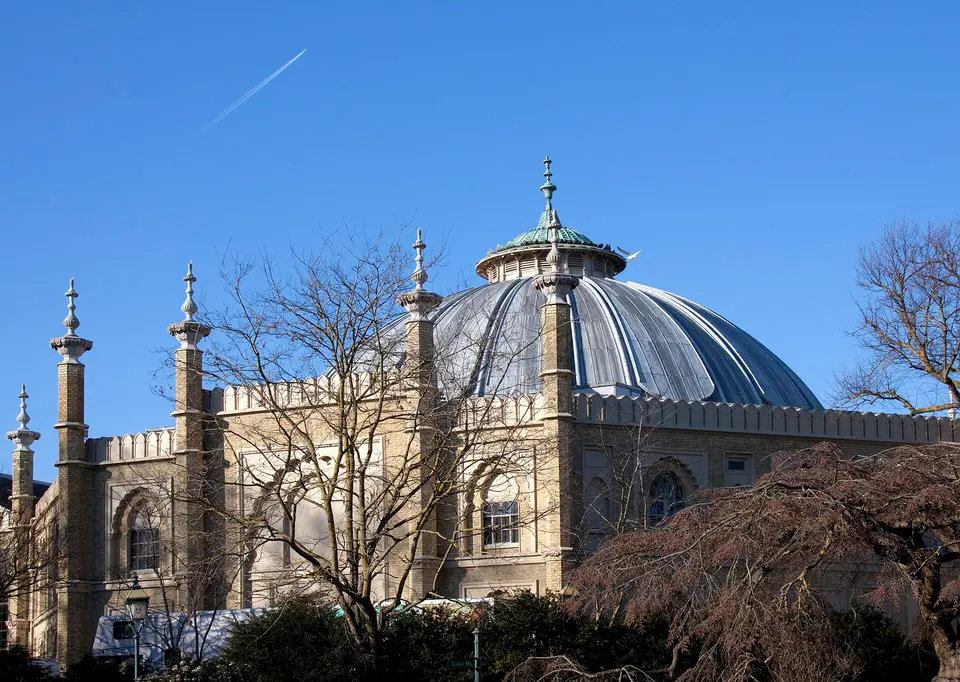
Brighton Dome

Built between 1803 and 1808 as the Prince Regent's riding house and stables — a domed rotunda big enough to exercise horses under cover, which at the time had a larger dome than St Paul's — and converted into a concert hall in 1867 once the town decided it would rather have music than cavalry. It is the main venue of the Brighton Festival every May, and it is where ABBA won the Eurovision Song Contest in 1974, a fact the town has never once been shy about. The Corn Exchange and Studio Theatre next door complete the complex.

  • Plan about 30 min
  • Free to look at from the outside and from the Pavilion Gardens; to get inside, book something — the programme runs year-round and the Brighton Festival in May fills all three rooms
600 m south to the sea, about eight minutes on foot down Old Steine
Brighton Palace Pier
Photo: Arild Vågen, CC BY-SA 4.0
4Pier

Brighton Palace Pier

Opened in 1899 and Brighton's third pier, after the Chain Pier that a storm destroyed in 1896 and the West Pier that is now a skeleton down the beach. It is 524 metres of cast iron and timber carrying a funfair, two arcades, a helter-skelter, doughnut stands and a great deal of noise, and it is Grade II* listed, which means the fish and chips are protected architecture. Something over three million people walk it a year. It is not refined and it is not trying to be; a pleasure pier is a Victorian invention for people who wanted the sea without a boat, and this is the last one doing it properly.

  • Plan about 1 h 30 min
  • Free to walk on; the rides and arcades are pay-as-you-go and a wristband is cheaper if you are with children. Sunset from the pier deck looking west at the West Pier is the photograph everyone comes for

Evening

1.1 km west along the promenade, about fifteen minutes on foot
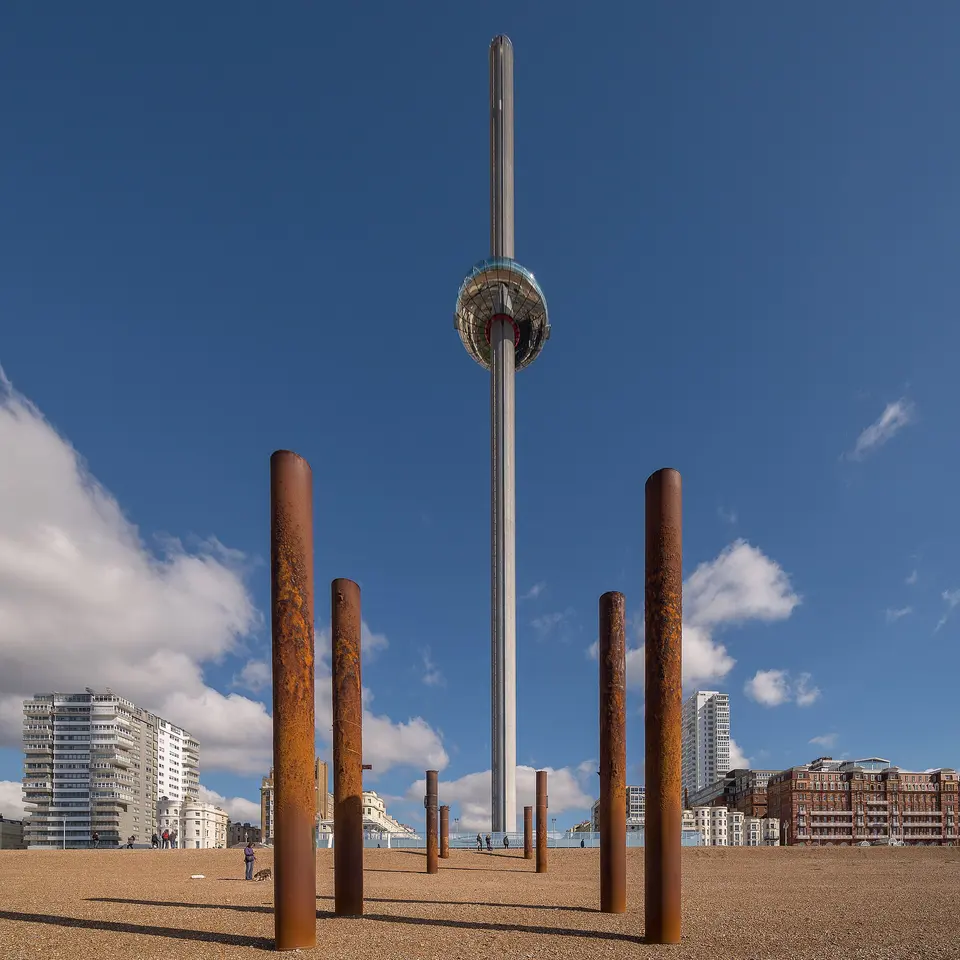
Brighton i360
Photo: Arild Vågen, CC BY-SA 4.0
5Observation tower

Brighton i360

A 162-metre steel needle on the seafront at the landward end of the ruined West Pier, with a glass pod that slides up the outside to 138 metres and turns slowly while you look at the Downs, the Channel and the whole curve of the town. Marks Barfield, the team behind the London Eye, designed it and it opened in August 2016 on a council loan that became a long political argument; the company went into administration in December 2024 and closed, and the tower was bought and reopened in 2025 under new owners as simply the Brighton i360. There is a bar in the pod.

  • Plan about 1 h 15 min
  • Book online; residents of the BN1, BN2, BN3 and BN41 postcodes get a £7 local ticket, children under two go free with any adult ticket, and the Sky Walk and Climb — standing on top of the pod — run on Saturday mornings at 09:00, alternating week by week

Day 2

Two quarters that sound the same and are not, and the beach's own museum

Spend the day on foot between the station and the sea: the grid of independent shops built over market gardens, the toy museum under the railway arches, the medieval alleys of the fishing village, and the arch that remembers the fleet.

  • 5 sights
  • Transport between sights
12345250 mN
Stops in order, straight-line distancesWalking route in Google Maps ↗

Morning

North Laine
Photo: Andy Li, CC0
1Neighbourhood

North Laine

A grid of narrow streets between the station and the Pavilion, built over what were market gardens — a laine is a Sussex word for an open field, which is why it is not spelled like a lane. Slum-clearance plans in the 1970s would have flattened it; a campaign saved it, and what survived became the densest run of independent shops in southern England: several hundred of them, selling records, vintage clothes, comics, tattoos, coffee and a large quantity of things nobody needs. Kensington Gardens and Gardner Street are the centre of it and the whole quarter is at its best on a Saturday.

  • Plan about 2 h
  • Free; the shops run roughly 10:00 to 18:00 and the cafés longer. It is five minutes downhill from Brighton station, so it is the natural first or last hour of a trip
300 m north under the station arches, four minutes on foot
Brighton Toy and Model Museum
Photo: Eric Baird, CC BY-SA 3.0
2Museum

Brighton Toy and Model Museum

Four brick arches under Brighton station, packed with about ten thousand toys and models from the 1850s onwards: Hornby and Märklin trains running on layouts built to period, Meccano, Britains lead soldiers, Dinky and Corgi cars, tinplate, and a wall of dolls' houses including a Gottschalk. The centrepiece is a 1930s model railway layout of genuine scale, which is run for visitors on a schedule. It is a small, slightly cramped, entirely unmodernised museum staffed largely by volunteers who know everything, and it is one of the best of its kind in Europe.

  • Plan about 1 h 15 min
  • A modest admission, generally open Tuesday to Saturday and closed Sunday and Monday; the model railways run at set times through the day, so ask at the desk when you arrive

Midday

LunchNorth Laine is the lunch quarter: bagels, falafel, Korean, a great deal of coffee, and the Open Market on Marshalls Row with food stalls under a roof. Kensington Gardens and Gardner Street are where to look. If you want to sit down properly, the Lanes have the older pubs and the seafront arches have the fish. Brighton does breakfast until about three in the afternoon and nobody thinks anything of it.

Afternoon

700 m south, about nine minutes on foot through the middle of town
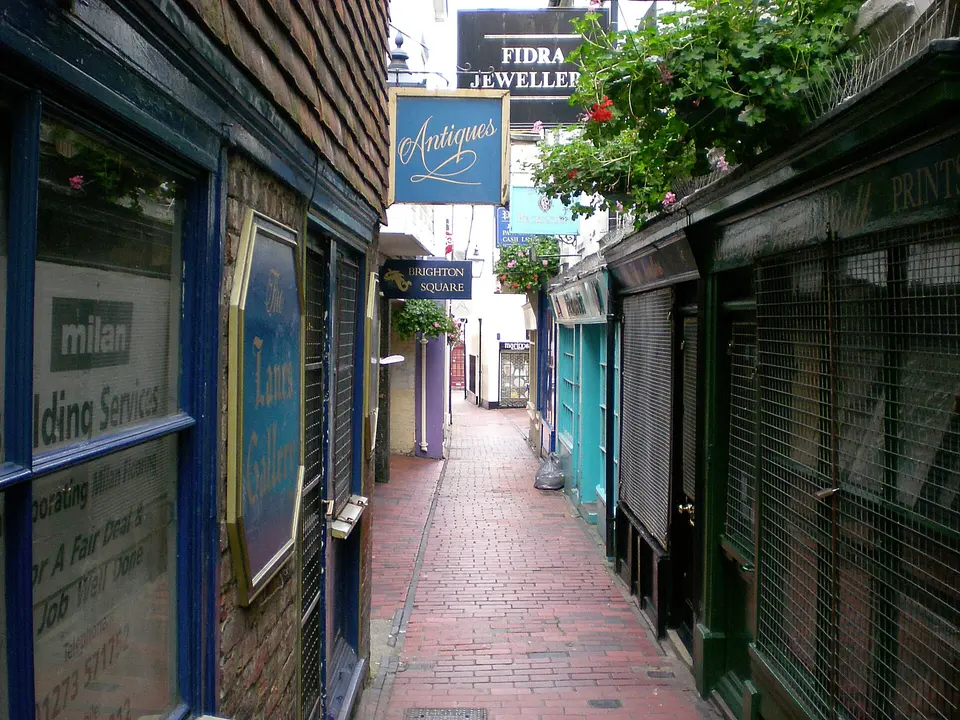
The Lanes
Photo: Frank Jepsen, CC BY 2.0
3Neighbourhood

The Lanes

The street plan of Brighthelmstone, the fishing village that was here before the Prince Regent: a knot of twittens — the Sussex word for an alley — too narrow for two people to pass comfortably, running between the seafront and North Street. The fishermen have long gone and the shops are jewellers, antique dealers, and the sort of pubs that have been there since before any of it. It is small enough to walk in twenty minutes and confusing enough to take an hour, and the point of it is the wandering rather than any single address.

  • Plan about 1 h 30 min
  • Free; the shops open around 10:00 and the pubs stay open late. Do not confuse the Lanes with North Laine — they are different quarters five minutes apart and locals will correct you
500 m south-west to the lower promenade, seven minutes on foot
Brighton Fishing Museum
Photo: Simon Burchell, CC BY-SA 3.0
4Museum

Brighton Fishing Museum

One arch on the lower promenade, free to enter, run by volunteers, and the only place on the seafront that remembers what the seafront was for. Inside stands a clinker-built Sussex beach punt, the type that was launched off the shingle to catch mackerel and herring and was hauled back up by capstan; around it are photographs of the beach when it was covered in nets and boats rather than deckchairs, the story of the Brighton fleet and of the storms that took it, and the trades — net-making, rope, smoking — that went with it. It takes half an hour and it recalibrates the whole town.

  • Plan about 45 min
  • Free and generally open daily through the afternoon; it is on the lower promenade between the two piers, and there is still a small fish market and fishing boats on the beach beside it

Evening

700 m west along the beach, about nine minutes on foot
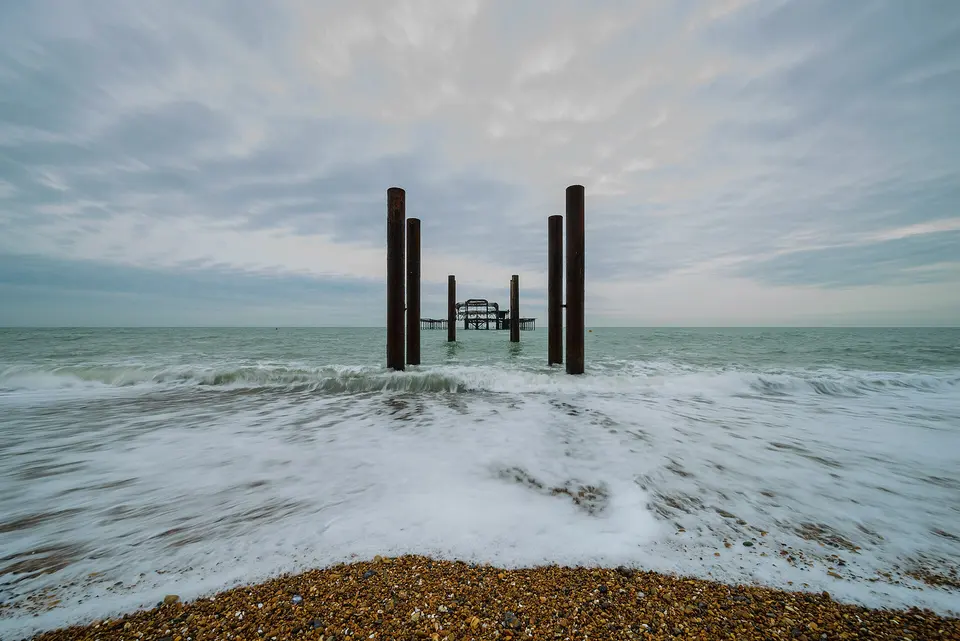
West Pier
Photo: Arild Vågen, CC BY-SA 4.0
5Ruin

West Pier

Eugenius Birch built it in 1866 and it was the elegant one — a concert hall, a pavilion, deckchairs and a bandstand — until it closed in 1975 and the sea, two fires in 2003 and a storm took the rest. What is left is a black iron skeleton standing offshore, which the town has decided to keep rather than clear, and which has become the most photographed object in Brighton. In winter it is also a starling roost: tens of thousands of birds gather over it at dusk and turn in the murmuration, which is genuinely one of the great free spectacles in Britain.

  • Plan about 45 min
  • Free, viewed from the beach and the promenade below the i360; the starling murmurations run from roughly November to February and happen about half an hour before sunset, weather permitting

Day 3

Out of town: the oldest electric railway, a marina under the cliff and the Downs

Take an 1883 electric railway east along the beach to the marina, then go inland and up onto the chalk for an Edwardian house kept as it was and the biggest dry valley in Britain.

  • 4 sights
  • Transport between sights
12342 kmN
Stops in order, straight-line distancesDriving route in Google Maps ↗

Morning

Volk's Electric Railway
Photo: mattbuck, CC BY-SA 4.0
1Heritage railway

Volk's Electric Railway

Magnus Volk, a Brighton clockmaker's son who electrified his own house before the town had a supply, opened this along the seafront in 1883, which makes it the oldest operating electric railway in the world. It runs 1.6 kilometres on a narrow gauge from the Aquarium station beside the Palace Pier to Black Rock by the marina, at about thirteen kilometres an hour, in open wooden cars, with the sea on one side and the beach volleyball and the naturist section on the other. It is slow, it is short, and it has been doing exactly this for more than 140 years.

  • Plan about 45 min
  • A cheap single or return, running daily in the season and at weekends in the shoulder months, closed through the winter; the whole run takes about ten minutes each way
At the Black Rock end of the railway, a five-minute walk from the terminus
Brighton Marina
Photo: Andy Li, CC0
2Marina

Brighton Marina

Built between 1971 and 1979 behind two long breakwaters and usually described as the largest man-made marina in Europe, with about 1,600 berths under the white chalk cliff at Black Rock. The village around it is a 1990s development of restaurants, a cinema, a bowling alley and a supermarket, and it is nobody's idea of picturesque. What it is good for is the walk: the outer breakwater goes a long way out into the Channel, the boats are worth an hour, and the undercliff path back into town under the cliffs is the best level seafront walk on this coast.

  • Plan about 1 h 30 min
  • Free; the undercliff walk runs about 5 km east to Rottingdean and is flat the whole way, and Volk's Railway drops you at Black Rock at the marina end. Parking is free for the first few hours

Midday

LunchThe marina has chain restaurants and a decent enough view of the boats. The better plan is to eat in Kemptown on the way back — St James's Street and the roads off it have the neighbourhood restaurants, the delis and the pubs that Brighton people actually use — or to carry something up to Devil's Dyke, where there is a pub at the top and a view that improves anything you brought with you.

Afternoon

6 km north-west, about twenty minutes by car or the bus up London Road
Preston Manor
Photo: Jnicho02, CC BY-SA 4.0
3Historic house

Preston Manor

A manor house of 1738 remodelled in 1905 and left to the town in 1932 with its contents intact, which is the unusual part: it is presented as an Edwardian house on a single day, upstairs and downstairs both, with the drawing rooms, the servants' quarters, the kitchens and the butler's pantry laid out as if the family had just gone out. The Macquoids who lived here were serious collectors and spiritualists, and the house has the reputation of being among the most haunted in Sussex, which the museum service does not discourage. The walled garden and the pet cemetery are outside.

  • Plan about 1 h 30 min
  • Ticketed and run by the same trust as the Royal Pavilion, generally open in the afternoon on a limited number of days a week, so check before going; it is 3 km north of the centre and the bus up the London Road stops outside

Evening

8 km north-west onto the Downs, about twenty minutes by car; the 77 bus runs from Brighton station at weekends and in summer
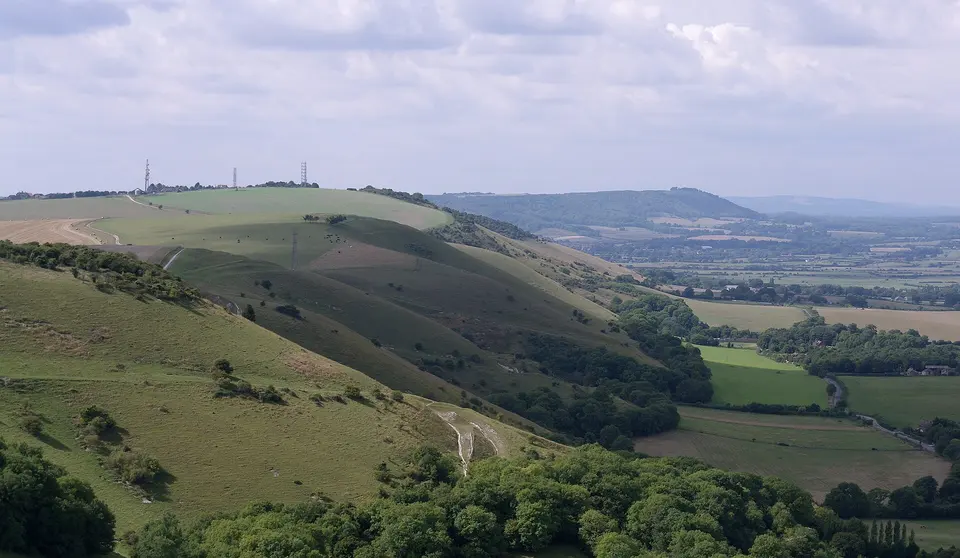
Devil's Dyke
Photo: mattbuck, CC BY-SA 4.0
4Valley

Devil's Dyke

A dry chalk valley on the South Downs eight kilometres north of the town, about a kilometre long and a hundred metres deep, and the largest of its kind in Britain — cut by meltwater at the end of the last ice age, though the better story is that the Devil dug it in a night to let the sea in and drown the churches of the Weald, and was interrupted by an old woman with a candle. From the ridge above it the view runs the whole way across the Weald to the North Downs. In the 1890s there was a funicular, a cable car across the valley and a railway up here; all of it has gone.

  • Plan about 2 h
  • Free, National Trust land, always open, with a pay-and-display car park and a pub at the top; the number 77 bus runs from Brighton station at weekends and in summer. It is exposed and windy, so take a layer more than you think

Good to know in Brighton

Brighton i360: the new owner and the new website

  • The tower now trades as the Brighton i360 and its official site is brightoni360.co.uk; the former britishairwaysi360.com address no longer belongs to the attraction. The official site states that local resident tickets at £7 are available exclusively to residents of the BN1, BN2, BN3 and BN41 postcodes, that children under two go free with any adult ticket purchase, and that the café is open every day from 8am.Source: Brighton i360 — official site · checked Sep 2026
  • The Sky Walk and the Climb — standing on top of the pod at 450 ft — take place every Saturday at 09:00, alternating week by week, and a 60-minute experience runs every Saturday and Sunday at 9am.Source: Brighton i360 — Tickets · checked Sep 2026

The Royal Pavilion

3 days in Brighton: quick answers

Is 3 days enough for Brighton?

Comfortably, and two would do for the sights alone. Brighton is a small, dense town where almost everything is within twenty minutes on foot, and the third day here is deliberately spent getting out of it — onto the Downs and along the coast — because that is what the town itself does at weekends. If you have longer, Lewes is twelve minutes by train and has a castle and the best bonfire night in England, and the Seven Sisters cliffs are forty minutes east.

Is Brighton a day trip from London?

It is the classic one — the train from Victoria or London Bridge takes about an hour and runs every few minutes — and that is exactly why staying over is better. The town changes after six: the restaurants fill, the pubs and the music venues open, and the seafront at night is the reason people move here. A day trip gives you the Pavilion, the pier and the Lanes. Two nights gives you the rest.

What is the best time of year to visit Brighton?

May to September for the sea and the long evenings, and May in particular for the Brighton Festival and the Fringe, which take over the town for three weeks. Pride in early August is enormous and books the town out. The quiet secret is winter: the starling murmurations over the West Pier run from about November to February, the Pavilion is at its best without crowds, and hotel prices halve. It is exposed to the Channel and the wind is a real factor all year.

How much does Brighton cost per day?

Less than London and more than most of the south coast. A hostel bed runs £25 to £45, a mid-range hotel £100 to £180 outside the festival and Pride weeks and a good deal more during them. The Royal Pavilion and the museum are cheaper on a combined ticket, the i360 is the big single expense at around £20 for an adult, and the Fishing Museum and the beach are free. A pub lunch is £14 to £20 and dinner in the Lanes £30 to £50 a head.

Is the Brighton i360 still open?

Yes, but under new ownership and a new name. The tower opened in 2016 as the British Airways i360, the operating company went into administration and closed it in December 2024, and it was bought and reopened in 2025 as simply the Brighton i360. The practical consequence for visitors is that the old britishairwaysi360.com address is no longer the attraction's website and should not be used; book through brightoni360.co.uk. Residents of the BN1, BN2, BN3 and BN41 postcodes pay £7.

Can you swim at Brighton beach?

Yes, and people do all year, but know what you are getting: the beach is pebbles rather than sand, the shelf drops away quickly, and the water is cold enough that a wetsuit is normal outside July and August. There are lifeguards on the main stretches in the season and the safe areas are flagged. Water shoes make the walk in much less painful. The beach immediately east of the marina is quieter, and there is a long-established naturist section beyond Volk's Railway.

Other Brighton itineraries

Keep exploring

Where this connects

THE TRIPWOA APP

Go somewhere.
Make it yours.

Build days around what you love. Follow your route, find your next stop and keep the moments along the way.

Get it on Google PlayAvailable for Android
Free to start
Tripwoa home with a Paris trip and nearby places to explore
Tripwoa day plan for New York with a route map and Times Square stop

A day that feels like you.

Sources and method

Places and coordinates: Wikidata and Tripwoa's open-data place catalog (Overture Maps Foundation, © OpenStreetMap contributors). Photos: Wikimedia Commons, credited on each image. Practical rules: the official sources linked in each note, checked in September 2026.

How this plan was made: Tripwoa's planner drafted the day order from real coordinates and typical visit times. Each stop was then reviewed, reordered where needed and rewritten with AI assistance. Walking distances are straight-line estimates, so allow a little extra time on real streets.