3-day itinerary · Brazil

3 Days in Rio de Janeiro

A realistic first-timer plan that keeps each day in one part of the city: the Sugarloaf cable car, the fort at the end of Copacabana and sunset at Arpoador; the train up to Christ the Redeemer, Parque Lage and the Botanical Garden; then the Museum of Tomorrow on the port, the centre's churches and cafés, the Lapa Arches, the Selarón steps and the tram up to Santa Teresa. Every stop comes with walking distances and the opening rules that matter in 2026.

  • 3days
  • 16sights
  • 8.2 kmon foot between sights

Updated 12 September 2026 · 10 official sources checked · report an error

Christ the Redeemer (Cristo Redentor)
Photo: Donatas Dabravolskas, CC BY-SA 4.0

The beaches and Sugarloaf, then the Christ and the gardens, then the centre and Santa Teresa

Rio's sights fall into three zones, so the plan gives each a day: day one takes the cable car up Sugarloaf in the morning, then walks the length of Copacabana to the fort and on to Ipanema and the sunset rock at Arpoador; day two rides the cog train up to Christ the Redeemer, then visits Parque Lage and the Botanical Garden at its foot; day three starts at the Museum of Tomorrow on the revived port, walks through the centre past Candelária, the Confeitaria Colombo and the cathedral to the Lapa Arches and the Selarón steps, and ends with the yellow tram up to Santa Teresa. The Museum of Tomorrow and the fort are closed on Mondays and the Rio Art Museum on Wednesdays, so plan days one and three around them.

At a glance

Ways to use these days

If it rains
4 of the stops are indoors — Museum of Tomorrow (Museu do Amanhã) · Museu de Arte do Rio (MAR) and Praça Mauá · Candelária Church
Outdoors
Copacabana Beach · Ipanema Beach · Jardim Botânico
Lightest day on foot
Day 2 — 2.4 km between stops
Most walking
Day 1 — 7.5 km

Day 1

Sugarloaf, Copacabana and Ipanema

Ride the two cable cars up Sugarloaf before the haze builds, then walk the Copacabana promenade to the fort for lunch, round the point to Arpoador and along Ipanema, coming back to the rock for the sunset applause.

  • 5 sights
  • 4.0 km on foot
  • Longest walk 1.7 km
123452 kmN
Stops in order, straight-line distancesRoute in Google Maps ↗

Morning

Sugarloaf Mountain (Pão de Açúcar)
Photo: Wilfredor, CC0
1Cable car and viewpoint

Sugarloaf Mountain (Pão de Açúcar)

Two glass cable cars, the first line opened in 1912, climb from Praia Vermelha to the Morro da Urca and then to the 396-metre granite dome at the mouth of Guanabara Bay, with the whole city, the Christ and the beaches laid out beneath. Come early for clear air; the Morro da Urca has cafés and a trail through the forest.
  • Plan about 2 h 30 min
  • Monday to Thursday from 9:00, Friday to Sunday from 8:30; last boarding 90 minutes before closing

Midday

About 15 minutes by taxi or rideshare from the cable-car station at Praia Vermelha to Posto 2 at the north end of Copacabana
Copacabana Beach
Photo: Wilfredor, CC0
2Beach

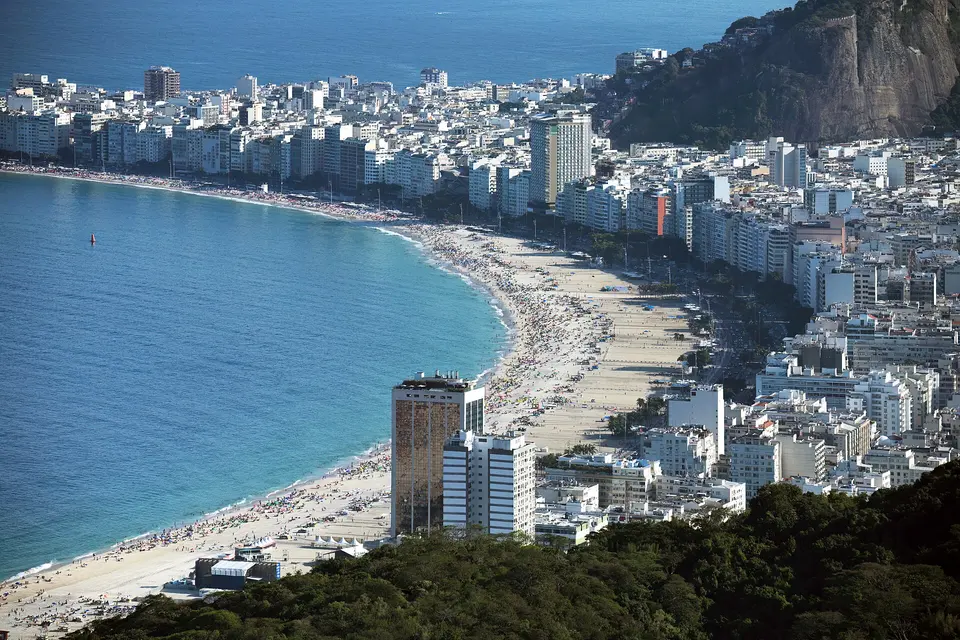
Copacabana Beach

Four kilometres of sand in a perfect crescent, edged by Roberto Burle Marx's black-and-white wave pavement of 1970 and a wall of 1950s apartment blocks and the Copacabana Palace hotel. Walk the promenade from Leme at the north end past the kiosks and the lifeguard posts to the fort at the south; the beach itself is at its calmest in the morning.

  • Plan about 1 h 30 min
1.7 km · about 26 min on foot
Forte de Copacabana
Photo: Gabriel Heusi/Brasil2016.gov.br, CC BY 3.0 br
3Fort and museum

Forte de Copacabana

The 1914 coastal fort on the rocks at the southern end of the beach keeps its Krupp guns and an army history museum, but the reason to come is the view back along the whole of Copacabana to Sugarloaf, and the branch of the Confeitaria Colombo on the ramparts, which serves lunch and cake at tables facing the bay.

  • Plan about 1 h
  • Tuesday to Sunday 10:00–19:00; closed Mondays

Afternoon

840 m · about 13 min on foot
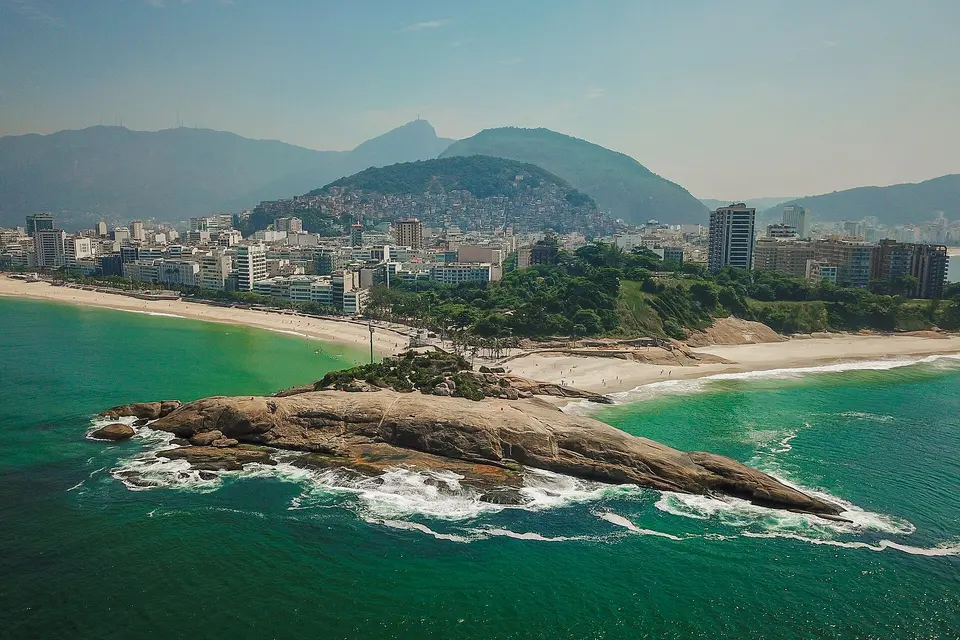
Arpoador
Photo: Donatas Dabravolskas, CC BY-SA 4.0
4Rock and beach

Arpoador

The rock between Copacabana and Ipanema is Rio's sunset gallery: the crowd climbs it in the late afternoon to watch the sun drop behind the Dois Irmãos peaks and applauds when it goes. The small beach below is the city's surf spot, and the path around the rock links the two big beaches.

  • Plan about 45 min
1.5 km · about 23 min on foot
Ipanema Beach
Photo: chensiyuan, CC BY-SA 4.0
5Beach

Ipanema Beach

The beach of the bossa nova song is a two-kilometre stretch of soft sand facing the Dois Irmãos peaks, divided by numbered lifeguard posts into tribes: families near Posto 8, the gay beach at the rainbow flag by Rua Farme de Amoedo, surfers and volleyball players towards Posto 9. Rent a chair from a barraca, order a coconut and stay until the light goes.

  • Plan about 1 h 30 min

Evening

DinnerWalk back along the sand to Arpoador rock, where the crowd applauds the sunset, then eat in Ipanema: the streets behind the beach, from Rua Visconde de Pirajá to Rua Garcia d'Ávila, are lined with restaurants and juice bars.

Day 2

Christ the Redeemer, Parque Lage and the Botanical Garden

Take the cog railway from Cosme Velho up through the Tijuca forest to the statue, come down to the jungle gardens and mansion of Parque Lage, and spend the afternoon under the imperial palms of the Botanical Garden.

  • 3 sights
  • 1.4 km on foot
  • Longest walk 1.4 km
123500 mN
Stops in order, straight-line distancesRoute in Google Maps ↗

Morning

Christ the Redeemer (Cristo Redentor)
Photo: Donatas Dabravolskas, CC BY-SA 4.0
1Monument and viewpoint

Christ the Redeemer (Cristo Redentor)

The 30-metre Art Deco statue by Paul Landowski, finished in 1931 on the 710-metre summit of Corcovado, is reached by a cog railway from Cosme Velho that climbs for 20 minutes through the Tijuca forest, then escalators and stairs to the terrace at its feet, with the city, the bay and the beaches on all sides. Buy the train ticket for a set departure time and go early, before the clouds gather on the peak.

  • Plan about 2 h 30 min
  • Train daily 8:00–18:00 every 20 minutes; timed tickets, R$134 adults

Midday

LunchThe café in the courtyard of Parque Lage's mansion, with the Christ statue framed above the pool, is the obvious lunch; the restaurants of Rua Jardim Botânico are the alternative.
Back down on the train to Cosme Velho, then about 10 minutes by taxi (or a 25-minute walk) to the park gate on Rua Jardim Botânico
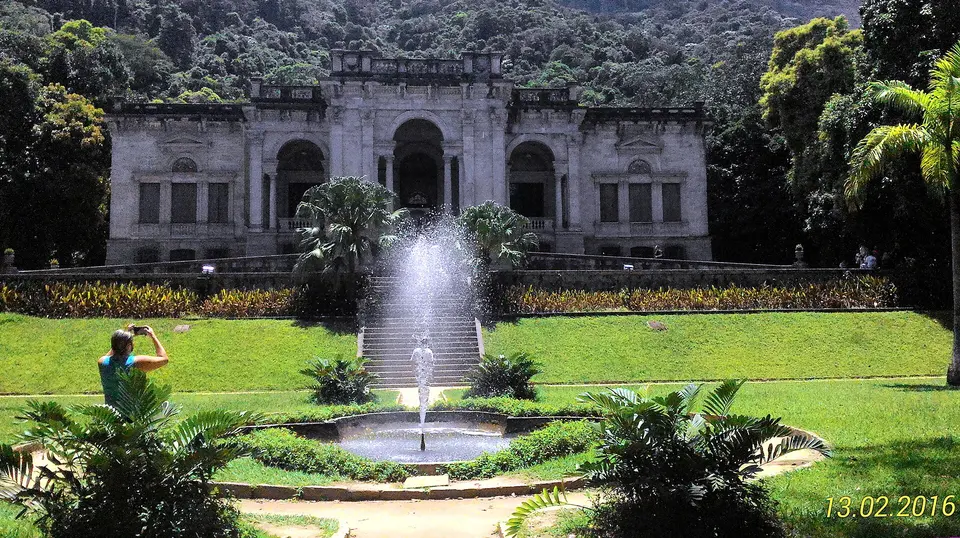
Parque Lage
Photo: Aquino Hilton, CC BY-SA 4.0
2Park and mansion

Parque Lage

The 1920s mansion of industrialist Henrique Lage sits at the foot of Corcovado in a romantic English-style park of ponds, grottoes and Atlantic forest, with the Christ statue framed above its courtyard pool. The house is now the Visual Arts School (EAV); the park is free, and the trail to the Christ starts at its back.

  • Plan about 1 h
  • Free; park 8:00–18:00, mansion 9:00–17:00 with online booking

Afternoon

1.4 km · about 22 min on foot
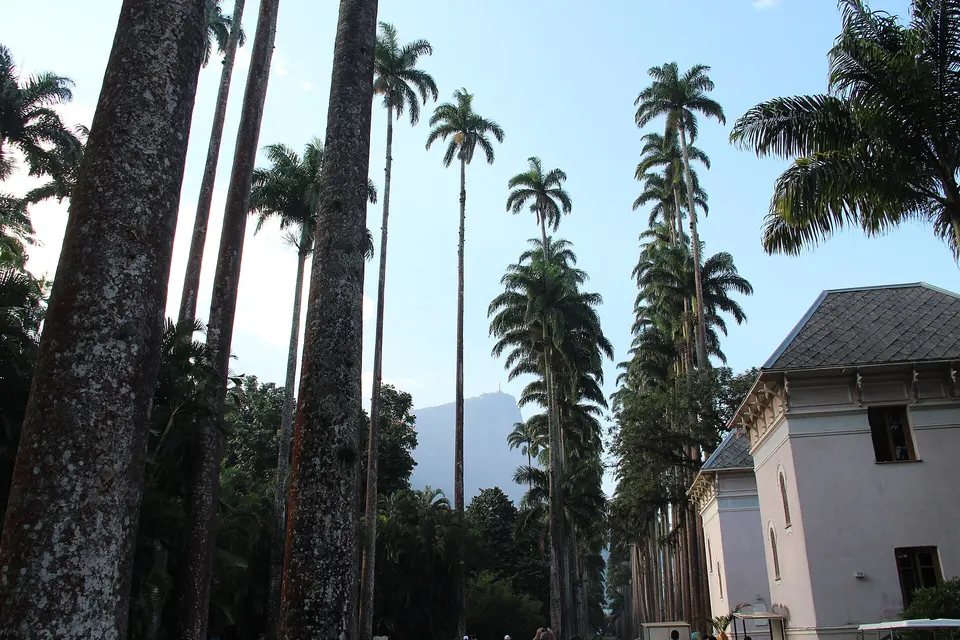
Jardim Botânico
Photo: Marinelson Almeida, CC BY 2.0
3Botanical garden

Jardim Botânico

Founded by the Portuguese prince regent in 1808, the 54-hectare garden is famous for its avenue of 134 imperial palms, all descended from a single tree, and holds an orchid house, a Japanese garden, giant Amazon water lilies and toucans and marmosets in the canopy, with Corcovado rising behind.

  • Plan about 2 h
  • Thursday to Tuesday 8:00–17:00, Wednesday 11:00–17:00; R$60 for foreign visitors

Evening

DinnerWalk or take a short taxi to the Lagoa Rodrigo de Freitas for a drink at one of the lakeside kiosks, then dinner in Leblon or Jardim Botânico.

Day 3

The port, Centro, Lapa and Santa Teresa

Start at the Museum of Tomorrow and the Rio Art Museum on Praça Mauá, walk into the centre for Candelária, the Confeitaria Colombo and the cathedral, pass under the Lapa Arches to the Selarón steps, and ride the yellow tram over the aqueduct to Santa Teresa for the evening.

  • 8 sights
  • 2.7 km on foot
  • Longest walk 680 m
123456781 kmN
Stops in order, straight-line distancesRoute in Google Maps ↗

Morning

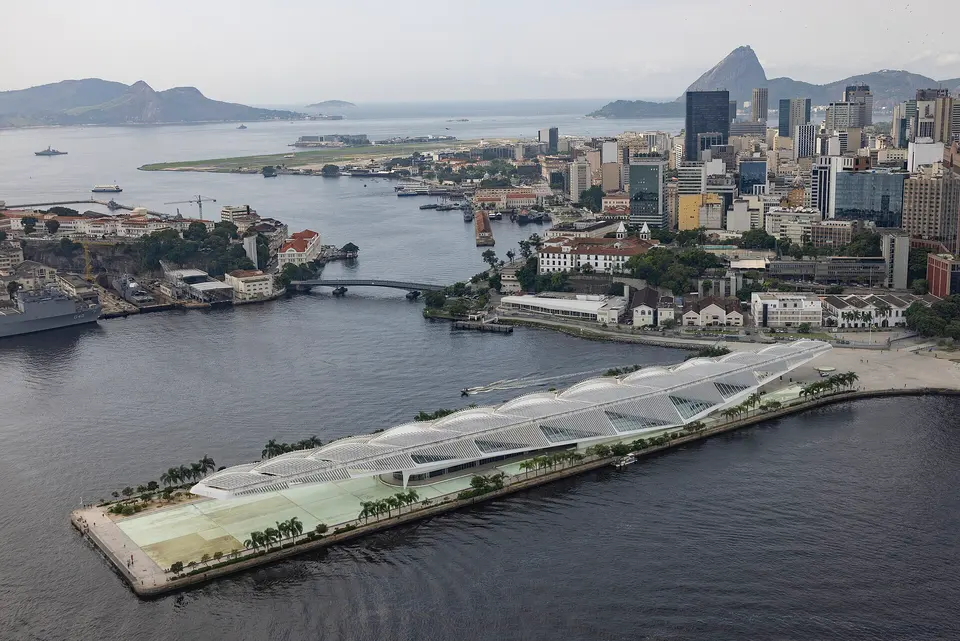
Museum of Tomorrow (Museu do Amanhã)
Photo: Arne Müseler, CC BY-SA 3.0 de
1Science museum

Museum of Tomorrow (Museu do Amanhã)

Santiago Calatrava's white cantilevered building on the pier of Praça Mauá, opened in 2015, is a science museum about the planet's future, from cosmology to climate, with the reflecting pools and gardens of the revived port around it. It anchors the Boulevard Olímpico, where Eduardo Kobra's giant Etnias mural covers a warehouse wall.

  • Plan about 2 h
  • Thursday to Tuesday 10:00–18:00, last entry 17:00; closed Mondays
380 m · about 6 min on foot
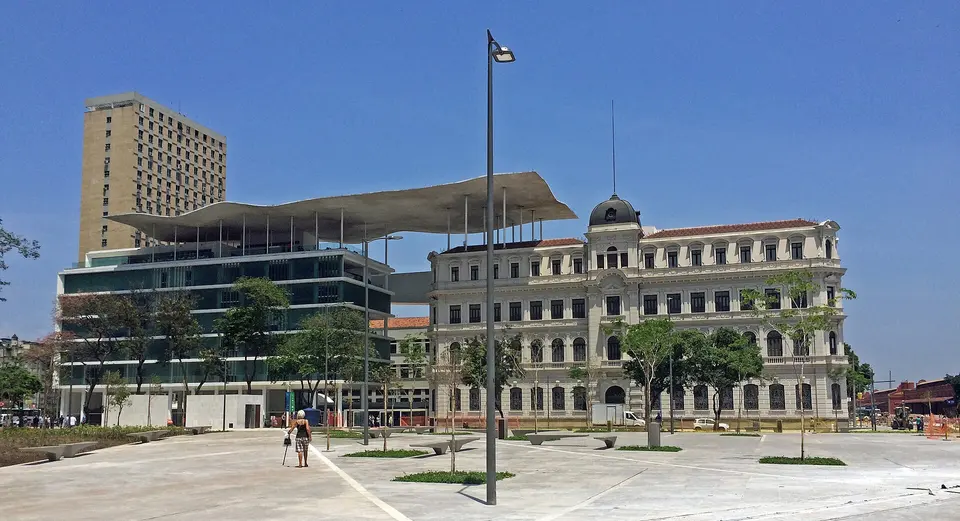
Museu de Arte do Rio (MAR) and Praça Mauá
Photo: Mariordo (Mario Roberto Durán Ortiz), CC BY-SA 4.0
2Art museum

Museu de Arte do Rio (MAR) and Praça Mauá

Across the square from the Museum of Tomorrow, an eclectic palace of 1916 and a former bus station are joined under a wave-shaped roof to hold the city's art museum, whose exhibitions are about Rio itself, from colonial painting to samba and the favelas; the rooftop terrace looks over the port.

  • Plan about 1 h 15 min
  • Open 11:00–18:00, closed Wednesdays; free on Tuesdays
630 m · about 10 min on foot
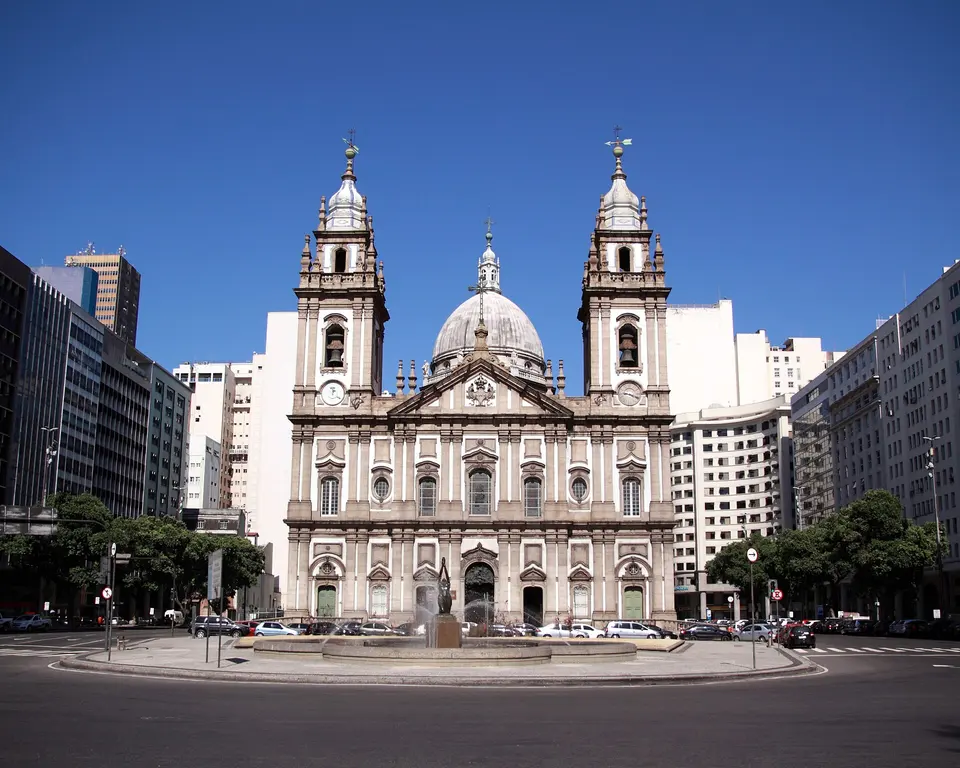
Candelária Church
Photo: Halley Pacheco de Oliveira, CC BY-SA 3.0
3Church

Candelária Church

The domed Baroque-and-Neoclassical church of 1775 to 1877 stands alone on a traffic island at the top of Avenida Presidente Vargas, its interior of Italian marble and painted ceilings a surprise after the plain façade. It was the setting for the 1993 street-children massacre, remembered by a memorial outside.

  • Plan about 30 min

Midday

480 m · about 7 min on foot
Confeitaria Colombo and the Real Gabinete Português de Leitura
Photo: Diego Baravelli, CC BY-SA 4.0
4Historic café and library

Confeitaria Colombo and the Real Gabinete Português de Leitura

The 1894 tea room on Rua Gonçalves Dias, with its Belgian mirrors, jacaranda cabinets and stained-glass skylight, is Rio's Belle Époque preserved for lunch and pastries. Two blocks away, the Royal Portuguese Reading Room of 1887 is one of the most beautiful libraries in the world, a neo-Manueline hall of carved wood holding the largest collection of Portuguese books outside Portugal.

  • Plan about 1 h 15 min

Afternoon

680 m · about 11 min on foot
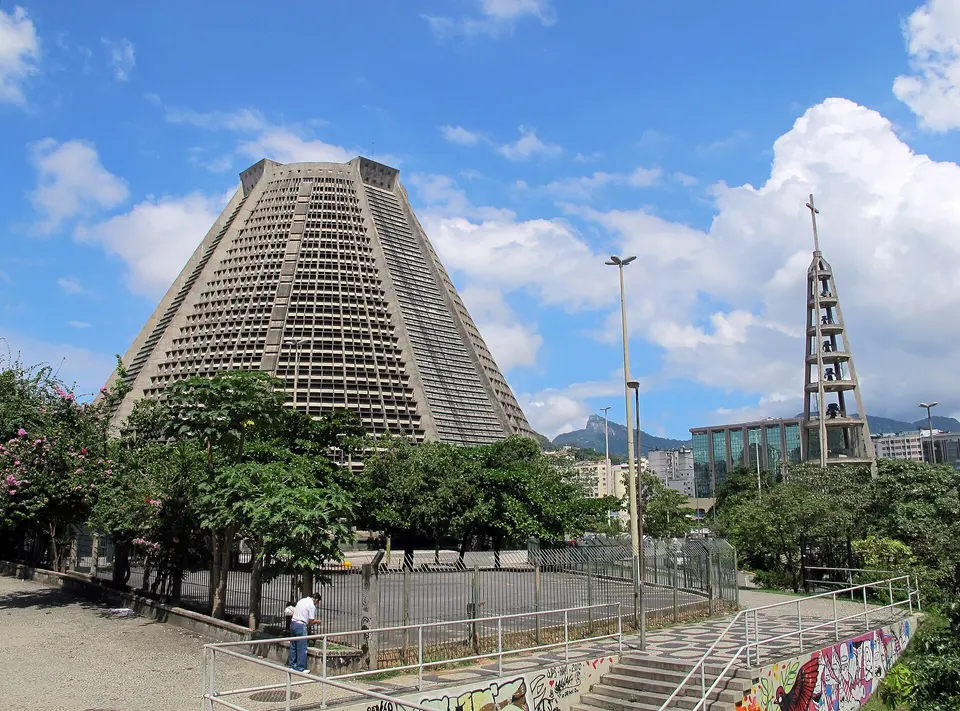
Metropolitan Cathedral of Saint Sebastian
Photo: Haakon S. Krohn, CC BY-SA 3.0
5Cathedral

Metropolitan Cathedral of Saint Sebastian

Edgar de Oliveira da Fonseca's concrete cone of 1979, 75 metres high and 106 across, seats 20,000; inside, four stained-glass windows run 64 metres from floor to roof and the light is like being inside a Mayan pyramid crossed with a kaleidoscope.

  • Plan about 30 min
  • Daily 7:00–17:00
210 m · about 3 min on foot
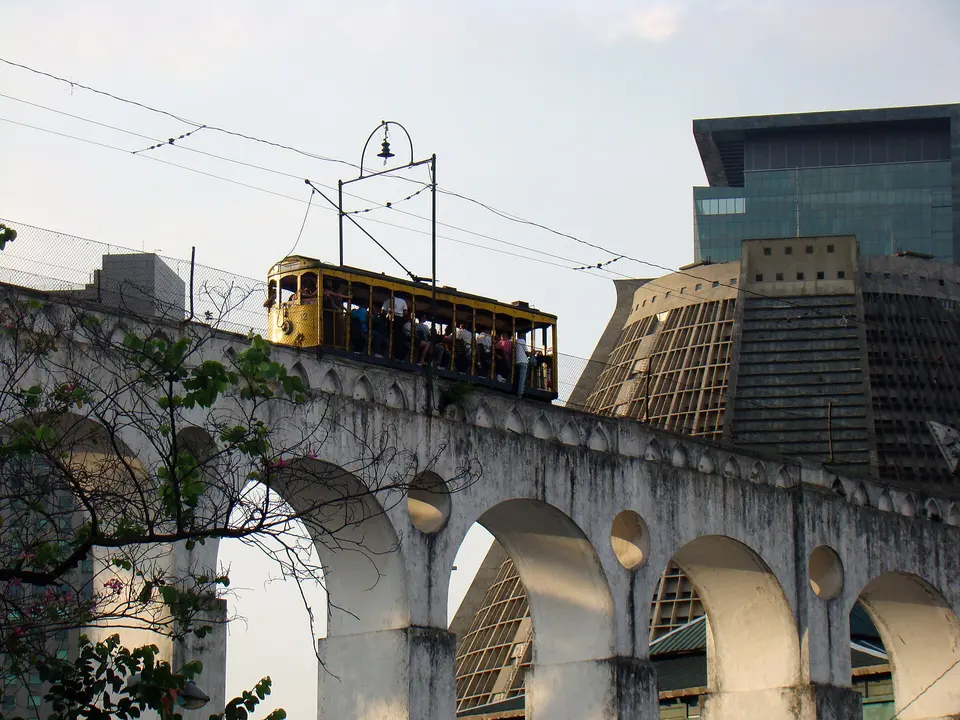
Lapa Arches (Arcos da Lapa)
Photo: Rodrigo Soldon, CC BY 2.0
6Aqueduct

Lapa Arches (Arcos da Lapa)

The whitewashed double row of 42 arches, built in the 1750s to bring water from the Carioca river to the city, has carried the Santa Teresa tram since 1896; the square beneath is the heart of Lapa, the samba and nightlife district whose bars fill the surrounding streets from Friday to Sunday.

  • Plan about 20 min
320 m · about 5 min on foot
Escadaria Selarón
Photo: Donatas Dabravolskas, CC BY-SA 4.0
7Public artwork

Escadaria Selarón

From 1990 until his death in 2013, the Chilean artist Jorge Selarón covered the 215 steps between Lapa and Santa Teresa with more than 2,000 tiles from 60 countries, in the green, yellow and blue of the Brazilian flag; the steps are free and always open, and busiest in the middle of the day.

  • Plan about 30 min

Evening

The Santa Teresa tram (bonde) leaves from the Carioca station on Rua Lélio Gama, near the arches, and crosses the aqueduct up to Largo dos Guimarães; tickets are sold at the station
Santa Teresa by the yellow tram (bonde)
Photo: Henrique Freire / GovRJ, CC BY 3.0 br
8Historic neighbourhood

Santa Teresa by the yellow tram (bonde)

The hilltop neighbourhood of 19th-century mansions, artists' studios and cobbled lanes is reached by the open-sided yellow tram that has crossed the Lapa Arches since 1896, restored and running again from the Carioca station to Largo dos Guimarães. Walk between the bars and restaurants around the Largo, the Parque das Ruínas viewpoint and the Chácara do Céu museum, and come down by tram or taxi after dark.

  • Plan about 1 h 30 min

Good to know in Rio de Janeiro

Tickets and opening days

  • The Corcovado train to Christ the Redeemer runs daily 8:00–18:00 from the Cosme Velho station, every 20 minutes; adult tickets cost R$134 and are sold for a set departure time on the official site.Source: Trem do Corcovado · checked Sep 2026
  • The Sugarloaf cable car park is open Monday to Thursday 9:00–20:00 (last boarding 18:30) and Friday to Sunday 8:30–20:30 (last boarding 19:00), every day including holidays; the standard adult ticket is R$195.Source: Parque Bondinho Pão de Açúcar · checked Sep 2026
  • The Museum of Tomorrow is open Thursday to Tuesday 10:00–18:00, last entry 17:00, and closed on Mondays; full-price tickets cost R$30.Source: Museu do Amanhã · checked Sep 2026
  • The Botanical Garden's arboretum is open Thursday to Tuesday 8:00–17:00 and Wednesday 11:00–17:00. Foreign visitors pay R$60 (R$45 from Mercosur countries) and residents of Brazil R$24; tickets can be bought in advance online.Source: Jardim Botânico do Rio de Janeiro · checked Sep 2026
  • The Rio Art Museum (MAR) is open 11:00–18:00 with last entry at 17:00, closed on Wednesdays; admission is R$20 and free on Tuesdays.Source: Museu de Arte do Rio · checked Sep 2026
  • The Forte de Copacabana and its army museum are open Tuesday to Sunday and holidays 10:00–19:00, with no visits on Mondays.Source: Museu Histórico do Exército e Forte de Copacabana · checked Sep 2026
  • Parque Lage's grounds are free and open 8:00–18:00; the mansion can be visited 9:00–17:00 with a free online booking, or on the day if places remain.Source: Secretaria de Cultura do Rio de Janeiro · checked Sep 2026
  • The Metropolitan Cathedral is open daily 7:00–17:00.Source: Catedral Metropolitana de São Sebastião · checked Sep 2026

Getting around

  • On MetrôRio you can pay at the turnstile by tapping a contactless Visa, Mastercard or Elo card or a phone; the single fare is R$7.90 from 12 April 2026, and with Visa and Elo cards the fare covers re-entries within two hours.Source: MetrôRio · checked Sep 2026
  • The Santa Teresa tram leaves from the Carioca station on Rua Lélio Gama, near the Carioca metro station; tickets are sold only at that station, and departures run every 15 to 20 minutes.Source: Riotur · checked Sep 2026

3 days in Rio de Janeiro: quick answers

Is 3 days enough for Rio de Janeiro?

Three days cover Sugarloaf, the beaches, Christ the Redeemer, the gardens, the port museums, the centre, Lapa and Santa Teresa. A fourth day allows a hike in the Tijuca forest to the Vista Chinesa or Pedra Bonita, a Maracanã stadium tour, or the beach at Prainha.

Which days should I plan around?

The Museum of Tomorrow and the Copacabana fort are closed on Mondays, the Rio Art Museum on Wednesdays, and the Botanical Garden opens late (11:00) on Wednesdays, so day three works best Thursday to Tuesday and day one on any day but Monday.

Sugarloaf or Christ the Redeemer first?

Do both, on different days and both in the morning: the Sugarloaf cable car opens at 8:30 or 9:00 and the haze and queues build by midday, while the Corcovado train runs from 8:00 and the statue is at its clearest early. Day one and day two are built around that.

How do I get around?

Days one and three are largely on foot along the beachfront and through the centre, with one taxi each; day two needs the Corcovado train and a taxi. The metro accepts contactless bank cards and phones at the turnstiles, and taxis and rideshares are cheap by European standards.

How much walking is this itinerary?

Day one is the long one, about 4 km in a straight line along the Copacabana and Ipanema promenades, all flat; day two is under 1.5 km plus the train and a taxi; day three is under 3 km through the centre, with the tram doing the climb to Santa Teresa.

Other Rio de Janeiro itineraries

Keep exploring

Where this connects

THE TRIPWOA APP

Go somewhere.
Make it yours.

Build days around what you love. Follow your route, find your next stop and keep the moments along the way.

Get it on Google PlayAvailable for Android
Free to start
Tripwoa home with a Paris trip and nearby places to explore
Tripwoa day plan for New York with a route map and Times Square stop

A day that feels like you.

Sources and method

Places and coordinates: Wikidata and Tripwoa's open-data place catalog (Overture Maps Foundation, © OpenStreetMap contributors). Photos: Wikimedia Commons, credited on each image. Practical rules: the official sources linked in each note, checked in September 2026.

How this plan was made: Tripwoa's planner drafted the day order from real coordinates and typical visit times. Each stop was then reviewed, reordered where needed and rewritten with AI assistance. Walking distances are straight-line estimates, so allow a little extra time on real streets.