Guides · Romania
Bucharest tickets
Ticket and booking rules for Bucharest: timed entries, closing days and official links, checked September 2026.
Checked September 2026 against official sources
Bucharest
Bookings and opening rules
Follow the official link before you buy. Full walking days: Bucharest itinerary.
The Village Museum: gates, hours and tickets
- The houses in the open-air exhibition are open Wednesday to Sunday, 09:00 to 19:00 in summer and 09:00 to 17:00 in winter, and the last ticket is issued 60 minutes before the museum closes. The two main gates on Șoseaua Kiseleff, at numbers 28 and 30, open Monday 09:00 to 17:00 and Tuesday to Sunday 09:00 to 19:00 in summer, and daily 09:00 to 17:00 in winter. The Miorița and Transilvania gates inside Herăstrău Park are closed Monday to Friday in summer and open Saturday and Sunday 10:00 to 18:00, and Wednesday to Sunday 09:00 to 17:00 in winter.Source: Dimitrie Gusti National Village Museum — Museum schedule · checked Sep 2026
- A full ticket costs 40 lei, pensioners pay 20 lei and pupils and students 10 lei. On Mondays and Tuesdays, when most of the monuments are closed because the supervising staff work at weekends, a 50 per cent discount applies. Admission is free for adults with severe or accentuated disabilities and their companions, for Euro 26 card holders under 30 on the 26th of each month, and for several other listed categories.Source: Dimitrie Gusti National Village Museum — Tickets · checked Sep 2026
Antipa and Stavropoleos: hours and tickets
- The Grigore Antipa National Museum of Natural History keeps its summer schedule from 1 April to 31 October, opening Tuesday to Sunday from 10:00 to 20:00 with the last visitor admitted at 19:00, and closing on Mondays. A full ticket is 32 lei, pensioners pay 16 lei, and pupils, students and holders of Euro 26, ISIC, IYTC and European Youth cards pay 8 lei; preschool children enter free, as do visitors with a disability certificate and their companions.Source: Grigore Antipa National Museum of Natural History — Schedule and tariffs · checked Sep 2026
- Stavropoleos Monastery is open to visitors every day from 08:00 to 19:00, subject to the schedule of services, prayer and confession. Matins and the Divine Liturgy begin at 08:00 and vespers at 18:00, and the monastery is free to enter.Source: Stavropoleos Monastery — Visiting programme · checked Sep 2026
On the day
What to watch at each stop
Palace of the Parliament
- Tours run through the day by advance booking and fill up; the standard tour is about an hour and costs roughly 85 lei for adults with student and child rates; a physical passport or identity card is required at the door, not a photograph of one
National Museum of Romanian History
- Open Wednesday to Sunday, roughly 10:00 to 18:00, with a modest ticket and a supplement for the treasury; check what is open before going, because parts of the building are usually closed for works
National Museum of Art of Romania
- Open Wednesday to Sunday, roughly 10:00 to 18:00 in summer and shorter in winter, closed Monday and Tuesday; the two galleries are separate tickets with a combined option; allow two hours for one of them
Romanian Athenaeum
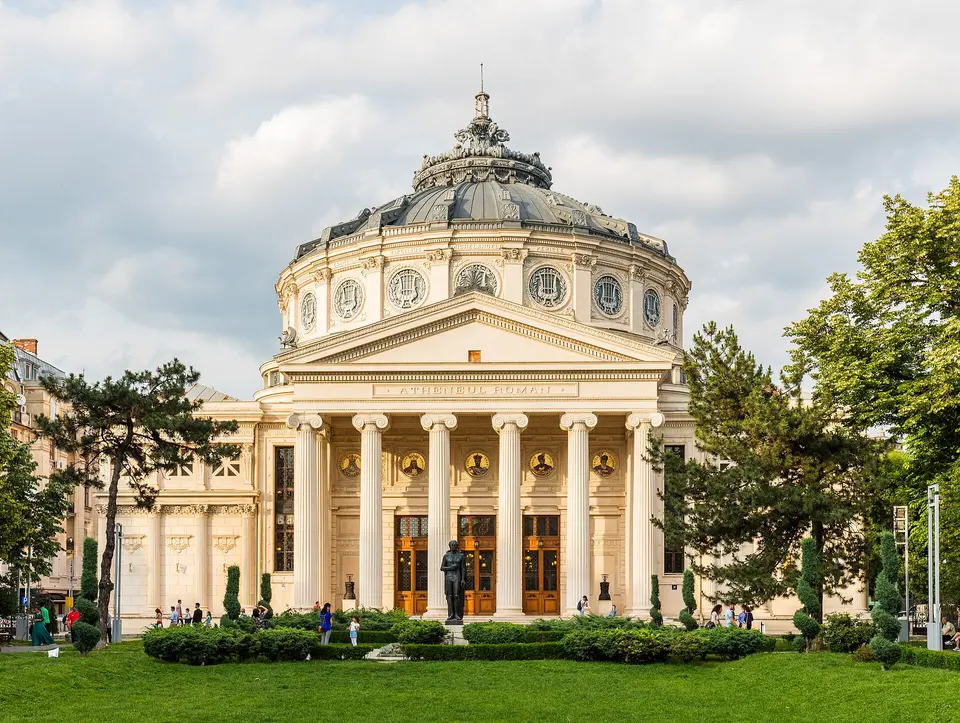
- You can usually look into the lobby and the hall for a small charge during the day when no rehearsal is running; the better plan is to buy a concert ticket, which starts cheaply and is the only way to sit in it
Dimitrie Gusti National Village Museum
- The houses are open Wednesday to Sunday 09:00 to 19:00 in summer and 09:00 to 17:00 in winter, with the last ticket an hour before closing; 40 lei full, 20 for pensioners, 10 for students, and half price on Mondays and Tuesdays when most houses are shut
Museum of the Romanian Peasant
- Open Tuesday to Sunday, roughly 10:00 to 18:00, closed Monday, with a modest ticket; it is on Șoseaua Kiseleff a few minutes from Piața Victoriei metro and next door to the Antipa museum
Questions
Quick answers
What is the best time of year to visit Bucharest?
May, June and September. Spring brings the parks and the terraces back to life and the temperature sits around 22 to 26°C; September is warm, dry and quieter, and the George Enescu festival fills the Athenaeum every second year. July and August regularly pass 35°C and the city empties towards the coast and the mountains, with many restaurants on reduced hours. Winter is properly cold, often below freezing, with the Christmas market in Piața Constituției and half the outdoor attractions on winter hours.
Do you need to book the Palace of the Parliament in advance?
Yes. Tours run by the Chamber of Deputies are booked ahead rather than sold at the door, they fill several days out in high season, and there is no online ticketing for the walk-up. Bring a physical passport or national identity card, because a photograph or photocopy is not accepted at security. The standard tour lasts about an hour and covers the state rooms; separate longer tours take in the terrace and the underground levels.
How much does Bucharest cost per day?
It is one of the cheapest capitals in the European Union. A hostel bed runs 70 to 120 lei, a good mid-range hotel 300 to 500, and a serious one 700 upwards. Eating out is the pleasant surprise: a canteen lunch is 30 to 50 lei, a restaurant dinner with wine 120 to 200 a head, and a beer in the old town 15 to 25. Museums are modest at 20 to 40 lei, the metro is 5 lei a journey or 35 for a 72-hour pass, and taxis and ride apps are cheap enough that most visitors stop counting.
How do you get around Bucharest?
The metro has five lines and reaches most of what you want, with the M2 running north to south through the centre and past Piața Victoriei and Aviatorilor for the northern museums. Buy an Activ card at a station and top it up; a single journey is about 5 lei and a 72-hour pass 35. Trams and trolleybuses fill the gaps but are slow in traffic. Ride-hailing apps are cheap and widely used, and street taxis should be avoided unless the meter rate is printed on the door and matches what is charged.
The days these rules belong to
3 days in Bucharest
Bucharest is a city of about 1.8 million on the Wallachian plain, first recorded in 1459 in a document signed by Vlad III, and the capital of Romania since 1862. It spent the second half of the nineteenth century rebuilding itself in a French manner, with boulevards, a triumphal arch and enough Beaux-Arts stone to earn the nickname Little Paris of the East, and then lost much of that to an earthquake in 1977 and to Nicolae Ceaușescu, who used the damage as cover to flatten a fifth of the historic city for a civic centre and the largest administrative building in the world. What survives is patchy and rewarding: Brâncovenesc churches wedged between apartment blocks, an old merchants' quarter now full of bars, a royal picture collection, and in the north, on a lake, three hundred village buildings brought here from every region of the country. Otopeni airport is 17 km north with a rail link into Gara de Nord.