3-day itinerary · Romania

3 Days in Bucharest

A plan that walks the two halves of central Bucharest on the first two days and gives the northern museums, which most visitors never reach, a day of their own. Opening hours, the gates that are shut on which days, and what each ticket costs in 2026 are in the stops.

  • 3days
  • 14sights
  • 0.0 kmon foot between sights

Updated 12 September 2026 · 4 official sources checked · report an error

Romanian Athenaeum
Photo: Diego Delso, CC BY-SA 4.0

The palace and the old town, then Calea Victoriei and the museums, then the village houses and Kiseleff

Bucharest is a city of about 1.8 million on the Wallachian plain, first recorded in 1459 in a document signed by Vlad III, and the capital of Romania since 1862. It spent the second half of the nineteenth century rebuilding itself in a French manner, with boulevards, a triumphal arch and enough Beaux-Arts stone to earn the nickname Little Paris of the East, and then lost much of that to an earthquake in 1977 and to Nicolae Ceaușescu, who used the damage as cover to flatten a fifth of the historic city for a civic centre and the largest administrative building in the world. What survives is patchy and rewarding: Brâncovenesc churches wedged between apartment blocks, an old merchants' quarter now full of bars, a royal picture collection, and in the north, on a lake, three hundred village buildings brought here from every region of the country. Otopeni airport is 17 km north with a rail link into Gara de Nord.

At a glance

Ways to use these days

If it rains
5 of the stops are indoors — Stavropoleos Monastery · National Museum of Romanian History · National Museum of Art of Romania
Outdoors
Cișmigiu Gardens · Herăstrău Park
Lightest day on foot
Day 1 — 1.6 km between stops
Most walking
Day 3 — 3.7 km

Day 1

The Ceaușescu palace, the princely court and the old town

Start with the building that cost a fifth of historic Bucharest, walk back into what survived of it, stand in Vlad the Impaler's courtyard, look into the finest small church in the country and the handsomest bookshop in the region, and let the evening happen in Lipscani.

  • 5 sights
  • Transport between sights
12345250 mN
Stops in order, straight-line distancesWalking route in Google Maps ↗

Morning

Palace of the Parliament
Photo: William John Gauthier, CC BY-SA 2.0
1Government building

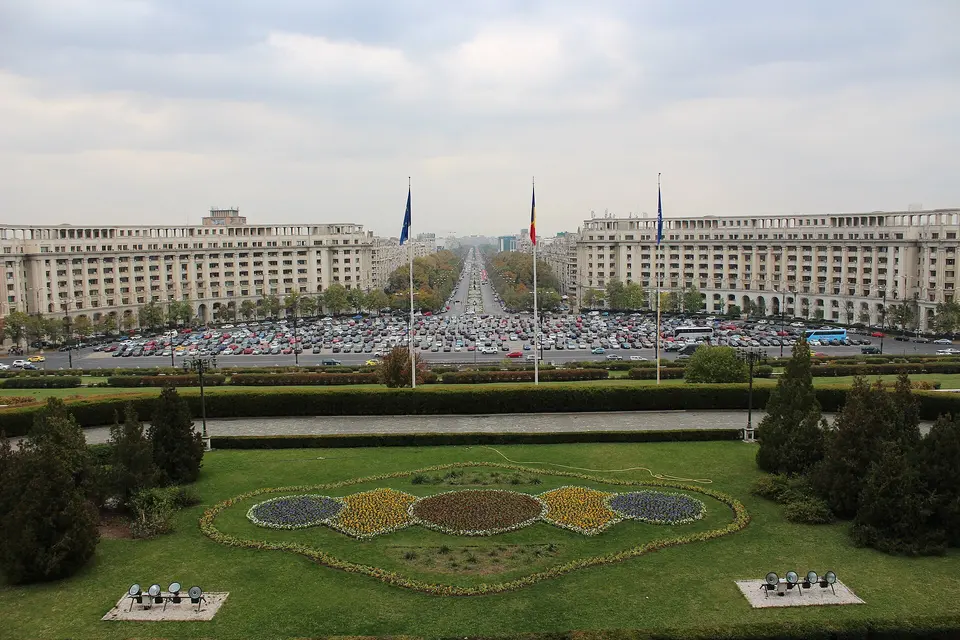
Palace of the Parliament

Nicolae Ceaușescu demolished a fifth of historic Bucharest for this, about eight square kilometres of the Uranus quarter, including some thirty churches, twenty synagogues and the homes of forty thousand people, and set twenty thousand workers and seven hundred architects to build the heaviest building in the world in their place. It was begun in 1984, is still not finished, and contains 1,100 rooms over twelve storeys above ground and eight below, all of it in Romanian marble, oak, crystal and wool woven on site because nothing was allowed to be imported. He was shot in December 1989 without ever having lived in it. The guided tour takes you through perhaps five per cent of the interior, along corridors the width of a road and into ballrooms with four-tonne chandeliers, and the effect is less impressive than oppressive, which is the honest reaction and the useful one.
  • Plan about 2 h
  • Tours run through the day by advance booking and fill up; the standard tour is about an hour and costs roughly 85 lei for adults with student and child rates; a physical passport or identity card is required at the door, not a photograph of one

Midday

LunchLunch in the old town is a minefield of tourist menus with one reliable exception: Caru' cu Bere, an 1879 beer hall off Lipscani with painted vaults and stained glass, which is touristy, is always full, and still serves a proper sarmale and mici. For something quieter, the lanes off Strada Franceză have small places doing ciorbă de burtă, the sour tripe soup, and papanași, fried cheese doughnuts with soured cream and jam, for a third of the price.

Afternoon

1.5 km east into the old town, about 20 minutes on foot or two stops on the metro to Piața Unirii
Curtea Veche
Photo: Stefan Jurca, CC BY-SA 2.0
2Ruins

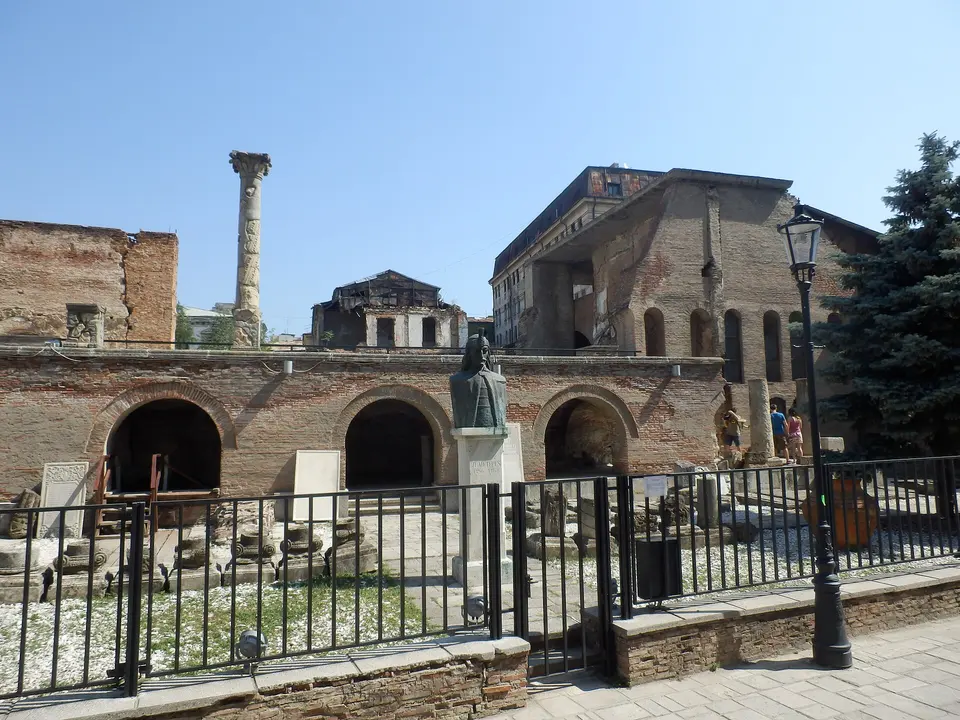
Curtea Veche

Bucharest first appears in writing in 1459 in a document signed here by Vlad III, the prince of Wallachia whom the world knows as Dracula, and the Old Princely Court is the ruin of the palace that grew from his fort. What is left is a sunken field of brick arches, cellars and column bases, uncovered in the 1960s after the whole site had been built over, with a stone bust of Vlad at the edge and a section of wall where the vaulted throne room stood. Next to it stands the Curtea Veche church of 1559, the oldest church in Bucharest still in use, a small Wallachian building of brick and plaster bands where the princes were crowned and where the fresco fragments survive.

  • Plan about 45 min
  • The ruins are open daily with a small entry charge and a walkway over the excavation; the church beside them is free and in constant use; together they need less than an hour
350 m north-west through the lanes, about 5 minutes on foot
Stavropoleos Monastery
Photo: Neoclassicism Enthusiast, Public domain
3Monastery

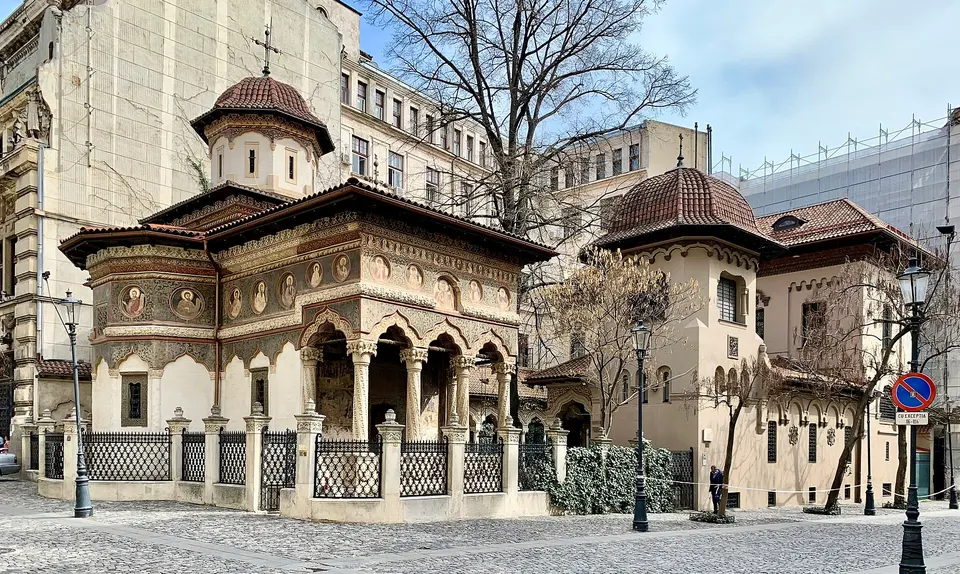
Stavropoleos Monastery

A Greek monk from Epirus built this in 1724 as the chapel of an inn he ran, and it is the finest small building in Bucharest: late Brâncovenesc, the Wallachian style that mixes Ottoman, Byzantine and Italian late-Renaissance detail into something entirely local. The porch is a row of stone columns carved into vine leaves and rosettes, the doorway is a frame of interlacing stone, and the interior is dark and painted all over. Behind it a small cloister of 1908 holds a lapidarium of tombstones and carved fragments rescued from churches Ceaușescu demolished, and above it the monastery keeps the largest collection of Byzantine church music in Romania. The nuns sing the services in the old chant and it is worth timing a visit for.

  • Plan about 30 min
  • Open to visitors every day from 08:00 to 19:00, free, around the services; morning liturgy is at 08:00 and vespers at 18:00; it is one lane off Lipscani and easy to walk past
250 m east on Strada Lipscani, three minutes on foot
Cărturești Carusel
Photo: J Stimp, CC BY 2.0
4Bookshop

Cărturești Carusel

A nineteenth-century bank belonging to the Chrissoveloni family, confiscated by the communist state, turned into a general store and then left derelict for decades, was restored in 2015 into six floors of bookshop around a white spiral of galleries and staircases under a glass roof. The renovation kept the cast-iron columns and stripped everything else back to white, so the building reads as one bright volume with people leaning over the balconies at every level. There is a bistro on the top floor, a gallery in the basement and about ten thousand titles in between, a good number of them in English. It is a shop rather than a monument and it takes twenty minutes, but it is the best-looking interior in the old town.

  • Plan about 30 min
  • Open daily from about 10:00 to 22:00 and later at weekends, free to walk in; it is busiest on weekend afternoons, when the stairs are a queue of people taking photographs

Evening

The quarter starts at the bookshop door
Lipscani
Photo: Tiia Monto, CC BY-SA 4.0
5Old town quarter

Lipscani

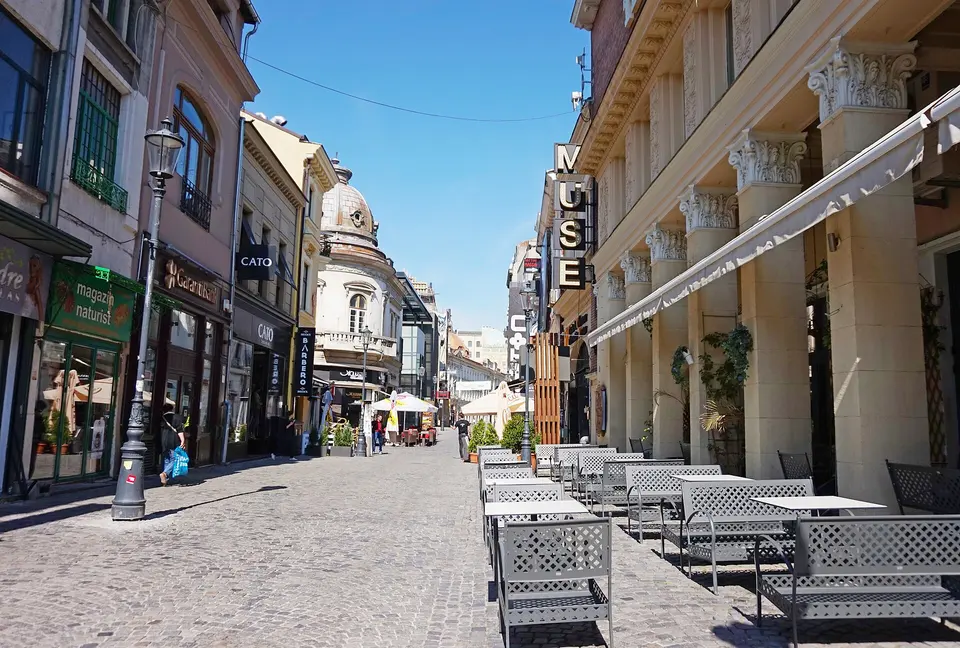
The old merchants' quarter takes its name from Leipzig, where the traders who filled it bought their stock, and its streets are still named after the guilds that worked them: Covaci for the blacksmiths, Șelari for the saddlers, Blanari for the furriers. It fell into deep decay under communism and was left to rot through the 1990s, then pedestrianised and restored from about 2005, and what came back was not the trades but several hundred bars, terraces and restaurants packed into nineteenth-century buildings with plaster falling off the upper floors. On a summer evening it is loud, crowded and cheerful in a way that no other capital in the region manages, and by day it is quiet enough to see the architecture, the passages and the churches wedged between the bars.

  • Plan about 2 h
  • Free and always open; the bars fill from about 21:00 and run late, especially Thursday to Saturday; it is a small area and easy to walk in an hour by daylight before deciding where to eat

Day 2

Calea Victoriei: the gold, the palaces, the paintings and the park

Walk the street that was the spine of the city when it called itself the Little Paris of the East, taking in a Dacian gold helmet, a bank with a glass dome, the royal picture collection and the concert hall paid for a brick at a time, and finish among the plane trees.

  • 5 sights
  • Transport between sights
12345500 mN
Stops in order, straight-line distancesWalking route in Google Maps ↗

Morning

CEC Palace
Photo: Diego Delso, CC BY-SA 4.0
1Historic building

CEC Palace

Paul Gottereau, a French architect who worked in Bucharest for thirty years, built the headquarters of the Romanian savings bank between 1897 and 1900 on the site of a medieval monastery, and gave it a glass and iron dome over an entrance arch flanked by pairs of columns, with four smaller domes at the corners and a great deal of stone garland. It was the height of the period when Bucharest was rebuilding itself as a French city and calling itself the Little Paris of the East, and it stands directly opposite the National History Museum, so the two face each other across Calea Victoriei as the most photographed pair of buildings in the city. It is still a working bank, so the interior is not a museum, but the banking hall under the dome can be looked into during business hours.

  • Plan about 20 min
  • Free to look at from the street at any time; the banking hall is open on weekdays during business hours and photography inside is generally tolerated but not encouraged
Directly across Calea Victoriei from the CEC Palace, one minute
National Museum of Romanian History
Photo: Diego Delso, CC BY-SA 4.0
2Museum

National Museum of Romanian History

The old Post Office Palace of 1900, a heavy neoclassical block on Calea Victoriei, has held the national history collection since 1972, and much of it has been under renovation for years, which means the permanent galleries come and go. Two things do not. The treasury in the basement holds the Pietroasele hoard, twelve surviving pieces of fourth-century Gothic gold including a fibula in the shape of an eagle's head set with garnets, and the helmet of Coțofenești, a Geto-Dacian gold helmet of the fourth century BC covered in embossed eyes and mythological scenes, which is one of the great objects of European prehistory. The other is the full-size plaster cast of Trajan's Column, cut into sections and laid out so you can read the whole Dacian war at eye level, which you cannot do in Rome.

  • Plan about 1 h 30 min
  • Open Wednesday to Sunday, roughly 10:00 to 18:00, with a modest ticket and a supplement for the treasury; check what is open before going, because parts of the building are usually closed for works

Midday

LunchThe streets between Calea Victoriei and the Athenaeum are where Bucharest's modern kitchen is: bistros around Strada Episcopiei and the Ateneu, terraces on Strada Aristide Demetriade, and a very good wine culture built on Romanian grapes most visitors have not met, Fetească Neagră and Fetească Regală among them. If you want the older version, the restaurants in the restored houses of the Armenian quarter serve the Wallachian repertoire in a courtyard.

Afternoon

900 m north up Calea Victoriei, about 12 minutes on foot, past the Crețulescu church
National Museum of Art of Romania
Photo: Neoclassicism Enthusiast, CC BY-SA 4.0
3Art museum

National Museum of Art of Romania

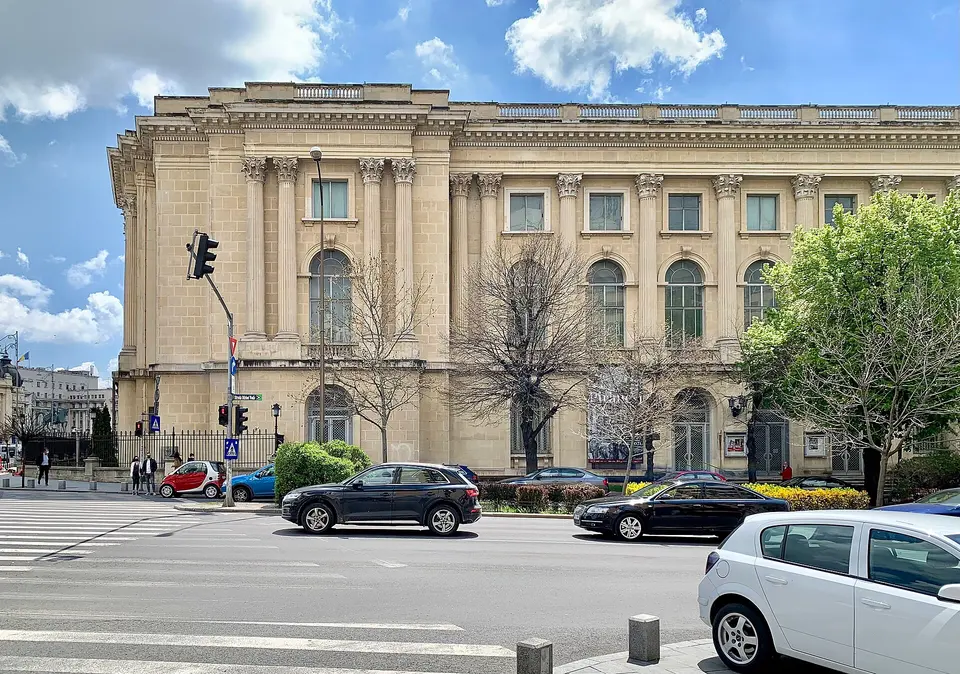
The former Royal Palace on Calea Victoriei, burnt during the fighting of December 1989 and restored afterwards, holds two collections that are worth separate visits. The Romanian gallery runs from medieval icons and church silver, through the enormous holdings of Nicolae Grigorescu, who painted peasants and ox-carts in a French manner and more or less invented modern Romanian painting, to Theodor Aman, Ștefan Luchian and a room of Constantin Brâncuși's early work before he left for Paris. The European gallery came out of the royal family's own collection and holds El Greco, Tintoretto, Rembrandt, Rubens, Bruegel the Elder, Monet and Sisley in quantities nobody expects to find in Bucharest. The throne room and the royal apartments are shown separately.

  • Plan about 2 h
  • Open Wednesday to Sunday, roughly 10:00 to 18:00 in summer and shorter in winter, closed Monday and Tuesday; the two galleries are separate tickets with a combined option; allow two hours for one of them
200 m north across Revolution Square, three minutes on foot
Romanian Athenaeum
Photo: Diego Delso, CC BY-SA 4.0
4Concert hall

Romanian Athenaeum

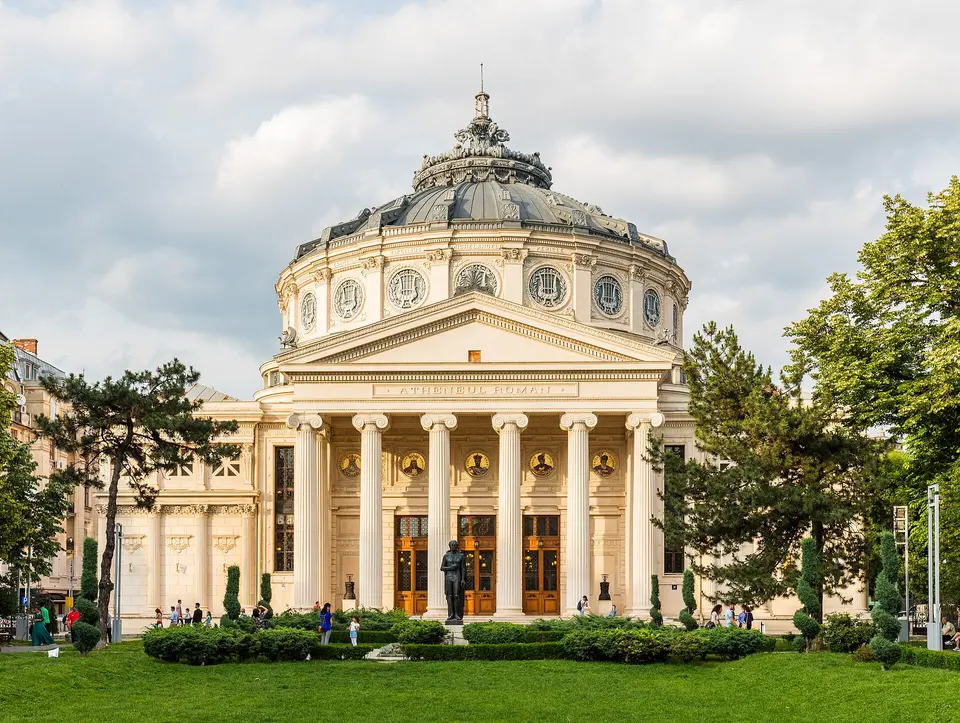
The concert hall was paid for in the 1880s by public subscription, with a campaign that asked people to give one leu for a brick, and the French architect Albert Galleron gave the money a circular building behind a Greek portico of six Ionic columns under a shallow dome. Inside, the auditorium seats about eight hundred under a fresco that runs the whole way round above the boxes, twenty-five metres of it, showing the history of Romania in twenty-five scenes from Trajan to the union of 1918. The acoustics are genuinely fine, the George Enescu Philharmonic plays here, and the international Enescu festival takes it over every second September. The square in front holds the equestrian statue of Carol I and the National Library.

  • Plan about 45 min
  • You can usually look into the lobby and the hall for a small charge during the day when no rehearsal is running; the better plan is to buy a concert ticket, which starts cheaply and is the only way to sit in it

Evening

1 km south-west, about 15 minutes on foot, or two stops on the M2 metro
Cișmigiu Gardens
Photo: Joe Mabel, CC BY-SA 3.0
5Park

Cișmigiu Gardens

The oldest public park in Bucharest was laid out from 1847 on what had been a swamp fed by springs, by the Viennese landscape gardener Carl Wilhelm Meyer, who brought trees in from the Romanian mountains and from abroad and died before it opened. It is seventeen hectares of winding paths, a lake with rowing boats in summer and skating in cold winters, an artificial rock garden, a beer garden, chess tables that are permanently occupied by men in their seventies, and the Rotunda of the Writers, a ring of busts of Romanian authors under the trees. It sits a few streets from the centre and is where the city goes to sit down. The plane trees and the ironwork are original.

  • Plan about 1 h
  • Free and open at all hours; boats on the lake run through the summer for a small charge; the chess tables are on the south side and the players will let you watch but not advise

Day 3

The north: three hundred village houses, the lake, and two museums on Kiseleff

Take the metro north to the open-air museum where a whole country's rural architecture was reassembled on a lake shore, walk the park around it, and spend the afternoon in the two museums on the boulevard that explain Romania better than anything downtown.

  • 4 sights
  • Transport between sights
12341 kmN
Stops in order, straight-line distancesDriving route in Google Maps ↗

Morning

Dimitrie Gusti National Village Museum
Photo: Chainwit., CC BY-SA 4.0
1Open-air museum

Dimitrie Gusti National Village Museum

The sociologist Dimitrie Gusti spent the 1920s and 1930s running research teams into Romanian villages, and in 1936 he had the buildings they had recorded taken apart, carted to Bucharest and rebuilt on the shore of Herăstrău lake. There are now more than three hundred of them over ten hectares, arranged as a country of its own: sunken houses roofed with earth from the Danube plain, tall wooden houses from Maramureș with carved gates and shingled roofs, a windmill from Dobrogea, watermills, a church from 1722 whose spire is forty metres of oak, and the furnished interiors of all of them. It is one of the oldest open-air museums in Europe and it explains more about Romania in two hours than any museum in the centre.

  • Plan about 2 h 30 min
  • The houses are open Wednesday to Sunday 09:00 to 19:00 in summer and 09:00 to 17:00 in winter, with the last ticket an hour before closing; 40 lei full, 20 for pensioners, 10 for students, and half price on Mondays and Tuesdays when most houses are shut
The park surrounds the museum; the lakeside path starts at its northern gate
Herăstrău Park
Photo: Rula Sibai, CC0
2Park

Herăstrău Park

The largest park in Bucharest, nearly two hundred hectares, was drained out of marshland along the Colentina river in the 1930s and laid out around a lake that takes up half of it. Officially it is now King Michael I Park. There are boats and a small ferry, an island with a rose garden, a Japanese garden given by Japan in 1998, a promenade of busts of European writers, restaurants and terraces along the water on the Herăstrău side, and enough space that on a summer weekend it absorbs a very large number of people without feeling crowded. The Village Museum occupies the south-western corner of it, so the two go together, and the Arcul de Triumf stands at the park's southern gate.

  • Plan about 1 h 30 min
  • Free and open at all hours; boat trips on the lake run from spring to autumn; the walk from the Village Museum gate round the western shore to the Japanese garden takes about forty minutes

Midday

LunchThe Herăstrău lakeside has a run of restaurants with terraces over the water on the eastern side, which are pleasant and priced for it. Cheaper and better food is around Piața Victoriei at the southern end of Kiseleff, where the office crowd eats: canteens doing the daily ciorbă and a main course for very little, and a couple of good Lebanese and Turkish places left over from the student trade.

Afternoon

3 km south on Șoseaua Kiseleff, about 10 minutes by taxi or metro to Piața Victoriei
Museum of the Romanian Peasant
Photo: Neoclassicism Enthusiast, CC BY-SA 4.0
3Museum

Museum of the Romanian Peasant

The building is a neo-Brâncovenesc pile of 1912 built for the national art collections, used from 1953 as the Museum of the Communist Party, and returned after 1989 to what it was for. What Horia Bernea then made of it won the European Museum of the Year award in 1996 and is unlike any ethnographic museum you have seen: no chronology, no explanatory panels to speak of, just objects arranged by the museum's own poetic logic, with a whole wooden church reassembled inside the building, walls hung with icons on glass, and a room of textiles arranged as if for a service. In the basement is a small permanent exhibit on collectivisation, with a bust of Lenin left over from the previous tenants. The shop sells real village craft and the courtyard has a good café.

  • Plan about 1 h 30 min
  • Open Tuesday to Sunday, roughly 10:00 to 18:00, closed Monday, with a modest ticket; it is on Șoseaua Kiseleff a few minutes from Piața Victoriei metro and next door to the Antipa museum
150 m along Kiseleff from the Peasant Museum, two minutes on foot
Grigore Antipa Natural History Museum
Photo: Andrei Stroe, CC BY-SA 3.0
4Museum

Grigore Antipa Natural History Museum

Grigore Antipa ran this museum for fifty-two years from 1893 and invented the modern habitat diorama here, well before the technique reached the great American museums: a group of mounted animals in front of a painted background curved so that there is no visible join, lit to imitate the light of the place. The museum was gutted and rebuilt in 2011 and the dioramas were kept, so you walk from the Danube delta through the Carpathians to the African savannah and the polar ice in a single circuit, with two million specimens behind the scenes and a plesiosaur and a Deinotherium skeleton among the highlights. It is aimed squarely at children and completely enjoyable for anyone, and it is the best-value large museum in the city.

  • Plan about 1 h 30 min
  • Open Tuesday to Sunday 10:00 to 20:00 from 1 April to 31 October with the last visitor admitted at 19:00, closed Monday; 32 lei full, 16 for pensioners, 8 for pupils and students, preschool children free

Evening

DinnerDinner is worth planning on the last night. The restored houses of the Armenian quarter and the streets around Piața Romană hold most of the serious kitchens, and a table at one of them costs a fraction of what the same meal would in Vienna or Budapest.

Good to know in Bucharest

The Village Museum: gates, hours and tickets

  • The houses in the open-air exhibition are open Wednesday to Sunday, 09:00 to 19:00 in summer and 09:00 to 17:00 in winter, and the last ticket is issued 60 minutes before the museum closes. The two main gates on Șoseaua Kiseleff, at numbers 28 and 30, open Monday 09:00 to 17:00 and Tuesday to Sunday 09:00 to 19:00 in summer, and daily 09:00 to 17:00 in winter. The Miorița and Transilvania gates inside Herăstrău Park are closed Monday to Friday in summer and open Saturday and Sunday 10:00 to 18:00, and Wednesday to Sunday 09:00 to 17:00 in winter.Source: Dimitrie Gusti National Village Museum — Museum schedule · checked Sep 2026
  • A full ticket costs 40 lei, pensioners pay 20 lei and pupils and students 10 lei. On Mondays and Tuesdays, when most of the monuments are closed because the supervising staff work at weekends, a 50 per cent discount applies. Admission is free for adults with severe or accentuated disabilities and their companions, for Euro 26 card holders under 30 on the 26th of each month, and for several other listed categories.Source: Dimitrie Gusti National Village Museum — Tickets · checked Sep 2026

Antipa and Stavropoleos: hours and tickets

  • The Grigore Antipa National Museum of Natural History keeps its summer schedule from 1 April to 31 October, opening Tuesday to Sunday from 10:00 to 20:00 with the last visitor admitted at 19:00, and closing on Mondays. A full ticket is 32 lei, pensioners pay 16 lei, and pupils, students and holders of Euro 26, ISIC, IYTC and European Youth cards pay 8 lei; preschool children enter free, as do visitors with a disability certificate and their companions.Source: Grigore Antipa National Museum of Natural History — Schedule and tariffs · checked Sep 2026
  • Stavropoleos Monastery is open to visitors every day from 08:00 to 19:00, subject to the schedule of services, prayer and confession. Matins and the Divine Liturgy begin at 08:00 and vespers at 18:00, and the monastery is free to enter.Source: Stavropoleos Monastery — Visiting programme · checked Sep 2026

3 days in Bucharest: quick answers

Is 3 days enough for Bucharest?

Three days covers the city comfortably: the palace and the old town, Calea Victoriei with the museums, and a day in the north for the Village Museum and the two on Kiseleff. Bucharest is not a city of monuments so much as of streets and interiors, and it rewards slowing down more than adding stops. With a fourth day, the easy trips are Mogoșoaia Palace, a Brâncovenesc country house on a lake 14 km north-west, and Snagov monastery on its island 34 km north, where Vlad III is traditionally said to be buried.

What is the best time of year to visit Bucharest?

May, June and September. Spring brings the parks and the terraces back to life and the temperature sits around 22 to 26°C; September is warm, dry and quieter, and the George Enescu festival fills the Athenaeum every second year. July and August regularly pass 35°C and the city empties towards the coast and the mountains, with many restaurants on reduced hours. Winter is properly cold, often below freezing, with the Christmas market in Piața Constituției and half the outdoor attractions on winter hours.

Do you need to book the Palace of the Parliament in advance?

Yes. Tours run by the Chamber of Deputies are booked ahead rather than sold at the door, they fill several days out in high season, and there is no online ticketing for the walk-up. Bring a physical passport or national identity card, because a photograph or photocopy is not accepted at security. The standard tour lasts about an hour and covers the state rooms; separate longer tours take in the terrace and the underground levels.

How much does Bucharest cost per day?

It is one of the cheapest capitals in the European Union. A hostel bed runs 70 to 120 lei, a good mid-range hotel 300 to 500, and a serious one 700 upwards. Eating out is the pleasant surprise: a canteen lunch is 30 to 50 lei, a restaurant dinner with wine 120 to 200 a head, and a beer in the old town 15 to 25. Museums are modest at 20 to 40 lei, the metro is 5 lei a journey or 35 for a 72-hour pass, and taxis and ride apps are cheap enough that most visitors stop counting.

How do you get around Bucharest?

The metro has five lines and reaches most of what you want, with the M2 running north to south through the centre and past Piața Victoriei and Aviatorilor for the northern museums. Buy an Activ card at a station and top it up; a single journey is about 5 lei and a 72-hour pass 35. Trams and trolleybuses fill the gaps but are slow in traffic. Ride-hailing apps are cheap and widely used, and street taxis should be avoided unless the meter rate is printed on the door and matches what is charged.

Is Bucharest worth visiting?

Yes, if you take it for what it is. It has no single sight that justifies the trip in the way Prague's castle or Budapest's river does, and the centre is a hard collage of nineteenth-century French facades, interwar modernism, communist blocks and building sites. What it has instead is texture: the finest small Brâncovenesc churches anywhere, a picture collection nobody expects, an open-air museum that is among the best in Europe, a genuinely good eating and drinking culture, and prices that make three days easy. Go for the city rather than the checklist.

Other Bucharest itineraries

Keep exploring

Where this connects

THE TRIPWOA APP

Go somewhere.
Make it yours.

Build days around what you love. Follow your route, find your next stop and keep the moments along the way.

Get it on Google PlayAvailable for Android
Free to start
Tripwoa home with a Paris trip and nearby places to explore
Tripwoa day plan for New York with a route map and Times Square stop

A day that feels like you.

Sources and method

Places and coordinates: Wikidata and Tripwoa's open-data place catalog (Overture Maps Foundation, © OpenStreetMap contributors). Photos: Wikimedia Commons, credited on each image. Practical rules: the official sources linked in each note, checked in September 2026.

How this plan was made: Tripwoa's planner drafted the day order from real coordinates and typical visit times. Each stop was then reviewed, reordered where needed and rewritten with AI assistance. Walking distances are straight-line estimates, so allow a little extra time on real streets.