3-day itinerary · India

3 Days in Agra

A realistic first-timer plan that opens the gates with the first ticket of the day at the Taj Mahal, spends the afternoon in the marble pavilions and the prison tower of Agra Fort and crosses the river for the sunset view from Mehtab Bagh; drives out on day two to Fatehpur Sikri, Akbar's abandoned capital of red sandstone, and the marble shrine of Salim Chishti inside it, coming back by way of Akbar's own tomb at Sikandra; and keeps day three for the east bank of the Yamuna, the jewel-box tomb that rehearsed the Taj, the blue-tiled Chini Ka Rauza and the oldest Mughal garden in India, ending in the Jama Masjid and the jewellers' lanes of Kinari Bazaar. Every stop comes with the ASI fee, the hours and the timing that matters in 2026.

  • 3days
  • 11sights
  • 0.0 kmon foot between sights

Updated 12 September 2026 · 3 official sources checked · report an error

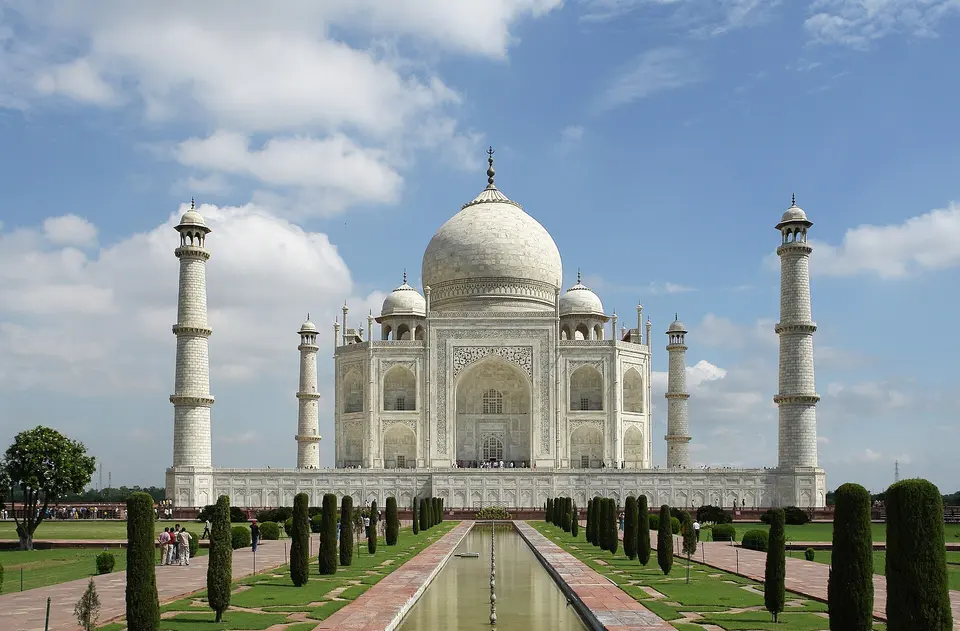
Taj Mahal
Photo: Yann, CC BY-SA 4.0

The Taj and the fort, then Fatehpur Sikri and Sikandra, then the east bank and the bazaars

Agra is a city of 1.6 million on the Yamuna, 230 km south of Delhi and two hours by the Gatimaan Express, and its monuments are spread along both banks, so every day needs a car, an auto-rickshaw or the new metro's first line. The Taj Mahal is closed every Friday, which fixes the shape of any visit; it opens 30 minutes before sunrise, and the first hour, before the tour buses from Delhi arrive around 9:00, is the reason to stay the night. Fatehpur Sikri is 37 km west, an hour each way by road. The Agra Development Authority's toll ticket, bought with the first monument of the day, is valid at the other four that charge it, so the order of the day matters to the wallet; it is waived on Fridays. October to March is the season; April and May pass 45°C and the monsoon runs July to September.

At a glance

Ways to use these days

If it rains
2 of the stops are indoors — Tomb of Salim Chishti · Jama Masjid
Lightest day on foot
Day 1 — 4.1 km between stops
Most walking
Day 2 — 32.2 km

Day 1

The Taj Mahal, Agra Fort and sunset from Mehtab Bagh

Be at the east gate before the ticket window opens for the Taj Mahal in the first light, walk the marble platform and the mausoleum before the crowd, spend the afternoon in Agra Fort where Shah Jahan was imprisoned with a view of what he had built, and cross the river for the sunset from the garden that was meant to frame it.

  • 3 sights
  • Transport between sights
123500 mN
Stops in order, straight-line distancesDriving route in Google Maps ↗

Morning

Taj Mahal
Photo: Yann, CC BY-SA 4.0
1Mausoleum

Taj Mahal

Shah Jahan began it in 1632, the year after his wife Mumtaz Mahal died giving birth to their fourteenth child, and twenty thousand workers finished it around 1653: a white marble mausoleum on a platform above the Yamuna, perfectly symmetrical but for the emperor's own cenotaph added beside hers, the marble inlaid with jasper, jade, turquoise and lapis in flowers so fine the joins are invisible, four minarets tilted outward so that an earthquake would drop them away from the dome, and a garden divided by water channels that hold the reflection. Come at the gate before it opens; the marble turns from grey to pink to white in the first hour, and by nine the crowd is shoulder to shoulder on the platform.
  • Plan about 3 h
  • Sunrise to sunset, closed Fridays; foreigners ₹500 ASI plus ₹500 toll, about ₹200 more for the mausoleum chamber, Indians ₹30 plus toll, under 15 free; three-hour limit, no tripods or drones

Midday

LunchLunch is in Taj Ganj or on the Fatehabad Road: the rooftop cafés south of the Taj's east gate do a thali and a view of the dome for very little, Pinch of Spice and the Mughal restaurants of Fatehabad Road do the Mughlai kitchen the city is known for, korma, kebabs and biryani, and the sweet shops sell petha, the translucent ash-gourd candy that is Agra's own. Eat by 13:00; the fort takes two hours and the light on its sandstone is best late.

Afternoon

2.5 km north-west, 15 minutes by auto-rickshaw along the river road
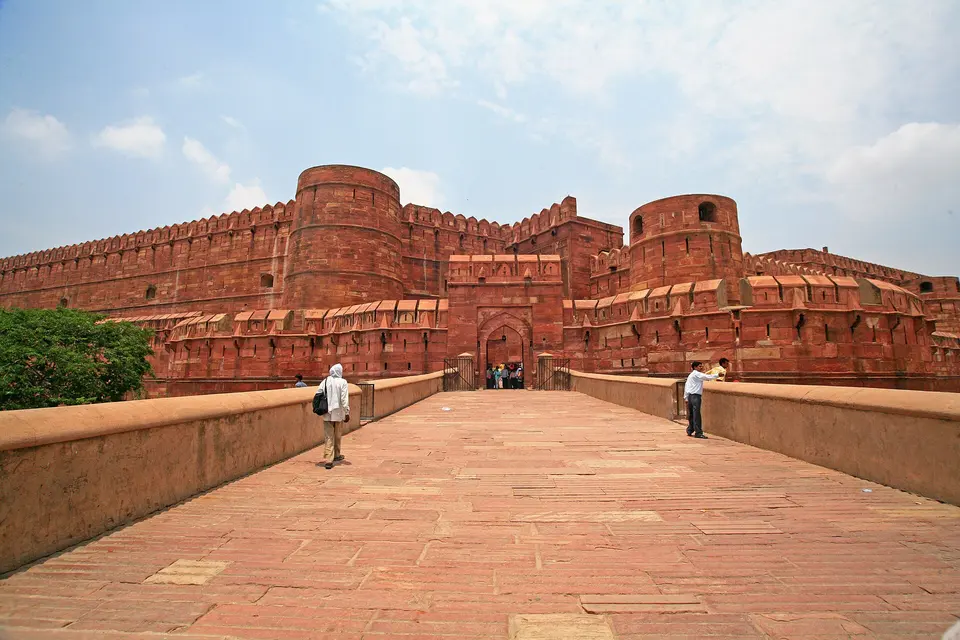
Agra Fort
Photo: LASZLO ILYES, CC BY 2.0
2Fort

Agra Fort

Akbar rebuilt the old Delhi Sultanate fort in red sandstone from 1565, a crescent of 21-metre walls two and a half kilometres round on the river, and his son and grandson filled it with marble: the Jahangir Mahal of carved Hindu and Central Asian motifs, the Khas Mahal and the mirror-work Sheesh Mahal of the harem, the Diwan-i-Am where the emperor heard petitions from a marble throne, the small Nagina Masjid of the ladies' court, and the Musamman Burj, the octagonal tower with the pierced marble screens where Shah Jahan spent the last eight years of his life under house arrest by his son, looking at the Taj two kilometres downriver. A quarter of the fort is open; the rest is army. It takes two unhurried hours.

  • Plan about 2 h 30 min
  • Sunrise to sunset every day; foreigners ₹500 plus ₹50 toll, Indians ₹30 plus toll, under 15 free; the Musamman Burj view of the Taj is the reason to go late in the day

Evening

11 km round by the Yamuna bridge to the north bank, about 30 minutes by taxi; there is no bridge at the Taj itself
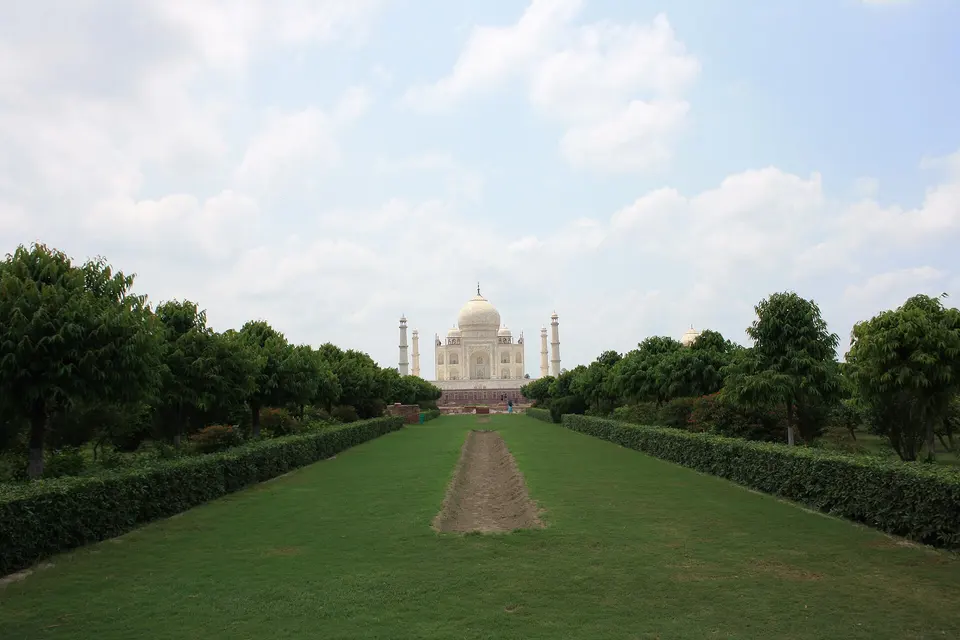
Mehtab Bagh
Photo: LittleDwangs, CC BY-SA 4.0
3Mughal garden

Mehtab Bagh

The Moonlight Garden on the north bank, the last of eleven Mughal gardens along this stretch of the Yamuna, sits exactly on the Taj's axis: an octagonal pool at its far end was built to hold the reflection of the dome, and the legend of a black marble twin tomb here has been dug for and never found. The garden itself is a plain quadrangle of lawns and old trees, restored in the 1990s; what people come for is the view across a hundred metres of river to the back of the Taj with nothing in between, the best photograph of the building in the city and the only place to watch the sunset light it from the side. Come an hour before dark.

  • Plan about 1 h
  • Sunrise to sunset; foreigners about ₹300 at the gate (about ₹250 online), Indians about ₹25; no shade, and the river bank is dry for most of the year

Day 2

Fatehpur Sikri, the shrine of Salim Chishti and Akbar's tomb at Sikandra

Leave early for the red sandstone city Akbar built and abandoned inside fifteen years, walk the courtyards, the pillared hall of the private audience and the tallest gateway in India, pay respects at the marble shrine of the saint who gave him an heir, and come back through Sikandra to the tomb Akbar designed for himself.

  • 3 sights
  • Transport between sights
1235 kmN
Stops in order, straight-line distancesDriving route in Google Maps ↗

Morning

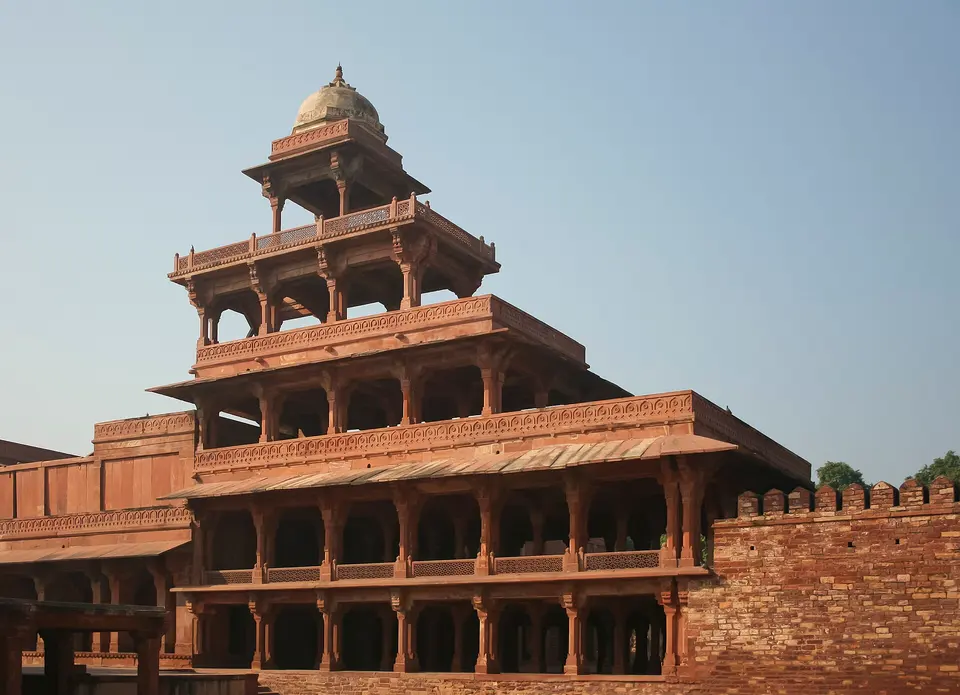
Fatehpur Sikri
Photo: Diego Delso, CC BY-SA 4.0
1Abandoned imperial city

Fatehpur Sikri

Akbar built a new capital here from 1571 on the ridge where the Sufi saint Salim Chishti had promised him a son, and abandoned it around 1585, the water having run out and the empire having moved to Lahore; what he left is the most complete Mughal city anywhere, red sandstone carved like wood, with the Diwan-i-Khas and its single central pillar where the emperor sat above his advisers, the five-storey Panch Mahal of open colonnades that thins as it rises, the pachisi courtyard where the game was played with living pieces, the houses of his Hindu, Christian and Muslim wives, and, through the 54-metre Buland Darwaza, the tallest gateway in India, a mosque courtyard the size of a parade ground. Guides at the gate are persistent and worth one if you pick a licensed one.

  • Plan about 3 h
  • Sunrise to sunset every day; foreigners ₹510, Indians ₹40, under 15 free; the ticket covers the 93 protected monuments of the complex; an hour each way from Agra
Inside the same complex, through the Buland Darwaza into the Jama Masjid courtyard; shoes off and covered heads
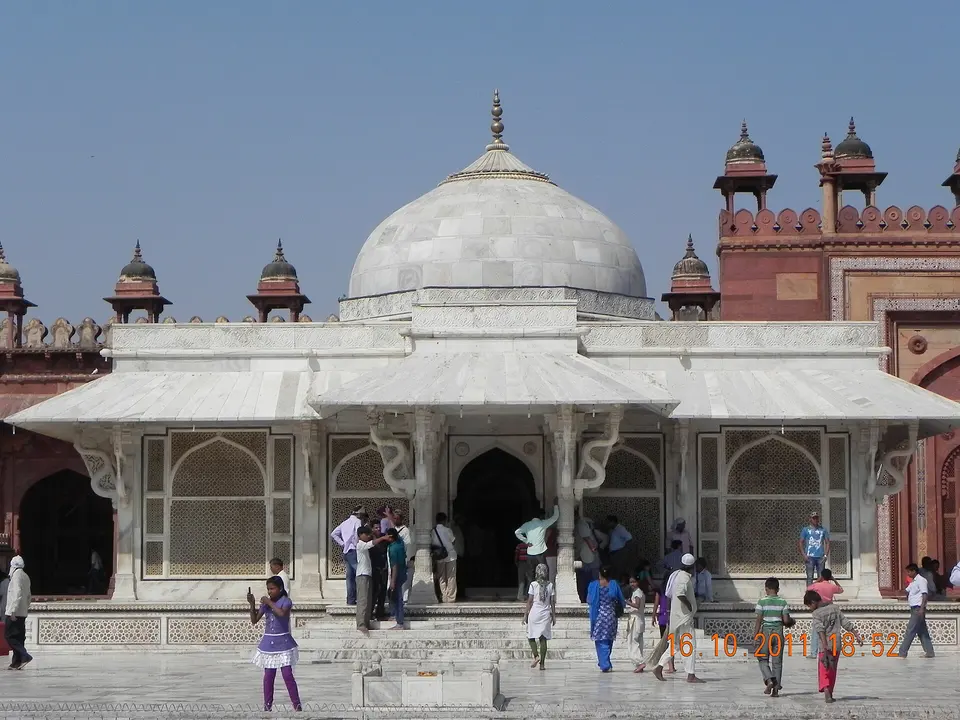
Tomb of Salim Chishti
Photo: Neeladri, CC BY-SA 3.0
2Shrine

Tomb of Salim Chishti

In the middle of Fatehpur Sikri's great mosque courtyard, a small square tomb of white marble, begun in 1571 and finished by Jahangir, holds the saint who told Akbar he would have three sons; the walls are cut into jali screens of such fineness that the marble reads as lace, the serpentine brackets under the eaves are the most photographed detail in India, and the mother-of-pearl canopy inside covers the grave. Pilgrims still come to tie a thread on the screens and make a wish, which is why the courtyard is alive in a way the palaces across the road are not. Shoes come off at the gate, heads are covered, and the men who offer to sell you a thread and a blessing are not part of the shrine.

  • Plan about 45 min
  • Inside the Jama Masjid courtyard, free, open through the day; shoes off and heads covered; the mosque and dargah do not need the ASI ticket

Midday

LunchThere is little at Fatehpur Sikri beyond the stalls and the state tourism restaurant by the car park, which does a decent thali; the better plan is to eat on the road back at one of the highway dhabas toward Sikandra, where dal, roti from the tandoor and a sweet lassi cost a few rupees and the truck drivers vouch for the kitchen. Carry water; the sandstone throws the heat back at you all morning.

Afternoon

45 km back east and north, about 1 hour 15 minutes; Sikandra is on the Delhi road, 8 km from the centre
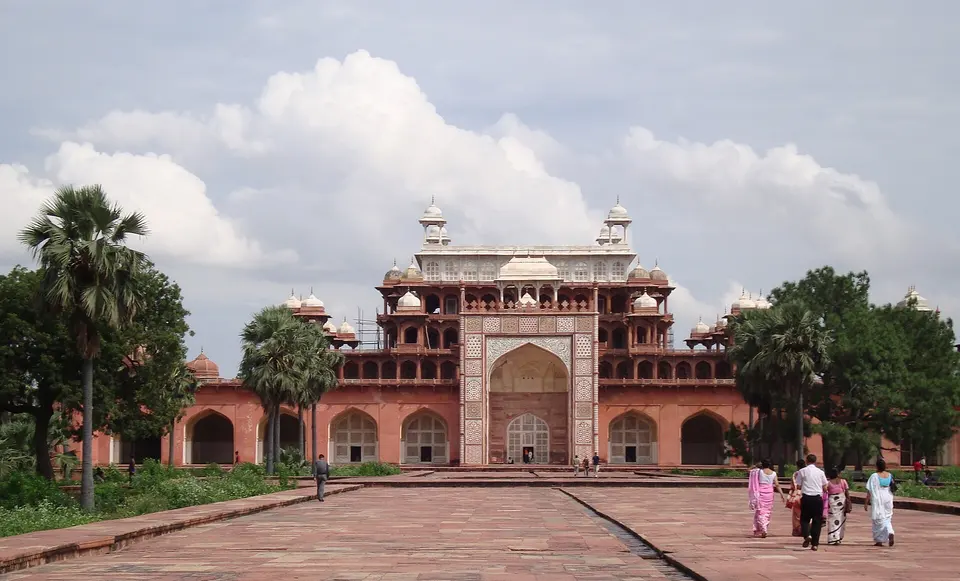
Akbar's Tomb, Sikandra
Photo: Adrianne Wadewitz, CC BY-SA 3.0
3Mausoleum

Akbar's Tomb, Sikandra

The greatest of the Mughal emperors designed his own tomb and his son finished it in 1613, and it is unlike anything else they built: a five-storey sandstone pyramid of open arcades, the top tier in white marble with a false grave in the open air, standing in a 48-hectare walled garden where blackbuck and langurs graze under the trees. The south gate is inlaid with white marble mosaic and topped by four minarets, an idea that would reach the Taj forty years later. The crowds go to the Taj and the fort; here a weekday morning gives you the avenue of deer, the echo of the tomb chamber and the emperor's tomb almost alone.

  • Plan about 1 h 30 min
  • Sunrise to sunset; foreigners about ₹310, Indians about ₹35, under 15 free; 8 km north-west of the centre on the Delhi road

Evening

DinnerBack in the city by 18:00. Dinner is either the Mughlai kitchens of Fatehabad Road or, for something made for visitors and enjoyed anyway, the Mohabbat the Taj show at the Kalakriti centre on the same road, a 90-minute telling of the Taj story with dance and live music that runs most evenings in two sittings and sells tickets at the door.

Day 3

The east bank: the Baby Taj, Chini Ka Rauza, Aram Bagh, the Jama Masjid and the bazaars

Cross to the quiet side of the Yamuna for the small marble tomb that rehearsed every idea the Taj would use, the blue-tiled Persian tomb beside it and the first Mughal garden in India, then come back into the old city for Shah Jahan's congregational mosque and the jewellers' and spice lanes behind it.

  • 5 sights
  • Transport between sights
123451 kmN
Stops in order, straight-line distancesDriving route in Google Maps ↗

Morning

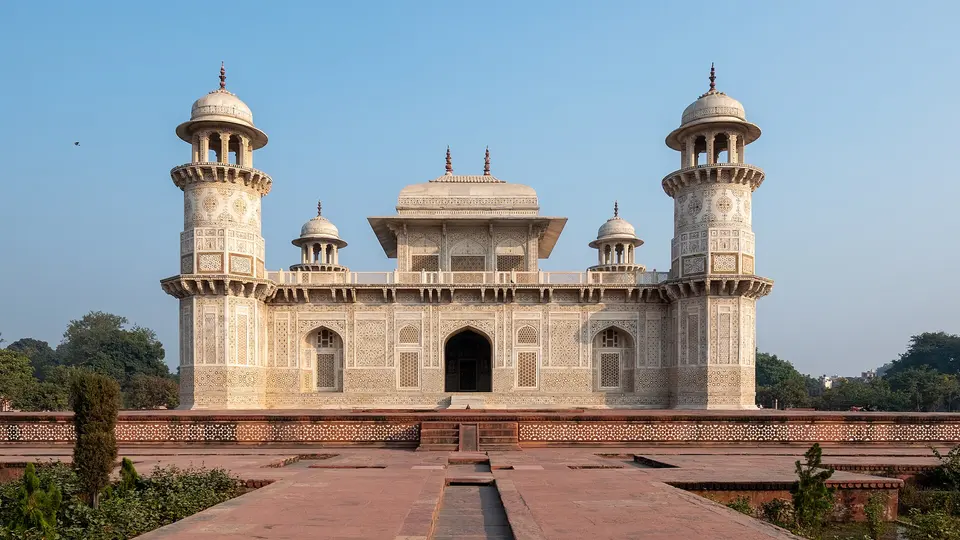
Tomb of I'timād-ud-Daulah
Photo: Rohit Sharma, CC BY-SA 4.0
1Mausoleum

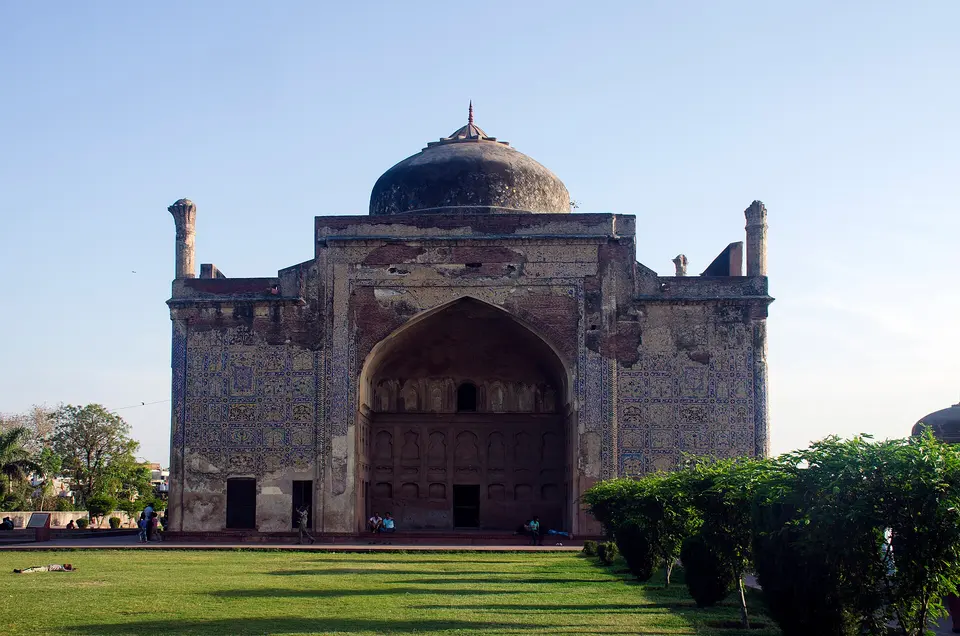
Tomb of I'timād-ud-Daulah

The Baby Taj, built between 1622 and 1628 by the empress Nur Jahan for her father, a Persian who rose to be Jahangir's treasurer, is the first Mughal building entirely of white marble and the first to use pietra dura, the inlay of semi-precious stone that the Taj would take to its limit; the walls are covered in it, wine flasks, cypresses and vases in jasper, onyx and topaz, the jali screens are cut so fine the light falls in patterns on the floor, and the whole thing is small enough to walk round in twenty minutes. It sits in a garden on the quiet east bank with almost nobody in it. Everything the Taj does, this rehearsed.

  • Plan about 1 h 15 min
  • Sunrise to sunset; foreigners about ₹310, Indians about ₹30, under 15 free; the most rewarding half hour in Agra after the Taj
1.5 km further north along the river road, 5 minutes
Chini Ka Rauza
Photo: Rangan Datta Wiki, CC BY-SA 4.0
2Tomb

Chini Ka Rauza

A kilometre north of the Baby Taj, the tomb of Afzal Khan, a Persian poet who became Shah Jahan's prime minister and died in 1639, is the only building in India faced entirely in glazed tilework, the chini of its name: blue, turquoise, yellow and green mosaic that once covered the whole cube and now survives in patches on the north face, with a painted plaster dome inside. It is unrestored, unvisited and half ruined in a garden by the river, and for anyone who has seen the polished monuments it is the most atmospheric stop in the city. Ten minutes and a guard who will unlock the gate.

  • Plan about 30 min
  • Sunrise to sunset, free or a nominal fee; unrestored, uneven ground; combine with the Baby Taj and Aram Bagh
1 km north again, 5 minutes; the garden's gate is on the main road
Aram Bagh (Ram Bagh)
Photo: Rangan Datta Wiki, CC BY-SA 4.0
3Mughal garden

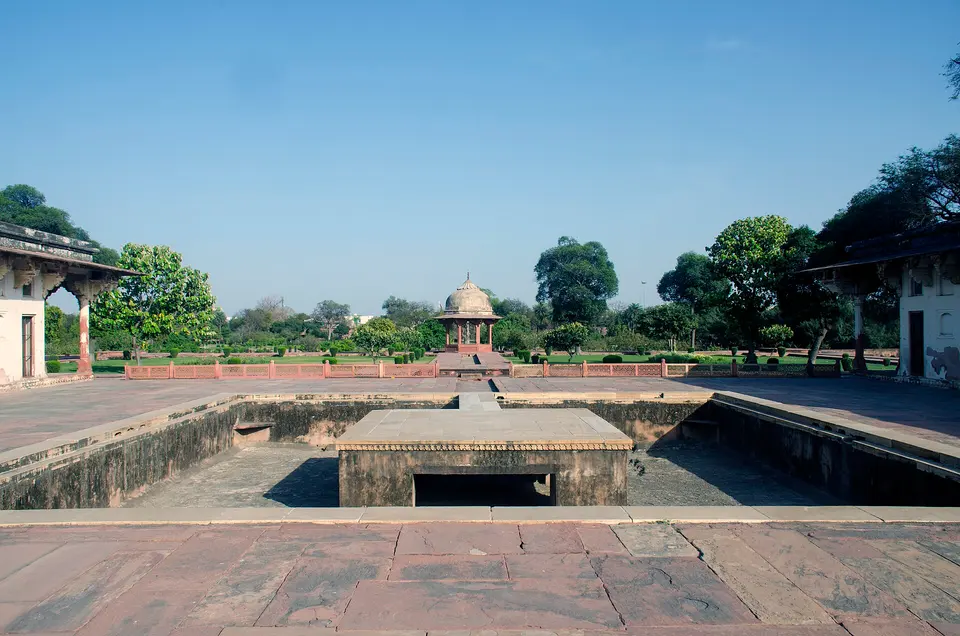
Aram Bagh (Ram Bagh)

Babur, the first Mughal, laid this out in 1528 as the Garden of Rest, the oldest Mughal garden in India and the template for everything after it: a charbagh of four quarters divided by water channels, terraces stepping down to the Yamuna, pavilions to catch the river breeze and an underground tahkhana where the court sat out the summer. Babur's body rested here before it was carried to Kabul. Restored by the ASI, it is a quiet green rectangle where the city's students come to read and the parrots are louder than the traffic.

  • Plan about 45 min
  • Sunrise to sunset; foreigners about ₹300, Indians about ₹25; 1 km north of Chini Ka Rauza on the east bank

Midday

LunchKinari Bazaar, the lane behind the Jama Masjid, is the lunch: Deviram's bedai and jalebi in the morning, the chaat stalls at midday, Mama Chicken's rolls for the brave and the petha shops for what you carry home. It is loud, narrow and full of motorbikes, and it is the part of Agra that has nothing to do with the Mughals and everything to do with the city.

Afternoon

6 km back south-west across the bridge, about 25 minutes; the mosque faces Agra Fort railway station
Jama Masjid
Photo: Jonathan Freundlich, CC BY-SA 3.0
4Mosque

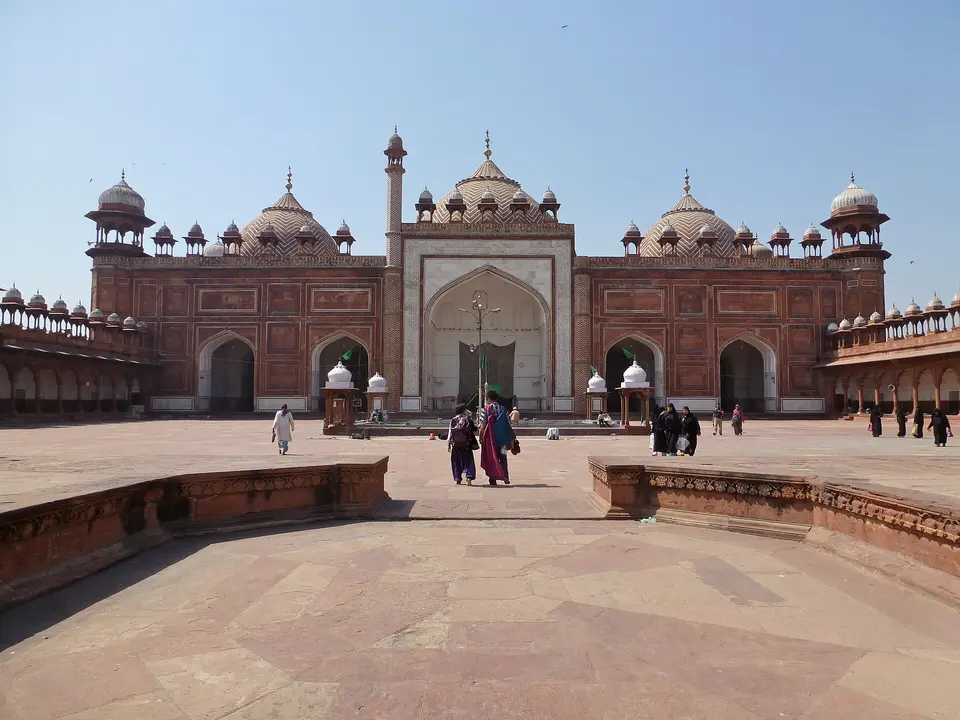
Jama Masjid

Shah Jahan's daughter Jahanara Begum paid for the congregational mosque of the city in 1648, a broad red sandstone building with three domes striped in white marble and an inverted-lotus finial, facing Agra Fort across what was the fort's great forecourt until the British put a railway through it. It is a working mosque in the middle of the old city's noise, its courtyard full of pigeons and shoppers cutting through to the bazaar, and the view from its steps across the traffic to the fort's walls is the view of Agra that the postcards leave out. Dress modestly, take shoes off, avoid the Friday midday prayer.

  • Plan about 45 min
  • Open outside prayer times, free; opposite Agra Fort railway station; the Kinari Bazaar lanes start behind it
A 5-minute walk from the mosque through the bazaar lanes
Mankameshwar Temple
Photo: IAshishTripathi, CC BY-SA 4.0
5Hindu temple

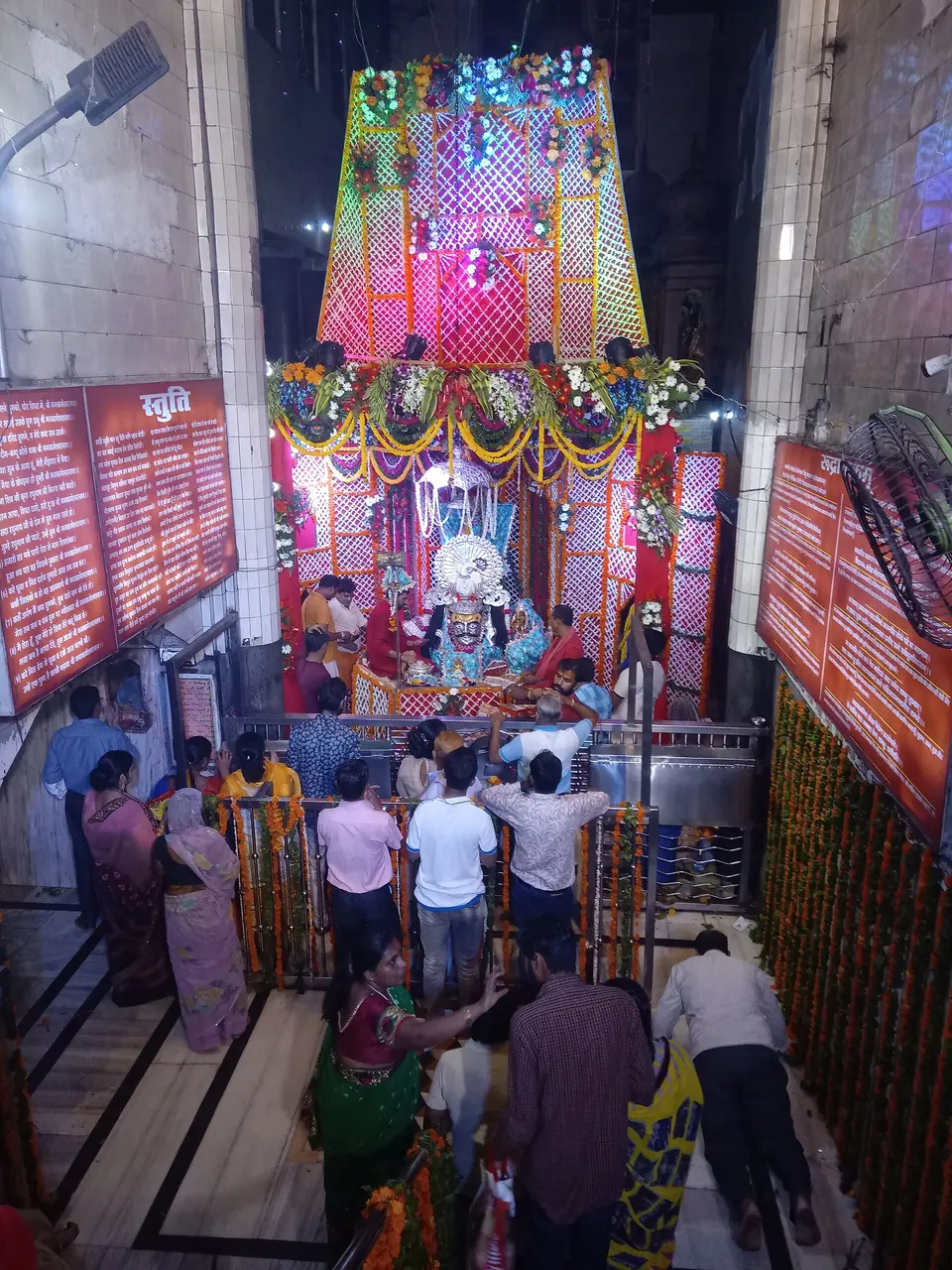
Mankameshwar Temple

Hidden in the bazaar lanes behind the Jama Masjid, one of the four ancient Shiva temples said to mark the corners of old Agra keeps a silver-clad lingam that pilgrims believe Shiva himself installed, under a small silver-covered shrine that the goldsmiths of the surrounding streets have paid for over the centuries. In the evening the aarti fills the lane with bells and the temple with families; during Shivratri in February or March the queue runs for blocks. Shoes and leather are left outside, and the photography rule inside is no.

  • Plan about 30 min
  • Open early morning to late evening, free; evening aarti is the time to come; leave shoes and leather at the door

Evening

DinnerGive the last evening back to the Taj from outside: the rooftop cafés of Taj Ganj look straight at the dome as the light goes, and Mehtab Bagh across the river takes the last of it if you did not go on day one. If the moon is near full and it is not a Friday, the ASI's night viewing runs in half-hour batches between 20:00 and midnight, booked a day ahead.

Good to know in Agra

Tickets and opening days

  • The Taj Mahal is open sunrise to sunset and closed on Fridays, when the mosque inside opens only between noon and 2 p.m. for prayers; night viewing is allowed on the full-moon night and the two nights before and after it, excluding Fridays and the month of Ramadan. Indian and SAARC visitors pay ₹30 per head to the ASI and foreign visitors ₹500, plus a ₹500 toll tax charged by the Agra Development Authority.Source: Archaeological Survey of India, Agra Circle — Taj Mahal · checked Sep 2026
  • Agra Fort is open from sunrise to sunset; Indian and SAARC/BIMSTEC visitors pay ₹30 per head and foreign visitors ₹500 plus ₹50 toll tax, and the ₹500 development-authority ticket covers Agra Fort, Itimad-ud-Daulah, Akbar's Tomb at Sikandra and Fatehpur Sikri, with children under 15 admitted free.Source: Archaeological Survey of India, Agra Circle — Agra Fort · checked Sep 2026
  • Fatehpur Sikri is open sunrise to sunset; Indian visitors pay ₹30 to the ASI plus ₹10 toll tax and foreign visitors ₹500 plus ₹10, and children under 15 enter free. The fee covers the 93 protected monuments in and around Fatehpur Sikri, and foreign visitors who have bought the toll-tax ticket the same day at the Taj Mahal, Agra Fort, Akbar's Tomb or Itimad-ud-Daulah need not buy it again; the toll tax is waived on Fridays.Source: Archaeological Survey of India, Agra Circle — Fatehpur Sikri · checked Sep 2026

3 days in Agra: quick answers

Is 3 days enough for Agra?

Three days is more than almost anyone gives Agra and exactly enough to see it properly: the Taj twice, the fort without hurrying, Fatehpur Sikri as its own morning and the east-bank tombs that the day-trippers never reach. A fourth day is the bear and elephant rescue centres that Wildlife SOS runs on the Delhi road, the bird sanctuary at Keetham Lake, the ghost fort of Bateshwar and its 101 Shiva temples on the Yamuna, or the deserted Mughal city of Sikandra's surroundings. Delhi is two hours by the Gatimaan Express and Jaipur four by road.

Which days should I plan around?

The Taj Mahal is closed to visitors every Friday, when the mosque inside opens only for prayers, so the Taj day is never a Friday. It is open from sunrise to sunset otherwise, and night viewing runs on the full-moon night and the two nights either side, excluding Fridays and the month of Ramadan. Agra Fort, Fatehpur Sikri, the Baby Taj and Akbar's tomb are open sunrise to sunset every day, Fridays included, and the Agra Development Authority waives its toll tax on Fridays, which makes Friday the cheapest day for everything except the Taj.

How much do the tickets cost?

The Archaeological Survey of India charges foreign visitors ₹500 at the Taj Mahal plus a ₹500 development-authority toll, with about ₹200 more to enter the mausoleum chamber itself; Indians and SAARC citizens pay ₹30 plus the toll. Agra Fort is ₹500 plus a ₹50 toll for foreigners and ₹30 plus toll for Indians. Fatehpur Sikri is ₹510 for foreigners and ₹40 for Indians, and children under 15 enter free everywhere. The Baby Taj, Akbar's tomb and Mehtab Bagh are about ₹310, ₹310 and ₹300 for foreigners. The toll ticket bought at the first of the five main monuments on a given day covers the others, so buy it where you start.

How do I get around?

By auto-rickshaw, which is cheap and everywhere, by the app taxis that work well in Agra, or by hiring a car with a driver for the day, which is what most people do for Fatehpur Sikri and Sikandra. Battery rickshaws and cycle rickshaws do the last stretch to the Taj, since petrol engines are banned within 500 metres of it. The first line of the Agra Metro opened in 2024 between the Taj East Gate, Agra Fort and the cantonment station and is the easiest way along that axis. Agra Cantt station is where the Delhi trains arrive and Agra Fort station serves the Rajasthan lines.

What should I know before the Taj Mahal?

Tickets are timed and bought online through the ASI's portal or at the gates, entry is limited to three hours, and the queues split by nationality and gender at security. Tripods, drones, food, tobacco and large bags are refused; a small bag, a phone and a camera are fine and shoe covers come with the foreigner ticket for the marble platform. The east gate is the quietest at dawn; the south gate through Taj Ganj is closed for entry. The mausoleum chamber needs its own small ticket, and photography is not allowed inside it.

How much walking is this itinerary?

About 5 km on day one across the Taj's gardens and the fort's courtyards; about 5 km on day two, most of it inside the 3 km circuit of Fatehpur Sikri's palace city and the climb to the Buland Darwaza; and about 4 km on day three between the east-bank tombs and the bazaar lanes. The walking is flat but the sun is fierce from March to October and the stone holds the heat, so mornings and late afternoons are the working hours.

Other Agra itineraries

Keep exploring

Where this connects

THE TRIPWOA APP

Go somewhere.
Make it yours.

Build days around what you love. Follow your route, find your next stop and keep the moments along the way.

Get it on Google PlayAvailable for Android
Free to start
Tripwoa home with a Paris trip and nearby places to explore
Tripwoa day plan for New York with a route map and Times Square stop

A day that feels like you.

Sources and method

Places and coordinates: Wikidata and Tripwoa's open-data place catalog (Overture Maps Foundation, © OpenStreetMap contributors). Photos: Wikimedia Commons, credited on each image. Practical rules: the official sources linked in each note, checked in September 2026.

How this plan was made: Tripwoa's planner drafted the day order from real coordinates and typical visit times. Each stop was then reviewed, reordered where needed and rewritten with AI assistance. Walking distances are straight-line estimates, so allow a little extra time on real streets.