3-day itinerary · United States

3 Days in Austin

A plan that walks the Capitol corridor on the first day, gives Zilker and the water a full second, and uses the third on the edges of the city, finishing under the bridge when the bats come out. Opening hours, what needs booking and what is free are in the stops.

  • 3days
  • 14sights
  • 0.0 kmon foot between sights

Updated 13 September 2026 · 5 official sources checked · report an error

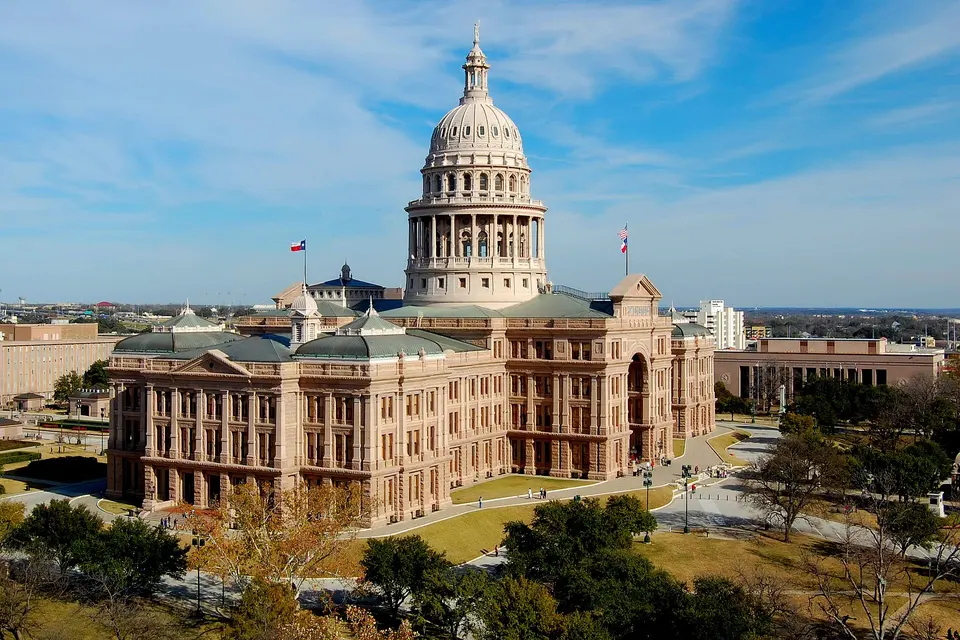
Texas State Capitol
Photo: LoneStarMike, CC BY 3.0

The Capitol and Sixth Street, then Zilker and South Congress, then Mount Bonnell, McKinney Falls and the bats

Austin is a city of about a million on the Colorado River where the Texas Blackland Prairie runs into the Hill Country, and that geological line explains most of it: the limestone to the west gives the city its springs, its swimming holes and its bluffs, and the flat land to the east gave it room to grow. It was founded in 1839 as the capital of the Republic of Texas and named for Stephen F. Austin, stayed a small government and university town for most of the next century, and then became in turn the live music capital of the world by act of the city council in 1991 and one of the fastest-growing technology centres in America. The result is a place arguing with itself about what it is. What visitors get is a walkable centre, a river with a sixteen-kilometre trail round it, serious barbecue, and a bat colony that empties out from under a bridge every evening for eight months of the year.

At a glance

Ways to use these days

If it rains
2 of the stops are indoors — Bullock Texas State History Museum · Blanton Museum of Art
For the view
Mount Bonnell
Outdoors
Zilker Park · Zilker Botanical Garden · Congress Avenue Bridge
Lightest day on foot
Day 1 — 4.0 km between stops
Most walking
Day 3 — 27.0 km

Day 1

The Capitol, the state's own story and the street that made the noise

Start under a dome that Texas built taller than Washington's on purpose, work north through the state history museum and the university's art collection, spend the afternoon with the tapes in a president's library, and finish on eight blocks of Victorian brick that turn into a hundred bars after dark.

  • 5 sights
  • Transport between sights
12345500 mN
Stops in order, straight-line distancesWalking route in Google Maps ↗

Morning

Texas State Capitol
Photo: LoneStarMike, CC BY 3.0
1Capitol building

Texas State Capitol

Elijah E. Myers finished this in 1888 and Texas made sure of one thing: at 94 metres to the tip of the Goddess of Liberty, it stands taller than the national Capitol in Washington, a fact every guide mentions within a minute. It is built of Sunset Red granite quarried at Marble Falls and hauled here on a railway built for the purpose, and it was paid for not in cash but in land, three million acres of the Panhandle signed over to the contractors, which became the largest cattle ranch in the world. Inside, the rotunda is a whispering gallery with the terrazzo seals of the six nations that have governed Texas set in the floor, and an underground extension of 1993 put most of the working offices below the lawn so the building could stay as it was.

  • Plan about 1 h 15 min
  • Open to the public on weekdays from about 07:00 to 22:00 and at weekends from 09:00, free; free guided tours run through the day from the visitor desk on the ground floor; the south lawn and the 1857 General Land Office building are worth a loop
600 m north across the Capitol grounds, about 8 minutes on foot
Bullock Texas State History Museum
Photo: Michael Barera, CC BY-SA 4.0
2Museum

Bullock Texas State History Museum

Three floors that set out to tell the whole story of Texas, and a museum honest enough to have rewritten large parts of itself over the past decade to do it better. The first floor covers the land and the peoples who were here for thirteen thousand years before anyone else; the second the colonial and revolutionary periods, including the recovered hull of La Belle, the French ship that sank in Matagorda Bay in 1686 and was excavated with a cofferdam, now reassembled in a gallery of its own; the third the oil booms, the cattle drives, the space programme and the civil rights movement. The exterior is granite with a 10-metre bronze star out front that is the most photographed object in Austin after the Capitol.

  • Plan about 2 h
  • Open daily, roughly 10:00 to 17:00 with a Sunday noon opening; ticketed, with an IMAX and a special exhibition sold separately; it stands two blocks north of the Capitol and the two go together in one morning

Midday

LunchAustin's case for itself is barbecue and breakfast tacos, in that order. Franklin Barbecue on East 11th queues from before dawn and sells out by early afternoon; the alternatives on the east side are nearly as good with a fraction of the wait. A breakfast taco is a flour tortilla with egg, potato, bacon or chorizo and salsa, eaten standing up, and Austin will argue about the best one indefinitely. The university campus drag on Guadalupe Street has cheap food all day.

Afternoon

300 m east on Martin Luther King Jr. Boulevard, four minutes on foot
Blanton Museum of Art
Photo: Larry D. Moore, CC BY 4.0
3Art museum

Blanton Museum of Art

The University of Texas art museum, and one of the largest university collections in the United States: about 21,000 works, with real depth in European painting from the Renaissance to the eighteenth century, a Latin American collection that is among the most important anywhere and reflects decades of deliberate collecting, and American and contemporary galleries. The single reason most visitors come is outside: Ellsworth Kelly's Austin, a 260-square-metre stone building of his own design with coloured glass windows, a totemic redwood column and fourteen black-and-white marble panels, finished in 2018 after his death and the only building he ever made. Snøhetta reworked the whole campus in 2023 with petal-roofed canopies over a new plaza.

  • Plan about 1 h 45 min
  • Open Tuesday to Sunday, roughly 10:00 to 17:00 with a Sunday afternoon start, closed Monday; ticketed with free Thursdays; Austin is a separate building in the grounds and is included
1.2 km north-east across the university campus, about 15 minutes on foot
LBJ Presidential Library
Photo: LBJLibraryNow, Public domain
4Presidential library

LBJ Presidential Library

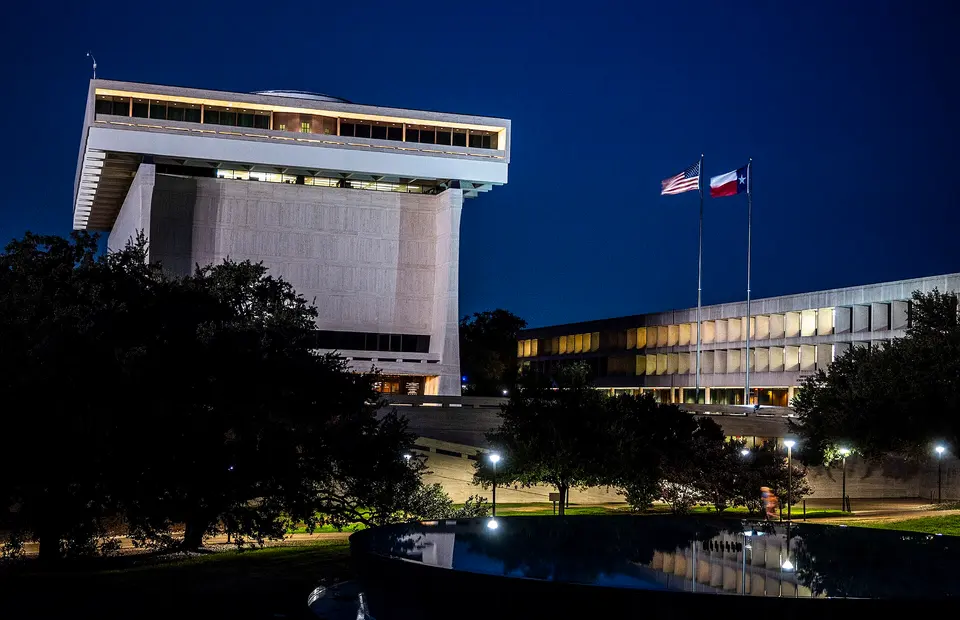
Gordon Bunshaft designed this windowless travertine block on the university campus in 1971, and Lyndon Johnson supervised it closely enough that the result reads as a monument to himself, which is fair enough. Behind a four-storey glass wall the red archive boxes of forty-five million pages sit stacked and visible, each bearing the presidential seal. The galleries cover the Great Society, the Civil Rights Act and the Voting Rights Act, the war in Vietnam, and the tapes: Johnson recorded his telephone calls, and listening to him work a senator over is the most instructive thing in the building. A seven-eighths-scale replica of the Oval Office occupies the top floor, and an animatronic Johnson tells his own jokes.

  • Plan about 2 h
  • Open daily, roughly 09:00 to 17:00, closed on major holidays; ticketed with concessions and free entry for children; parking is on the university campus and is easier at weekends

Evening

2 km south back into downtown, about 25 minutes on foot or five by car
Sixth Street
Photo: Kevin Payravi, CC BY-SA 4.0
5Historic district

Sixth Street

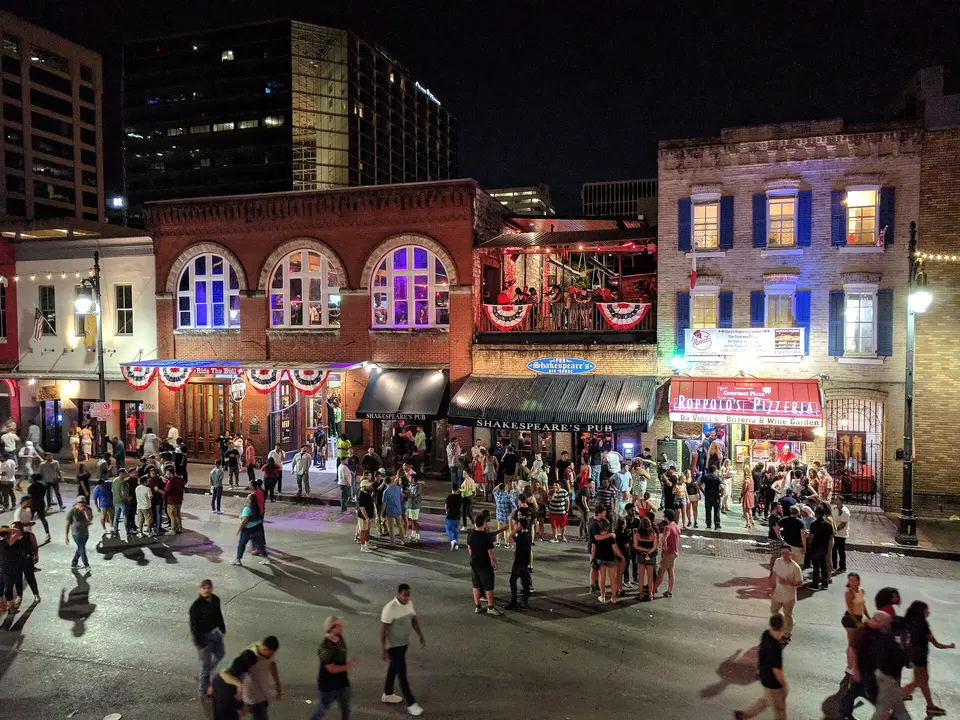
Old Pecan Street was the commercial spine of Austin from the 1870s and it kept its Victorian brick and limestone shopfronts because the city was too poor to knock them down; it went onto the National Register in 1975 and turned into a strip of bars somewhere around the same time. The eight blocks between Congress Avenue and Interstate 35 hold something over a hundred licensed venues, and on a Friday night the street is closed to cars and the noise is continuous. It is where South by Southwest began in 1987 and where it still spills. Locals will tell you the good music has moved to Red River Street and the east side, which is true, and they will still take you to Sixth Street once.

  • Plan about 2 h
  • Free; the street closes to traffic on Friday and Saturday nights from about 21:00; the live music is better on Red River Street one block east, and the historic architecture is best seen by daylight when nothing is open

Day 2

Zilker, a spring-fed pool and the avenue everyone photographs

Spend the day on the water and the lawn: a park that was sold to the city on condition it stayed public, a limestone swimming hole that holds at 20 degrees all year, a Japanese garden built by a seventy-year-old in eighteen months, and the shopping street with the Capitol framed at the end of it.

  • 5 sights
  • Transport between sights
123451 kmN
Stops in order, straight-line distancesWalking route in Google Maps ↗

Morning

Zilker Park
Photo: Mwyzykowski0821, CC BY-SA 4.0
1Park

Zilker Park

Andrew Zilker sold the city 140 hectares along the Colorado River for a fraction of their worth in the 1910s on condition it stayed public, and the park that resulted is the centre of outdoor Austin. The Great Lawn is where Austin City Limits Music Festival happens over two October weekends and where everyone else lies down the rest of the year; there is a miniature train, a polo field, canoe and paddleboard rental on Lady Bird Lake, disc golf, and the botanical garden and sculpture garden on the hillside above. The skyline stands up directly across the water, which is why the view from the lawn is the picture most people take home from Austin.

  • Plan about 1 h 30 min
  • Free and open daily from 05:00 to 22:00; parking is charged at weekends and fills early; the free Zilker shuttle runs from downtown during festivals, when the park is closed to everyone without a ticket
Inside Zilker Park at its eastern end, five minutes on foot
Barton Springs Pool
Photo: Todd Dwyer, CC BY-SA 2.0
2Swimming pool

Barton Springs Pool

Four springs feed about 120 million litres a day out of the Edwards Aquifer into a limestone creek bed, and in the 1920s the city dammed a 300-metre stretch of it into a swimming pool. It is not chlorinated, it has a grass and limestone bottom, and it holds at 20 to 22°C every day of the year, which means it is bracing in August and warm in January. People swim laps here before work in the dark. The pool is also the only known habitat of the Barton Springs salamander, an endangered species that closed the pool for years of litigation and now shapes how it is cleaned. Locals treat it as something between a public bath and a church.

  • Plan about 1 h 30 min
  • Open daily except Thursday mornings when it is cleaned, roughly 05:00 to 22:00, with a modest charge during staffed hours and free early and late; the free upstream section at Barton Creek is where dogs swim

Midday

LunchThe food trailers are the Austin institution and there are pods of them all over the south side, most reliably on South First Street and at the northern end of South Congress. Tex-Mex migas, a Vietnamese banh mi, Detroit pizza and a wood-fired doughnut can all be had within fifty metres of each other. Sit at a picnic table, pay by card, and expect a line at the good ones.

Afternoon

800 m north-west up the hillside, about 12 minutes on foot
Zilker Botanical Garden
Photo: Daderot, CC0
3Botanical garden

Zilker Botanical Garden

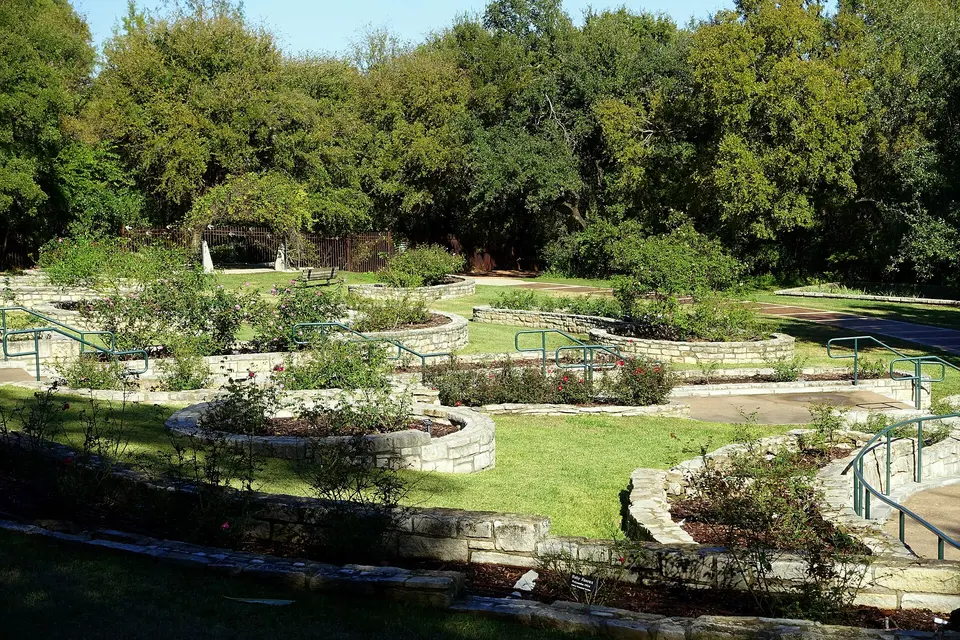
Eleven hectares cut into the hillside above the park in a series of themed gardens, and the best of them is the Isamu Taniguchi Japanese Garden, built between 1967 and 1969 by a retired Japanese-American nurseryman who was interned during the Second World War, offered to build it for nothing, and worked on it for eighteen months at the age of seventy. He shaped the ponds so that seen from above they spell the word love in Japanese characters. Elsewhere there is a rose garden, a herb garden, a prehistoric garden built around a set of dinosaur tracks found on the site in 1992, and a pioneer village of relocated log cabins.

  • Plan about 1 h 15 min
  • Open daily, roughly 09:00 to 18:00 in summer and shorter in winter, with a modest ticket; the Japanese garden is at its best in the early morning and in the last hour of light
The hike-and-bike trail starts at the park's northern edge and runs both ways
Lady Bird Lake
Photo: Michael Barera, CC BY-SA 4.0
4Reservoir

Lady Bird Lake

Longhorn Dam turned this stretch of the Colorado River into a reservoir in 1960, and Lady Bird Johnson spent the following decades pushing the city to plant and protect its banks rather than build on them. The result is the Ann and Roy Butler Hike-and-Bike Trail, sixteen kilometres of decomposed granite path round the whole lake, crossed by a boardwalk built out over the water on the south-east side where the bank ran out. Motorboats are banned, so it is all kayaks, canoes, paddleboards and rowing eights. On a spring evening the trail is a slow-moving crowd of runners with the towers reflected beside them, and the bats come out from under the bridge at the western end.

  • Plan about 1 h 30 min
  • Free and open at all hours; kayak and paddleboard rental is at several points around the lake and the boardwalk section is the most scenic stretch; the trail is busiest between 17:00 and 19:00

Evening

3 km east, about 10 minutes by car, or 35 minutes along the lake trail on foot
South Congress
Photo: LoneStarMike, CC BY-SA 3.0
5Shopping street

South Congress

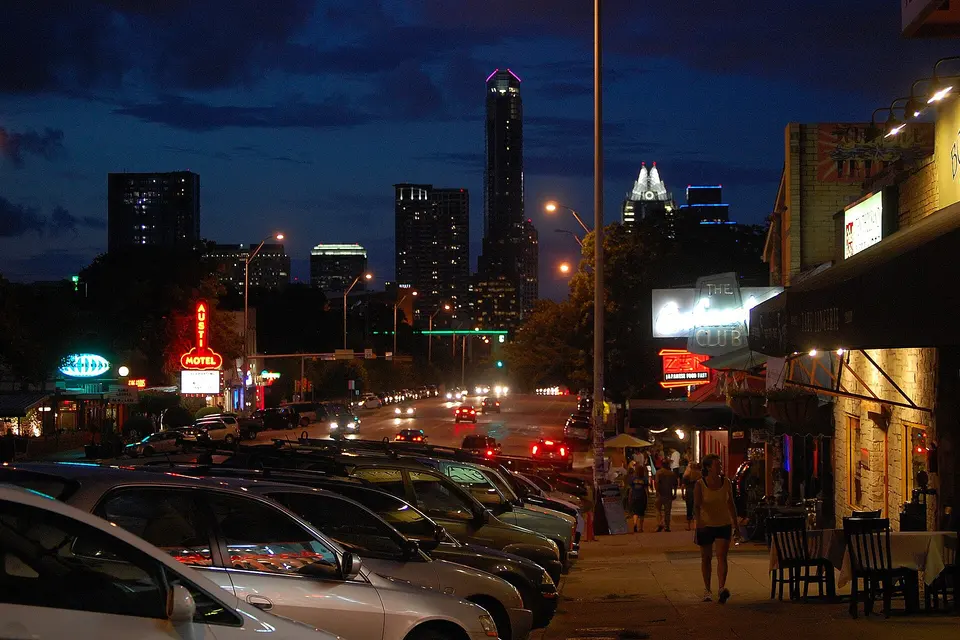
Congress Avenue runs south from the bridge, and the stretch known locally as SoCo was a rundown motel strip within living memory. It is now the most photographed shopping street in Texas: vintage clothing shops, a hat maker who will block a Stetson to your head, a cowboy boot emporium the size of a warehouse, food trailers in a gravel lot, an independent cinema and a run of murals that people queue to stand in front of, among them the I love you so much wall and the Greetings from Austin postcard. The reason to walk north rather than south is the view: the Capitol dome sits perfectly framed at the end of the avenue, which the city's zoning protects by law.

  • Plan about 2 h
  • Free; shops open around 11:00 and the street is busiest on Saturday afternoons; the First Thursday street event runs monthly; walk north up the avenue for the framed view of the Capitol

Day 3

The bluff, the falls, a cathedral built of junk and 1.5 million bats

A day of short drives to the edges of the city: the limestone bluff people have climbed since the 1850s, a state park where the Hill Country geology breaks the surface, one man's sixty-tonne back garden, and the largest urban bat colony in the world coming out from under a bridge at dusk.

  • 4 sights
  • Transport between sights
12345 kmN
Stops in order, straight-line distancesDriving route in Google Maps ↗

Morning

Mount Bonnell
Photo: Baytownbert, CC BY-SA 3.0
1Viewpoint

Mount Bonnell

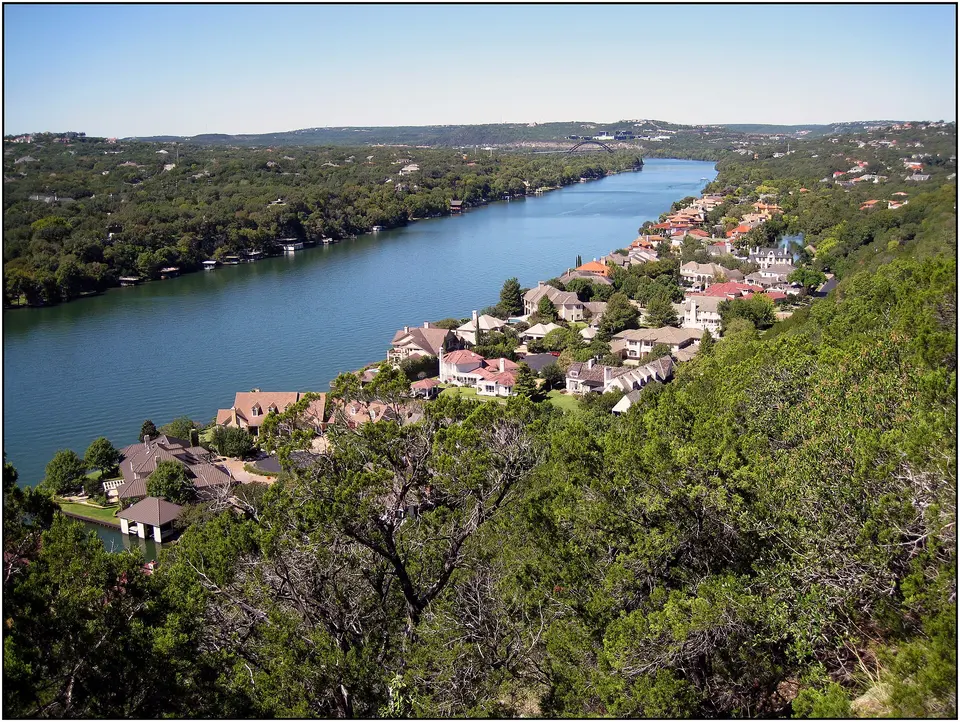
A limestone bluff 230 metres above sea level and about 240 steps above the car park, and the highest point within the city, which in central Texas is not a high bar but is enough. It has been a tourist destination since the 1850s, when visitors came by carriage and the local tradition held that a couple who climbed it together would fall in love. From the pavilion at the top the Colorado River curls below in the stretch called Lake Austin, with the limestone hills and a good deal of expensive real estate on both banks and the downtown towers visible to the south-east. It takes ten minutes to climb, five to see, and the sunset is the reason to time it late.

  • Plan about 45 min
  • Free and open daily from 05:00 to 22:00; the car park is small and fills at sunset; the steps are steep and uneven and there is no shade at the top
14 km south, about 20 minutes by car; visits are by telephone appointment only
Cathedral of Junk
Photo: Jennifer Morrow, CC BY 2.0
2Folk art structure

Cathedral of Junk

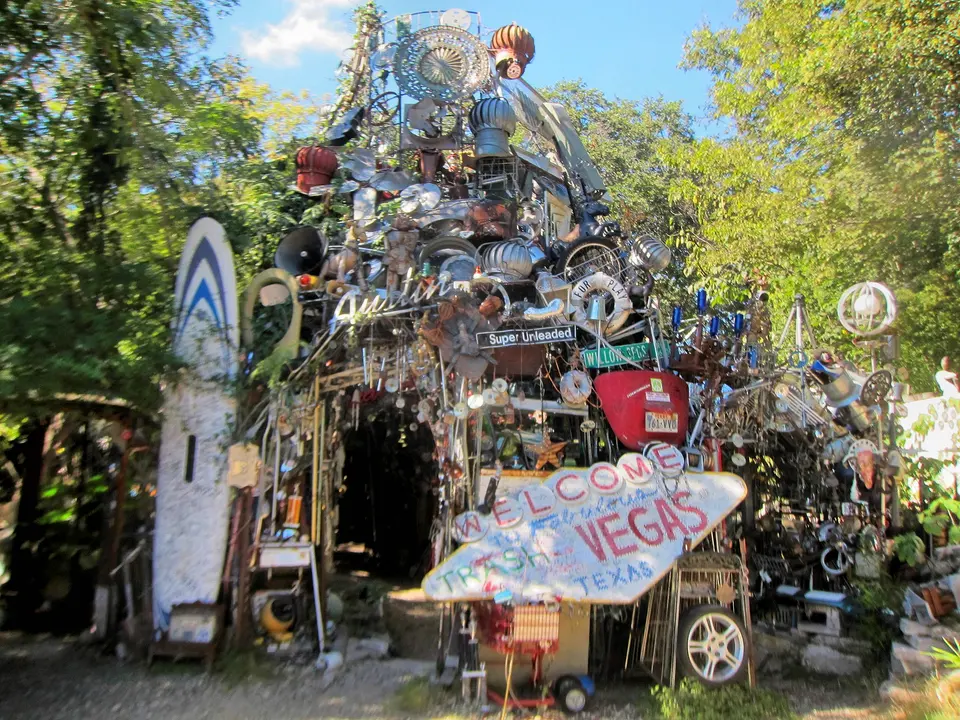
Vince Hannemann started piling things in his back garden in South Austin in 1988 and has not stopped: about sixty tonnes of bicycle wheels, hubcaps, television sets, crutches, mannequin legs, surfboards, telephones, road signs and several thousand bottles, welded and wired into a three-storey structure with rooms, stairs, a throne and a colour-sorted wall. The city made him take a third of it down in 2010 on structural grounds and he rebuilt. It is on private property, he lets people in by appointment, and he is usually there. It is the clearest surviving example of the old slogan about keeping Austin weird, which the city put on T-shirts around the time it stopped being true.

  • Plan about 45 min
  • By appointment only, arranged by telephone, with a small charge per group; it is a residential back garden in a quiet street, so keep the noise down; bring cash

Midday

LunchSouth Austin is where the city's older character survives, and lunch here means a picnic table under a live oak: a taqueria on South Lamar, a barbecue joint that closes when the meat runs out, or one of the trailers on Menchaca Road. If you are heading straight to McKinney Falls there is nothing in the park, so buy something before the gate.

Afternoon

13 km south-east, about 20 minutes by car; reserve a day pass online at weekends
McKinney Falls State Park
Photo: G. Lamar, CC BY 2.0
3State park

McKinney Falls State Park

Onion Creek drops over two ledges of hard limestone inside the city limits, and the state park built around them in 1976 is the only place in Austin where the Hill Country geology is on open display. The Upper Falls pour into a wide swimming hole; the Lower Falls tumble over a bare limestone shelf that has been scoured into potholes and channels by flood water and looks like a pavement. Beyond them are 13 km of trail, the ruins of Thomas McKinney's 1850s homestead and horse-training track, a rock shelter used for thousands of years, and Old Baldy, a bald cypress on the creek bank reckoned to be more than five hundred years old.

  • Plan about 2 h 30 min
  • Open daily 08:00 to 22:00 with a modest state park entry fee; day passes should be reserved online in advance at weekends because the park closes when it fills; swimming depends on water quality and flow and is posted at the gate

Evening

13 km north-west back to the river, about 20 minutes; park south of the bridge and walk to the lawn
Congress Avenue Bridge
Photo: Aleksandr Zykov, CC BY-SA 2.0
4Bridge

Congress Avenue Bridge

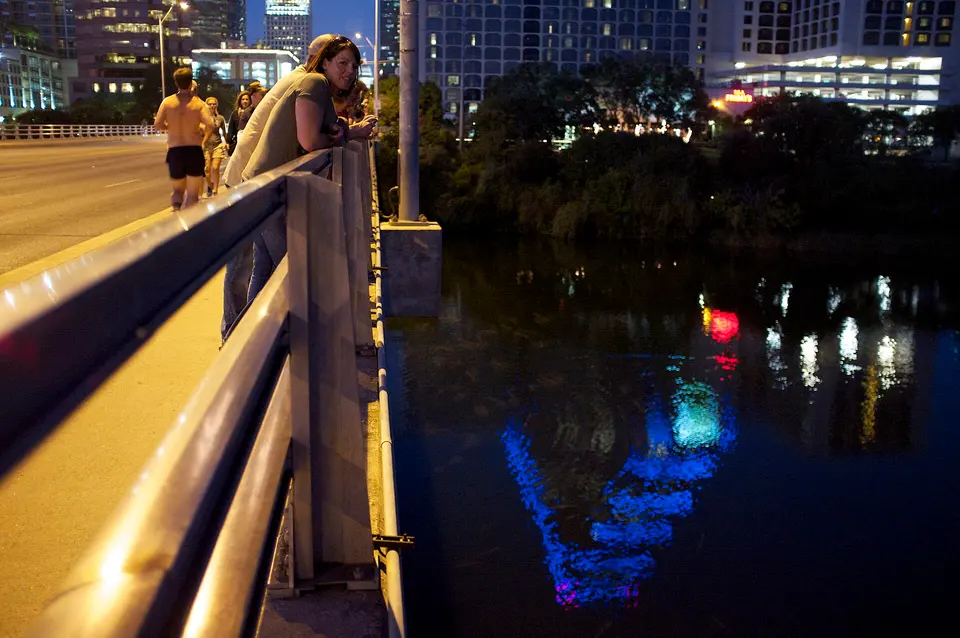
When the bridge was rebuilt in 1980 the engineers left expansion joints in the underside that turned out to be the ideal crevice for a Mexican free-tailed bat. About 1.5 million of them now roost here between March and early November, the largest urban bat colony in the world, and they eat something like ten tonnes of insects a night. Austin considered exterminating them in the early 1980s, was talked out of it by Bat Conservation International, and now the emergence is the city's biggest free attraction: on a still evening the colony pours out from under the deck in a continuous ribbon that takes forty-five minutes to clear. The best view is from the lawn on the south-east bank, not the bridge itself.

  • Plan about 1 h
  • Free; the bats emerge around sunset from late March to early November and the timing shifts with the season, so check the daily estimate; the grass at the Statesman Bat Observation Center on the south-east bank is the best spot, and the bridge pavement is the worst

Good to know in Austin

The Capitol corridor museums

  • The Bullock Texas State History Museum is open daily from 10:00 to 17:00. Its exhibitions close on Thanksgiving, Christmas Day, New Year's Day and Easter, and the IMAX theatre closes on selected holidays. Museum admission covers all galleries and children aged five and under enter free.Source: Bullock Texas State History Museum — Visit · checked Sep 2026
  • The Blanton Museum of Art opens Tuesday to Friday 10:00 to 17:00, Saturday 10:00 to 20:00 and Sunday 10:00 to 17:00, and is closed on Mondays. Admission is free for every visitor on Tuesdays, funded by the Moody Family Free Day Endowment, and free for active military with identification and up to five guests between Armed Forces Day and Labor Day.Source: Blanton Museum of Art — Visit · checked Sep 2026
  • The LBJ Presidential Library is open every day from 09:00 to 17:00, the last visitor is admitted at 16:00, and a ticket is valid for the full day. Admission is half price on Tuesdays and no advance reservation is needed then; groups of 15 or more must reserve. The library closes on Thanksgiving, Christmas and New Year's Day, and it advises allowing two to four hours.Source: LBJ Presidential Library — Visit · checked Sep 2026

Zilker and McKinney Falls

  • Zilker Botanical Garden runs seasonal hours: 09:00 to 17:00 with last entry at 16:30 from September to May, and 08:00 to 16:00 with last entry at 15:30 from June to August. Admission for Austin residents is $6 for adults, $5 for visitors 62 and over and $3 for young people aged 3 to 17, with higher non-resident rates.Source: Zilker Botanical Garden — Hours and Admission · checked Sep 2026
  • McKinney Falls State Park is open daily from 08:00 to 22:00, with the headquarters staffed 08:00 to 16:15. The park often reaches capacity and Texas Parks and Wildlife strongly recommends reserving a day pass online in advance to guarantee entry, for day use as well as camping.Source: Texas Parks and Wildlife — McKinney Falls State Park · checked Sep 2026

3 days in Austin: quick answers

Is 3 days enough for Austin?

Three days is the right length. One day covers the Capitol, the museums and Sixth Street, one covers Zilker and the water, and the third takes in the edges of the city and the bats. What gets left out is the Hill Country: Hamilton Pool Preserve is a collapsed grotto with a waterfall 40 km west and needs a booked permit, Fredericksburg and the wineries are an hour and a half, and Lake Travis is forty minutes. Any of those makes a strong fourth day, and all need a car.

What is the best time of year to visit Austin?

March to May and October to November. Spring brings bluebonnets on the roadsides and temperatures around 25 to 29°C, and it is also when the city is busiest: South by Southwest takes over in March and the Austin City Limits festival fills Zilker over two October weekends, both of which double hotel prices. Summer is the problem, with weeks above 35°C and a stretch of days past 38 most years, which turns every outdoor plan into a morning plan. Winter is mild at around 16°C and is the quietest, cheapest time to come.

When can you see the bats in Austin?

The colony is under Congress Avenue Bridge from about mid-March to early November, peaking in July and August when the pups can fly and the numbers reach around 1.5 million. They come out at dusk, but the exact time shifts by up to an hour with the season and the weather, and on cool or wet evenings they may not emerge at all. The best viewing is from the lawn at the Statesman Bat Observation Center on the south-east bank rather than from the bridge itself, and arriving thirty minutes before sunset gets you a place.

How much does Austin cost per day?

More than the rest of Texas and less than the coasts, except during festivals when it is neither. A hostel bed runs $40 to $65, a mid-range hotel $170 to $280, and during South by Southwest or Austin City Limits those double or worse. Eating is where Austin is generous: a food trailer lunch is $12 to $18, breakfast tacos under $10, and a barbecue plate $20 to $30. The Capitol, Zilker Park, Lady Bird Lake, South Congress and the bats are all free, and the ticketed museums run $13 to $20.

Do you need a car in Austin?

For the first two days, no. Downtown, the Capitol, the university, Sixth Street, Zilker and South Congress are walkable or a short ride apart, and Capital Metro buses and the MetroRail line cover the corridor. The third day is different: Mount Bonnell, McKinney Falls and the Cathedral of Junk are scattered around the edges with no useful transit between them. Hire a car for that day or use ride-hailing, which is plentiful and cheap outside the late-night bar rush.

Is Austin still weird?

Less than the slogan suggests, and locals will tell you so at length. The city has roughly doubled since 2000, the technology industry has pushed rents up sharply, and a number of the places that earned the reputation have closed. What survives is real enough: the Cathedral of Junk, the springs, the bats, the trailers, the music on Red River Street and the east side, and an outdoor culture that puts several thousand people on the lake trail on an ordinary Tuesday evening. Go for those rather than for the T-shirt.

Other Austin itineraries

Keep exploring

Where this connects

THE TRIPWOA APP

Go somewhere.
Make it yours.

Build days around what you love. Follow your route, find your next stop and keep the moments along the way.

Get it on Google PlayAvailable for Android
Free to start
Tripwoa home with a Paris trip and nearby places to explore
Tripwoa day plan for New York with a route map and Times Square stop

A day that feels like you.

Sources and method

Places and coordinates: Wikidata and Tripwoa's open-data place catalog (Overture Maps Foundation, © OpenStreetMap contributors). Photos: Wikimedia Commons, credited on each image. Practical rules: the official sources linked in each note, checked in September 2026.

How this plan was made: Tripwoa's planner drafted the day order from real coordinates and typical visit times. Each stop was then reviewed, reordered where needed and rewritten with AI assistance. Walking distances are straight-line estimates, so allow a little extra time on real streets.