3-day itinerary · South Korea

3 Days in Busan

A realistic first-timer plan that spends day one around the old harbour, from the painted lanes of Gamcheon to the fish stalls of Jagalchi, the alleys of Gukje Market and BIFF Square and the view from Busan Tower at dusk; day two on the east coast, the seaside temple of Haedong Yonggungsa, Haeundae Beach, the Sky Capsule along the cliffs to Cheongsapo, Dongbaek Island and the lights of the Gwangan Bridge from Gwangalli Beach; and day three on the southern cliffs of Taejongdae, the skywalk and cable car of Songdo and the food alleys of Seomyeon. Every stop comes with distances and the prices that matter in 2026.

  • 3days
  • 12sights
  • 0.9 kmon foot between sights

Updated 12 September 2026 · 7 official sources checked · report an error

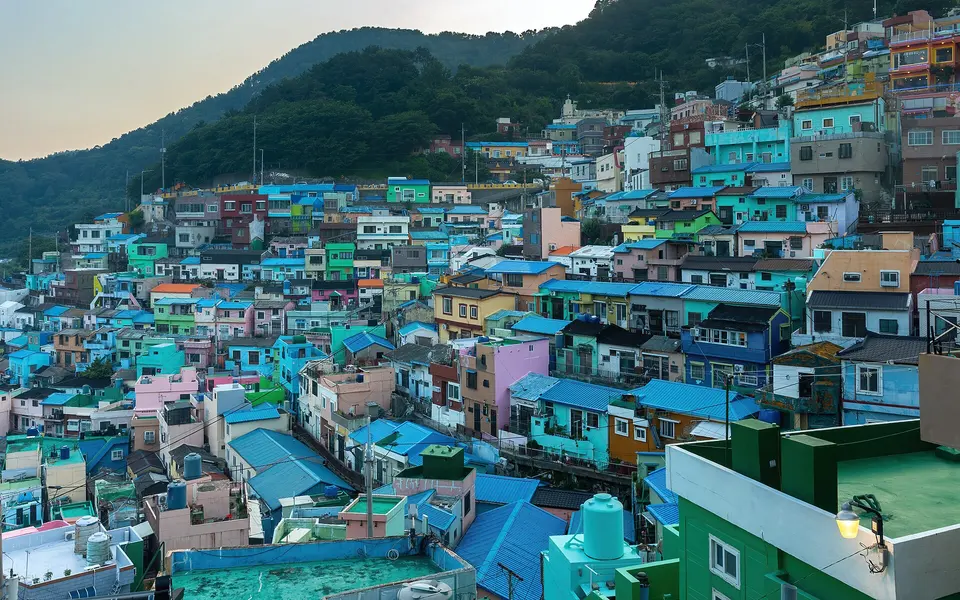
Gamcheon Culture Village
Photo: Basile Morin, CC BY-SA 4.0

The old harbour, then the east coast, then the cliffs of Yeongdo and Songdo

Busan is long and thin along its coast, so the plan takes one stretch of it a day. Day one is Nampo, the old centre by the harbour: the hillside village of Gamcheon in the morning, raw fish upstairs at Jagalchi for lunch, the market alleys of Gukje and the film-festival square, and Busan Tower at sunset. Day two starts at Haedong Yonggungsa, the temple on the rocks, and comes back down the coast: Haeundae Beach, the Sky Capsule along the old railway line to the fishing village of Cheongsapo, Dongbaek Island and the evening at Gwangalli, where the Gwangan Bridge is lit across the bay. Day three is Taejongdae's cliffs and lighthouse, lunch in the cliff-side village of Huinnyeoul, the Songdo skywalk and cable car and dinner in Seomyeon. Jagalchi closes on the first, third and fifth Tuesdays of the month, so keep day one off those days.

At a glance

Ways to use these days

For the view
Busan Tower and Yongdusan Park
Lightest day on foot
Day 1 — 2.8 km between stops
Most walking
Day 2 — 17.0 km

Day 1

Nampo: Gamcheon, Jagalchi, the markets and Busan Tower

Climb through the painted houses of Gamcheon Culture Village in the morning light, choose your lunch from the tanks at Jagalchi Fish Market, walk the alleys of Gukje Market and BIFF Square, and go up Busan Tower in Yongdusan Park as the harbour lights come on.

  • 4 sights
  • 900 m on foot
  • Longest walk 510 m
1234500 mN
Stops in order, straight-line distancesRoute in Google Maps ↗

Morning

Gamcheon Culture Village
Photo: Basile Morin, CC BY-SA 4.0
1Hillside village

Gamcheon Culture Village

Refugees of the Korean War and the followers of the Taegukdo religion built this village of tiny terraced houses up a steep hillside above the port in the 1950s, each house set so as not to block the view of the one behind; since a 2009 art project painted the houses in pastel colours and filled the lanes with murals, sculptures and the Little Prince looking out over the roofs, it has become the most photographed place in the city. Buy the stamp map at the information centre, follow the fish signs through the alleys, and come in the morning before the tour groups.
  • Plan about 2 h
  • Free; a residential neighbourhood, so keep voices down and stay on the marked routes; no drones

Midday

Village bus down to Toseong station and metro line 1 one stop to Jagalchi, about 25 minutes; a taxi takes 15
Jagalchi Fish Market
Photo: Mobius6, CC BY-SA 4.0
2Fish market

Jagalchi Fish Market

The largest seafood market in Korea fills a seven-storey hall and the streets around it on the harbour front, run since the war by the ajumma, the women who gut, sell and cook: on the ground floor you choose your fish, octopus, sea squirts or king crab from the tanks, and it is carried upstairs and served raw as hoe with side dishes, or grilled, at the restaurants on the second floor. The street stalls outside sell grilled eel and dried fish; lunch here is the point of the day.

  • Plan about 1 h 30 min
  • 5:00–22:00; closed 1st, 3rd and 5th Tuesdays

Afternoon

510 m · about 8 min on foot
Gukje Market and BIFF Square
Photo: Christophe95, CC BY-SA 4.0
3Market district

Gukje Market and BIFF Square

Gukje, the 'international market', began as the black market where refugees sold what they had in 1950 and is now a maze of alleys of clothes, kitchenware, fabric and food stalls, joined to the Kkangtong 'tin can' market and the Bupyeong night market; BIFF Square on its southern edge, with the handprints of film stars in the pavement, is where the Busan International Film Festival started and where the ssiat hotteok, sweet pancakes stuffed with seeds, are fried at the street stalls. Bosu-dong's alley of second-hand bookshops is two streets away.

  • Plan about 1 h 30 min
  • Shops mostly 9:00–20:00; many closed on the 1st and 3rd Sundays

Evening

390 m · about 6 min on foot
Busan Tower and Yongdusan Park
Photo: Mobius6, CC BY-SA 4.0
4Observation tower

Busan Tower and Yongdusan Park

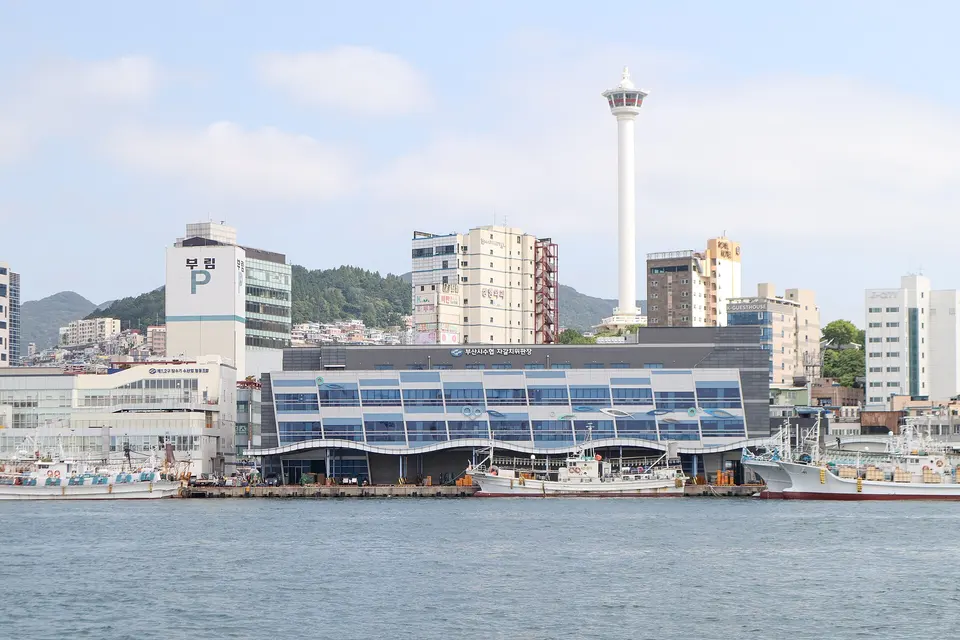
On the hill of Yongdusan above Nampo, reached by escalators from the market streets, the 120-metre tower of 1973, renamed the Diamond Tower after its 2021 refit, has the best view of the old city: the harbour and its container cranes, the Yeongdo bridge, the hills of Gamcheon and the lights coming on across the port. The park below has the statue of Admiral Yi Sun-sin, the great bell and the flower clock; go up half an hour before sunset.

  • Plan about 1 h 15 min
  • 10:00–22:00 daily, last tickets 21:30; ₩12,000

Day 2

The east coast: the sea temple, Haeundae, the Sky Capsule and Gwangalli

Be at Haedong Yonggungsa when the coaches have not yet arrived, take the bus back to Haeundae Beach for lunch, ride the Sky Capsule along the cliffs to Cheongsapo, walk out to Dongbaek Island and the APEC House, and end on the sand at Gwangalli with the bridge lit across the bay.

  • 5 sights
  • Transport between sights
123452 kmN
Stops in order, straight-line distancesRoute in Google Maps ↗

Morning

Haedong Yonggungsa Temple
Photo: lumoplank, CC0
1Buddhist temple

Haedong Yonggungsa Temple

Founded in 1376 and rebuilt in the 1970s, the 'sea dragon palace' is one of the few temples in Korea built on the coast rather than in the mountains: 108 steps lead down between the zodiac statues to a cluster of halls, a stone bridge and a golden Buddha on rocks that the waves break against, with the sunrise straight out of the sea in front. It is free and open from before dawn; come early, because by mid-morning the path down is a queue.

  • Plan about 1 h 30 min
  • Free; 4:30–19:20, last entry 18:50; bus 181 from Haeundae station

Midday

Bus 181, 100 or Haeundae 9 from the temple stop back to Haeundae station, about 40 minutes
Haeundae Beach
Photo: StephNurnberg, CC BY 2.0
2Beach

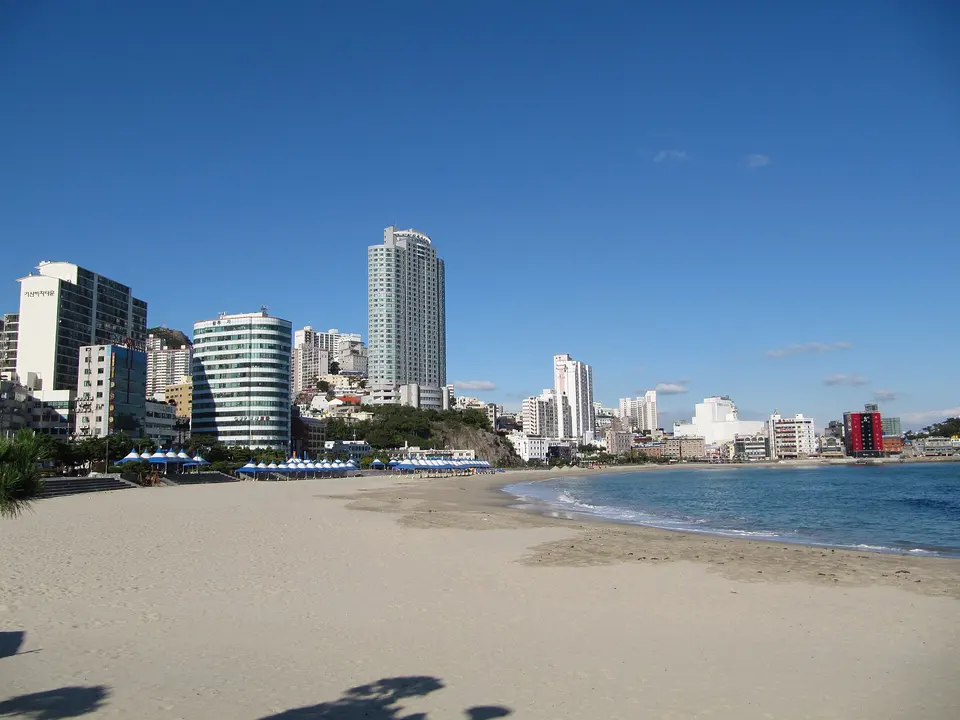
Haeundae Beach

Korea's most famous beach is a kilometre and a half of sand between the skyscrapers of Marine City and the headland of Dalmaji, with the high-rises of the LCT tower and the BUSAN X the SKY observatory at its eastern end; in summer it is a wall of parasols, and the rest of the year a promenade where the city walks. The traditional market a block inland is where to eat: eel, pork soup and the tent bars that stay open late.

  • Plan about 1 h 15 min

Afternoon

A 20-minute walk east along the beach to Mipo station, then the Sky Capsule, about 30 minutes to Cheongsapo
Haeundae Blueline Park: Sky Capsule to Cheongsapo
Photo: VN.NguyenDucDuy, CC BY-SA 4.0
3Coastal railway

Haeundae Blueline Park: Sky Capsule to Cheongsapo

The old Donghae railway line along the cliffs east of Haeundae has become a park with two trains: the Beach Train, a slow tram running 4.8 kilometres from Mipo to Songjeong along the water, and the Sky Capsule, small four-seat cabins on a raised monorail above it for the two kilometres between Mipo and the fishing village of Cheongsapo, with the sea on one side the whole way. Ride the capsule out, walk the Daritdol observatory over the water at Cheongsapo, and take the Beach Train back; book the capsule online, it sells out.

  • Plan about 2 h
  • Sky Capsule ₩50,000 per two-seat cabin one way (₩60,000 for four); Beach Train ₩8,000–10,000 a ride, ₩16,000 all-station pass
Beach Train back from Cheongsapo to Mipo, then a 25-minute walk the length of Haeundae Beach
Dongbaek Island and the Nurimaru APEC House
Photo: Mobius6, CC BY-SA 4.0
4Coastal park

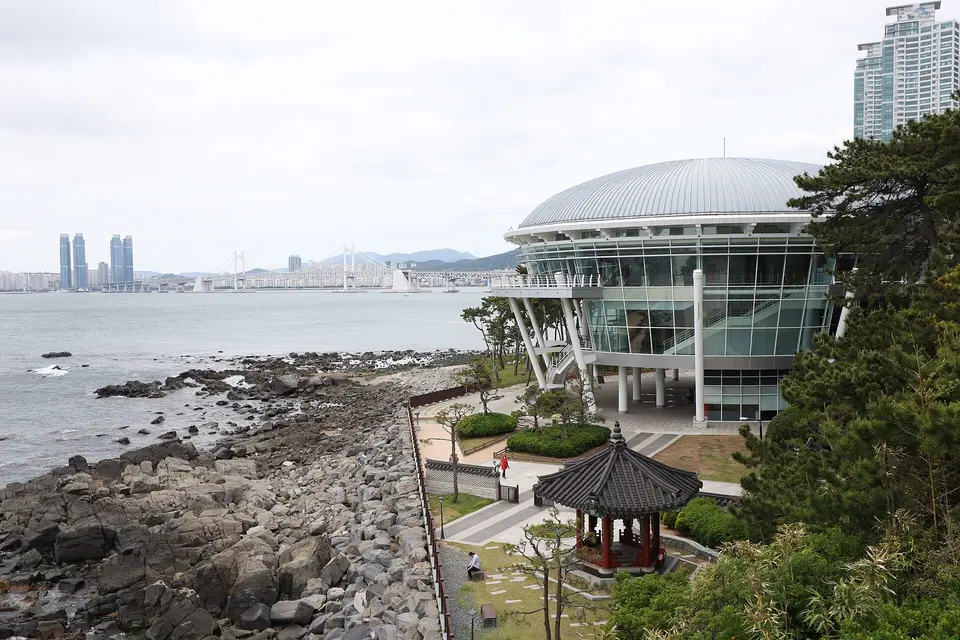
Dongbaek Island and the Nurimaru APEC House

The wooded headland at the western end of Haeundae, an island once, has a boardwalk round its shore under the camellias that give it its name, with the mermaid statue on the rocks, the lighthouse and the view back along the beach to Dalmaji; on the tip stands the Nurimaru APEC House, the round glass pavilion built for the 2005 summit, which is free to walk through. It is the best walk of the day, twenty minutes round.

  • Plan about 1 h
  • Free; the APEC House is open to visitors during the day

Evening

Taxi about 15 minutes, or metro line 2 from Dongbaek to Gwangan and a 10-minute walk
Gwangalli Beach and the Gwangan Bridge
Photo: Jeena Paradies, Public domain
5Beach and viewpoint

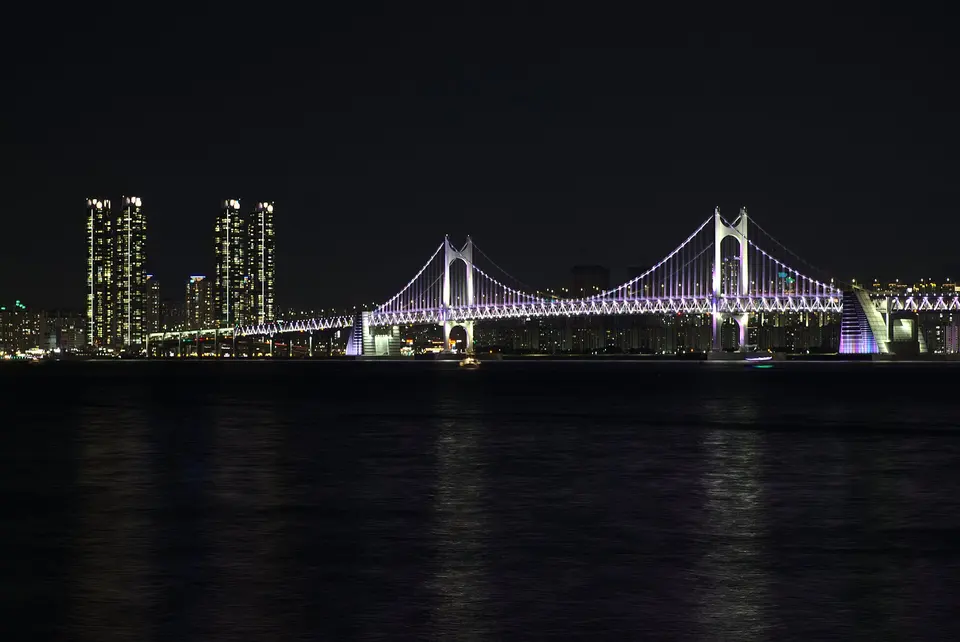
Gwangalli Beach and the Gwangan Bridge

Busan's second beach faces the 7.4-kilometre Gwangan suspension bridge across the bay, and after dark the bridge becomes the city's light show, its cables and towers lit in changing colours, with the cafés, bars and raw-fish restaurants along the beachfront road facing it like a grandstand. Get a table on the sand or a rooftop, and stay late; on weekend nights there are drone shows over the water.

  • Plan about 2 h

Day 3

Taejongdae, Songdo and Seomyeon

Ride the Danubi train round the cliffs of Taejongdae and walk down to the lighthouse, lunch in the cliff-side village of Huinnyeoul, walk the Songdo skywalk and take the cable car over the bay, and finish with pork soup and the night streets of Seomyeon.

  • 3 sights
  • Transport between sights
1235 kmN
Stops in order, straight-line distancesRoute in Google Maps ↗

Morning

Taejongdae
Photo: Christophe95, CC BY-SA 4.0
1Coastal park

Taejongdae

The southern tip of Yeongdo island is a park of pine forest ending in 100-metre cliffs above the open sea, named for a Silla king who is said to have practised archery here; the Danubi road train circles the park in twenty minutes with stops at the observatory and the Yeongdo lighthouse, from which stairs lead down to the rock platforms where women sell raw seafood out of buckets, with Tsushima visible on a clear day. Get off at the lighthouse and walk back.

  • Plan about 2 h 30 min
  • Park free; Danubi train ₩3,000, 9:20–17:30, every 20 minutes

Midday

LunchHuinnyeoul Culture Village, a line of white houses on the cliff path of Yeongdo ten minutes from Taejongdae by bus, has cafés and small restaurants looking straight down on the ships at anchor; the fish restaurants around the Taejongdae bus terminus are the plainer choice.

Afternoon

Taxi about 20 minutes around the coast of Yeongdo and over the bridge; by bus, change at Nampo
Songdo Beach, the Skywalk and the cable car
Photo: Michiel1972, CC BY-SA 3.0
2Beach and cable car

Songdo Beach, the Skywalk and the cable car

Korea's first public beach, opened in 1913, was rebuilt in the 2010s with a 365-metre skywalk curling out over the water from the eastern end and the Busan Air Cruise cable car, 1.6 kilometres across the bay to the Amnam Park cliffs, in cabins with glass floors if you want them. Walk the skywalk first, take the cable car over for the view of the whole city and the port, and come back as the lights come on.

  • Plan about 2 h
  • Skywalk free; cable car ₩19,000 return (₩24,000 with a glass floor), 9:00–21:00, last tickets 30 minutes before closing

Evening

Bus or taxi to Jagalchi station and metro line 1 to Seomyeon, about 40 minutes in all; a taxi takes 25
Seomyeon
Photo: Christophe95, CC BY-SA 4.0
3Downtown district

Seomyeon

The commercial centre of the city, where the two metro lines cross, is the place for the last evening: the underground shopping arcades, the department stores, the Jeonpo café street of converted workshops, and the food alleys where Busan's own dish, dwaeji gukbap, pork and rice in a milky broth, is served round the clock, with the neon and the bars of the side streets afterwards.

  • Plan about 2 h

Good to know in Busan

Opening hours and tickets

  • Haedong Yonggungsa Temple is open every day 4:30–19:20 with last entry by 18:50, and admission is free. From exit 7 of Haeundae station on metro line 2, take bus 181, 100 or Haeundae 9 to the Haedong Yonggungsa Temple stop.Source: Visit Busan, Busan Tourism Organization · checked Sep 2026
  • Jagalchi Market is open every day 5:00–22:00 and closed on the 1st, 3rd and 5th Tuesdays of the month.Source: Visit Busan, Busan Tourism Organization · checked Sep 2026
  • Busan Tower is open every day of the year 10:00–22:00, with ticketing until 21:30; adults (13 and over) pay ₩12,000, children and seniors ₩9,000, infants under 36 months free.Source: Visit Busan, Busan Tourism Organization (Korean) · checked Sep 2026
  • Haeundae Blueline Park's Sky Capsule is priced per cabin one way: ₩50,000 for a two-seater, ₩55,000 for three and ₩60,000 for four. The Beach Train is ₩10,000 for a single ride from Mipo or Songjeong and ₩8,000 from Cheongsapo, or ₩16,000 for an all-station pass.Source: Haeundae Blueline Park, official fares · checked Sep 2026
  • The Taejongdae Danubi train costs ₩3,000 for adults, with the ticket counter open 9:00–17:30 and trains running 9:20–17:30 at 20-minute intervals; a loop takes 20–25 minutes.Source: Visit Busan, Busan Tourism Organization · checked Sep 2026
  • The Songdo cable car (Busan Air Cruise) costs ₩19,000 return or ₩15,000 one way for adults in a standard cabin and ₩24,000 return or ₩19,000 one way in a Crystal Cruise cabin with a glass floor; it runs 9:00–21:00 with ticketing closing 30 minutes before.Source: Busan Air Cruise, official site · checked Sep 2026

Getting around

  • Busan Metro adult fares are ₩1,600 for section 1 and ₩1,800 for section 2 with a transit card, or ₩1,700 and ₩1,900 with a single-use QR ticket; transit cards, mobile tickets and QR tickets are the three ticket types.Source: Busan Transportation Corporation (Humetro) · checked Sep 2026

3 days in Busan: quick answers

Is 3 days enough for Busan?

Three days cover the old harbour and its markets, the painted village, the sea temple, the beaches and the coast train, the cliffs and the downtown. A fourth day allows Beomeosa temple in the hills to the north, the UN Memorial Cemetery and the Busan Museum, the Oryukdo skywalk and the Igidae coastal walk, or a day trip to the Silla capital of Gyeongju.

Which days should I plan around?

Jagalchi Market closes on the first, third and fifth Tuesdays of the month, so keep day one off those days; Gukje Market's shops mostly close on the first and third Sundays. The temple, the beaches, the Sky Capsule and the parks are open every day. Sky Capsule tickets sell out on weekends, so book a weekday slot online in advance.

How much do the tickets cost?

Gamcheon, the temple, the beaches, the Songdo skywalk and the parks are free. Busan Tower is ₩12,000, the Taejongdae Danubi train ₩3,000, the Songdo cable car ₩19,000 return in a standard cabin, and the Sky Capsule ₩50,000 for a two-seat cabin one way, with the Beach Train ₩8,000–10,000 a ride.

How do I pay for the metro and buses?

Buy a T-money or Cashbee transit card at a convenience store or the airport with cash and tap it on the metro gates and buses: the metro fare with a card is ₩1,600 for short trips and ₩1,800 for longer ones, against ₩1,700 and ₩1,900 for a single-use QR ticket from the machines. Taxis are cheap and take cards.

How much walking is this itinerary?

About 2 km in a straight line between sights on day one, with the steep lanes of Gamcheon on top; about 2 km on foot on day two plus the bus, the capsule and one taxi; and the cliff paths of Taejongdae and the Songdo skywalk on day three, with taxis in between. Busan is hilly: the villages of Gamcheon and Huinnyeoul are all stairs.

Other Busan itineraries

Keep exploring

Where this connects

THE TRIPWOA APP

Go somewhere.
Make it yours.

Build days around what you love. Follow your route, find your next stop and keep the moments along the way.

Get it on Google PlayAvailable for Android
Free to start
Tripwoa home with a Paris trip and nearby places to explore
Tripwoa day plan for New York with a route map and Times Square stop

A day that feels like you.

Sources and method

Places and coordinates: Wikidata and Tripwoa's open-data place catalog (Overture Maps Foundation, © OpenStreetMap contributors). Photos: Wikimedia Commons, credited on each image. Practical rules: the official sources linked in each note, checked in September 2026.

How this plan was made: Tripwoa's planner drafted the day order from real coordinates and typical visit times. Each stop was then reviewed, reordered where needed and rewritten with AI assistance. Walking distances are straight-line estimates, so allow a little extra time on real streets.