3-day itinerary · Germany

3 Days in Cologne

A plan that walks the cathedral quarter on the first day, the Romanesque churches and the Gestapo house on the second, and the rebuilt harbour on the third. It carries the 2026 rule that the cathedral now needs a ticket, and the two big museums that are shut.

  • 3days
  • 14sights
  • 0.0 kmon foot between sights

Updated 13 September 2026 · 9 official sources checked · report an error

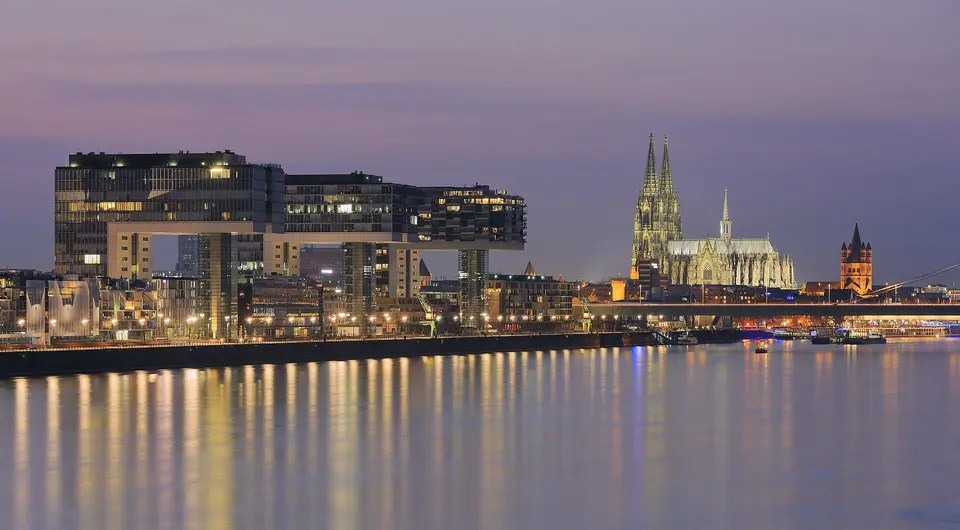
Cologne Cathedral
Photo: CEphoto, Uwe Aranas, CC BY-SA 4.0

The cathedral and Museum Ludwig, then the Romanesque churches and Kolumba, then the harbour and the cable car

Cologne was founded as a Roman colony in AD 50 and made the capital of Lower Germania; by the Middle Ages it was the largest city in Germany, an archbishopric, a free imperial city and a place of pilgrimage, and the cathedral it started in 1248 was designed for the traffic. The Second World War destroyed about nine tenths of the old town and the rebuilding was fast rather than careful, which is why an extraordinary set of Roman and Romanesque monuments now stands among unremarkable post-war blocks. The city that grew back is the fourth-largest in Germany, relaxed to the point of scruffiness, proud of its dialect, its beer and its carnival, and much more interested in being lived in than looked at.

At a glance

Ways to use these days

If it rains
8 of the stops are indoors — Cologne Cathedral · Museum Ludwig · Great St. Martin Church
Outdoors
Alter Markt and the Historic City Hall · Hohenzollern Bridge
Lightest day on foot
Day 1 — 0.9 km between stops
Most walking
Day 3 — 4.8 km

Day 1

The cathedral, the Pop Art next door and the padlocks on the railway bridge

Give the morning to the building that took six hundred years, spend the afternoon in one of the best modern collections in Europe fifty metres from its door, then walk the old market and cross the Rhine for the view back.

  • 5 sights
  • Transport between sights
12345100 mN
Stops in order, straight-line distancesWalking route in Google Maps ↗

Morning

Cologne Cathedral
Photo: CEphoto, Uwe Aranas, CC BY-SA 4.0
1Cathedral

Cologne Cathedral

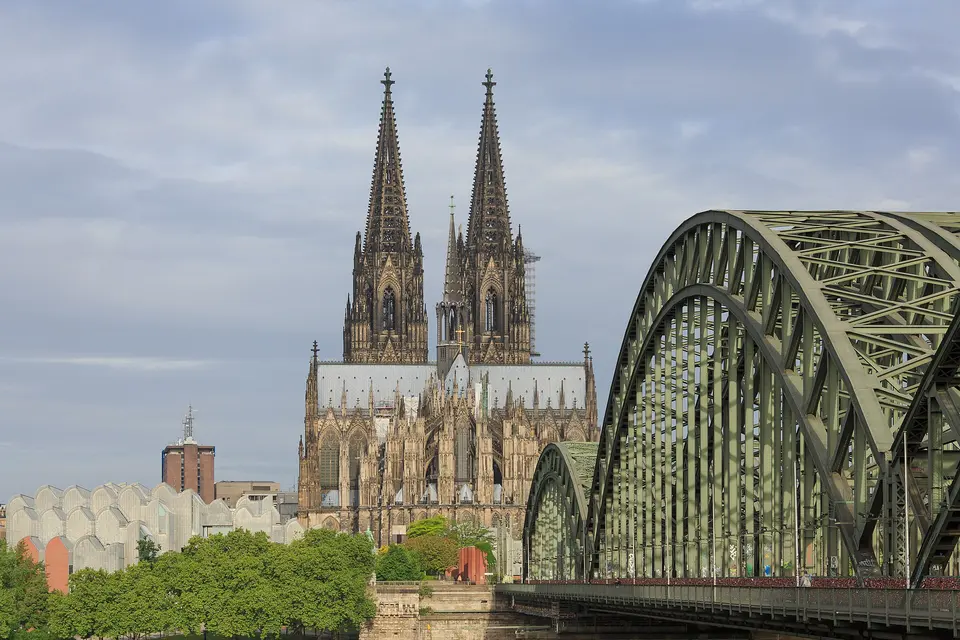
Begun in 1248 to house the Shrine of the Three Kings, the gilded reliquary Nicholas of Verdun made for the bones Frederick Barbarossa's chancellor had carried off from Milan, and left unfinished in 1560 with a medieval crane standing on the stump of the south tower for three centuries. The original façade drawings turned up in the 1810s and Prussia finished the building to them by 1880, at which point its 157-metre spires made it the tallest structure in the world for four years. Inside are the Gero Cross of about 970, the oldest large crucifix north of the Alps, and Gerhard Richter's south transept window of 2007, 11,500 squares of coloured glass arranged by a random number generator.
  • Plan about 2 h
  • Since 1 July 2026 a ticket is required to visit the cathedral, and visiting hours are separate from prayer hours: generally 10:00 to 17:45 daily and 13:30 to 16:30 on Sundays and church holidays. The tower climb is 533 steps and ticketed separately

Midday

LunchKölsch is served in 0.2-litre glasses called Stangen by a waiter called a Köbes, who will keep replacing them without being asked until you put your beer mat on top of the glass. The brewery taps do the food that goes with it: Halver Hahn, which is a rye roll with a wedge of aged Gouda and not the half chicken the name promises; Himmel un Ääd, black pudding with mashed potato and apple sauce; and Rievkooche, potato pancakes. Früh am Dom is the one everyone finds; Päffgen on Friesenstraße is the one to look for.

Afternoon

150 m east, two minutes on foot across the cathedral terrace
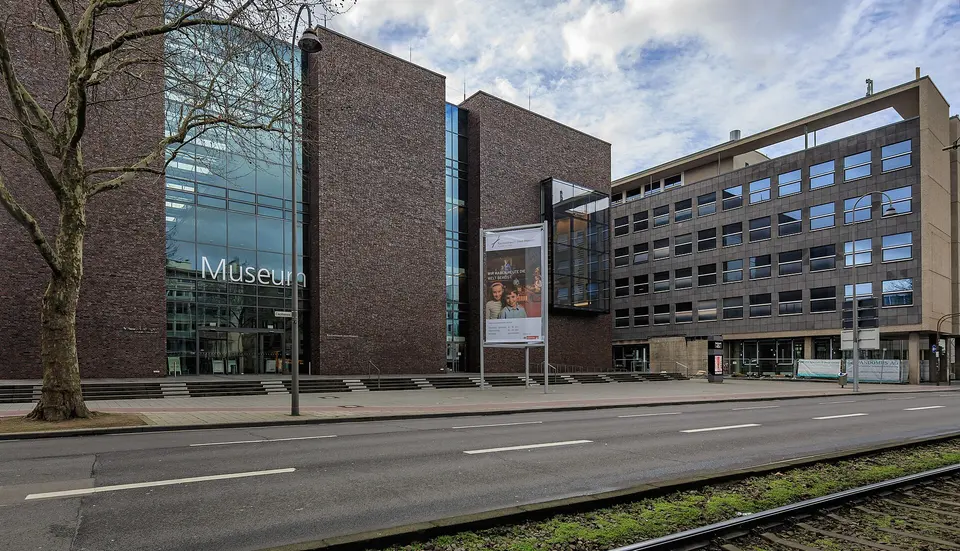
Museum Ludwig
Photo: Jorge Franganillo, CC BY 4.0
2Art museum

Museum Ludwig

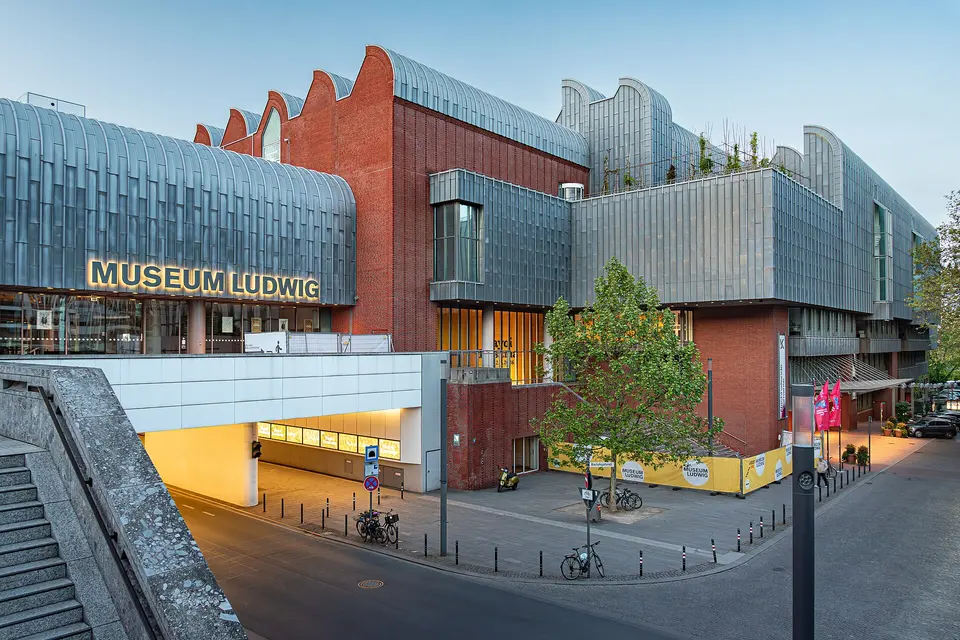
Peter and Irene Ludwig, who made their money in chocolate, offered the city 350 works of modern art in 1976 on condition that a building was put up for them, and this zinc-roofed wedge between the cathedral and the Rhine opened in 1986. What it holds is exceptional: the largest collection of Pop Art outside the United States, with Lichtenstein, Warhol, Rosenquist and Oldenburg in quantity; around 900 works by Picasso, the third-largest holding anywhere; a Russian avant-garde collection assembled when almost nobody in the West was buying it; German Expressionism; and the Agfa photography archive. The Philharmonie sits underneath, which is why the galleries go quiet during concerts.

  • Plan about 2 h 30 min
  • Open Tuesday to Sunday including public holidays from 10:00 to 18:00 and to 22:00 on the first Thursday of the month, closed Mondays except holidays; on that first Thursday, entry is free for Cologne residents and 7 euros for everyone else after 17:00
400 m south, five minutes on foot down through the old town
Alter Markt and the Historic City Hall
Photo: Raimond Spekking, CC BY-SA 4.0
3Square

Alter Markt and the Historic City Hall

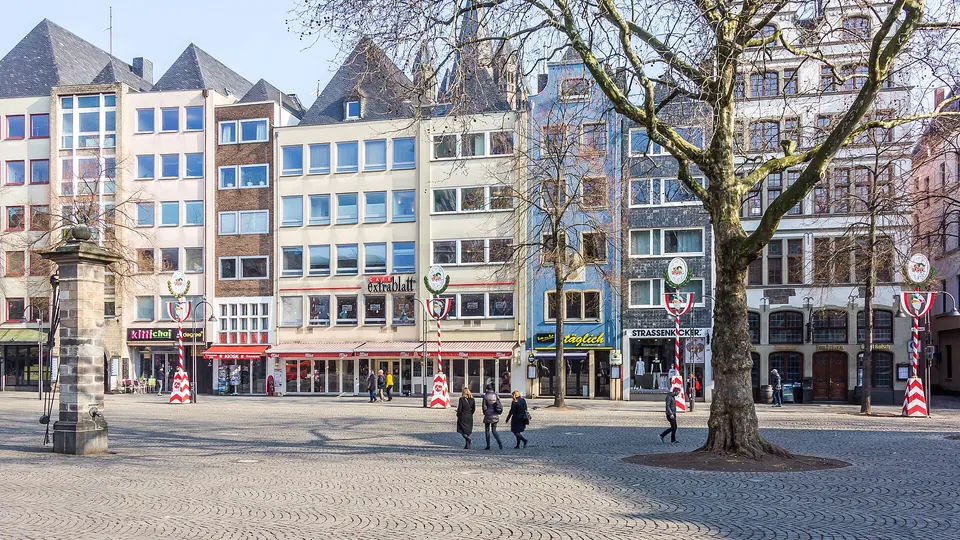
The old market square, with the Historic City Hall on its western side — the oldest town hall in Germany still in use, run by the citizens since about 1135 after they wrested self-government from the archbishop. The Gothic tower of 1407 to 1414 carries 124 stone figures of people connected with the city, from Albertus Magnus to Konrad Adenauer, and the Renaissance loggia in front of it dates from 1569. Beneath the square lies the Praetorium, the palace of the Roman governor of Lower Germania, excavated after wartime bombing. The Rose Monday parade comes through here, and so does one of the Christmas markets.

  • Plan about 1 h
  • Free to walk; the city hall's Renaissance loggia and the Hansa Room can usually be seen on weekdays, and the Praetorium excavation below has been closed while the MiQua Jewish museum is built on the adjoining square

Evening

200 m east, two minutes on foot towards the river
Great St. Martin Church
Photo: CEphoto, Uwe Aranas, CC BY-SA 3.0
4Church

Great St. Martin Church

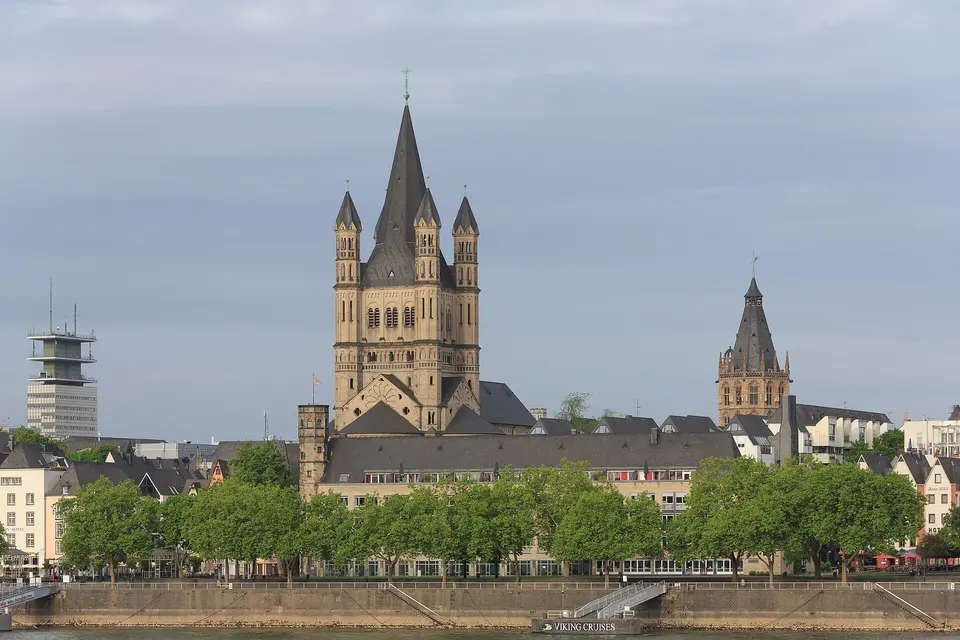
The 75-metre crossing tower that anchors the old-town skyline in every photograph of Cologne from the river, and one of the twelve Romanesque churches that make this the greatest concentration of Romanesque building in Europe. The Benedictine abbey church went up in the twelfth and thirteenth centuries on an island in the Rhine, over the foundations of a Roman warehouse and swimming pool that you can still walk through in the crypt. Allied bombing left it a shell in 1942 and the reconstruction was not finished until 1985; the inside is plain, tall and pale, and a small ecumenical community holds services in it.

  • Plan about 45 min
  • Free, with a modest charge for the Roman excavations in the crypt; generally open daily with a break around midday and closed during services. The lanes of Fischmarkt and Frankenwerft below it are the postcard view
600 m north along the Rhine promenade, about eight minutes on foot
Hohenzollern Bridge
Photo: Thomas Wolf (Der Wolf im Wald), CC BY-SA 3.0
5Bridge

Hohenzollern Bridge

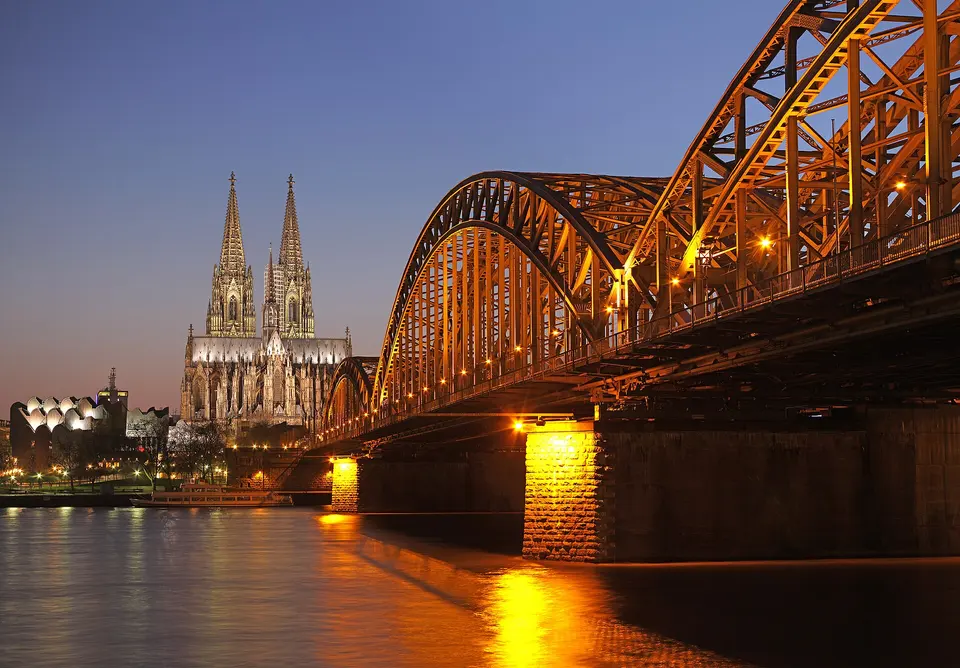
Six railway tracks straight out of the back of the main station, across the Rhine and past the cathedral, on three steel arches: about 1,200 trains a day cross it, which makes it the busiest railway bridge in Germany. The original of 1907 was blown up by German engineers on 6 March 1945 as the Americans entered the city, and was rebuilt without the equestrian statues' Prussian triumphal arches. Since the mid-2000s the pedestrian walkway on the downstream side has accumulated several hundred thousand love padlocks, weighing a reported few dozen tonnes, which Deutsche Bahn has decided to tolerate. The view back at the cathedral from the Deutz end is the best in the city.

  • Plan about 45 min
  • Free and open at all hours; walk across to the Deutz bank at dusk for the classic view of the cathedral and Great St. Martin with the river in front. It takes ten minutes each way

Day 2

Romanesque Cologne and the twentieth century: carved doors, a Gestapo basement and a quarter to eat in

Cologne has the densest group of Romanesque churches in Europe and one of the hardest museums in Germany, and they stand within a kilometre of each other. Two churches, Zumthor's museum over a bombed ruin, the Gestapo house, then dinner west of the ring.

  • 5 sights
  • Transport between sights
12345500 mN
Stops in order, straight-line distancesWalking route in Google Maps ↗

Morning

St. Maria im Kapitol
Photo: Raimond Spekking, CC BY-SA 4.0
1Church

St. Maria im Kapitol

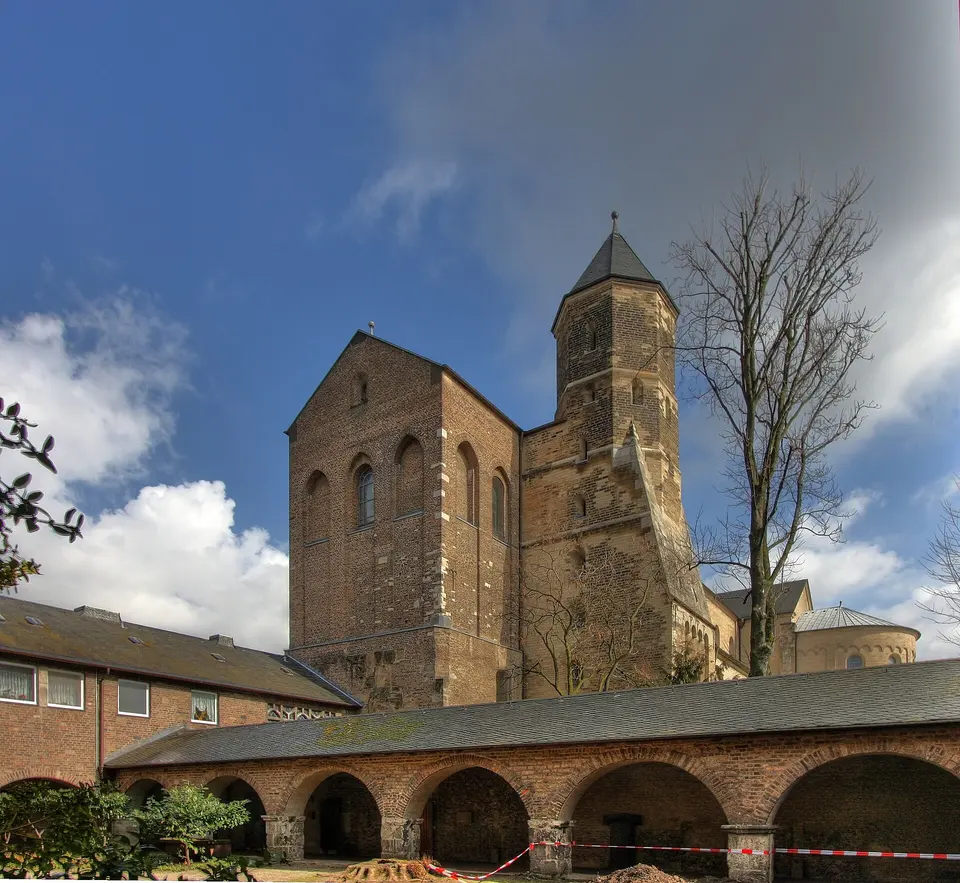
The largest of the Romanesque churches and the one that set the pattern: Ida, an abbess and a granddaughter of Otto the Great, had it built over the Roman Capitoline temple and it was consecrated in 1065 with a clover-leaf east end of three apses around the crossing. Every later trefoil choir in Cologne follows it. The treasure is at the west end — a pair of carved oak door leaves of about 1065 with 26 scenes from the life of Christ, one of the very few Ottonian wooden door ensembles anywhere in Europe, and worth the walk on their own. The church stands in a quiet square that most visitors never reach.

  • Plan about 45 min
  • Free, generally open through the middle of the day and closed during services; the carved doors are in the west porch and there is usually a light switch beside them. It is a ten-minute walk south of the old market
600 m north-west, about eight minutes on foot
Kolumba
Photo: MenkinAlRire, CC BY-SA 4.0
2Art museum

Kolumba

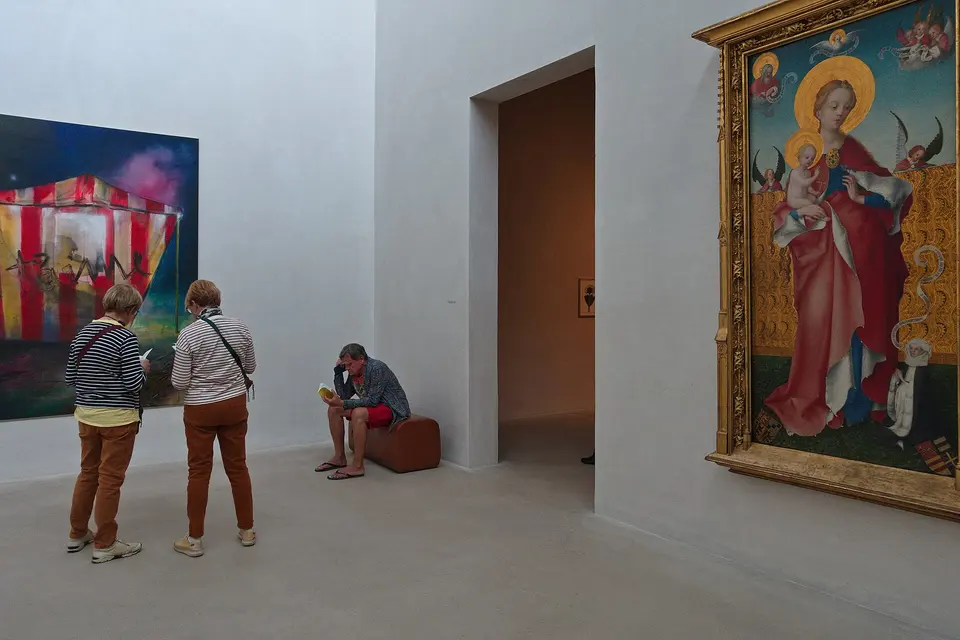
Peter Zumthor built the archdiocese's art museum between 2003 and 2007 over the ruin of the late Gothic church of St. Kolumba, which the bombing of 1943 reduced to a fragment of wall and a surviving figure of the Virgin. He kept the ruin, kept Gottfried Böhm's 1950 chapel inside it, and raised a grey brick building over the whole thing, with an upper wall perforated so that light and air and the occasional bird reach the excavation hall below. The collection runs from late antiquity to contemporary art, is rehung completely once a year, and carries almost no labels: you are expected to look first and consult the printed list afterwards.

  • Plan about 2 h
  • Open Wednesday to Monday, generally 12:00 to 17:00, and closed on Tuesdays; the museum shuts for several weeks each late summer while the annual exhibition is rebuilt, so check before you go. The 2026/27 exhibition opens on 19 and 20 September 2026 with free entry

Midday

LunchThe area around Neumarkt and the covered lanes off it is where office Cologne eats, which means good cheap lunch: Turkish, Vietnamese and the Rhenish standards. If you would rather sit down properly, the Belgian Quarter is fifteen minutes west and its restaurants are the best in the city for anything that is not pork and potatoes — the quarter has the Italian, Levantine and Japanese kitchens the old town does not.

Afternoon

400 m north-west to Appellhofplatz, about five minutes on foot
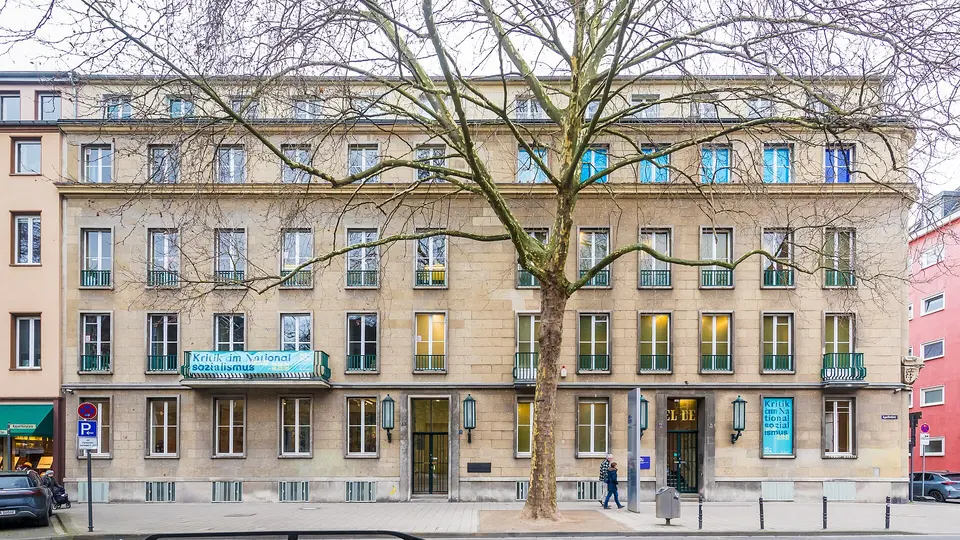
NS Documentation Centre (EL-DE Haus)
Photo: Raimond Spekking, CC BY-SA 4.0
3Museum

NS Documentation Centre (EL-DE Haus)

Leopold Dahmen put his initials on the building he finished in 1935 and rented the whole of it to the Gestapo, who ran their Cologne headquarters from it until the end of the war. Ten cells survive in the basement, and their walls carry about 1,800 inscriptions scratched by prisoners in German, Russian, Polish, French and Dutch — names, dates, prayers, the addresses of relatives — which is among the most important documents of its kind in Europe. More than four hundred people were hanged in the courtyard. Above the cells, the permanent exhibition on Cologne under National Socialism is the largest local memorial museum for the period in Germany.

  • Plan about 2 h
  • Open Tuesday to Friday 10:00 to 18:00, Saturdays, Sundays and holidays 11:00 to 18:00, and to 22:00 on the first Thursday of the month; admission is 4.50 euros, 2 euros reduced, and it is closed on Carnival Thursday, Carnival Sunday and Rose Monday
700 m south-west to Neumarkt, about nine minutes on foot
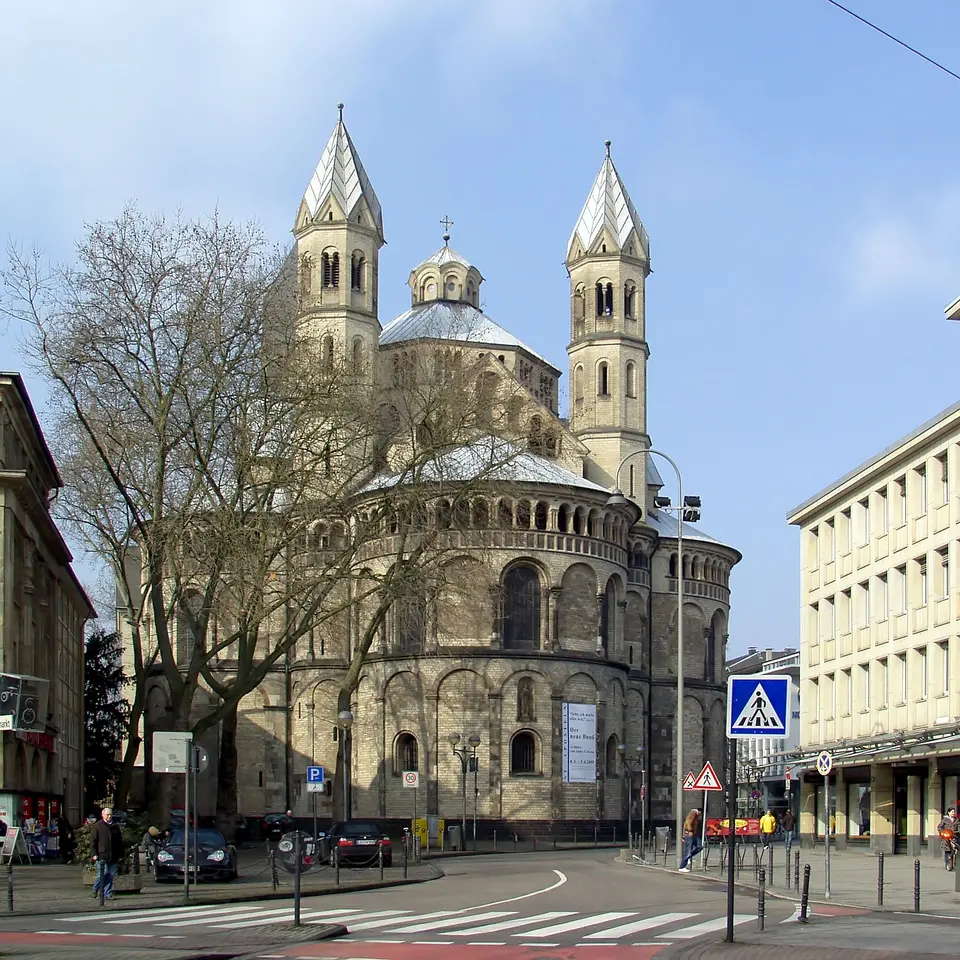
Basilica of the Holy Apostles
Photo: Raimond Spekking, CC BY-SA 4.0
4Church

Basilica of the Holy Apostles

On the corner of Neumarkt, and the last and most confident of the Romanesque trefoil churches: the eastern end of about 1200 puts three apses and a dwarf gallery under an octagonal crossing tower, and a heavy Westwerk balances it at the other end, so the building reads as symmetrical from the square. It was a collegiate foundation from the early eleventh century and the archbishops were involved in it from the start. Hermann Gottfried covered the interior with paintings in the 1980s and 1990s during the post-war restoration, which divides opinion sharply and is worth going in to form your own.

  • Plan about 30 min
  • Free and generally open during the day outside services; it is a five-minute walk from the Neumarkt tram and metro interchange and sits directly between the old town and the Belgian Quarter

Evening

700 m west across the ring, about nine minutes on foot
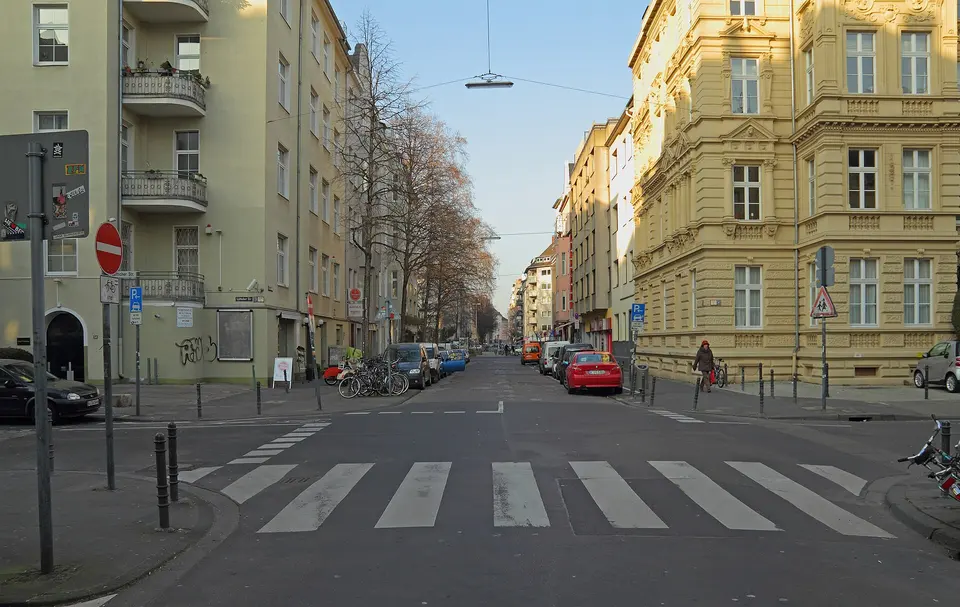
Belgian Quarter
Photo: A.Savin, CC BY-SA 3.0
5Neighbourhood

Belgian Quarter

When the medieval walls came down in 1881 the city laid out a new district west of the ring and named its streets after Belgian cities and provinces: Brüsseler, Antwerpener, Lütticher, Maastrichter, Brabanter. Enough of the tall Wilhelmine apartment houses survived the war for the grid to keep its shape, and since the 1990s this has been where Cologne's independent shops, design studios, record stores and bars have settled. The centre of it is Brüsseler Platz, where on summer evenings several hundred people sit on the steps of St. Michael with bottles from the corner shop, to the well-documented irritation of the residents above.

  • Plan about 2 h
  • Free; the bars and restaurants run along Brüsseler Straße, Aachener Straße and Antwerpener Straße, and this is the part of Cologne to eat in if you have had enough of the old town. Brüsseler Platz is loudest on warm weekend evenings

Day 3

The harbour: chocolate, three upside-down cranes and a cable car over the Rhine

Spend the day downstream of the old town in the rebuilt port, with a museum about cacao, the strangest office buildings in Germany and an ethnographic collection that has thought about what it is doing, then finish fifty metres above the river.

  • 4 sights
  • Transport between sights
12341 kmN
Stops in order, straight-line distancesWalking route in Google Maps ↗

Morning

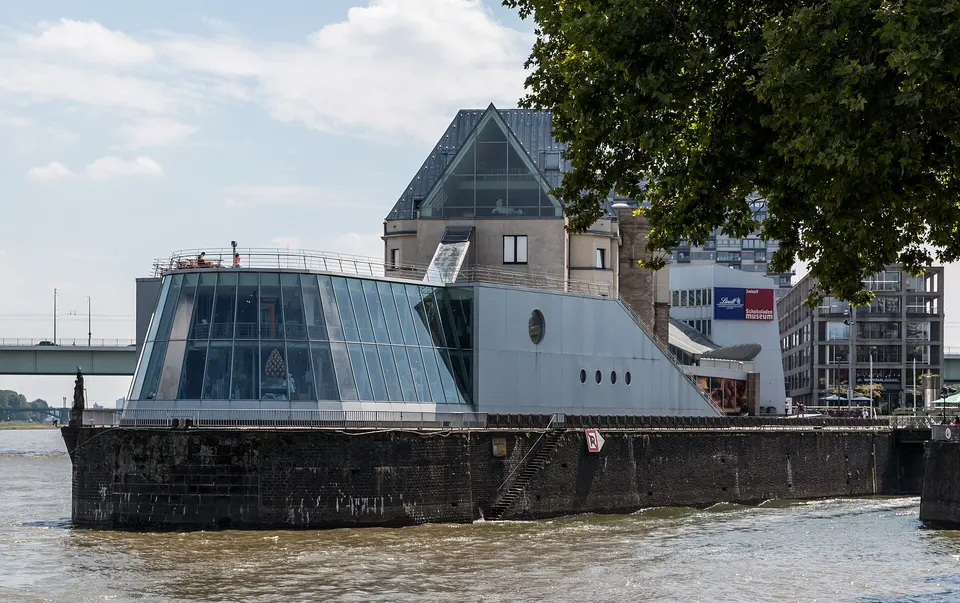
Chocolate Museum
Photo: Dietmar Rabich, CC BY-SA 4.0
1Museum

Chocolate Museum

Hans Imhoff bought the Stollwerck chocolate works in 1972, found its archive, and in 1993 put up a glass and steel building shaped like a ship on a spit of land in the Rheinauhafen to hold it. It is a proper museum — cacao cultivation, the colonial trade, the industrialisation of a luxury, a tropical greenhouse with cocoa trees growing in it — wrapped around a small working production line where you can watch hollow figures being cast and packed. At the middle stands a three-metre bronze fountain of tempered chocolate, and someone hands you a wafer dipped in it, which is the moment every child has come for.

  • Plan about 2 h
  • Open daily 10:00 to 18:00 with the last entry an hour before closing and the production line stopping about thirty minutes before; it closes on Mondays from January to the end of March and in November, and tickets are cheaper and quicker bought online
800 m further south along the harbour, about ten minutes on foot
Kranhäuser and the Rheinauhafen
Photo: Martin Falbisoner, CC BY-SA 4.0
2Modern architecture

Kranhäuser and the Rheinauhafen

A two-kilometre spit of nineteenth-century harbour south of the old town, which stopped working as a port and was rebuilt from 2002 as offices and flats. The three Kranhäuser of 2008 to 2010 are the reason to walk it: inverted L-shapes 62 metres high with the top four storeys cantilevered out over the water, a deliberate echo of the gantry cranes that used to stand there. Around them the old customs hall, the Siebengebirge warehouse with its Rhenish gables and a converted grain silo have all been kept. It is a good hour's walk along the water from the Chocolate Museum to the southern end and back through the Severinsviertel.

  • Plan about 1 h 15 min
  • Free and open at all hours; the promenade is level and continuous, the Rheinauhafen car parks sit underneath it, and the best view of the crane houses is from the Rodenkirchen side of the river or from the Severinsbrücke

Midday

LunchThe Severinsviertel, the old southern quarter behind the harbour, is the least touristed part of central Cologne and the one locals defend hardest. Severinstraße has old-fashioned Brauhäuser, a Turkish grocery every fifty metres and a handful of very good small restaurants, and lunch there costs half what it does on the Rhine promenade. On the harbour itself the options are smart, glassy and priced for the offices above them.

Afternoon

600 m west into the Severinsviertel, about eight minutes on foot
Rautenstrauch-Joest Museum
Photo: CEphoto, Uwe Aranas, CC BY-SA 3.0
3Ethnographic museum

Rautenstrauch-Joest Museum

Cologne's ethnographic museum, in a building on Cäcilienstraße since 2010, and one of the few of its kind to have thought hard about how it presents other people's cultures. Instead of a room per continent it is arranged by theme — dwelling, ritual, the body, dealing with the dead, prejudice — so that a Javanese object sits next to a European one making the same argument. A thousand-year-old rice barn from Sulawesi stands in the atrium. The collection began in 1901 with Wilhelm Joest's material, given by his sister Adele Rautenstrauch, and the museum is now working publicly through the question of what in it was acquired legitimately.

  • Plan about 2 h
  • Open Tuesday to Sunday, generally 10:00 to 18:00 and to 22:00 on the first Thursday of the month, closed Mondays; a KölnCard gives 20 per cent off admission at all the municipal museums, this one included

Evening

5 km north to the Zoo station, about fifteen minutes on the U-Bahn line 18 to Zoo/Flora
Cologne Cable Car
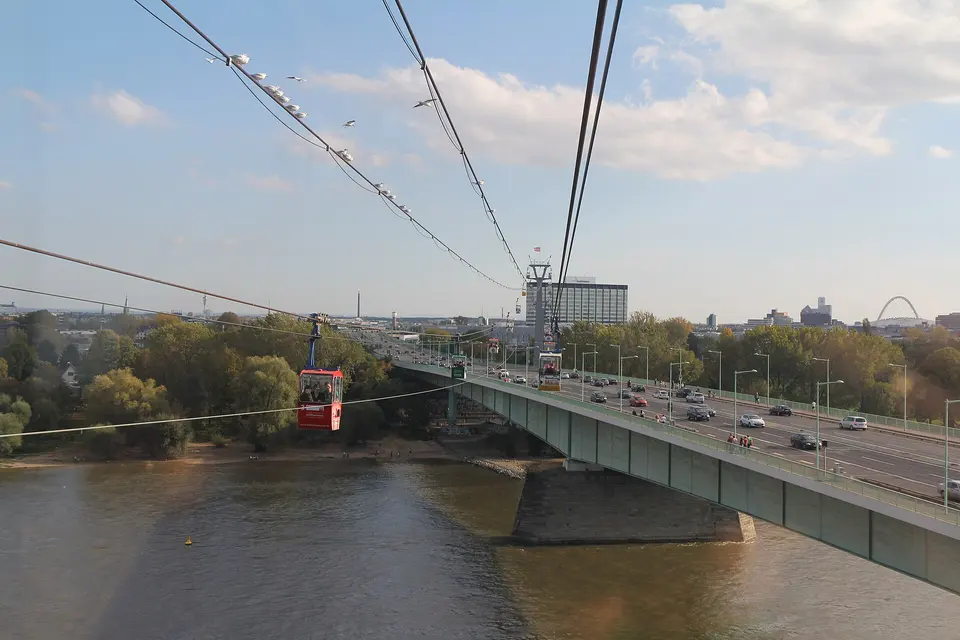
Photo: Till Niermann, CC BY 3.0
4Cable car

Cologne Cable Car

Built for the federal garden show of 1957 and the first cable car in Germany to cross a river, which it still does: 935 metres from the Zoo on the left bank to the Rheinpark on the right, hanging about fifty metres above the water beside the Zoo bridge. The ride takes six minutes each way and the gondolas are small, slow and entirely of their period, with the cathedral and the whole sweep of the city downstream on one side and the container terminals upstream on the other. Land on the Rheinpark side and you are in the garden-show park, with the Tanzbrunnen open-air stage and a long riverside walk back into Deutz.

  • Plan about 1 h
  • The 2026 season runs from 12 March to the beginning of November, daily 10:00 to 18:00 with the last boarding at 17:45, plus the four Advent weekends; a single adult ride is 5.50 euros and a child aged 4 to 12 is 3.30 euros, sold only at the ticket office

Good to know in Cologne

Cologne Cathedral: the new ticket rule and the hours

  • The cathedral states: “Since 1 July 2026, you have required a ticket to visit Cologne Cathedral.” Sightseeing hours are generally 10:00 to 17:45 daily with the last entry at 17:30, and 13:30 to 16:30 on Sundays and church holidays with the last entry at 16:15. The cathedral itself is open from 06:00 to 20:00.Source: Kölner Dom — Öffnungszeiten · checked Sep 2026
  • The tower climb is generally open 09:00 to 18:00 from March to October and 09:00 to 16:00 from November to February, and stays closed on Weiberfastnacht, Carnival Saturday, Carnival Sunday, Rose Monday, 11 November, Christmas Eve, Christmas Day and New Year's Eve. Tickets can also be bought on the spot at the central box office in the Kurienhaus, Roncalliplatz 2, which is staffed daily from 09:00 to 17:30; the belfry stays closed until 14:00 on Sundays and public holidays.Source: Kölner Dom — Turmbesteigung · checked Sep 2026

Two museums that are closed

  • The Wallraf-Richartz Museum is shut for a two-year general refurbishment and will not reopen until the end of 2028, when the restored Ungers building and a new extension by Christ & Gantenbein open together. The museum states explicitly that its works will not be shown at other venues during the closure.Source: Wallraf-Richartz-Museum — Vorübergehend geschlossen · checked Sep 2026
  • The Romano-Germanic Museum states that its building on Roncalliplatz is closed for renovation work. The Ubiermonument, the Roman tower it also manages, is open on the first Thursday of the month (KölnTag) from 14:00 to 17:00.Source: Römisch-Germanisches Museum Köln · checked Sep 2026

Museums: hours, prices and the first Thursday

  • Museum Ludwig opens Tuesday to Sunday including public holidays from 10:00 to 18:00, and until 22:00 on the first Thursday of each month; it is closed on Mondays except public holidays. On that first Thursday, the KölnTag, entry is free for Cologne residents to the collection and all special exhibitions, while non-residents pay the regular price until 17:00 and 7.00 euros after it. KölnCard holders may visit all municipal museums at a 20 per cent reduction.Source: Museum Ludwig — Tickets + Öffnungszeiten · checked Sep 2026
  • The NS Documentation Centre opens Tuesday to Friday 10:00 to 18:00, Saturdays, Sundays and public holidays 11:00 to 18:00, and on the first Thursday of the month 10:00 to 22:00, when Cologne residents enter free. Regular admission is 4.50 euros and reduced admission 2 euros. It is closed on Carnival Thursday, Carnival Sunday and Rose Monday, and on 24, 25 and 31 December and 1 January.Source: NS-Dokumentationszentrum der Stadt Köln — Öffnungszeiten · checked Sep 2026
  • The Chocolate Museum is open daily from 10:00 to 18:00, with the last entry one hour before closing and the production line stopping about thirty minutes before. It is closed on Mondays from January to the end of March and in November — for 2026 that means 2, 9 and 16 November — and on 24 and 25 December, and it opens 10:00 to 16:00 on New Year's Eve.Source: Schokoladenmuseum Köln — Besuch planen · checked Sep 2026

The cable car: season and fares

  • The Kölner Seilbahn's 2026 season began on 12 March and runs daily from 10:00 to 18:00 until the beginning of November, with the last boarding at 17:45. It also runs on all four Advent weekends, Saturdays and Sundays 10:00 to 18:00: 28–29 November, 5–6 December, 12–13 December and 19–20 December 2026. A single one-way ticket costs 5.50 euros for adults and 3.30 euros for children aged 4 to 12 (2026 prices); tickets are sold only at the ticket office and cannot be reserved.Source: Kölner Seilbahn — Fahrten · checked Sep 2026

Kolumba: the annual rebuild

  • Kolumba rehangs its entire exhibition once a year and closes for the changeover. The museum gives 19 and 20 September 2026, 12:00 to 17:00, as the opening days of the new annual exhibition, with free admission on both.Source: Kolumba — Eröffnungstage · checked Sep 2026

3 days in Cologne: quick answers

Is 3 days enough for Cologne?

Comfortably. Cologne is compact, almost everything of interest sits inside the ring of the old walls, and three days lets you take the cathedral slowly, give the museums the time they deserve and still walk the harbour. If you have a fourth day, use it on a Rhine excursion — Bonn is 25 minutes by train and Brühl with its two Baroque palaces is 15 — or on the rest of the twelve Romanesque churches, which is a genuinely rewarding walk if the first two hook you.

What is the best time of year to visit Cologne?

May to September for the weather, late November and December for the Christmas markets, and the week before Ash Wednesday if you want Carnival, which is not so much an event as a suspension of the normal city. Carnival falls in February most years; Weiberfastnacht opens it at 11:11 on the Thursday and Rose Monday brings a parade of around a million people. Hotels double in price and many museums close for part of it. Summer is warm rather than hot and the Rhine promenade is at its best in the long evenings.

Which Cologne museums are closed at the moment?

Two significant ones. The Wallraf-Richartz Museum, which holds the medieval and old master collection, closed for a general refurbishment and will not reopen until the end of 2028; the museum states that its works will not be shown at other venues in the meantime. The Romano-Germanic Museum's building on Roncalliplatz beside the cathedral is also closed for renovation, with only the Ubiermonument opening on the first Thursday of the month from 14:00 to 17:00. Plan around both — several older guidebooks still send you to them.

How much does Cologne cost per day?

A mid-range hotel runs 90 to 160 euros outside the trade-fair calendar and considerably more during one, so check whether a Messe is on before you book. Museums are cheap by German standards — the NS Documentation Centre is 4.50 euros, the municipal museums mostly 8 to 13 — and a KölnCard gives 20 per cent off all of them plus free public transport. A Kölsch is around 2.50 euros, a brewery dinner 15 to 25, and the cable car 5.50 each way.

Do you need a ticket for Cologne Cathedral?

Yes. Since 1 July 2026 visiting the cathedral requires a ticket, which is a change from the free entry it offered for centuries and catches out most people arriving with an older guidebook. Visiting hours are generally 10:00 to 17:45 daily with the last entry at 17:30, and 13:30 to 16:30 on Sundays and church holidays. The building itself opens at 6:00 for prayer, the tower climb is ticketed separately, and the central box office at Roncalliplatz 2 is staffed from 9:00 to 17:30.

How do you get around Cologne?

Mostly on foot: the old town, the Belgian Quarter and the harbour are all within about three kilometres of the cathedral. Where you need it, the KVB runs a dense tram and light-rail network that goes underground in the centre, and a single ticket covers trams, buses and the S-Bahn. The airport is 15 minutes from the main station by S-Bahn. A KölnCard covers unlimited travel and museum discounts and pays for itself in a day if you use both.

Other Cologne itineraries

Keep exploring

Where this connects

THE TRIPWOA APP

Go somewhere.
Make it yours.

Build days around what you love. Follow your route, find your next stop and keep the moments along the way.

Get it on Google PlayAvailable for Android
Free to start
Tripwoa home with a Paris trip and nearby places to explore
Tripwoa day plan for New York with a route map and Times Square stop

A day that feels like you.

Sources and method

Places and coordinates: Wikidata and Tripwoa's open-data place catalog (Overture Maps Foundation, © OpenStreetMap contributors). Photos: Wikimedia Commons, credited on each image. Practical rules: the official sources linked in each note, checked in September 2026.

How this plan was made: Tripwoa's planner drafted the day order from real coordinates and typical visit times. Each stop was then reviewed, reordered where needed and rewritten with AI assistance. Walking distances are straight-line estimates, so allow a little extra time on real streets.