3-day itinerary · United States

3 Days in Dallas

A plan that gives the Kennedy sites a proper morning rather than a photo stop, spends a day in an arts district that is genuinely worth it, and uses the third day on Fort Worth, where two of the best free museums in America stand on one lawn. Official 2026 hours, closed days and ticket prices are in the stops.

  • 3days
  • 14sights
  • 0.0 kmon foot between sights

Updated 13 September 2026 · 5 official sources checked · report an error

Dealey Plaza
Photo: Renelibrary, CC BY-SA 4.0

Dealey Plaza and Oak Cliff, then the Arts District and Deep Ellum, then a day in Fort Worth

Dallas is a city of 1.3 million at the centre of a metropolitan area of about eight million, sitting on flat blackland prairie in north Texas with no harbour, no navigable river and no natural reason to be where it is. It was a trading post at a ford on the Trinity in 1841, grew because two railways crossed here in the 1870s, got rich on cotton and then on the banking and insurance that financed the East Texas oil boom, and has been building towers ever since. Almost everything a visitor comes for was made deliberately: an arts district assembled block by block with buildings by Barnes, Piano, Foster and Koolhaas, a park laid over a freeway, a museum in the warehouse from which the shots were fired in 1963. Fort Worth, fifty kilometres west, is older, lower and completely different in temperament, and it holds museums that outrank anything in Dallas. The airport between them is one of the busiest in the world.

At a glance

Ways to use these days

If it rains
6 of the stops are indoors — The Sixth Floor Museum at Dealey Plaza · Old Red Museum · Perot Museum of Nature and Science
For the view
Reunion Tower
Outdoors
Klyde Warren Park · Fort Worth Water Gardens
Lightest day on foot
Day 2 — 2.7 km between stops
Most walking
Day 3 — 9.0 km

Day 1

Dealey Plaza, the depository and Oak Cliff

Walk the junction whose shape everyone knows from film, spend two hours on the sixth floor of the warehouse above it, read the city's own history in the old courthouse, go up the sphere for the shape of the place, and cross the river for dinner in the one neighbourhood that works on foot.

  • 5 sights
  • Transport between sights
123451 kmN
Stops in order, straight-line distancesWalking route in Google Maps ↗

Morning

Dealey Plaza
Photo: Renelibrary, CC BY-SA 4.0
1Historic district

Dealey Plaza

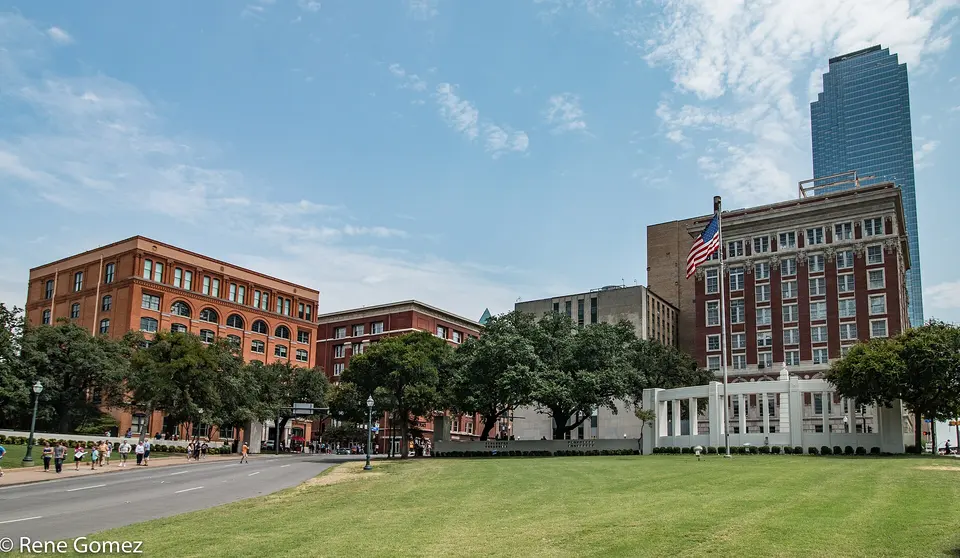
The three streets of downtown Dallas funnel together here and pass under a railway bridge, and because of what happened on 22 November 1963 the shape of that junction is one of the most closely studied pieces of ground in the world. The plaza itself is a 1930s public works project of colonnades, pergolas and lawns, all of it still there and all of it recognisable: the grassy knoll on the north side with its stockade fence, the triple underpass, the pergola where Abraham Zapruder stood with his camera, and two white X marks painted on Elm Street where the shots struck. On any given afternoon there are conspiracy sellers working the pavement, tourists standing in traffic to photograph the X, and people who simply stop and go quiet. It takes fifteen minutes to walk and much longer to leave.
  • Plan about 45 min
  • Open ground, free, always accessible; the X marks are in a live traffic lane, so look before you step; the pamphlet sellers on the knoll are not affiliated with the museum and their material is not history
The depository stands on the north-west corner of the plaza, one minute on foot
The Sixth Floor Museum at Dealey Plaza
Photo: Farragutful, CC BY-SA 4.0
2Museum

The Sixth Floor Museum at Dealey Plaza

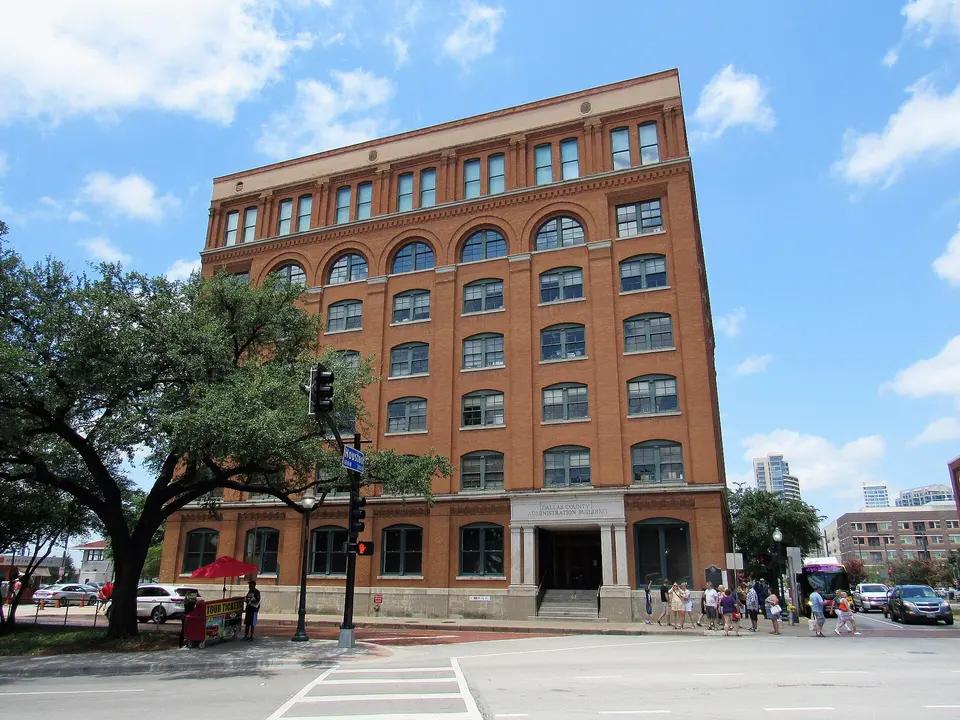
The Texas School Book Depository stood empty and condemned for years after 1963 before Dallas County bought it, and in 1989 the sixth floor opened as a museum. It is a plain warehouse floor with the original wooden columns and cast-iron radiators, and the exhibition runs the length of it: newsreel, campaign material, the political temperature of the city that November, the motorcade, the hours in Parkland Hospital, the Warren Commission, the 1979 House Select Committee, and the arguments that have never stopped. The south-east corner window, with its stacked book cartons, is glassed off and left exactly as the police photographed it. From the window beside it you look straight down onto the two marks on Elm Street. The audio guide is included and is the reason the visit works.

  • Plan about 2 h
  • Open Wednesday to Sunday 10:00 to 17:00 and closed Monday and Tuesday, with the last ticket sold and last entry at 16:15; book ahead for a timed slot in spring and autumn; the seventh-floor gallery has a separate temporary exhibition
150 m east across Houston Street, two minutes on foot
Old Red Museum
Photo: Martin Alon, CC BY-SA 4.0
3Museum

Old Red Museum

The 1892 Dallas County Courthouse is a mass of red Pecos sandstone with granite trim, Romanesque arches, and a clock tower that was pulled down in 1919 and rebuilt in 2007 from the original drawings, and it is the handsomest building in the city by a distance. Four courtrooms and a jail worked here until 1966. It is now a county history museum with four galleries running from the Caddo and the Republic of Texas through the cotton and oil booms to the present, and it is the only place downtown that explains why a city exists here at all, which is a fair question given the Trinity River is barely navigable. The stair hall, the tile and the stained glass are worth the ticket on their own.

  • Plan about 1 h
  • Open daily, roughly 10:00 to 17:00 with a modest ticket; it stands directly across from Dealey Plaza and the Sixth Floor Museum, so the three go together in one morning

Midday

LunchThe West End around the plaza is tourist-priced and thin. Ten minutes east there is better: the food hall in the old Dallas Farmers Market, the counter at a downtown taqueria, or one of the barbecue places that do brisket by the half pound with white bread and pickles. Texas barbecue is a beef tradition rather than a pork one, the meat is smoked over post oak, and the proper order is fatty brisket, a sausage link and no sauce.

Afternoon

700 m south-west past the Kennedy Memorial, about 10 minutes on foot
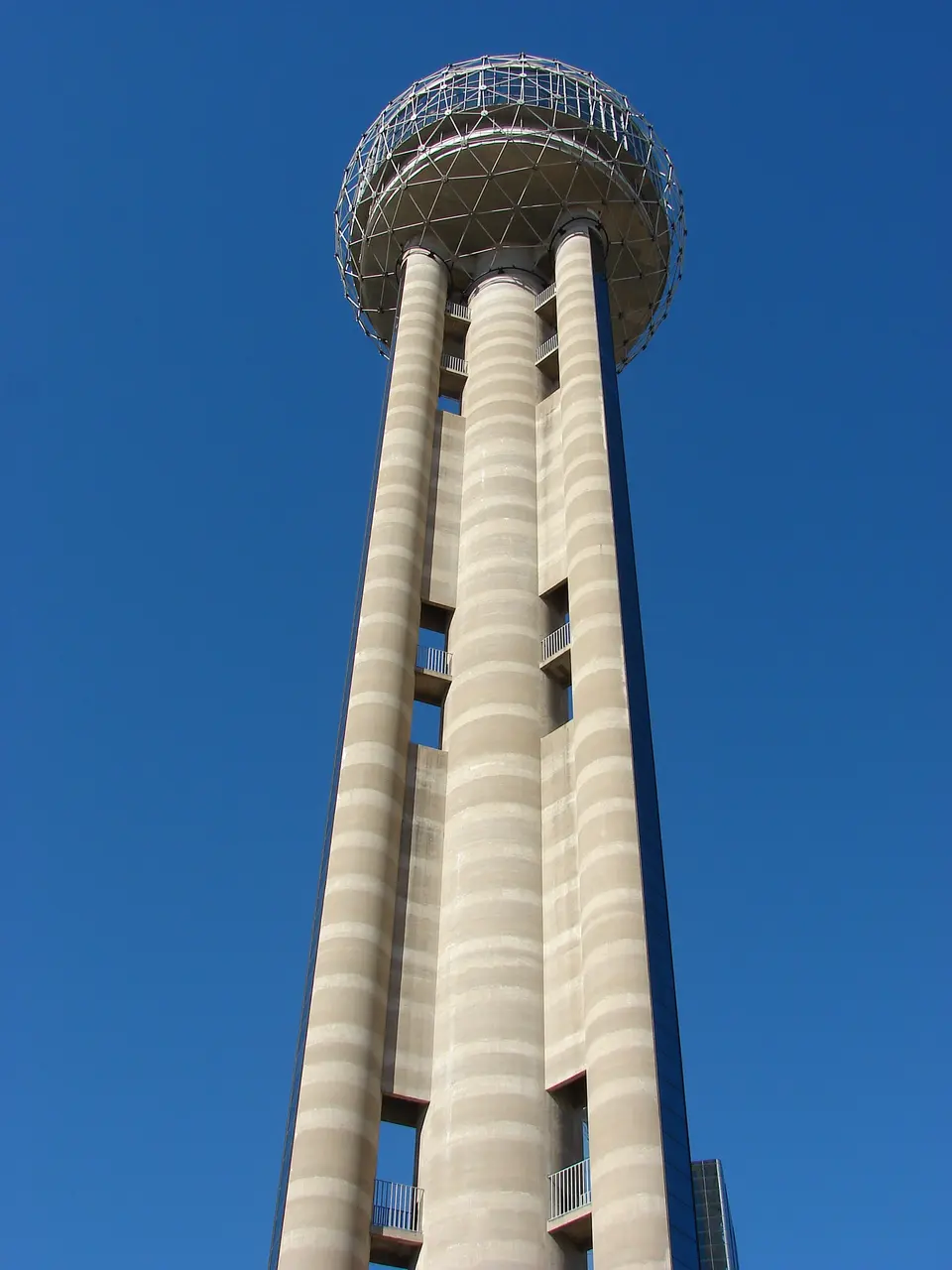
Reunion Tower
Photo: Loadmaster, CC BY-SA 3.0
4Observation tower

Reunion Tower

A 171-metre concrete shaft with a geodesic sphere on top, studded with 259 lights that can be programmed into patterns, built in 1978 as part of a hotel complex and now the thing that makes the Dallas skyline identifiable from any direction. The GeO-Deck at the top has an indoor level and an open-air one, telescopes, and a 360-degree view over a city that has almost no natural features to interrupt it: you can see the Trinity bottoms, the airport traffic stacking up to the north-west, Fort Worth on a clear day, and directly below, the shape of Dealey Plaza. The revolving restaurant one floor up is a separate business. Go at dusk, when the office towers light up and the sphere starts its sequence.

  • Plan about 1 h
  • Ticket sales close and the final elevator departs 30 minutes before closing; adult tickets run from about $19 to $40 depending on the date and time slot, seniors $16 to $35 and children 4 to 12 $10 to $20; a Day + Night ticket lets you come back within 24 hours

Evening

5 km south-west across the Trinity, about 12 minutes by car, or the Dallas Streetcar from Union Station
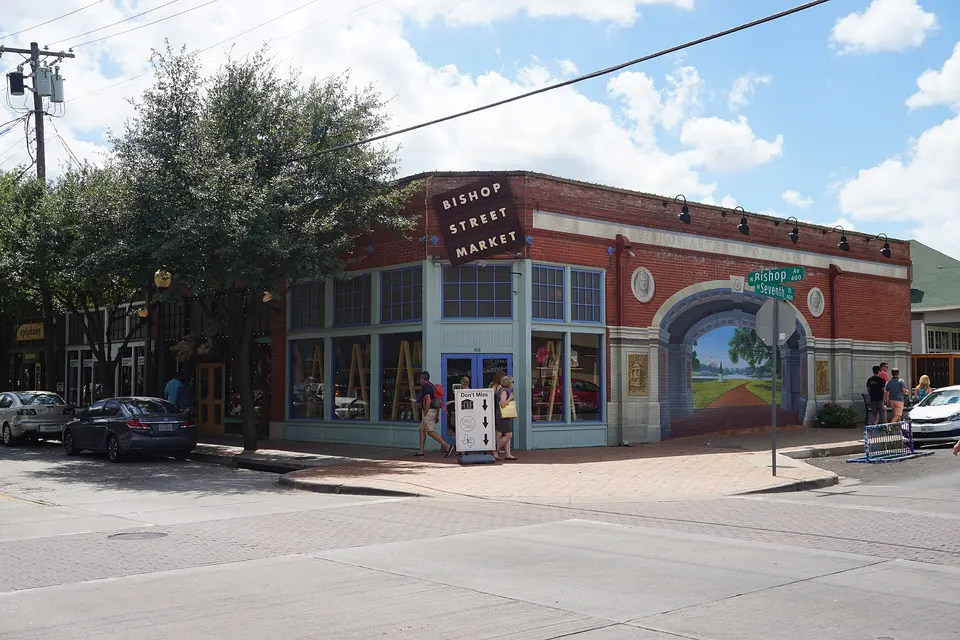
Bishop Arts District
Photo: Michael Barera, CC BY-SA 4.0
5Neighbourhood

Bishop Arts District

Oak Cliff is the older, lower, more Mexican half of Dallas on the far side of the Trinity, annexed in 1903 and left alone for most of the century afterwards, and the few blocks around Bishop Avenue and Seventh Street were its shopping street. By the 1980s it was almost empty. What filled it back up from the 1990s was small: independent bookshops, a chocolatier, taquerias, a cinema, galleries in former garages, and a lot of murals. It is the one part of Dallas that works at walking pace and looks nothing like the rest of the city, and the food is the best argument for coming, from the Tex-Mex institutions to the newer Oaxacan and Salvadoran kitchens. Gentrification is visible and locally contested.

  • Plan about 2 h
  • Free to walk; shops open around 11:00 and the restaurants run late, especially Thursday to Saturday; it is 5 km south-west of downtown, about 12 minutes by car, and the streetcar from Union Station reaches the edge of it

Day 2

The Arts District: a rock, a park over a freeway, and two very good museums

Give the morning to the natural science museum in Thom Mayne's concrete cube, cross the deck park that Dallas built over eight lanes of traffic, spend the afternoon in a free art museum and a Renzo Piano sculpture garden, and end where the city's music came from.

  • 5 sights
  • Transport between sights
12345500 mN
Stops in order, straight-line distancesWalking route in Google Maps ↗

Morning

Perot Museum of Nature and Science
Photo: Joe Mabel, CC BY-SA 3.0
1Museum

Perot Museum of Nature and Science

Thom Mayne's building of 2012 is a cube of pre-cast concrete with an exterior escalator running up one face in a glass tube, set on a plinth of drought-tolerant Texas landscaping, and it looks like a rock with a fault line through it, which is the point. Inside are eleven halls over five floors: a Cretaceous hall with an Alamosaurus and a Tyrannosaurus, a gems and minerals hall, a birds hall with a wall of specimens, an engineering floor where children can race their own avatar against Usain Bolt, and an Expanding Universe hall. It is aimed at families and it is unapologetic about it, but the palaeontology is serious and much of it was dug in Texas.

  • Plan about 2 h 30 min
  • Open Sunday 11:00 to 17:00 and Monday and Wednesday to Saturday 10:00 to 17:00, and closed on Tuesdays through 7 April 2027; last exhibit entry 16:00; timed entry tickets and the museum reckons two to three hours
500 m east across Woodall Rodgers, about 7 minutes on foot
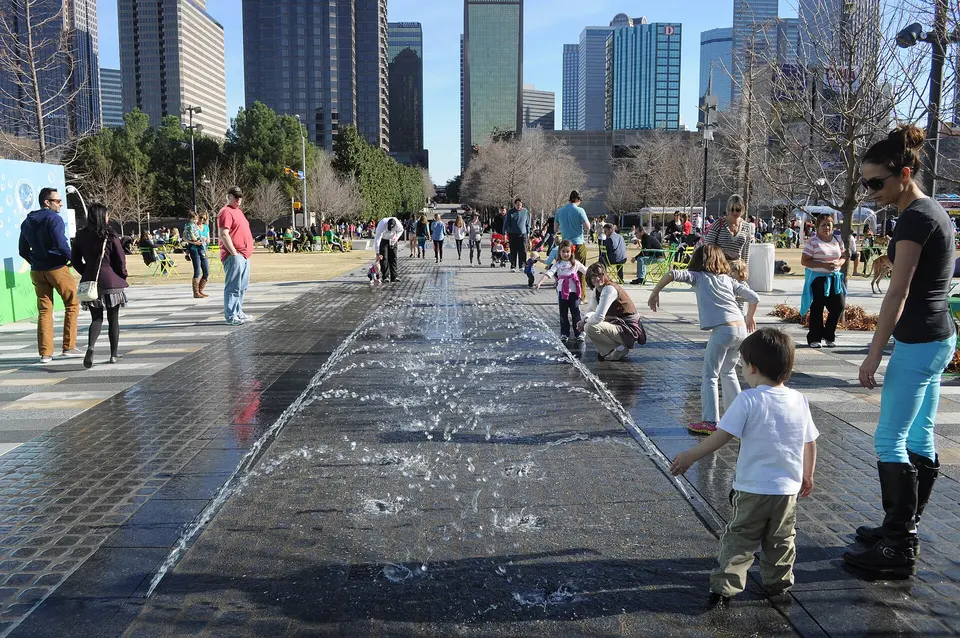
Klyde Warren Park
Photo: Joe Mabel, CC BY-SA 3.0
2Park

Klyde Warren Park

The Woodall Rodgers Freeway cut downtown Dallas off from its own arts district for forty years, and in 2012 the city built a two-hectare deck over a three-block stretch of it and put a park on top. Underneath, eight lanes of traffic; above, lawns, a children's garden, a dog park, a reading room with free newspapers, a performance stage and a permanent row of food trucks. It cost $110 million and it worked: the blocks on both sides have filled with towers since, and on a spring evening the lawn is full of people who work nearby. As urban repair it is the most interesting thing Dallas has done in a generation, and it takes twenty minutes to see and an afternoon to enjoy.

  • Plan about 1 h
  • Free and open daily from 06:00 to 23:00; the food trucks park on the Woodall Rodgers service road at lunch; free fitness classes, films and concerts run through spring and autumn

Midday

LunchThe food trucks at Klyde Warren Park are the obvious lunch and are better than they need to be, with a rotating line-up on the service road every weekday. The Nasher and the Dallas Museum of Art both have decent cafés if you would rather sit down, and Uptown, ten minutes north across the park, has a dense run of restaurants along McKinney Avenue that the free trolley reaches.

Afternoon

300 m south across Flora Street, four minutes on foot
Dallas Museum of Art
Photo: Kent Wang, CC BY-SA 2.0
3Art museum

Dallas Museum of Art

Edward Larrabee Barnes built this in 1984 as the anchor of a new arts district, a long limestone barrel-vaulted building that turns its back on the street and opens inward, and the collection inside runs to some 25,000 objects across the whole world. The strengths are specific: a very good body of ancient American gold and ceramics from Peru and Mexico, an African collection built with care, the Reves Collection of European painting and decorative arts installed in a reconstruction of the Reves villa on the Riviera, Mondrian and Pollock in the modern galleries, and an unusual holding of Indonesian and South Asian sculpture. General admission has been free since 2017, which changes how you use it: go twice for an hour rather than once for four.

  • Plan about 2 h
  • Open Tuesday to Sunday, roughly 11:00 to 17:00 with a late Thursday, and closed Monday; general admission is free and special exhibitions are ticketed; the Nasher and the Crow Collection are both within two minutes on foot
150 m east along Flora Street, two minutes on foot
Nasher Sculpture Center
Photo: Michael Barera, CC BY-SA 4.0
4Sculpture museum

Nasher Sculpture Center

Raymond and Patsy Nasher spent forty years buying modern sculpture and in 2003 Renzo Piano built them a home for it: five parallel travertine bays open at both ends, roofed in a cast-glass and aluminium sunscreen that filters the Texas light into something northern, with a walled garden behind that is really the main gallery. The collection is a short course in the subject, Rodin, Maillol, Matisse, Picasso, Giacometti, Calder, Moore, Serra, di Suvero and Kapoor, and the garden lets you walk round the big pieces at a distance nobody can manage indoors. James Turrell's Tending, (Blue) skyspace sits at the end of it. It is a small museum and one of the best of its kind anywhere.

  • Plan about 1 h 30 min
  • Open Wednesday to Sunday 11:00 to 17:00 and closed Monday and Tuesday; adults $10, DART riders $8, seniors over 65 $7, students and educators $5; free on the first Saturday of the month, and 'til Midnight on the third Friday runs 18:00 to midnight with films on the lawn

Evening

2 km south-east, about 25 minutes on foot or the Green Line to Deep Ellum station
Deep Ellum
Photo: Brittygriffy, CC BY-SA 4.0
5Neighbourhood

Deep Ellum

The blocks east of downtown along Elm Street were a Black and Jewish commercial district from the 1880s, and between the wars they were one of the important places in American music: Blind Lemon Jefferson, Huddie Ledbetter and Bessie Smith all worked the clubs and the recording sessions here, and the name is how Elm Street sounded when it was said quickly. A freeway cut through it in the 1960s and it emptied out. It came back as a live music and bar district in the 1980s, went through another bad patch, and is now several dozen venues, tattoo parlours, breweries and taco places behind a continuous run of murals painted on almost every wall. It is loud, it is uneven, and it is the only place in Dallas with an obvious musical lineage.

  • Plan about 2 h
  • Free to walk and best from about 19:00; the murals are on Main, Elm and Commerce and their side streets; venues run small and cheap and the listings are worth checking before you go, because the good nights are the reason to be there

Day 3

The day in Fort Worth: cattle pens, a Kahn building and a concrete waterfall

Drive fifty kilometres west to the city that still calls itself Cowtown, watch a small herd of Longhorns walk down the main street, then spend the afternoon in two free museums that would be the pride of a capital, and finish in the strangest public space in Texas.

  • 4 sights
  • Transport between sights
12342 kmN
Stops in order, straight-line distancesDriving route in Google Maps ↗

Morning

Fort Worth Stockyards
Photo: Michael Barera, CC BY-SA 4.0
1Historic district

Fort Worth Stockyards

Fort Worth was the last stop on the Chisholm Trail where a drover could buy supplies before the Indian Territory, and from 1889 the stockyards north of the river turned that traffic into an industry: pens, exchange buildings, and the Swift and Armour packing plants that made this one of the largest livestock markets in the country until the trade moved to trucks and feedlots in the 1960s. What survives is a brick-paved district of the Exchange Building, the Livestock Exchange, the coliseum where the world's first indoor rodeo was held in 1908, and the Stockyards Station of converted sheep and hog pens. Twice a day a handful of drovers walk a small herd of Texas Longhorns down Exchange Avenue, which is unabashedly a show and is also the only daily cattle drive anywhere.

  • Plan about 2 h 30 min
  • Free to walk; the Fort Worth Herd cattle drive runs twice daily at about 11:30 and 16:00 weather permitting, and the drovers are on the street beforehand; the rodeo at Cowtown Coliseum runs Friday and Saturday nights most of the year

Midday

LunchThe Stockyards will sell you a steak in a room with longhorn skulls on the wall, and it is fine and priced for visitors. The better lunch is in the Cultural District or in Sundance Square downtown, and the thing to look for is a chicken-fried steak, a cheap cut pounded flat, breaded and fried and served under cream gravy, which is the dish this part of Texas will defend to the death. Joe T. Garcia's on the north side has been doing Tex-Mex in a walled garden since 1935 and takes cash only.

Afternoon

8 km south-west to the Cultural District, about 15 minutes by car
Kimbell Art Museum
Photo: Carol M. Highsmith, Public domain
2Art museum

Kimbell Art Museum

Louis Kahn finished this in 1972 and architects have been coming to look at it ever since. It is sixteen parallel concrete vaults, each with a slot running the length of its crown, under which a perforated aluminium reflector throws daylight up onto the curved concrete so that the whole ceiling becomes the light source and nothing falls directly on a painting. The collection is deliberately small and almost freakishly good: Duccio, Fra Angelico, Mantegna, Caravaggio's Cardsharps, Velázquez, Rembrandt, El Greco, Goya, Cézanne, Matisse, the first Michelangelo painting in an American collection, and strong Asian and Mesoamerican holdings. Renzo Piano added a separate pavilion opposite in 2013 for exhibitions and the light in it is a knowing reply to Kahn.

  • Plan about 2 h
  • Open Tuesday to Sunday and closed Monday, roughly 10:00 to 17:00 with a late Friday; admission to the permanent collection is free and special exhibitions are ticketed; allow two hours, and look up at the vaults at least once
300 m west across the lawn, four minutes on foot
Amon Carter Museum of American Art
Photo: Amon Carter Museum of American Art, CC BY-SA 4.0
3Art museum

Amon Carter Museum of American Art

Amon G. Carter made his money in newspapers and oil and spent a good deal of it on Frederic Remington and Charles M. Russell, and the museum he endowed opened in 1961 in a small Philip Johnson building of Texas shellstone facing the city across a lawn. It has grown four times and now holds one of the best collections of American art anywhere: the Remingtons and Russells that started it, Thomas Cole and the Hudson River painters, Winslow Homer, Georgia O'Keeffe, Stuart Davis, Alexander Calder, and a photography collection of more than 45,000 prints including major Ansel Adams and Laura Gilpin holdings. Admission is free and always has been. It stands two minutes from the Kimbell and the Modern, which makes this lawn the densest square kilometre of museums in the southern United States.

  • Plan about 1 h 30 min
  • Admission is free; open Tuesday to Sunday with a late Thursday and closed on Mondays and on New Year's Day, Martin Luther King Jr. Day, Memorial Day, Juneteenth, Independence Day, Labor Day, Thanksgiving and Christmas

Evening

4 km east to the south edge of downtown Fort Worth, about 10 minutes by car
Fort Worth Water Gardens
Photo: Farragutful, CC BY-SA 4.0
4Park

Fort Worth Water Gardens

Philip Johnson and John Burgee built this in 1974 on four blocks of cleared land at the south edge of downtown Fort Worth, and it is a piece of landscape architecture that behaves like sculpture. Three water features sit in a concrete plain planted with live oaks: a quiet pool walled in falling sheets of water, an aerating pool of spray jets, and the active pool, a funnel of terraced steps down which 70,000 litres a minute crash towards a small platform at the bottom. Walking down those steps with the noise closing over you is the whole experience, and it is the reason the gardens turn up in films. Four people drowned in the active pool in 2004 and it was rebuilt shallower and reopened in 2007.

  • Plan about 45 min
  • Free and open daily, roughly 07:00 to 22:00; the steps of the active pool are wet, uneven and genuinely slippery, so take them slowly and hold a child's hand; it is a ten-minute walk from Sundance Square

Good to know in Dallas

Downtown Dallas: hours and tickets

  • The Sixth Floor Museum at Dealey Plaza is open Wednesday to Sunday from 10:00 to 17:00 and is closed on Mondays and Tuesdays. The last ticket is sold and the last entry allowed at 16:15.Source: The Sixth Floor Museum at Dealey Plaza — Plan Your Visit · checked Sep 2026
  • The Perot Museum of Nature and Science opens Sunday 11:00 to 17:00 and Monday and Wednesday to Saturday 10:00 to 17:00, and is closed on Tuesdays through 7 April 2027 apart from special holiday hours. The last entry to the exhibits is 16:00, the café runs daily 11:00 to 16:00, and the museum says the average visit takes two to three hours.Source: Perot Museum of Nature and Science — Hours · checked Sep 2026
  • At Reunion Tower, ticket sales close and the final elevator departs 30 minutes before closing time. General admission to the GeO-Deck runs $19 to $40 for adults, $16 to $35 for visitors over 65 and $10 to $20 for children aged 4 to 12, depending on the date and time; a Day + Night ticket costs $24 to $40 for adults and the second visit must be used within 24 hours of the first.Source: Reunion Tower — Plan Your Visit · checked Sep 2026

The Arts District and Fort Worth museums

  • The Nasher Sculpture Center is open Wednesday to Sunday 11:00 to 17:00 and closed Monday and Tuesday, as well as Thanksgiving, Christmas Day and New Year's Day. Admission is $10 for adults, $8 for DART riders with proof of ticket, $7 for visitors 65 and over and $5 for students and educators with identification, and it covers the galleries, the sculpture garden, special exhibitions and the café. Entry is free on the first Saturday of each month from 11:00 to 17:00, and the 'til Midnight evenings run on the third Friday from 18:00 to midnight.Source: Nasher Sculpture Center — Visit · checked Sep 2026
  • Admission to the Amon Carter Museum of American Art in Fort Worth is free. It is open Tuesday to Sunday, with Sunday from noon to 17:00, most days 10:00 to 17:00 and a late Thursday to 20:00, and it closes on Mondays and on New Year's Day, Martin Luther King Jr. Day, Memorial Day, Juneteenth, Independence Day, Labor Day, Thanksgiving Day and Christmas Day.Source: Amon Carter Museum of American Art — Visit · checked Sep 2026

3 days in Dallas: quick answers

Is 3 days enough for Dallas?

Three days covers it comfortably, and one of them is honestly better spent in Fort Worth. Day one is Dealey Plaza and the neighbourhoods, day two the Arts District, and day three the Stockyards and the Cultural District fifty kilometres west. If you only have two days, drop Fort Worth and add the Dallas Arboretum on White Rock Lake and the George W. Bush Presidential Center on the Southern Methodist University campus. With a fourth day, Fair Park is the largest collection of art deco exposition architecture anywhere and holds several museums, and the Dallas Zoo and the Texas Discovery Gardens are next to it.

What is the best time of year to visit Dallas?

March to May and October to November. Spring brings the bluebonnets and temperatures around 24 to 28°C, though it is also storm season and North Texas takes hail and the occasional tornado warning seriously. Autumn is drier and just as warm. July and August run above 35°C for weeks and regularly pass 38, which makes any outdoor plan a morning-only plan. Winter is mild at around 13°C with a few hard freezes and the rare ice storm that shuts the city down completely for a day or two.

Do you need a car in Dallas?

For three days, yes, or at least a lot of ride-hailing. DART runs four light rail lines and they are genuinely useful between downtown, Deep Ellum, Fair Park, the Bishop Arts edge and the airport, and the free M-Line trolley links downtown to Uptown. But the Arboretum, the Bush Center and anything in Fort Worth need a car or a train plus a taxi, and Dallas is a city built around the assumption that everyone is driving. If you are staying downtown and skipping Fort Worth, you can manage on transit and walking.

How much does Dallas cost per day?

It is cheaper than the coastal American cities and the museums help. Two of the best things in the metroplex, the Dallas Museum of Art and the Amon Carter, are free, and so is the Kimbell's permanent collection. A hostel bed is $40 to $60, a mid-range hotel room $150 to $250, and a good downtown hotel more. Eating is where Texas is generous: a barbecue plate is $18 to $25, a taqueria lunch under $15, and a serious dinner $60 to $90 a head. Budget about $60 for museum tickets on the day you do the Perot and Reunion Tower.

Is the Sixth Floor Museum worth it?

Yes, and more than most visitors expect. It is not a shrine and it is not a conspiracy exhibit; it is a careful, document-heavy account of a week in 1963 assembled from film, photographs, recordings and the physical floor itself, and it treats the competing investigations as evidence to be weighed rather than settled. The audio guide is included and carries the visit. Allow two hours. Note that it is closed on Mondays and Tuesdays, which catches people out, and that the last entry is 16:15.

Is Fort Worth worth a whole day from Dallas?

If you like museums or the West, yes. The Kimbell is one of the finest museum buildings in the world and its collection is small and extraordinary; the Amon Carter next door is free and holds the best Remington and Russell collection anywhere; the Modern Art Museum is a third heavyweight on the same lawn. The Stockyards are a tourist production and everyone knows it, and the twice-daily cattle drive is still a genuine pleasure. The drive is 50 km, about 45 minutes outside rush hour, and the TRE train runs between the two downtowns.

Other Dallas itineraries

Keep exploring

Where this connects

THE TRIPWOA APP

Go somewhere.
Make it yours.

Build days around what you love. Follow your route, find your next stop and keep the moments along the way.

Get it on Google PlayAvailable for Android
Free to start
Tripwoa home with a Paris trip and nearby places to explore
Tripwoa day plan for New York with a route map and Times Square stop

A day that feels like you.

Sources and method

Places and coordinates: Wikidata and Tripwoa's open-data place catalog (Overture Maps Foundation, © OpenStreetMap contributors). Photos: Wikimedia Commons, credited on each image. Practical rules: the official sources linked in each note, checked in September 2026.

How this plan was made: Tripwoa's planner drafted the day order from real coordinates and typical visit times. Each stop was then reviewed, reordered where needed and rewritten with AI assistance. Walking distances are straight-line estimates, so allow a little extra time on real streets.