3-day itinerary · United States

3 Days in Denver

A plan that walks lower downtown on the first day, uses the second on four museums within three hundred metres of each other, and gives the third to the foothills, where the amphitheatre is free on any day without a concert. Official 2026 hours, closed days and ticket prices are in the stops.

  • 3days
  • 14sights
  • 0.0 kmon foot between sights

Updated 13 September 2026 · 6 official sources checked · report an error

Red Rocks Amphitheatre
Photo: Sarbjit Bahga, CC BY-SA 4.0

Union Station and LoDo, then the Civic Center museums, then City Park, Red Rocks and Golden

Denver is a city of about 715,000 with a metropolitan area near three million, laid out on the high plains at exactly 1,609 metres, which is where the Mile High City comes from and why the Capitol has a step engraved to prove it. It began as a gold camp at the confluence of Cherry Creek and the South Platte in 1858, survived the bust because it made itself the supply and banking town for the whole Rocky Mountain mining region, and has grown fast enough since the 1990s to change character twice. The Front Range is the constant: the mountains start twenty kilometres west and run the length of the horizon, which shapes the weather, the light and what people do at weekends. The airport train reaches the middle of downtown in 37 minutes, and the amphitheatre cut into red sandstone half an hour west is the one thing every visitor is told to see.

At a glance

Ways to use these days

If it rains
4 of the stops are indoors — Denver Art Museum · Clyfford Still Museum · History Colorado Center
Outdoors
Confluence Park · Denver Botanic Gardens
Lightest day on foot
Day 2 — 1.2 km between stops
Most walking
Day 3 — 34.2 km

Day 1

LoDo: the station that became a living room, the block that saved itself, and the river Denver started on

Begin in the Beaux-Arts hall that Denver turned back into a public space, walk the one Victorian block that escaped demolition, follow the granite mall through downtown, and finish where two rivers meet and the gold was found.

  • 4 sights
  • Transport between sights
1234250 mN
Stops in order, straight-line distancesWalking route in Google Maps ↗

Morning

Denver Union Station
Photo: Missvain, CC BY 4.0
1Railway station

Denver Union Station

The third station on this site, finished in 1914 in Beaux-Arts granite with a great arched central window and the word UNION on the pediment, and by the 1980s it was handling one train a day and most of it was shut. A $500 million rebuild reopened it in 2014 as something American cities had almost forgotten how to do: the Great Hall is a public living room with long communal tables, armchairs, a shuffleboard court and free wifi, ringed by a dozen restaurants and bars and a hotel in the upper floors, while the trains and buses run from a new open-air platform and an underground concourse behind. People sit here who have no train to catch. The neon Travel by Train sign on the roof was rebuilt from the original.

  • Plan about 1 h
  • The Great Hall is free and open from about 05:00 to midnight; the Terminal Bar in the old ticket windows and the Cooper Lounge on the mezzanine are both worth a drink; the A Line to the airport runs from the platform behind, 37 minutes
600 m south-east along Wynkoop and Larimer, about 8 minutes on foot
Larimer Square
Photo: Sdkb, CC BY-SA 4.0
2Historic block

Larimer Square

Denver began on this block: Larimer Street was the first street of the 1858 gold-rush settlement, and the 1400 block held the first bank, the first bookshop and the first theatre. By 1965 the city had condemned the whole of lower downtown for urban renewal and demolition had started when Dana Crawford bought the block, restored the Victorian commercial fronts and saved it, which made it the first historic district in Denver and the reason the rest of LoDo still exists. It is now a single pedestrianised block of restaurants and shops under strings of lights that hang between the buildings, which sounds twee and photographs beautifully, particularly after dark.

  • Plan about 1 h
  • Free to walk; the restaurants are among the better ones downtown and book up at weekends; the lights are on every night and the block is at its best in the hour after sunset

Midday

LunchThe Great Hall at Union Station has half a dozen places to eat under one roof and is the easy answer, with an oyster bar, a bakery and a Mexican counter. Denver's own contributions to the table are worth trying: a Denver omelette, green chili served over almost anything, bison on the better menus, and Rocky Mountain oysters, which are exactly what you fear and are ordered as a dare. The Central Market on Larimer Street in RiNo is ten minutes north and better value.

Afternoon

The mall crosses Larimer one block away; the free MallRide shuttle runs its full length
16th Street Mall
Photo: Dough4872, CC BY-SA 4.0
3Pedestrian mall

16th Street Mall

I. M. Pei laid out this mile-and-a-quarter pedestrian spine in 1982, paving it in grey, red and white granite in a pattern meant to read as a diamondback rattlesnake from the air, and planting more than two hundred trees down the middle. A free shuttle bus has run end to end ever since, stopping on every block, which makes it the simplest way to move through downtown. It runs from Union Station at the north-west end to the Civic Center at the south-east, passing the department stores, the outdoor cafés and a row of painted pianos that anyone may play. A long reconstruction has had stretches of it fenced off and torn up, so expect construction hoardings alongside the granite.

  • Plan about 45 min
  • Free, always open, and the MallRide shuttle runs end to end every few minutes at no charge; parts of the mall have been under reconstruction, so the walk is not continuous everywhere

Evening

1.5 km north-west along the Cherry Creek path from the station, about 20 minutes on foot
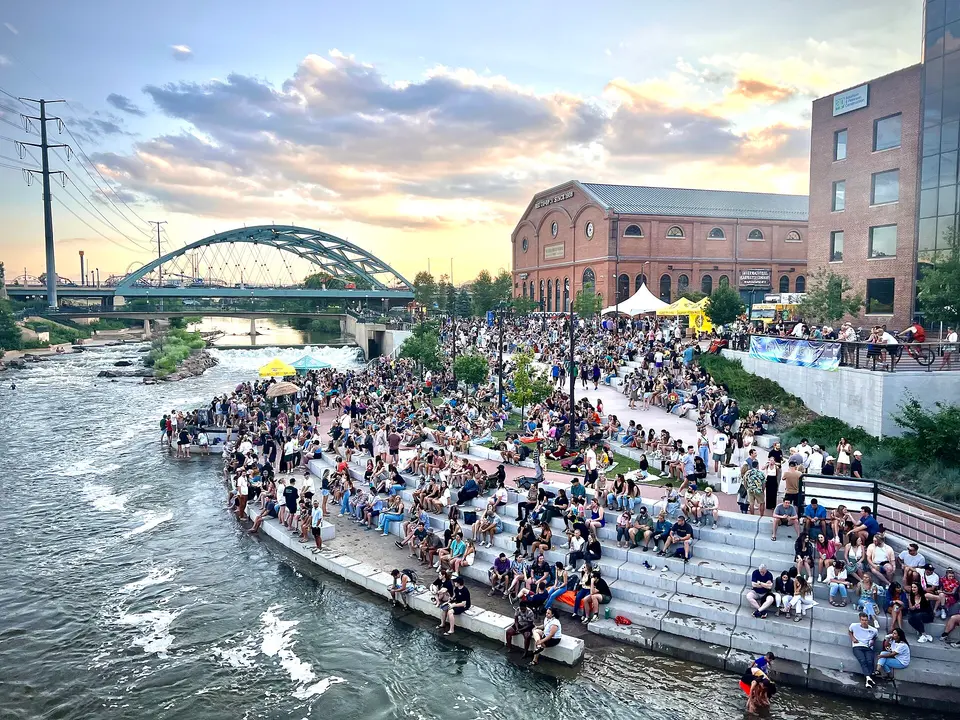
Confluence Park
Photo: Pdubs.94, CC0
4Park

Confluence Park

Gold was found where Cherry Creek runs into the South Platte in 1858, and the camp that grew on the spot became Denver, which means this is the exact reason the city exists. For a century afterwards it was rail yards and a rubbish dump. It was reclaimed as a park in the 1970s and rebuilt again in 2018, and it is now a set of stepped stone terraces down to the water with an artificial whitewater course in the river where kayakers and tubers queue up to run the drops all summer. The Platte River Trail and the Cherry Creek Trail meet here, so it is also the junction of Denver's cycling network. REI's flagship store occupies the 1901 tramway powerhouse across the water.

  • Plan about 1 h
  • Free and open daily; the water is cold, fast in spring melt and shallow in late summer, and the kayak drop is genuinely used by beginners; it is 1.5 km from Union Station on foot along the creek

Day 2

Civic Center: a Ponti fortress, a painter's whole estate, the state's own history and a gold dome

Four buildings within three hundred metres hold the city's art, one man's entire life's work, the state's account of itself including the parts it would rather forget, and the Capitol step that gave Denver its nickname.

  • 5 sights
  • Transport between sights
12345200 mN
Stops in order, straight-line distancesWalking route in Google Maps ↗

Morning

Denver Art Museum
Photo: Daniel Hartwig, CC BY 4.0
1Art museum

Denver Art Museum

Two very different buildings joined by a bridge. Gio Ponti's Martin Building of 1971 is a seven-storey fortress clad in a million grey glass tiles with slit windows, the only completed Ponti building in North America, reopened in 2021 after a full renovation. Daniel Libeskind's Hamilton Building of 2006 is a shard of titanium leaning over the street and is either exhilarating or unusable depending on who you ask. Inside, the American Indian art collection is the reason this museum matters: some 18,000 works from more than a hundred nations, assembled from 1925 when almost no American museum treated it as art. There are also strong Spanish colonial, western American, and modern and contemporary collections.

  • Plan about 2 h 30 min
  • Open six days a week and closed on Wednesdays as well as Thanksgiving and Christmas Day, 10:00 to 17:00 with a late Friday to 20:00; adult general admission is $22 or $25 depending on the day and free for members, and the museum runs several free days a year
100 m north across the plaza, two minutes on foot
Clyfford Still Museum
Photo: Sandersenvie, CC BY-SA 4.0
2Art museum

Clyfford Still Museum

Clyfford Still was one of the first of the abstract expressionists and the most uncompromising: he withdrew from the commercial gallery world in 1951 and kept almost everything he made, and his will stipulated that his estate go to any American city willing to build a museum for it alone, closed to all other art. Nobody took it up for thirty years. Denver did in 2004, and Brad Cloepfil's concrete building of 2011 now holds about 3,125 works, some 95 per cent of everything Still produced, shown in rotation in nine galleries lit through a perforated concrete ceiling. The paintings are enormous fields of torn-edged colour and the building was designed to make you slow down in front of them. It is next door to the art museum.

  • Plan about 1 h 15 min
  • Open Tuesday to Sunday, generally 10:00 to 17:00 with a late Friday, and closed Monday; it is a small museum and an hour is enough; combination tickets with the Denver Art Museum next door are sold

Midday

LunchCivic Center Eats sets up food trucks in the park through the warm months on weekday lunchtimes, which is the cheapest and best option on this walk. Otherwise Broadway south of the museums has a long run of restaurants, and Capitol Hill around Colfax Avenue is where Denver's cheap food lives, including a Cuban sandwich counter and several very good taquerias.

Afternoon

250 m east on Broadway, three minutes on foot
History Colorado Center
Photo: thirdsphoto, CC BY 4.0
3Museum

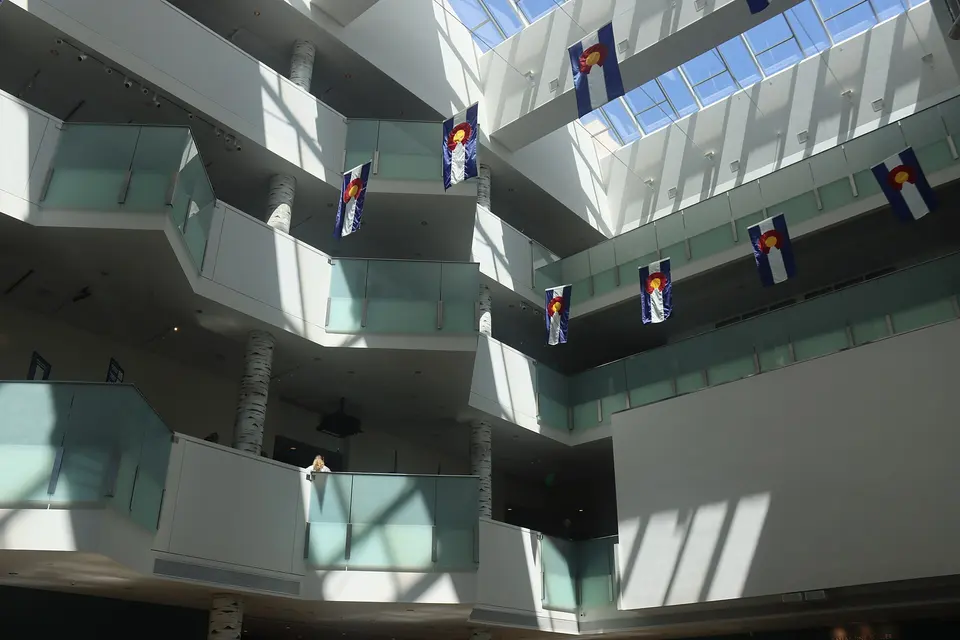
History Colorado Center

The state history museum, rebuilt in 2012 in a building whose atrium floor carries a giant terrazzo map of Colorado that visitors walk across. The permanent galleries are unusually willing to be uncomfortable: Written on the Land covers the peoples who were here first, and the Sand Creek Massacre exhibition, developed with the Cheyenne and Arapaho over years, does not soften the 1864 killing of some 230 people by Colorado volunteers. Elsewhere there is a full-scale Keota homestead you can walk into, a ski history gallery in a state that takes skiing very seriously, and a mining section. It sits between the art museum and the Capitol, which makes the three a single afternoon.

  • Plan about 2 h
  • Open every day from 10:00 to 17:00, closed Thanksgiving and Christmas Day, closing early at 15:00 on New Year's Eve and closed all day on New Year's Day; admission is free for children
400 m north-east across Lincoln Street, five minutes on foot
Colorado State Capitol
Photo: xiquinhosilva, CC BY 2.0
4Capitol building

Colorado State Capitol

A granite copy of the national Capitol finished in 1901, with two things that make it worth the climb. The first is the dome, gilded in 1908 with 200 ounces of Colorado gold leaf and regilded several times since, the last in 2013. The second is the step on the west entrance stairway engraved One Mile Above Sea Level, which is why Denver is the Mile High City; surveying has moved the true mark twice, so there are now three markers on three different steps, all of them correct for their date. Inside, the rotunda is lined with Colorado rose onyx from a quarry that was exhausted by the building, so it cannot be matched anywhere. Free tours climb to the dome gallery.

  • Plan about 1 h
  • Open on weekdays, roughly 07:30 to 17:00, and closed at weekends and on state holidays; free guided tours run through the day and the dome climb is 99 steps from the third floor, booked at the tour desk

Evening

700 m east into Capitol Hill, about 10 minutes on foot
Molly Brown House Museum
Photo: Onetwo1, CC BY-SA 3.0
5Historic house

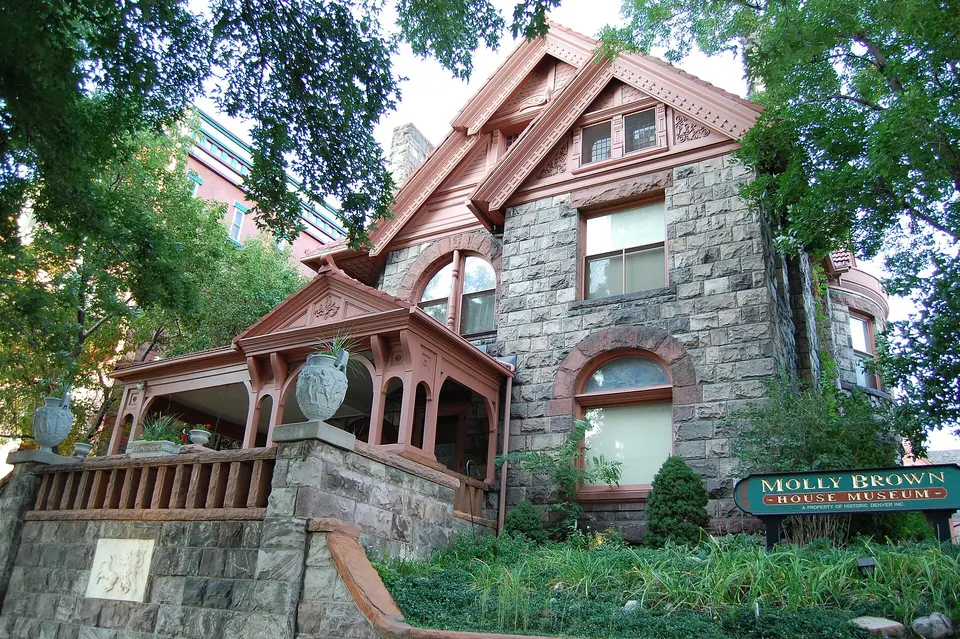
Molly Brown House Museum

Margaret Brown was born poor in Missouri, married a mining engineer who struck gold at Leadville, and became a philanthropist, a suffragist, a candidate for the US Senate before women could vote, and a survivor of the Titanic, where she helped load lifeboats and then badgered Lifeboat 6 into going back for people in the water. The nickname Unsinkable was invented by a Broadway musical twenty years after she died and she never used it. The 1889 Capitol Hill house she bought in 1894 was a rooming house by 1970 and about to be demolished; it was saved and restored to its 1910 appearance, and the guided tour through the rooms is a good deal more interesting than the legend.

  • Plan about 1 h 15 min
  • Entry is by guided tour or a self-guided Explore the Museum ticket and both should be booked in advance, because the museum says they sell out in summer; free admission for Denver-area residents on the first Thursday of the month from 16:00 to 19:00, first come first served

Day 3

City Park in the morning, the Front Range in the afternoon

Take the eastern parks first, with dioramas, elephants and a steppe garden, then drive west into the foothills for an amphitheatre cut into two sandstone slabs and a brick town at the mouth of a canyon.

  • 5 sights
  • Transport between sights
123455 kmN
Stops in order, straight-line distancesDriving route in Google Maps ↗

Morning

Denver Museum of Nature & Science
Photo: Sarbjit Bahga, CC BY-SA 4.0
1Museum

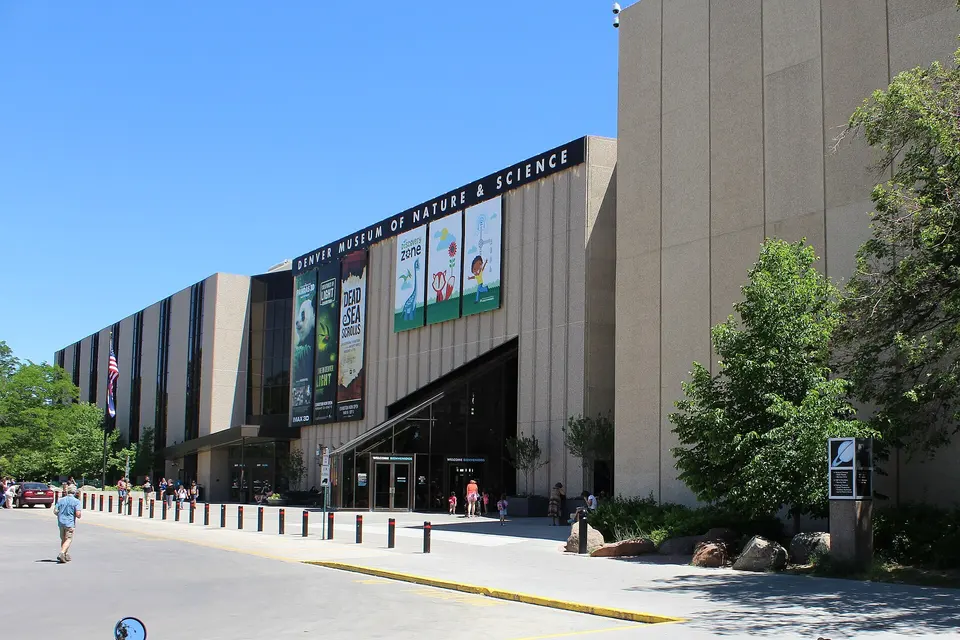
Denver Museum of Nature & Science

One of the oldest natural history museums in the American West, founded in 1900 on a naturalist's private collection and now holding more than a million objects on the eastern edge of City Park. Its wildlife dioramas are among the best made anywhere, painted backgrounds and mounted groups assembled in the 1930s and still convincing; the Prehistoric Journey hall runs through Colorado's own fossil record, which is unusually rich, with a Stegosaurus and a Diplodocus dug in the state; the Egyptian Mummies gallery and the Gems and Minerals hall are both serious. There is a planetarium and an IMAX. From the fourth-floor windows the entire Front Range stands up along the western horizon.

  • Plan about 3 h
  • Open daily with the last entry well before closing and a planetarium schedule that runs separately; allow three hours; parking is free and the number 20 and 24 buses run from downtown
1.5 km west inside City Park, about 5 minutes by car or 20 on foot across the park
Denver Zoo
Photo: Sarbjit Bahga, CC BY-SA 4.0
2Zoo

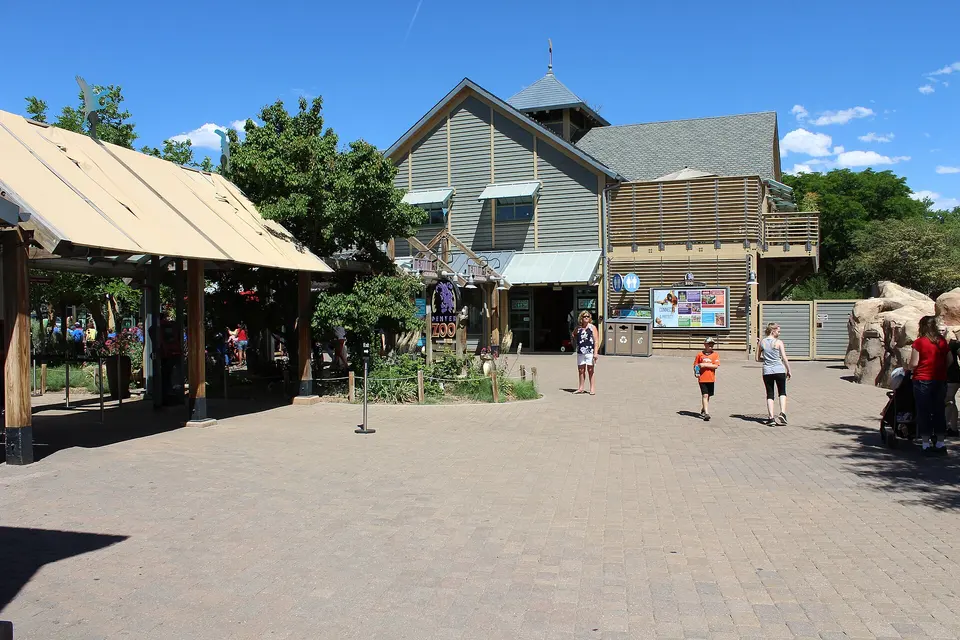
Denver Zoo

Thirty-two hectares in City Park holding about three thousand animals, and it started with an orphaned black bear cub given to the mayor in 1896. Two things set it apart. Predator Ridge rotates lions, hyenas and African wild dogs through three separate habitats so that each species smells the others, which keeps all of them alert in a way that zoos rarely manage. Toyota Elephant Passage is a four-hectare complex for Asian elephants, rhinos and tapirs built around the idea that elephants should walk several kilometres a day, so they are moved between yards along connecting trails. The zoo also runs its own gasification plant that turns animal waste and rubbish into energy.

  • Plan about 2 h 30 min
  • Open daily 09:00 to 16:00 with early entry from 08:00 between Memorial Day and Labor Day; online timed reservations are required and go on sale ten days ahead; closed Thanksgiving Day and Christmas Day

Midday

LunchCity Park has the museum café and the zoo's food stands and little else. Better: drive fifteen minutes to Denver Botanic Gardens and eat at the Hive Garden Bistro on the way in, or stop on Colfax or in the Cherry Creek district. If you are heading straight west, Golden's Washington Avenue has a good row of places along the creek and is the natural late lunch on this route.

Afternoon

3 km south to York Street, about 10 minutes by car
Denver Botanic Gardens
Photo: Sarbjit Bahga, CC BY-SA 4.0
3Botanical garden

Denver Botanic Gardens

Ten hectares in Cheesman Park laid out as more than forty separate gardens, and the interesting ones are the dry ones: this is a mile above sea level in a semi-arid climate, and the Gardens have spent decades demonstrating that a beautiful garden here does not need a lawn. The Steppe Garden sets the Colorado steppe beside the Patagonian, South African and Central Asian steppes that share its climate, and it is the only collection of its kind. Beyond it are a Japanese garden with a teahouse, an alpine rock garden, a conservatory of tropical plants, a water garden of Victoria lilies, and Mordecai Children's Garden on a roof. The summer concert series on the lawn sells out in minutes.

  • Plan about 2 h
  • Open daily with seasonal hours, generally 09:00 to 19:00 in summer and 09:00 to 16:00 in winter; adult admission is $16.25 and concessions $12.50, tickets are timed, and the conservatory ground floor needs no separate ticket
30 km west on Interstate 70 and Highway 26, about 30 minutes by car; there is no public transport
Red Rocks Amphitheatre
Photo: Sarbjit Bahga, CC BY-SA 4.0
4Amphitheatre

Red Rocks Amphitheatre

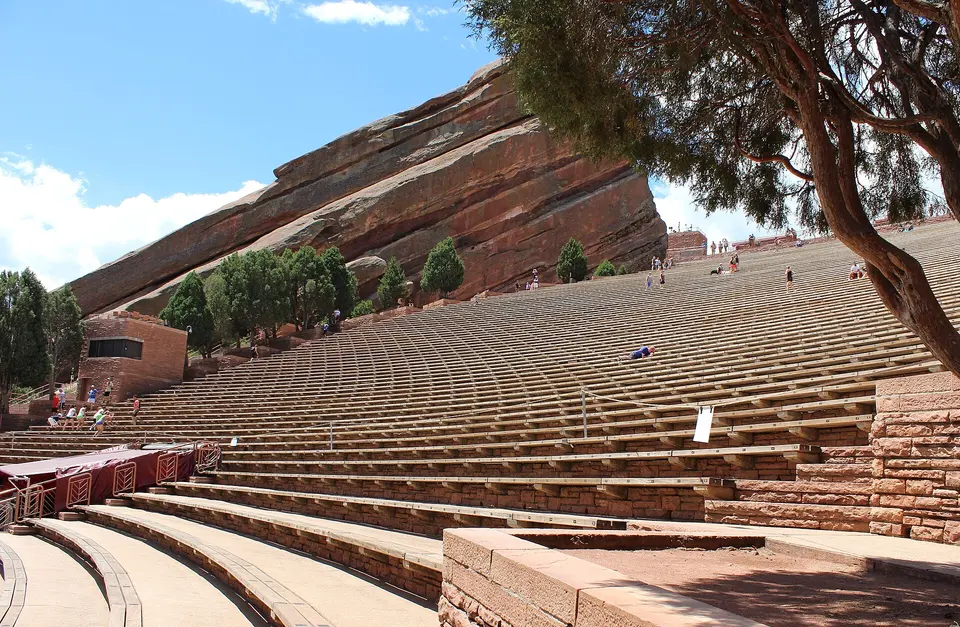
Two 90-metre slabs of red sandstone tilted up by the same uplift that made the Rockies stand 60 metres apart with a natural acoustic bowl between them, and in 1936 the Civilian Conservation Corps cut 9,500 seats into the gap. The result is the only naturally occurring acoustically perfect amphitheatre anywhere, and the list of people who have played it runs from the Beatles in 1964 through U2's Under a Blood Red Sky to most of the acts touring America in any given summer. On non-event days it is a free public park: people run the steps for exercise, do yoga on the stage at sunrise, and walk the Trading Post Trail through the rocks. The visitor centre has a small performers' hall of fame.

  • Plan about 2 h
  • The park and amphitheatre are free to enter on non-event days; the visitor centre is open 07:00 to 19:00 from March to October and 08:00 to 16:00 from November to February, and after 14:00 on event days access is limited to ticket holders

Evening

12 km north up Highway 93 from Red Rocks, about 15 minutes by car
Golden
Photo: thirdsphoto, CC BY 4.0
5Town

Golden

Golden was the capital of Colorado Territory from 1862 to 1867, lost the seat to Denver, and settled into being a small brick town at the mouth of Clear Creek Canyon with the Front Range standing directly behind it. An arch across Washington Avenue still reads Howdy Folks, Welcome to Golden. Coors has brewed here since 1873 and runs what it calls the largest single brewing site in the world, with a free tour that ends in a tasting room. Clear Creek runs through the middle of town with a whitewater park in it and a path along both banks. Up on Lookout Mountain above the town, Buffalo Bill Cody is buried under a slab of rock at his own request, with a museum beside the grave.

  • Plan about 2 h
  • Free to walk; the Coors brewery tour is free and needs an online booking and photo identification; Lookout Mountain is a 10 km drive of hairpins above the town and the grave and museum sit at the top

Good to know in Denver

Civic Center museums: hours and admission

  • The Denver Art Museum is open six days a week and is closed on Wednesdays as well as Thanksgiving Day and Christmas Day, running 10:00 to 17:00 with a late opening to 20:00 on Fridays. Adult general admission is $22 or $25 depending on the date, with concession rates of $19 or $22, and admission is always free for members. The museum also holds several free general admission days a year through the Scientific and Cultural Facilities District.Source: Denver Art Museum — Plan Your Visit · checked Sep 2026
  • The History Colorado Center is open every day from 10:00 to 17:00. It closes on Thanksgiving Day and Christmas Day, closes early at 15:00 on New Year's Eve and is closed all day on New Year's Day. Admission is free for children.Source: History Colorado — History Colorado Center · checked Sep 2026
  • The Molly Brown House Museum recommends buying tickets in advance because tours sell out, especially in summer, and warns that some tour times may be unavailable on the day. Denver-area residents get free admission on the first Thursday of each month from 16:00 to 19:00, with no reservations and first-come, first-served entry.Source: Molly Brown House Museum — Plan Your Visit · checked Sep 2026

City Park, the gardens and Red Rocks

  • Denver Zoo is open daily from 09:00 to 16:00, with early entry from 08:00 to 09:00 between Memorial Day and Labor Day, and closes on Thanksgiving Day and Christmas Day. Online timed ticket reservations are required for entry, visitors choose a timed entry window when booking, general admission tickets go on sale ten days in advance and they are non-refundable.Source: Denver Zoo Conservation Alliance — Hours and Admission · checked Sep 2026
  • Denver Botanic Gardens at York Street runs seasonal hours, generally 09:00 to 19:00 in the warmer months and 09:00 to 16:00 in winter. Adult admission is $16.25 and the concession rate is $12.50; no separate admission is required for the first floor of the conservatory, and free days apply to regular garden hours only and do not cover ticketed events.Source: Denver Botanic Gardens — York Street · checked Sep 2026
  • The Red Rocks visitor centre is open 07:00 to 19:00 from March to October and 08:00 to 16:00 from November to February. After 14:00 on event days, access to the visitor centre is limited to ticket holders only.Source: Red Rocks Park and Amphitheatre — Visit · checked Sep 2026

3 days in Denver: quick answers

Is 3 days enough for Denver?

Three days covers the city and gets you into the foothills once, which is the right balance. Day one is lower downtown, day two the Civic Center museums, day three City Park and then west to Red Rocks and Golden. What three days will not do is the mountains proper: Rocky Mountain National Park is 110 km north-west and needs a full day of its own, and the ski towns are two hours away. If you have a fourth day, take it for the park, or for Boulder and the Flatirons, 45 km north-west.

What is the best time of year to visit Denver?

June to September for the mountains and the concerts, and April, May or October if you want the city cheaper and quieter. Denver sits at 1,600 metres and gets about 300 days of sunshine, with summer highs around 31°C and very low humidity, cold clear nights, and afternoon thunderstorms that build fast over the Front Range. Winter is sunnier than people expect at about 7°C in the day, with heavy snow that usually melts within two days. Altitude is the real variable: drink much more water than usual for the first day and go easy on alcohol.

Do you need a car in Denver?

For the first two days, no. The A Line runs from the airport into Union Station in 37 minutes, the free MallRide and MetroRide shuttles cover downtown, and the light rail reaches most of the centre. Day three is different: Red Rocks and Golden have no useful public transport, and City Park is easier by car. Hire a car for the third day, or take one of the shuttle services that run to Red Rocks on concert nights.

How much does Denver cost per day?

A hostel bed runs $40 to $60, a mid-range hotel $180 to $280, and downtown hotels rise sharply when there is a convention. The museums are moderate: the art museum $22 to $25, the botanic gardens $16.25, the zoo and the nature and science museum around $25 each. Red Rocks costs nothing to visit on a non-event day and a concert ticket is whatever the act charges. Eating is reasonable at $15 to $20 for lunch and $50 to $70 for a good dinner, and the craft beer scene is one of the densest in America.

Is Red Rocks worth visiting without a concert?

Yes. On days without an event the whole amphitheatre is an open public park at no charge, and it is used as one: people run the 380 steps for training, there are yoga classes on the stage on summer mornings, and the Trading Post Trail loops 2 km through the rock formations behind. The setting is the point, two tilted slabs of 200-million-year-old sandstone with the plains stretching east behind the stage. If you can get to a concert, do, but the drive out is worth it either way.

Does the altitude in Denver actually affect visitors?

Often, mildly. At 1,600 metres there is about 17 per cent less oxygen than at sea level, and the usual effects are a headache, tiredness, broken sleep on the first night and a much lower tolerance for alcohol. The standard advice is sensible: drink a lot of water, take the first day easy, and delay any strenuous hiking until the second. It matters more if you drive straight up into the mountains, where the passes are above 3,000 metres and altitude sickness is a real risk rather than an inconvenience.

Other Denver itineraries

Keep exploring

Where this connects

THE TRIPWOA APP

Go somewhere.
Make it yours.

Build days around what you love. Follow your route, find your next stop and keep the moments along the way.

Get it on Google PlayAvailable for Android
Free to start
Tripwoa home with a Paris trip and nearby places to explore
Tripwoa day plan for New York with a route map and Times Square stop

A day that feels like you.

Sources and method

Places and coordinates: Wikidata and Tripwoa's open-data place catalog (Overture Maps Foundation, © OpenStreetMap contributors). Photos: Wikimedia Commons, credited on each image. Practical rules: the official sources linked in each note, checked in September 2026.

How this plan was made: Tripwoa's planner drafted the day order from real coordinates and typical visit times. Each stop was then reviewed, reordered where needed and rewritten with AI assistance. Walking distances are straight-line estimates, so allow a little extra time on real streets.