3-day itinerary · United States

3 Days in Houston

A plan that gives Space Center Houston the full day it needs rather than a rushed afternoon, treats the Museum District as the serious thing it is, and finds the parts of Houston that are hand-made. Official 2026 hours, closed days and what is currently shut are in the stops.

  • 3days
  • 14sights
  • 0.0 kmon foot between sights

Updated 13 September 2026 · 5 official sources checked · report an error

Space Center Houston
Photo: Jim Evans, CC BY-SA 4.0

Mission control and San Jacinto, then the Museum District and Hermann Park, then the bayou, downtown and the East End

Houston is a city of 2.3 million and a metropolitan area of more than seven million on the flat Gulf coastal plain of south-east Texas, fifty kilometres inland up a dredged ship channel that made it one of the largest ports in the world. It was founded in 1836 by two brothers who bought swampland and advertised it as a city, got rich on cotton and then on oil after the Spindletop strike of 1901, and is now the energy capital of the United States and the site of the largest medical complex on earth. It is also the only major American city with no zoning code, which is why a glass tower can stand beside a bungalow and why nothing about the layout makes sense on a map. What visitors come for is specific: the Johnson Space Center, a museum district assembled by oil fortunes with unusual taste, and food that reflects the most diverse population in the country.

At a glance

Ways to use these days

If it rains
4 of the stops are indoors — Museum of Fine Arts, Houston · The Menil Collection · Rothko Chapel
Outdoors
Hermann Park · Buffalo Bayou Park · Market Square Park
Lightest day on foot
Day 2 — 4.3 km between stops
Most walking
Day 1 — 22.0 km

Day 1

The day out east: mission control and the battlefield that made Texas

Drive south-east to the campus that has run every American crewed spaceflight since 1965, take the tram into the restored Apollo mission control room, walk the length of a Saturn V, and stop on the way back at the monument to the eighteen minutes that took Texas out of Mexico.

  • 2 sights
  • Transport between sights
125 kmN
Stops in order, straight-line distancesDriving route in Google Maps ↗

Morning

Space Center Houston
Photo: Jim Evans, CC BY-SA 4.0
1Science centre

Space Center Houston

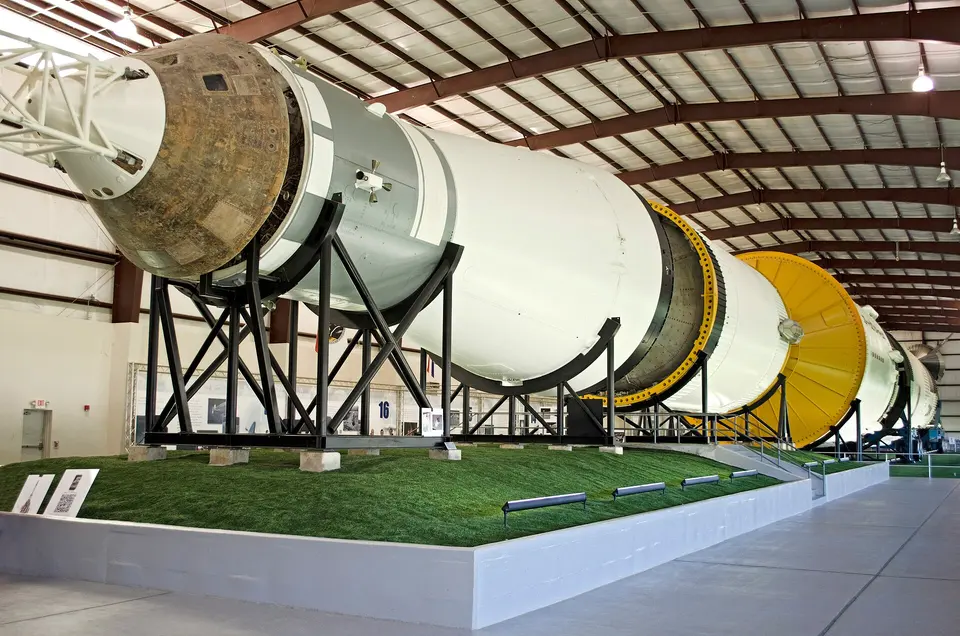
Every crewed American spaceflight since Gemini IV has been run from the campus behind this building, which is why the first word spoken from the surface of the Moon was Houston. The visitor centre holds the shuttle carrier aircraft with a full-size orbiter mock-up on its back, which you can walk through; Starship Gallery with a Mercury capsule, a Gemini, the Apollo 17 command module and a touchable lunar sample; the Astronaut Gallery of flown suits; and a large Independence Plaza. The tram tour into the working Johnson Space Center is the reason to come: it reaches the historic Apollo mission control room, restored to its 1969 condition down to the ashtrays and the paper coffee cups, and Rocket Park, where a genuine Saturn V lies on its side in a purpose-built shed at 110 metres long.

  • Plan about 5 h
  • Hours vary by day and are typically 10:00 to 17:00 with 09:00 openings in peak periods, so check the calendar before you drive; the tram tour is included but queues, and going first thing is the difference between one tram and three hours of waiting

Midday

LunchEat at the Space Center, where the food court is ordinary and the alternative is a 20-minute detour, or push on to Kemah and eat seafood on the boardwalk. The Gulf coast tradition here is boiled crawfish in season, from about February to May, ordered by the pound and dumped on a paper-covered table, and the Vietnamese-Cajun version that Houston invented, with garlic butter and lemongrass, is the one to look for.

Afternoon

30 km north-east round the Ship Channel, about 35 minutes by car
San Jacinto Monument
Photo: Daniel Schwen, CC BY-SA 4.0
2Monument

San Jacinto Monument

On 21 April 1836 Sam Houston's army attacked Santa Anna's camp here in the late afternoon and the battle was over in eighteen minutes; Texas independence followed, and with it the annexation and the war that took a third of Mexico. The monument that marks it was finished in 1939, a fluted shaft of Texas limestone 173 metres tall topped by a 220-tonne star, which makes it the tallest masonry column in the world, slightly taller than the Washington Monument by a margin Texans mention. There is a lift to an observation deck at 152 metres with a view over the battlefield, the reflecting pool and, in every other direction, the petrochemical refineries of the Houston Ship Channel, which is its own kind of history lesson. The museum at the base covers four hundred years of Texas.

  • Plan about 2 h
  • The grounds are free and the observation deck and film are ticketed; open daily, roughly 09:00 to 18:00; it is 30 km east of downtown and works well on the way back from the Space Center

Evening

DinnerBack in town, the Montrose and Washington Avenue corridors hold most of the good kitchens. Houston is the most ethnically diverse large city in the United States and it eats like it: the Mahatma Gandhi District for South Indian, Bellaire Boulevard for Chinese and Vietnamese, and a long tradition of Tex-Mex that here means fajitas, which were invented in Texas from skirt steak that nobody else wanted.

Day 2

The Museum District: a free Piano building, a dark room by Rothko and a hall full of dinosaurs

Spend the day in a cluster of nineteen museums inside two and a half kilometres, starting with the big encyclopaedic one, then the two that the de Menil family gave the city, and finishing in the park and the zoo at the southern end of it.

  • 6 sights
  • Transport between sights
1234561 kmN
Stops in order, straight-line distancesDriving route in Google Maps ↗

Morning

Museum of Fine Arts, Houston
Photo: Michael Barera, CC BY-SA 4.0
1Art museum

Museum of Fine Arts, Houston

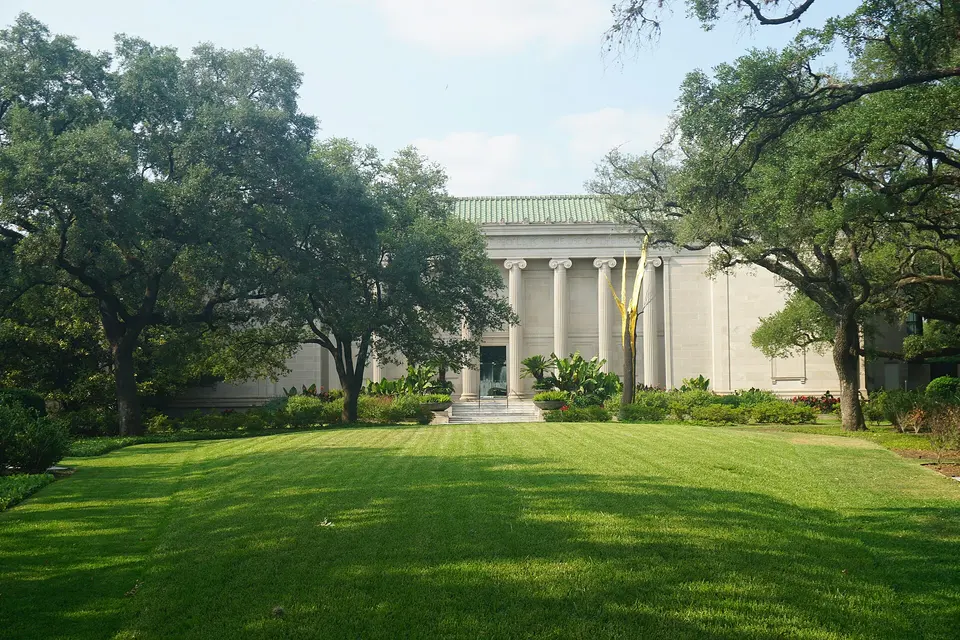
One of the largest art museums in the United States, spread over three buildings and a sculpture garden on either side of Bissonnet Street. Mies van der Rohe designed two of the wings, Isamu Noguchi the garden, and Steven Holl the Kinder Building of 2020 for modern and contemporary work. The collection runs to some 70,000 objects: Italian Renaissance and Dutch painting, a very strong body of Impressionism and post-Impressionism, an African gold collection that is among the best anywhere, pre-Columbian and Latin American holdings that reflect the city's own population, and photography in depth. The tunnel between the two older buildings holds James Turrell's The Light Inside, a 1999 neon corridor that most visitors walk through twice.

  • Plan about 2 h 30 min
  • Open Tuesday to Sunday with late evenings midweek and closed Monday; general admission is ticketed with free Thursdays for the permanent collection; the Kinder Building alone takes an hour
1.5 km west, about 5 minutes by car or 20 on foot through the Montrose bungalows
The Menil Collection
Photo: Francisco Anzola, CC BY 2.0
2Art museum

The Menil Collection

John and Dominique de Menil, refugees from occupied France who had married into the Schlumberger oil fortune, spent forty years buying art and then gave it away with a condition attached: admission would always be free. Renzo Piano's building of 1987 was his first museum, a low grey clapboard structure that looks like the bungalows around it, roofed in 300 curved ferro-concrete leaves that bounce daylight into the galleries without letting the sun in. The collection is about 17,000 works and is shown a little at a time: Palaeolithic and Byzantine objects, an unrivalled surrealism holding with Magritte and Max Ernst, African and Oceanic art, and Rothko, Warhol and Twombly. The campus around it is a residential neighbourhood the foundation quietly bought and kept low.

  • Plan about 2 h
  • Open Wednesday to Sunday 11:00 to 19:00 and closed Monday and Tuesday; admission is free, and so is everything else on the campus; groups over 15 should book ahead
200 m south across the Menil campus, three minutes on foot
Rothko Chapel
Photo: Another Believer, CC BY-SA 3.0
3Chapel

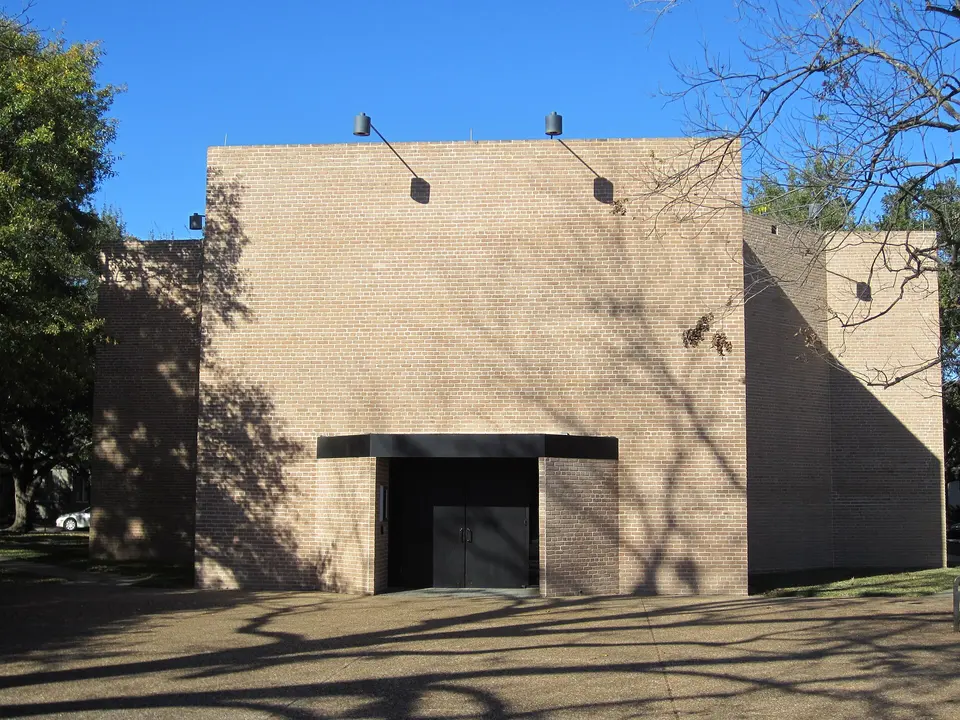
Rothko Chapel

Mark Rothko spent the last years of his life on the fourteen paintings in this octagonal brick room, which the de Menils commissioned in 1964 and opened in 1971, a year after he took his own life. They are very dark, seven of them purple-black triptychs and seven single panels, and in the diffused overhead light they go on changing for as long as you sit there: what looks like flat black at first resolves into maroon, plum and a green that is not quite present. The chapel belongs to no denomination and is used for meditation, for services of every faith and for none. Barnett Newman's Broken Obelisk stands in the reflecting pool outside, dedicated to Martin Luther King Jr. A restoration in 2020 fixed the light Rothko never saw working properly.

  • Plan about 45 min
  • Free and open most days, roughly 10:00 to 18:00 with a closed day midweek; there is no photography, no phones and no talking, and the point is to stay at least twenty minutes; it is two minutes' walk from the Menil

Midday

LunchBistro Menil on the campus is the convenient lunch and a good one. Otherwise walk into Montrose, five minutes away, which is the city's oldest bohemian quarter and holds coffee places, a famous doughnut shop and a long run of restaurants along Westheimer. The museum district itself is thin on food once you leave the Menil campus, so eat before you cross to Hermann Park.

Afternoon

2 km east back to Hermann Park, about 7 minutes by car
Houston Museum of Natural Science
Photo: Another Believer, CC BY-SA 3.0
4Museum

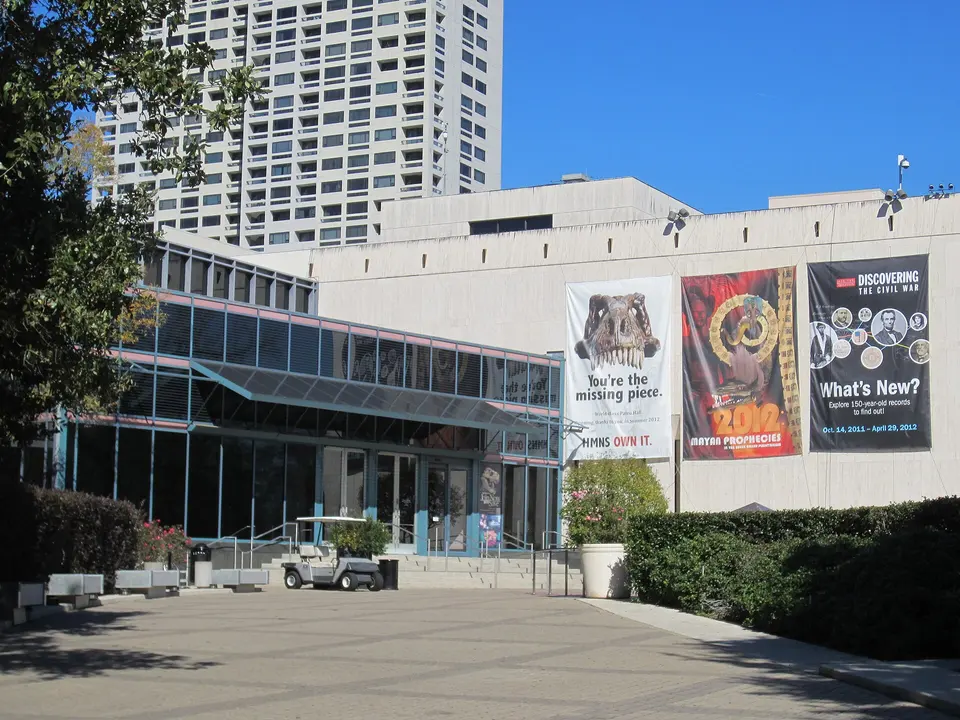
Houston Museum of Natural Science

Consistently one of the best-attended museums in the country, and the palaeontology hall is why: the Morian Hall of Paleontology was rebuilt in 2012 as a walk through deep time in which almost every skeleton is mounted in a moment of action rather than standing still, so a Tyrannosaurus stoops over a Triceratops carcass and a Quetzalcoatlus hangs overhead. Beyond it are the Cullen Hall of Gems and Minerals, the Hall of Ancient Egypt with a serious collection, a wildlife hall of habitat dioramas, the Burke Baker Planetarium and the Cockrell Butterfly Center, a three-storey glass cone full of free-flying tropical butterflies that is ticketed separately. It is next door to the zoo and Hermann Park, which is how most families spend the day.

  • Plan about 2 h 30 min
  • Open daily, generally 09:00 to 17:00 with last entry 16:30 and longer hours on some days; the museum reckons two hours or more; check the website before going, because individual halls close for reinstallation and the gems and entomology halls have both been shut recently
The park begins at the museum's back door, two minutes on foot
Hermann Park
Photo: Zp 2298, CC BY-SA 4.0
5Park

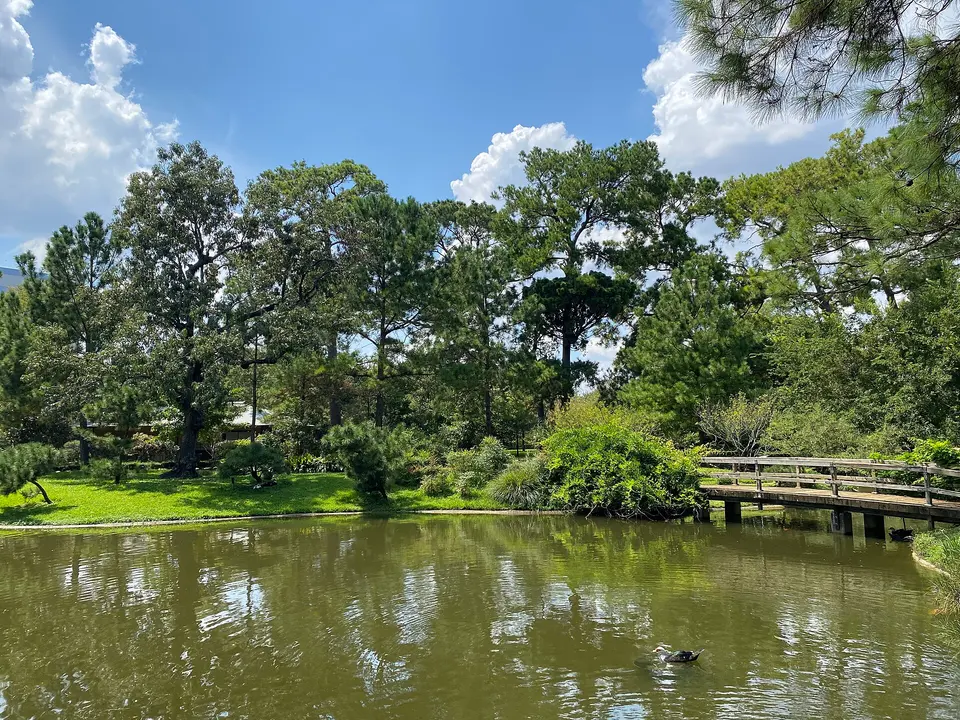
Hermann Park

George Hermann gave the city 115 hectares in 1914 and the park that grew on it is the green centre of Houston's museum district: a formal reflecting pool on the axis of a seated Sam Houston on horseback, a Japanese garden of 1992 with a teahouse and koi, a McGovern Centennial Garden with a spiral mount you can climb for a view, a small train that loops the grounds and is beloved by everyone under eight, and the Miller Outdoor Theatre, a covered stage with a grass hill behind it where every performance for the whole season is free. In a city with brutal summers and very little public space, this is where Houston goes outside.

  • Plan about 1 h 30 min
  • Free and open daily from 06:00 to 23:00; Miller Outdoor Theatre gives out free covered-seat tickets on the day and the hill behind is always open; the Japanese garden closes earlier than the park

Evening

500 m south inside the park, about 8 minutes on foot
Houston Zoo
Photo: Rasar90, CC BY-SA 4.0
6Zoo

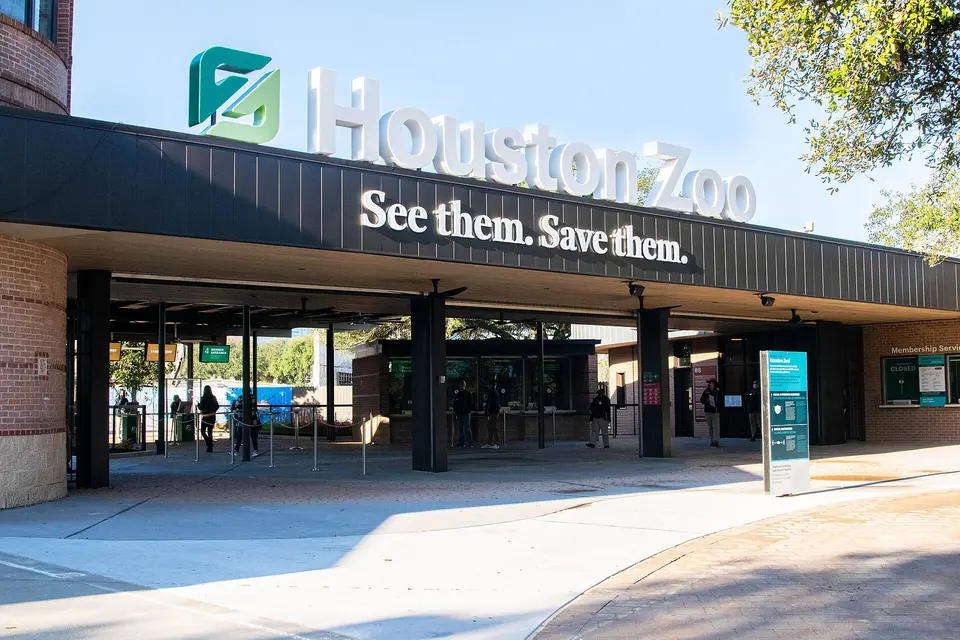
Houston Zoo

Twenty-two hectares inside Hermann Park holding about six thousand animals, and among the better American zoos for the amount of rebuilding it has done: the African Forest complex for chimpanzees, giraffes and rhinos, a Galápagos Islands section opened in 2023 with tortoises and Humboldt penguins, a sea lion pool with an underwater viewing tunnel, and a Kipp Aquarium. A stated share of every ticket goes to field conservation projects, which the zoo publishes. It is a hot walk in summer and the animals know it, so the first two hours after opening are worth more than the rest of the day.

  • Plan about 2 h 30 min
  • Open daily 09:00 to 17:00 with last entry at 16:00; online timed tickets are required for non-members and tickets are not sold at the gate; the zoo closes for daytime admission on 24 December

Day 3

The bayou, the old squares and a monument to the orange

Start on the water the city was founded on, with a flooded 1926 cistern under one end of it, work east through the parks and squares of downtown, and finish in the East End at a folk-art monument that one postman spent twenty-three years building by hand.

  • 6 sights
  • Transport between sights
1234562 kmN
Stops in order, straight-line distancesDriving route in Google Maps ↗

Morning

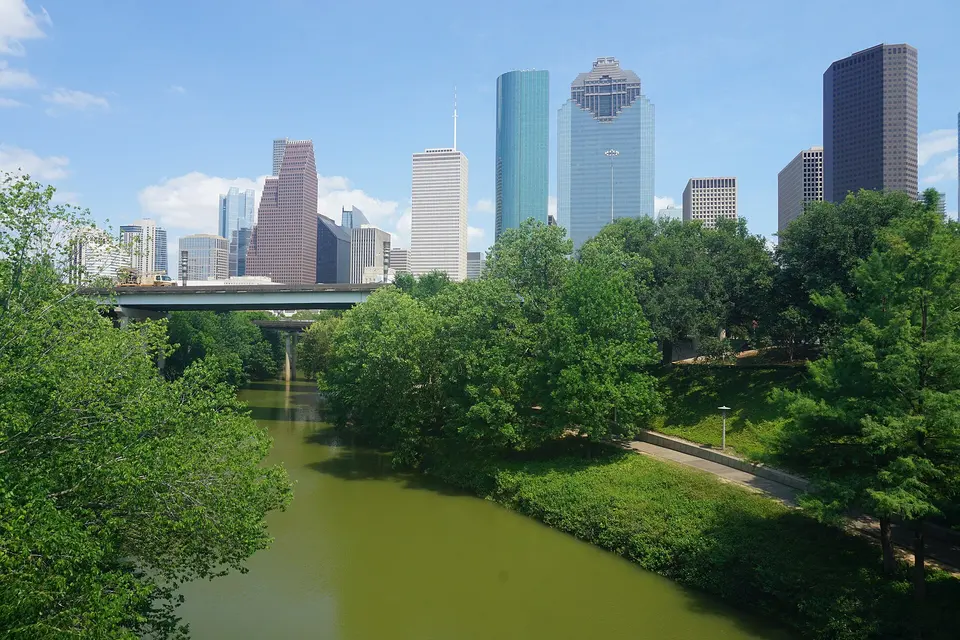
Buffalo Bayou Park
Photo: Michael Barera, CC BY-SA 4.0
1Park

Buffalo Bayou Park

Houston was founded on this bayou and then spent 150 years treating it as drainage. A $58 million rebuild finished in 2015 turned 65 hectares of it west of downtown into a park designed to flood: native planting, concrete paths that go under water and come back, a skate park, a dog park and the Wortham Fountain. Two things make it worth a detour. The first is the Cistern, an abandoned 1926 drinking-water reservoir under the eastern end, 87,000 square feet of columns and standing water with an extraordinary echo, opened for tours in 2016. The second is the Waugh Drive bridge, under which about 250,000 Mexican free-tailed bats live all year and pour out at dusk.

  • Plan about 1 h 30 min
  • The park is open daily with lit areas from 06:00 to 23:00; the Cistern is ticketed and open Wednesday to Sunday; the bats emerge from under the Waugh Drive bridge around sunset and the viewing platform is free
2 km east to the edge of downtown, about 6 minutes by car
Sam Houston Park
Photo: i_am_jim, CC BY-SA 3.0
2Park and historic houses

Sam Houston Park

Houston's first public park, laid out in 1899 at the edge of downtown, now holds eight historic buildings that were moved here to save them from demolition, which is more or less the only way anything old survives in this city. There is the Kellum-Noble House of 1847, the oldest brick house in Houston still on its original site; the 1868 Pillot House with the first indoor kitchen in the city; St. John Church, a German Evangelical Lutheran building of 1891; a plantation house, a cottage and a merchant's residence. The Heritage Society runs guided tours through them. Behind the lawns the glass towers of downtown stand up in a wall, and the contrast is the point.

  • Plan about 1 h 15 min
  • The park is free and open daily; the houses can only be seen on a guided tour, generally Tuesday to Saturday with a small charge, and the Heritage Society gallery is free; it sits directly behind City Hall
400 m north past City Hall, five minutes on foot
Houston City Hall and Tranquillity Park
Photo: Ed Uthman, CC BY 3.0
3Civic building

Houston City Hall and Tranquillity Park

Joseph Finger finished City Hall in 1939 in limestone-clad Art Deco, stepped back in setbacks with a clock tower, aluminium doors cast with scenes of civic virtue, and a lobby of terrazzo and marble that is open to anyone who walks in. It faces Hermann Square, a sunken lawn with a reflecting pool that is the traditional site of every protest, rally and victory parade in the city. Directly across Walker Street is Tranquillity Park, a block opened on 20 July 1979 for the tenth anniversary of the Moon landing: the ground is mounded and cratered to suggest a lunar surface, five stainless-steel cylinders stand in the craters as stylised rocket motors, water falls into the depressions, and the first words spoken from the Moon are cast in bronze in fifteen languages.

  • Plan about 45 min
  • The City Hall lobby is open on weekdays during business hours and is free; Hermann Square and Tranquillity Park are open at all times; with Space Center Houston they make the two ends of the same story, one built for visitors and one for the city itself

Midday

LunchDowntown's tunnel system runs for ten kilometres under the office towers, is air-conditioned, and is where thousands of people eat lunch on a weekday between 11:00 and 14:00; it is worth seeing once and it closes in the evening and at weekends. Above ground, the Historic District around Market Square has the best of the downtown restaurants, and Niko Niko's kiosk in the park itself does very good Greek at a counter.

Afternoon

900 m north-east through downtown, about 12 minutes on foot
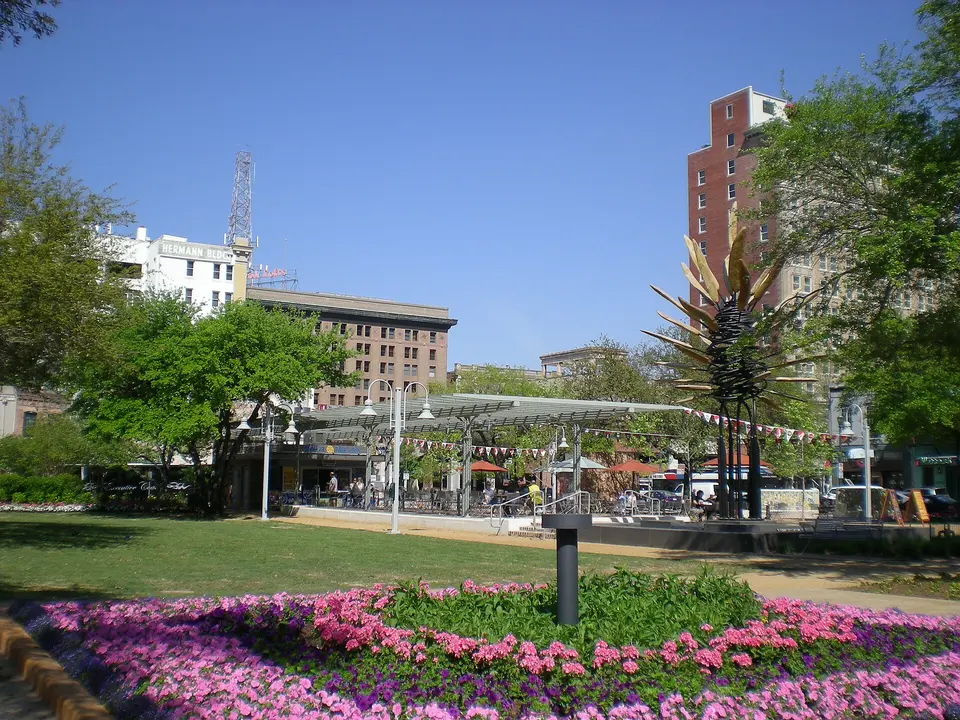
Market Square Park
Photo: Brian Reading, CC BY-SA 3.0
4Park

Market Square Park

This block was the market square of the Republic of Texas town from 1854 and the site of four successive city halls, all of which burned down. By the 1990s it was a parking lot with a reputation. It was rebuilt in 2010 as a small, well-made downtown park: a lawn, a dog run, a permanent kiosk that houses a branch of the Niko Niko's Greek café, public art including a fragment of the old city hall and James Surls's sculpture, and a paved reading area. The blocks around it are Houston's oldest surviving commercial architecture and hold the bars and restaurants of the Historic District, which is where downtown goes in the evening.

  • Plan about 45 min
  • Free and open daily from 06:00 to 23:00; the café kiosk runs through the day and a farmers' market sets up some weekends; the bars of the Historic District start one block west
1.2 km south-east past the ballpark, about 15 minutes on foot
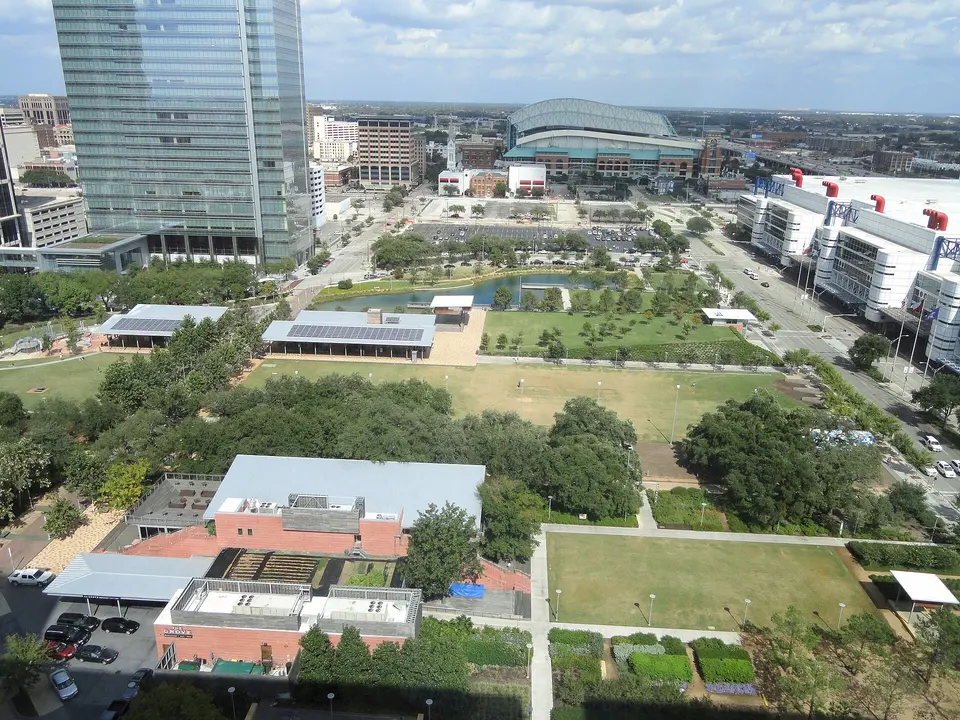
Discovery Green
Photo: Daderot, CC0
5Park

Discovery Green

Five hectares of surface parking opposite the convention centre were turned into a park in 2008, and it worked so completely that the blocks around it filled with towers and hotels within a decade. There is a small lake with model boats for hire, a mist fountain that children run through all summer, two dog runs, a playground, a promenade of live oaks left in place from the parking lot, a reading room, and an ice rink from November to January. Commissioned art is scattered through it, and the programme runs to several hundred free events a year. As a piece of urban repair it is the twin of Klyde Warren Park in Dallas and slightly older.

  • Plan about 1 h
  • Free and open daily from 06:00 to 23:00; the free events calendar is worth checking, and the two restaurants on the park are more expensive than the food trucks that turn up for lunch

Evening

7 km south-east, about 12 minutes by car
The Orange Show
Photo: Ed Schipul, CC BY-SA 2.0
6Folk art monument

The Orange Show

Jefferson Davis McKissack was a postman who believed the orange was the perfect food, and from 1956 to 1979 he built a monument to it on his own lot in the East End out of concrete, brick, scrap iron, tractor seats, mannequins, gears and tiles, opening it to the public in 1979 with a stated hope that it would draw 90,000 visitors a year. About a hundred came. He died a few months later. A foundation bought it, and it is now the anchor of Houston's outsider-art scene along with the Beer Can House and Smither Park next door, a mosaic amphitheatre built by hundreds of hands from broken crockery. It is small, strange, hand-made and entirely sincere, and it tells you more about Houston than any skyline.

  • Plan about 1 h
  • Open limited hours, generally weekend afternoons and some weekdays, with a small charge; Smither Park beside it is free and always open; it sits 7 km south-east of downtown and needs a car

Good to know in Houston

The Museum District: hours and admission

  • The Menil Collection is open Wednesday to Sunday from 11:00 to 19:00 and closed on Mondays and Tuesdays. Admission is free, and the museum asks that groups larger than 15 reserve in advance through its group visit form.Source: The Menil Collection — Visit · checked Sep 2026
  • The Houston Museum of Natural Science opens at 09:00, with regular closing at 17:00 and last entry 16:30, later closings of 18:00 with last entry 17:30 on some days, and a 12:00 opening on others. The museum says the average visit takes two hours or more. Individual halls close for reinstallation without notice: the Cullen Hall of Gems and Minerals and the Brown Hall of Entomology have both been listed as closed.Source: Houston Museum of Natural Science — Hours and Admission · checked Sep 2026
  • Houston Zoo is open daily for daytime admission from 09:00 to 17:00 with the last entry at 16:00. Online timed-ticket reservations are required for all non-member guests and tickets are not sold on site; ticket holders may enter any time after the arrival time printed on the ticket. The zoo closes for daytime admission on 24 December and is open on Thanksgiving Day.Source: Houston Zoo — Plan Your Visit · checked Sep 2026

Buffalo Bayou Park and Battleship Texas

  • Buffalo Bayou Park is open daily, with its lit areas accessible from 06:00 to 23:00. Within the park the Cistern opens Wednesday to Sunday, the Water Works area daily 09:00 to 18:00, and the dog park daily 07:00 to 20:00 except when it closes on Tuesdays from 07:00 to 16:00 for maintenance and on Fridays from 13:00 to 14:30 for pond cleaning.Source: Buffalo Bayou Partnership — Visit · checked Sep 2026
  • Battleship Texas is closed for regular tours because of ongoing repairs and restoration, and the foundation is targeting 2027 for its grand reopening. The ship is moored at the Gulf Copper Shipyard in Galveston, not at the San Jacinto Battleground, which state legislation prevents it from returning to; the best public view is from Galveston's Pier 21. Specialty tours will resume on a limited basis and are announced individually.Source: Battleship Texas Foundation — FAQs · checked Sep 2026

3 days in Houston: quick answers

Is 3 days enough for Houston?

Three days works if you accept that one of them is mostly driving. Space Center Houston needs four to five hours of its own and is 40 km out of town; the Museum District is a full day and could be two; downtown and the bayou are a third. What gets left out is Galveston, an hour south with a Victorian Strand district and the Gulf beaches, and the Houston Arboretum and Memorial Park. Battleship Texas, which used to sit beside the San Jacinto Monument, is closed and in a Galveston shipyard, so do not plan around it.

What is the best time of year to visit Houston?

Late October to April. Winter is mild at 15 to 20°C and is the only comfortable time to be outside for long. March and April are green and pleasant, with crawfish season at its peak. May to September is the problem: temperatures around 34 to 36°C with humidity that makes it feel worse, daily afternoon thunderstorms, and a hurricane season that runs from June to November and occasionally means serious flooding. If you come in summer, plan indoor mornings and outdoor evenings, and never park in an underpass.

Do you need a car in Houston?

Yes. Houston covers more than 1,600 square kilometres with almost no zoning, and its attractions are scattered accordingly. The METRORail Red Line is genuinely useful along the downtown–Museum District–Medical Center axis, and the downtown tunnel system covers a lot of ground underground, but Space Center Houston, San Jacinto, the Orange Show and most good restaurants are unreachable without driving. Ride-hailing works well and parking downtown is cheap by American standards.

How much does Houston cost per day?

Cheaper than most large American cities, and several of the best things are free. The Menil Collection, the Rothko Chapel, all the parks and the San Jacinto grounds cost nothing. A hostel bed runs $35 to $55, a mid-range hotel $130 to $220. Space Center Houston is the single biggest ticket at around $35 for an adult, and the natural science museum and zoo are $25 to $30 each. Eating is a bargain: a Vietnamese or Tex-Mex lunch under $15, a serious dinner $60 to $90, and the crawfish by the pound in season.

Is Space Center Houston worth the trip?

Yes, and it is the one thing in the city that is genuinely unique. The tram tour into the working Johnson Space Center is the reason: it reaches the Apollo-era mission control room, restored to how it looked on 20 July 1969, and Rocket Park, where one of only three surviving flight-ready Saturn V rockets lies horizontal in a shed the length of a football pitch. Go when it opens, take the first tram, and allow the rest of the day. Hours vary daily, so check the calendar before you drive out.

Can you visit Battleship Texas?

Not at the moment. The 1914 dreadnought, the only surviving battleship that served in both world wars, closed in 2019 and has been under restoration since; the Battleship Texas Foundation is targeting 2027 for a grand reopening and the ship is currently moored at a shipyard in Galveston rather than at the San Jacinto Battleground, which by law it cannot return to. The best public view is from Pier 21 in Galveston. Occasional specialty tours are announced but there are no regular tours.

Other Houston itineraries

Keep exploring

Where this connects

THE TRIPWOA APP

Go somewhere.
Make it yours.

Build days around what you love. Follow your route, find your next stop and keep the moments along the way.

Get it on Google PlayAvailable for Android
Free to start
Tripwoa home with a Paris trip and nearby places to explore
Tripwoa day plan for New York with a route map and Times Square stop

A day that feels like you.

Sources and method

Places and coordinates: Wikidata and Tripwoa's open-data place catalog (Overture Maps Foundation, © OpenStreetMap contributors). Photos: Wikimedia Commons, credited on each image. Practical rules: the official sources linked in each note, checked in September 2026.

How this plan was made: Tripwoa's planner drafted the day order from real coordinates and typical visit times. Each stop was then reviewed, reordered where needed and rewritten with AI assistance. Walking distances are straight-line estimates, so allow a little extra time on real streets.