3-day itinerary · India

3 Days in Jaipur

A first-timer's plan that walks the walled city on day one, gives the Amber ridge a whole day of its own rather than a rushed morning, and spends the third on the cenotaphs, the museum and the gorge full of macaques that the coach tours skip. Distances, opening hours and what each ticket costs in 2026 are in the stops.

  • 3days
  • 14sights
  • 0.0 kmon foot between sights

Updated 12 September 2026 · 1 official sources checked · report an error

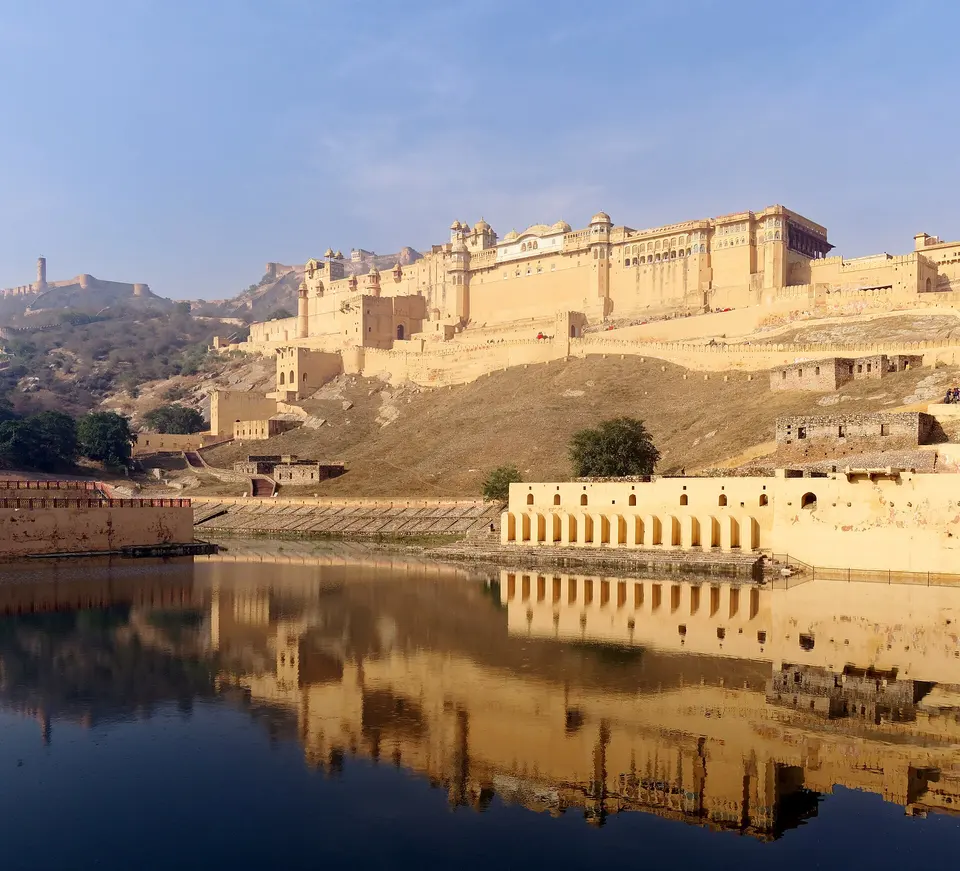
Amber Fort
Photo: Jakub Hałun, CC BY-SA 4.0

The pink city on foot, then Amber and the hill forts, then the cenotaphs, Galtaji and the painted gate

Jaipur is a city of about three million in eastern Rajasthan, 270 km south-west of Delhi and 240 km west of Agra, and it is the only large Indian city that was planned before it was built. Sawai Jai Singh II moved his court down from the fortress at Amber in 1727 because the old capital had run out of water and room, and he laid the new town out on a nine-block grid taken from the Shilpa Shastra, with straight bazaars wide enough for two elephants to pass and each street given to a trade. The walls, the gates, the grid and most of the buildings are still there, which is why UNESCO listed the walled city in 2019 and why Jaipur reads differently from every other city in the country. The pink is not original: Ram Singh II had the whole place washed in it for the Prince of Wales in 1876 and it stuck. Getting here is easy, four hours from Delhi on the fast trains, four from Agra by road, and direct flights from most Indian cities and a few in the Gulf.

At a glance

Ways to use these days

If it rains
3 of the stops are indoors — Govind Dev Ji Temple · Jal Mahal · Albert Hall Museum
Lightest day on foot
Day 1 — 1.9 km between stops
Most walking
Day 3 — 17.6 km

Day 1

The walled city on foot: Hawa Mahal, the City Palace, Jantar Mantar and the bazaars

Start under the honeycomb facade in the first light, spend the late morning in the palace the family still lives in, read the sun off Jai Singh's masonry instruments after lunch, and let the evening take you into the loudest aarti in Rajasthan and out through the trade streets.

  • 5 sights
  • Transport between sights
12345250 mN
Stops in order, straight-line distancesWalking route in Google Maps ↗

Morning

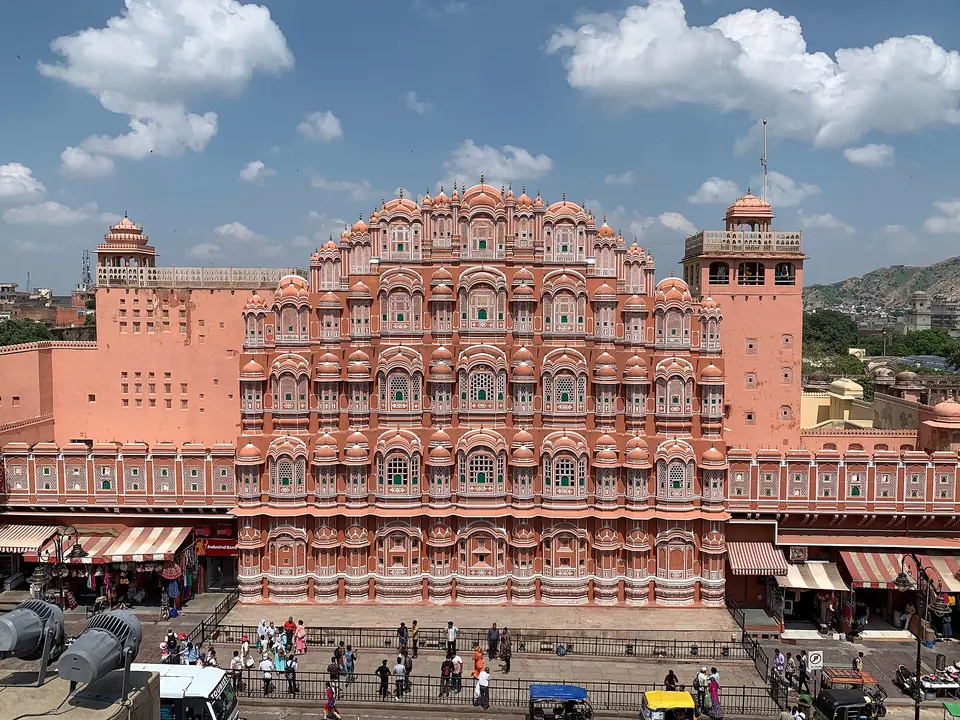
Hawa Mahal
Photo: Chainwit., CC BY-SA 4.0
1Palace facade

Hawa Mahal

Sawai Pratap Singh had it built in 1799 at the edge of the zenana so that the women of the household could watch the processions on the bazaar below without being seen from the street, and what Lal Chand Ustad gave him was not a palace but a screen: five storeys of pink and red sandstone pierced by 953 small windows, each with its own carved canopy, arranged in tiers that narrow towards the top into the shape of Krishna's crown. Behind the honeycomb there is almost nothing, a single room deep in places, reached by ramps rather than stairs because the palanquins had to go up, and the breeze that gave the building its name still comes through the lattice on the hottest afternoon. The east face catches the first sun, which is why every photograph of Jaipur is taken at seven in the morning from the roof of a café on the far side of the road.
  • Plan about 45 min
  • Open daily from about 9:00 to 17:00; entry about ₹50 for Indian visitors and about ₹200 for foreign visitors, and it is on the state composite ticket; the free view is from the rooftop cafés opposite, which expect you to buy a chai
600 m west through Tripolia Bazaar, about 10 minutes on foot; Gate 1 is beside the Jantar Mantar ticket counter and Gate 2 at Jaleb Chowk
City Palace
Photo: Sourabh.biswas003, CC BY-SA 4.0
2Palace museum

City Palace

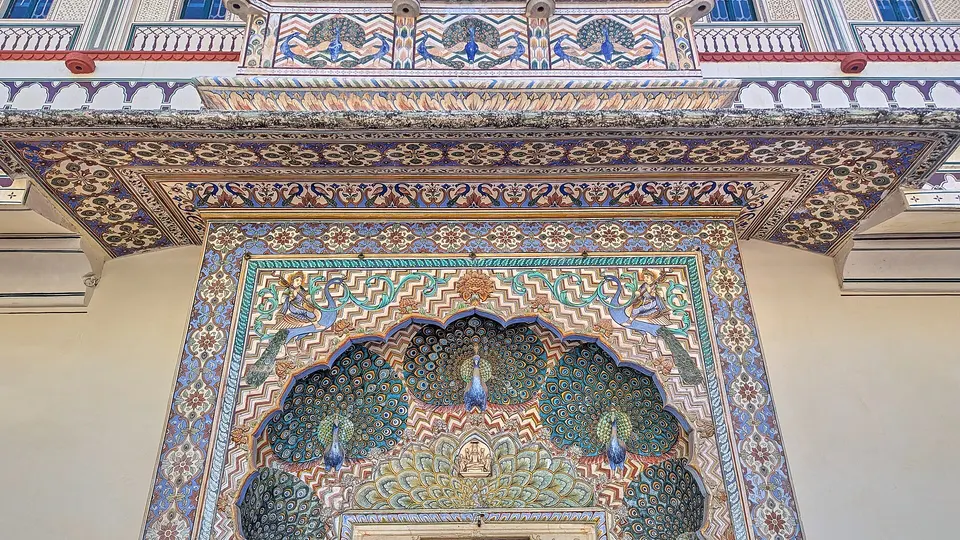
Jai Singh II laid the palace out with the city from 1727 and his descendants still live in the seven-storey Chandra Mahal at the middle of it, which is why a third of the complex is closed and the rest feels lived in rather than preserved. The route runs through the marble Mubarak Mahal, built as a reception house for guests and now holding the royal wardrobe including the enormous quilted robes of Madho Singh I; the Sabha Niwas audience hall, hung with chandeliers and lined with portraits; the Sarvato Bhadra courtyard where the two Gangajali stand, silver urns almost five feet high made from thousands of melted coins so that Madho Singh II could carry Ganges water with him to Edward VII's coronation and never drink anything English; the Sileh Khana armoury of Rajput swords and mail; and Pritam Niwas Chowk, where four doorways for the four seasons are worked in enamel and gilt, the Peacock Gate for autumn being the one every visitor photographs.

  • Plan about 2 h 30 min
  • Open 9:30 to 18:30 seven days a week and closed only on Dhulandi, last tickets at 18:00; two hours is the honest minimum and the composite ticket also covers Jaigarh and the royal cenotaphs

Midday

LunchLunch is easy inside the grid. Laxmi Misthan Bhandar on Johari Bazaar has been doing pure-vegetarian Rajasthani thalis and its own sweets for generations and is the city's default; Rawat Mishtan Bhandar near the station is where people queue for pyaaz kachori; and the rooftop places opposite Hawa Mahal trade a mediocre lunch for a very good view. Eat early, because Jantar Mantar needs sun and the instruments stop making sense in the late afternoon haze.

Afternoon

Next door to the City Palace's Gate 1, two minutes on foot
Jantar Mantar
Photo: Jakub Hałun, CC BY-SA 4.0
3Observatory

Jantar Mantar

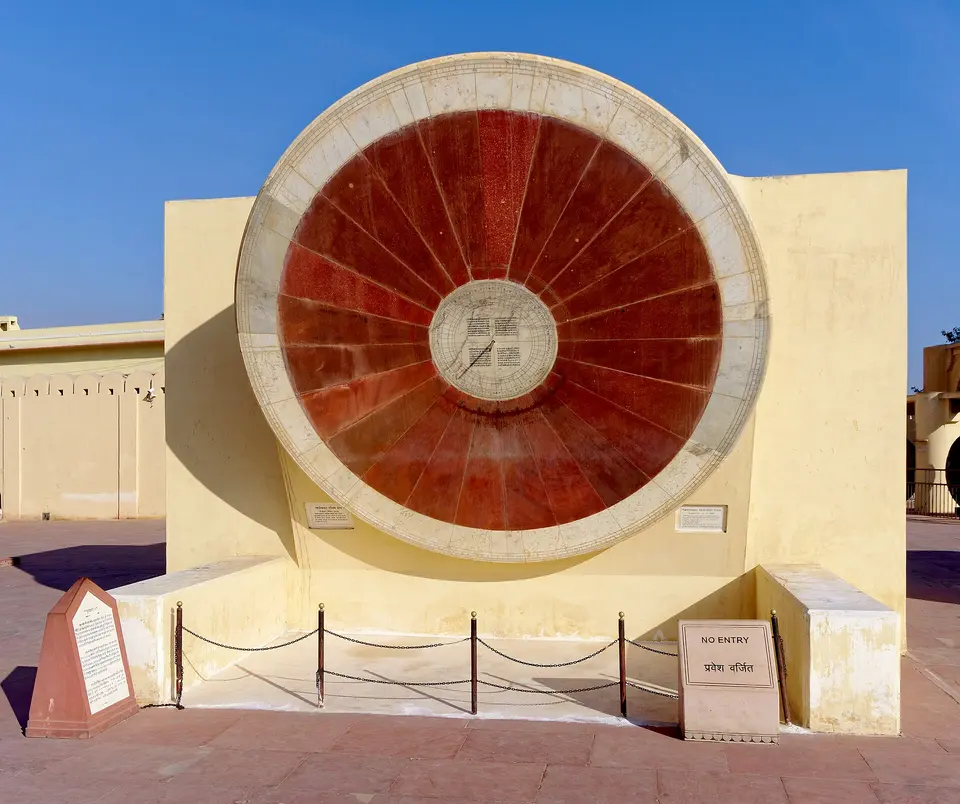
Jai Singh II built five observatories across northern India between 1724 and 1734 and this is the largest and the only one still complete: nineteen instruments in masonry and marble, built big precisely because size buys accuracy in an age before optics. The Vrihat Samrat Yantra is a right-angled triangle twenty-seven metres high whose shadow crosses a marble scale at a speed you can watch, and it gives the local time to two seconds; the two bowls of the Jai Prakash Yantra are sunk into the ground with cross-wires overhead so an observer can stand inside a model of the sky and read a star's position off the map at his feet; the twelve Rashivalaya instruments each face a different zodiac sign and are used for horoscopes to this day. It looks like an abstract sculpture park until somebody explains it, and then it does not.

  • Plan about 1 h 15 min
  • Open daily from about 9:00 to 16:30; about ₹50 for Indian visitors and about ₹200 for foreign visitors; take the guide or the audio guide, because the instruments are unreadable without one, and come on a sunny day

Evening

700 m north through the Jai Niwas gardens behind the palace, about 12 minutes on foot
Govind Dev Ji Temple
Photo: Jakub Hałun, CC BY-SA 4.0
4Temple

Govind Dev Ji Temple

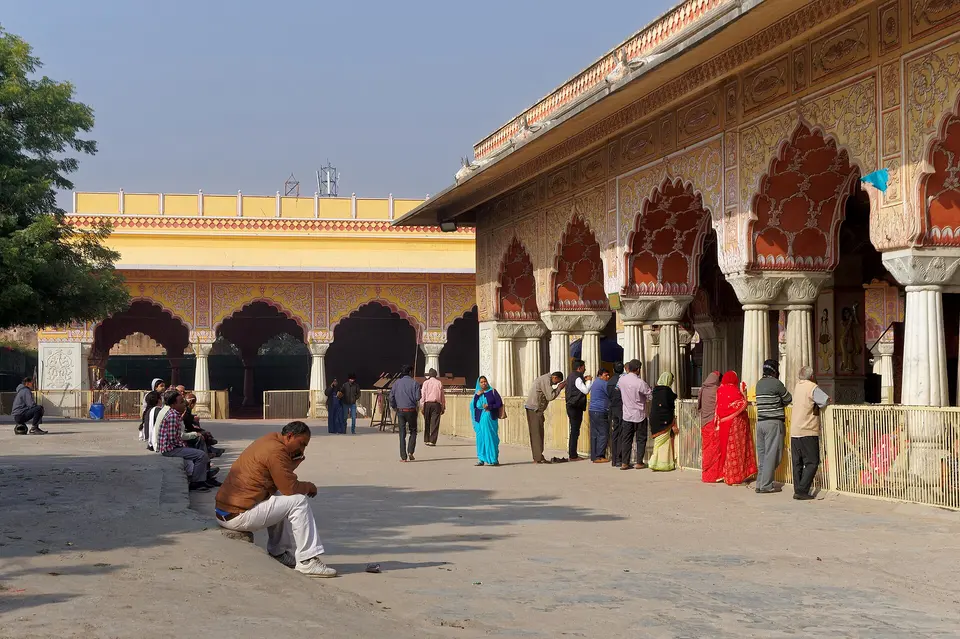
The image of Krishna here was carved in Vrindavan and carried to Rajasthan in the 1720s to keep it out of Aurangzeb's reach, and Jai Singh II housed it in a garden pavilion at the north end of the Jai Niwas gardens, directly on the axis of his own apartments in Chandra Mahal, so that he could see the deity from his window when he woke. There is no tower and no carved gateway; the temple is a broad open hall with a courtyard that holds thousands, and the drama is in the seven aarti of the day, when the curtains are drawn back to reveal the shrine and the crowd surges forward with a noise you hear from the street. It is the busiest devotional place in the city and almost no foreign visitor goes.

  • Plan about 45 min
  • Free and open through the day, with seven aarti between dawn and night; the evening ones are the crowded ones; leave shoes and phones at the counter, and photography of the deity is not allowed
900 m south-east back to Badi Chaupar and down Johari Bazaar, about 15 minutes on foot
Johari Bazaar and the old city bazaars
Photo: Chainwit., CC BY-SA 4.0
5Bazaar

Johari Bazaar and the old city bazaars

The walled city was laid out on a grid of nine blocks in 1727 and its streets were assigned by trade, which is still how they work. Johari Bazaar is the jewellers' street, the centre of a gem-cutting and setting industry that handles a large share of the world's coloured stones and does kundan and meenakari work in upstairs workshops you can ask to see; Tripolia Bazaar sells brass and ironware; Bapu Bazaar is textiles, block prints and the pointed mojari slippers; Chandpole is marble carving; and Maniharon ka Rasta, a lane off Tripolia, is nothing but lac bangles, made over a flame while you wait. The uniform pink wash on the arcades dates from 1876, when Ram Singh II had the city painted for the Prince of Wales and then kept it that way.

  • Plan about 1 h 30 min
  • Most shops open around 11:00 and stay open to about 21:00, and many close on Sunday; haggling is expected and the first price is not serious; the Badi Chaupar crossing is a crush after dark, so keep a hand on your bag

Day 2

Amber and the hill forts: the lake palace, the mirror hall, Jaigarh and sunset at Nahargarh

Drive north past the palace in the lake to be at Amber when the gates open and the courtyards are still cool, walk down to the stepwell in the village, climb to the treasury fort and its cannon, and finish on the ramparts above the city as the light goes.

  • 5 sights
  • Transport between sights
123452 kmN
Stops in order, straight-line distancesDriving route in Google Maps ↗

Morning

Jal Mahal
Photo: Jakub Hałun, CC BY-SA 4.0
1Palace

Jal Mahal

A five-storey sandstone palace standing in the middle of Man Sagar Lake with four of its floors under water when the lake is full, which it now usually is. Madho Singh I rebuilt it in the eighteenth century as a lodge for duck-shooting parties on a lake that had been dammed a century earlier to hold the monsoon run-off from the hills, and the terrace garden on its roof was replanted in a restoration twenty years ago that was never opened to the public. You cannot go in, and there is no boat; what you do is stop on the walkway on the Amber road, look at a building that appears to float, and watch the migratory birds that come to the lake in winter.

  • Plan about 20 min
  • No entry and no boats, so this is a free photo stop of ten or fifteen minutes on the way to Amber; the light is best in the morning, and the vendors on the walkway are persistent
5 km further north, about 15 minutes; park at the bottom and walk up the ramp, or take a shared jeep
Amber Fort
Photo: Jakub Hałun, CC BY-SA 4.0
2Fort palace

Amber Fort

Man Singh I, Akbar's general, began the palace in 1592 on the ridge above Maota Lake where the Kachwaha clan had ruled since the eleventh century, and his successors kept building until the court moved down to Jaipur in 1727. It rises in four courtyards. Jaleb Chowk is the parade ground where the returning army was reviewed; a stair leads to the Diwan-i-Am with its double row of carved pillars; the Ganesh Pol, painted in frescoes over a gateway that only the royal family used, opens into the private palace; and beyond it the Sheesh Mahal is lined floor to ceiling with convex mirror and coloured glass, cut so that a single candle throws a ceiling of stars. Across the courtyard the Sukh Niwas was cooled by water running in a marble channel through the room. Behind everything is the older, plainer Man Singh palace of 1599, and the whole hill is a UNESCO site as one of the Hill Forts of Rajasthan.

  • Plan about 2 h 30 min
  • Open daily from about 8:00 to 17:30 with a separate evening opening around 19:00; entry about ₹200 for Indian visitors and about ₹1,000 for foreign visitors since the state revised its monument fees on 1 January 2026; the walk up from the car park takes fifteen minutes, and a shared jeep saves it
1 km down into Amber village from the fort's east side, about 15 minutes on foot or five by car
Panna Meena ka Kund
Photo: Jakub Hałun, CC BY-SA 4.0
3Stepwell

Panna Meena ka Kund

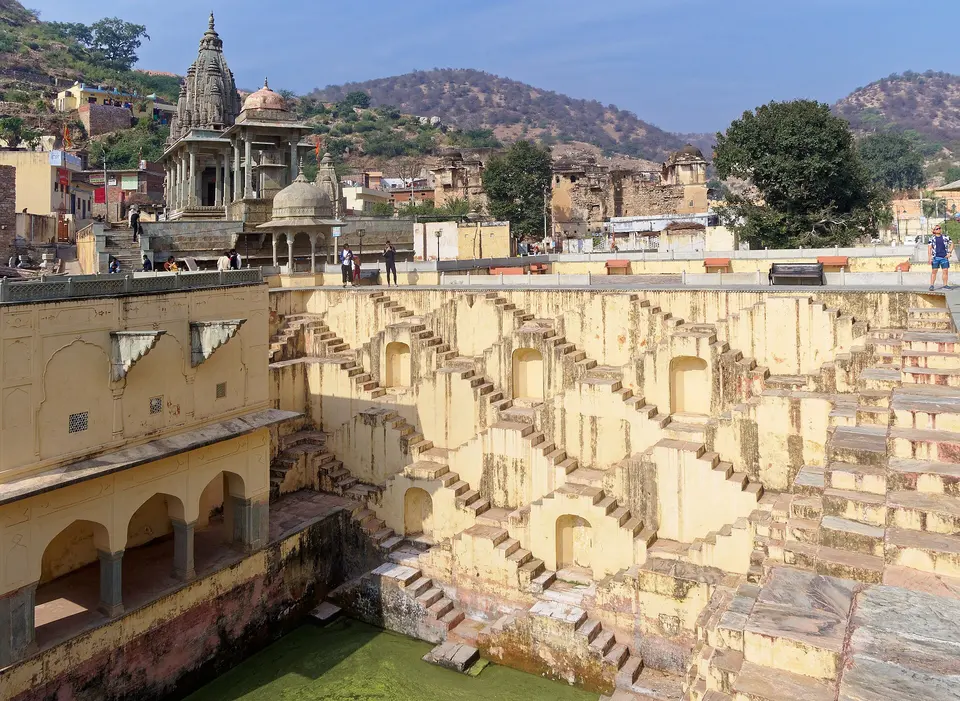
A square well eight storeys deep in the village below Amber, sunk in the sixteenth century so that the settlement had water through the dry months and a cool place to sit through the hot ones. Three of its four sides are covered in criss-crossing flights of steps arranged so that nobody going down ever meets anybody coming up, a piece of social engineering as deliberate as the hydraulics, and the fourth side carries a small pavilion where the women who came for water could rest. The geometry is the reason to come and the reason it photographs so well; climbing on the steps is no longer allowed, which has not stopped people trying.

  • Plan about 30 min
  • Free and open through the day, five minutes on foot from the Anokhi Museum in Amber village; come before 9:00 or after 16:00, because the midday sun flattens the shadows that make the pattern visible

Midday

LunchAmber village has a restaurant inside the fort itself, which is expensive and has the courtyard view, and a row of cheaper dhabas and cafés on the road below serving thali, kachori and lassi. If you would rather eat well than quickly, the old havelis converted to restaurants on the Amber road do laal maas, the fiery red Rajasthani mutton curry, and ker sangri, the desert bean and berry dish that was for centuries the only vegetable the region had.

Afternoon

4 km by the hill road above Amber, about 15 minutes by taxi; the walk up the fortified passage takes 40 minutes
Jaigarh Fort
Photo: Jakub Hałun, CC BY-SA 4.0
4Fort

Jaigarh Fort

The fort on the Cheel ka Teela ridge directly above Amber was finished by Jai Singh II in 1726 to defend the palace below, to which it is joined by a fortified passage, and it held the Kachwaha treasury and arsenal for two hundred years without ever being taken. It is a soldier's building rather than a prince's: long stretches of wall, watchtowers over the valley, courtyards, granaries and enormous underground rainwater tanks fed by a channel off the hills. Its foundry cast Jaivana in 1720, a cannon with a six-metre barrel on a wheeled carriage that is still the largest of its kind anywhere; it was test-fired once and never used in a war. The view down onto Amber's courtyards from the ramparts is the one photograph you cannot get from inside Amber itself.

  • Plan about 1 h 30 min
  • Open daily from about 9:00 to 16:30; about ₹100 for Indian visitors and about ₹200 for foreign visitors, and it is free on the City Palace composite ticket; the road up from Amber is steep, so take the taxi rather than the forty-minute climb

Evening

12 km round the ridge by the north road, about 35 minutes by taxi
Nahargarh Fort
Photo: Jakub Hałun, CC BY-SA 4.0
5Fort

Nahargarh Fort

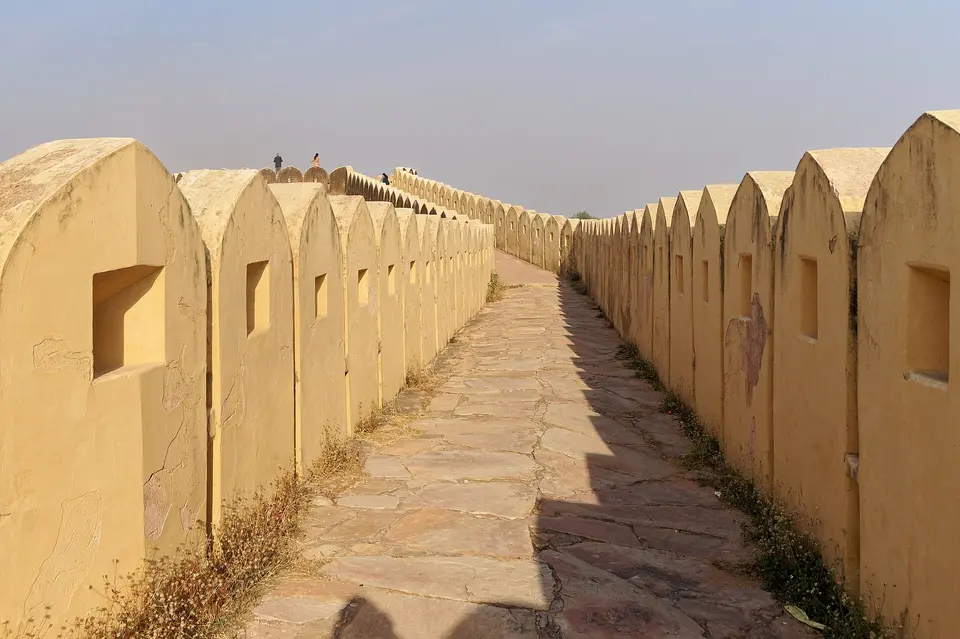
Jai Singh II put a fort on the Aravalli ridge in 1734 to close the northern approach to his new city, and it was never attacked either, which left it free to become something else. In 1868 Ram Singh II added Madhavendra Bhawan inside the walls: nine identical apartments for nine queens, each with its own kitchen, store and lavatory, laid out around a courtyard and joined by a corridor along which the maharaja could reach any of them without the others knowing. The frescoes in the passages are still there. Outside, the ramparts run along the edge of the hill and look straight down on the grid of the walled city, and the drop is sheer enough that the whole plan of Jai Singh's town reads like a drawing.

  • Plan about 1 h 30 min
  • Open daily from about 10:00 to 17:30; about ₹50 for Indian visitors and about ₹200 for foreign visitors; go for the last hour of daylight, when the city turns gold, and the café on the ramparts stays open into the evening

Day 3

Cenotaphs, the museum, the monkey temple and the painted gate

A slower day that circles the city: the royal crematorium garden under the hills, the Indo-Saracenic museum in its park, the spring-fed gorge full of macaques on the eastern edge, and the painted gate in the southern suburbs after dark.

  • 4 sights
  • Transport between sights
12345 kmN
Stops in order, straight-line distancesDriving route in Google Maps ↗

Morning

Cenotaphs of Gaitore
Photo: কুমুদ ঘোষ, CC BY 4.0
1Royal cenotaphs

Cenotaphs of Gaitore

The Kachwaha maharajas were cremated in a walled garden in a fold of the hills below Nahargarh, and each of them was given a chhatri, a domed pavilion on a carved plinth, on the spot where the pyre had stood. There are about twenty, in white marble and in the local pale sandstone, standing on lawns with peacocks in them. Jai Singh II's is the largest and the best carved, a marble dome on twenty pillars whose panels are cut with scenes from the Hindu epics, and it is the only piece of architecture in Jaipur where you can see plainly how much Mughal detail his masons had absorbed. The place is a ten-minute detour from the Amber road and is usually empty.

  • Plan about 45 min
  • Open daily from about 9:00 to 17:00; about ₹30 for Indian visitors and about ₹70 for foreign visitors, and free on the City Palace composite ticket; half an hour is enough, and it fits on the way back from Amber
5 km south back through the walled city to Ram Niwas garden, about 20 minutes
Albert Hall Museum
Photo: Chainwit., CC BY-SA 4.0
2Museum

Albert Hall Museum

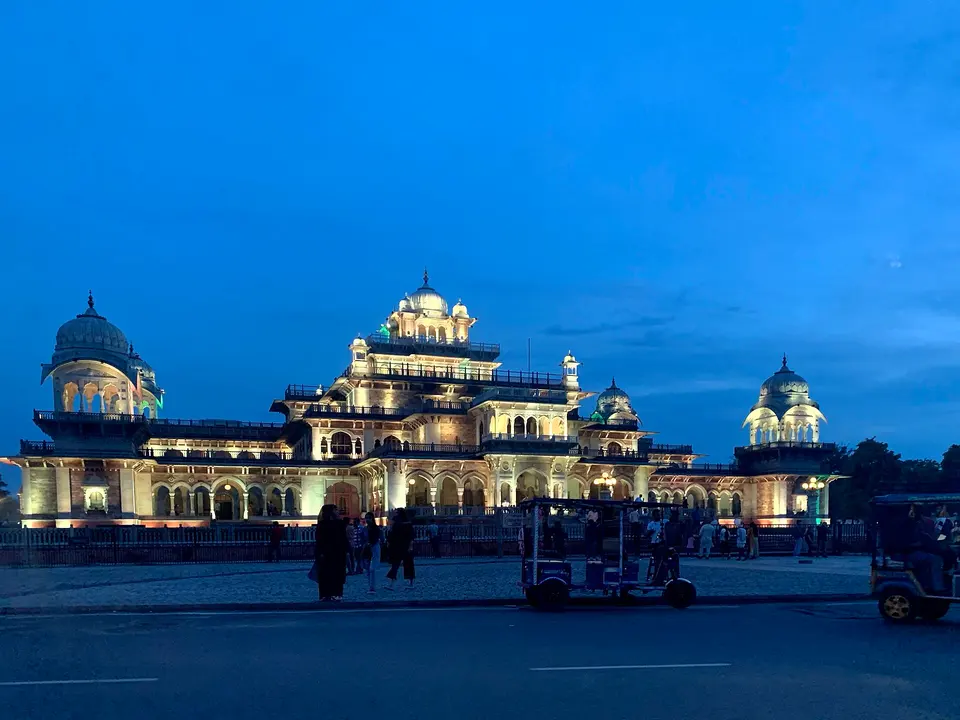
Samuel Swinton Jacob designed the building in 1876 for the visit of the Prince of Wales, and it is the clearest thing in India of what the Indo-Saracenic style was trying to do: a European public hall wearing Rajput chhatris, Mughal arches and a carved sandstone skin, with plaster friezes inside copying Egyptian, Greek and Chinese ornament as a teaching collection for local craftsmen. It opened as the state museum in 1887 and still is one, with Rajasthani miniature paintings, arms, brass and pottery, a room of musical instruments, an Egyptian mummy that arrived from Cairo in the 1880s, and a seventeenth-century Persian garden carpet, woven in Kirman and one of very few of its kind left. Floodlit after dark with the pigeons circling it, the building is better than anything inside it.

  • Plan about 1 h 30 min
  • Open daily from about 9:00 to 17:00 and again from about 19:00 to 22:00 for the lit building; about ₹40 for Indian visitors and about ₹300 for foreign visitors, with a cheaper night ticket; the Ram Niwas garden around it is a good place to sit

Midday

LunchAround Ram Niwas garden the choice runs from the old-city sweet shops to the cafés of C-Scheme ten minutes west, where Jaipur's modern kitchen lives: Anokhi Café above the block-print shop does salads and tarts, Tapri Central serves chai on a terrace over the Central Park, and the old handi restaurants on Station Road cook mutton slowly in a clay pot. Keep it light, because Galtaji is a climb and the macaques take food out of your hands.

Afternoon

6 km east through Ghat Gate and over the ridge, about 25 minutes by taxi; the last stretch is a lane
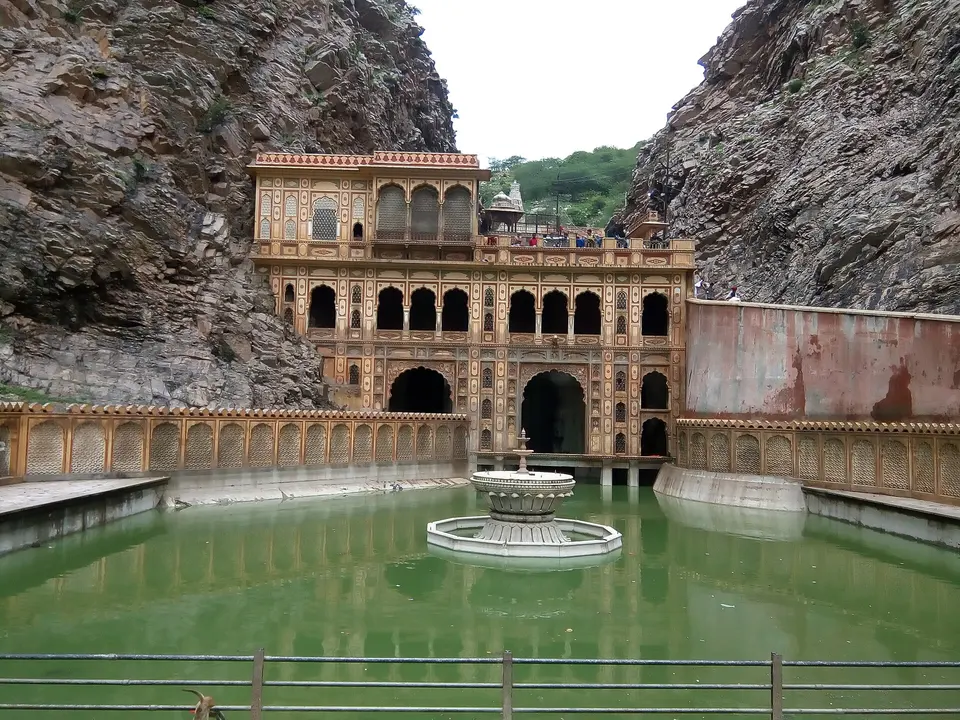
Galtaji
Photo: Roshanrajverma, CC BY-SA 4.0
3Temple complex

Galtaji

A spring rises in a narrow gorge in the hills east of the city, runs down through seven tanks cut into the rock and has never been known to fail, which is why there has been a hermitage here since long before Jaipur existed. Diwan Rao Kriparam built the present complex in the eighteenth century and built it like a palace rather than a temple: pink pavilions on several levels with painted ceilings, pillared halls, and steps down into the green water of the Galta Kund, where pilgrims bathe. Large troops of rhesus macaques live in the gorge and have given the place its tourist name; they are used to people and entirely unsentimental about food. The small Surya temple on the ridge above looks back down over the whole city.

  • Plan about 1 h 15 min
  • Free and open sunrise to sunset; do not carry food, loose bags, sunglasses or a water bottle in your hand, because the macaques will take them; the climb from the Surya temple side is twenty minutes of steps

Evening

11 km south-west to Jawahar Circle on the airport road, about 30 minutes
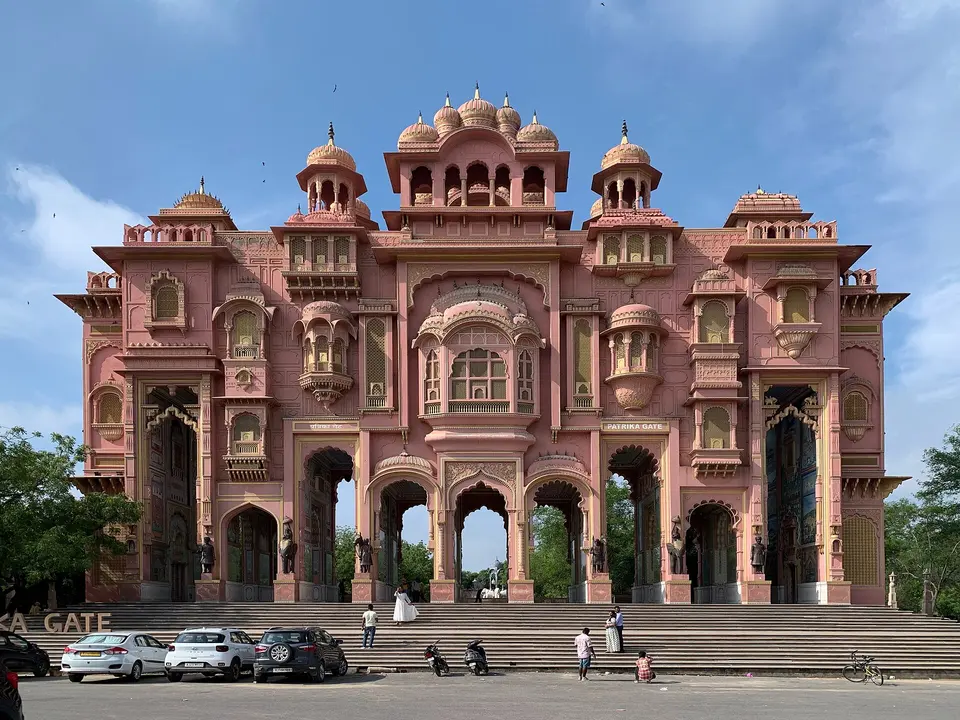
Patrika Gate, Jawahar Circle
Photo: Chainwit., CC BY-SA 4.0
4Gate and park

Patrika Gate, Jawahar Circle

Jaipur's walled city had eight gates; this is the ninth, built in 2016 at the entrance to Jawahar Circle, one of the largest circular parks in Asia, and it is the only piece of modern architecture in the city that people queue to photograph. The arches and the barrel vault are painted over every surface with frescoes of the regions of Rajasthan, done in the traditional manner by living painters, so that walking under it is like standing inside an illuminated manuscript. The park around it has a rose garden, a jogging track and a musical fountain that runs after dark, and it fills up in the evening with families from the new southern suburbs rather than with tourists.

  • Plan about 45 min
  • Free and open through the day, lit in the evening; the fountain show is after dark; it sits 12 km south of the old city on the airport road, so it is easy to fit in on the way in or out

Good to know in Jaipur

City Palace Museum: hours and tickets

  • The City Palace Museum is open from 9:30 to 18:30 seven days a week, with the last tickets sold at 18:00, and it closes only on Dhulandi, the second day of Holi. There are two entrances, Gate 1 next to the Jantar Mantar ticket counter and Gate 2 at Jaleb Chowk, and tickets are sold at both; parking is only at Gate 2, and the nearest metro station is Badi Chaupar on the Pink Line.Source: City Palace Museum, Jaipur — Visit · checked Sep 2026
  • The museum ticket covering the courtyards and galleries costs ₹400 for an Indian adult, ₹200 for students and children under 12 and ₹200 for senior citizens and defence personnel, and ₹1,200 for an international adult with ₹600 for students and children. The composite ticket, which adds Jaigarh Fort and the royal cenotaphs at Gaitore, costs ₹500 for an Indian adult and ₹1,700 for an international adult, with concessions at ₹300 and ₹850.Source: City Palace Museum, Jaipur — Ticket information · checked Sep 2026
  • The Chandra Mahal Royal Tour, which takes visitors into parts of the palace the royal family still occupies, costs ₹4,000 for an Indian adult and ₹5,000 for an international adult and can only be bought at the ticket counter, not online. The Textile Gallery in Mubarak Mahal has been closed for restoration since 27 March 2026 and the Museum at Night programme is temporarily suspended; golf carts within the complex cost ₹150 a person, and guides can be hired at the ticket desk.Source: City Palace Museum, Jaipur — Ticket information · checked Sep 2026

3 days in Jaipur: quick answers

Is 3 days enough for Jaipur?

Three days covers the city properly: a full day inside the walls, a full day on the Amber ridge with Jaigarh and Nahargarh, and a third for the cenotaphs, the museum, Galtaji and the southern edge. Two days forces you to choose between the old city and Amber, and the usual result is a rushed morning at the fort and a photograph of Hawa Mahal taken from a moving car. With a fourth day you could add Chand Baori at Abhaneri, the vast stepwell 90 km east on the Agra road, the ruined town at Bhangarh, or a block-printing workshop at Bagru or Sanganer.

What is the best time of year to visit Jaipur?

November to February, without much argument. Days are 20 to 25°C, the nights are cold enough for a jacket in December and January, and the light is clear. October and March are warm but workable. April to June is genuinely severe, regularly above 40°C, and the forts have almost no shade; July to September brings the monsoon, which greens the Aravallis and fills Man Sagar Lake but also brings humidity and afternoon downpours. Jaipur's festivals cluster in the cool months: the kite festival on 14 January, the literature festival in late January, Holi in March and Teej in the monsoon.

How do you get around Jaipur?

The walled city is a grid and is best walked, which also spares you the traffic at Badi Chaupar. The Pink Line metro runs from Mansarovar in the south-west to Badi Chaupar in the heart of the old city and is quick, clean and cheap, but it is a single line and it does not go to Amber. For everything outside the walls, use a metered auto-rickshaw for short hops, an app cab for longer ones, or hire a car with a driver for the day, which is what most visitors do for the Amber and Nahargarh day because the hill roads are slow and the stops are scattered.

How much does Jaipur cost per day?

Monuments are the main expense for foreign visitors and they rose sharply in January 2026: budget roughly ₹2,500 to ₹3,000 a head for a day that includes Amber, or under ₹500 if you are an Indian resident. A dormitory or simple guesthouse room runs ₹700 to ₹1,500, a good mid-range hotel ₹3,000 to ₹6,000, and a heritage haveli from ₹8,000. Food is cheap if you eat where the city eats: a thali is ₹200 to ₹400, a café lunch ₹600, a serious dinner ₹1,500 a head. A car with a driver for the Amber day is about ₹2,000 to ₹2,500.

Should you visit Amber Fort in the morning or the afternoon?

Morning, and early. The fort opens at about 8:00, the coach groups arrive between 10:00 and 11:00, and the courtyards are both cooler and emptier in the first two hours. It also leaves the afternoon for Jaigarh above it, which is the natural continuation, and the evening for Nahargarh, where the point is the sunset over the city rather than the building. If you can only go in the afternoon, go late and stay for the separate evening opening, when the Sheesh Mahal is lit.

Is Jaipur safe for visitors?

Yes, with the ordinary caution any crowded Indian city asks for. Petty theft happens in the crush at Badi Chaupar and around Hawa Mahal, so carry your bag in front; the commission system is aggressive, and a driver who offers to take you to a government emporium is being paid to, so decline and name your own stop. Solo women travellers generally report Jaipur as comfortable by day and prefer app cabs after dark. At Galtaji the macaques are the real hazard: they will take food, bottles and sunglasses straight out of your hand.

Other Jaipur itineraries

Keep exploring

Where this connects

THE TRIPWOA APP

Go somewhere.
Make it yours.

Build days around what you love. Follow your route, find your next stop and keep the moments along the way.

Get it on Google PlayAvailable for Android
Free to start
Tripwoa home with a Paris trip and nearby places to explore
Tripwoa day plan for New York with a route map and Times Square stop

A day that feels like you.

Sources and method

Places and coordinates: Wikidata and Tripwoa's open-data place catalog (Overture Maps Foundation, © OpenStreetMap contributors). Photos: Wikimedia Commons, credited on each image. Practical rules: the official sources linked in each note, checked in September 2026.

How this plan was made: Tripwoa's planner drafted the day order from real coordinates and typical visit times. Each stop was then reviewed, reordered where needed and rewritten with AI assistance. Walking distances are straight-line estimates, so allow a little extra time on real streets.