3-day itinerary · Morocco

3 Days in Marrakech

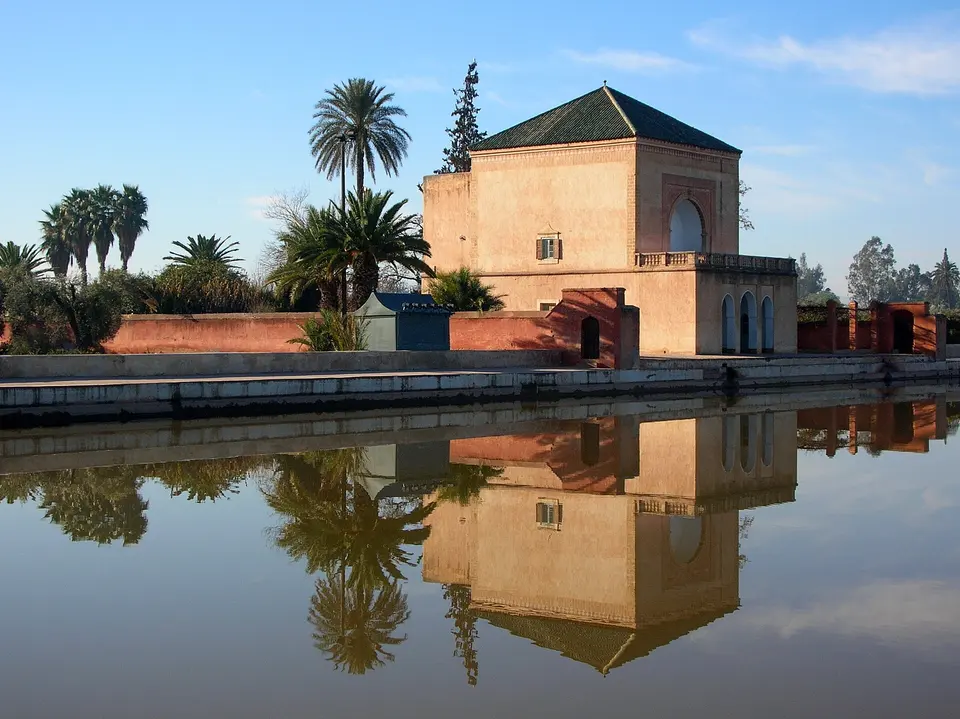
A realistic first-timer plan that walks the southern medina on day one, from the Koutoubia minaret to the Bahia Palace, the ruins of El Badi and the Saadian Tombs, and ends among the food stalls of Jemaa el-Fna; spends day two in the Majorelle garden and the Yves Saint Laurent museum before the Ben Youssef Madrasa, Le Jardin Secret and the souks; and gives day three to the palace of Dar el Bacha, the Mellah and its synagogue, the kasbah gate of Bab Agnaou and sunset at the Menara. Every stop comes with walking distances and the prices and hours that matter in 2026.

  • 3days
  • 16sights
  • 6.3 kmon foot between sights

Updated 12 September 2026 · 11 official sources checked · report an error

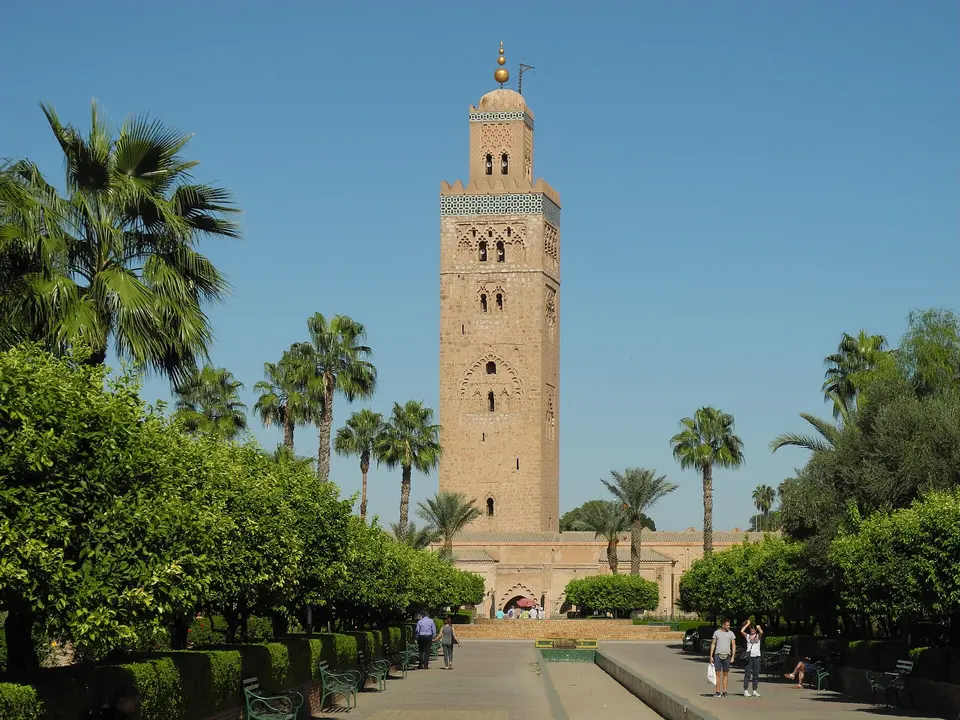
Koutoubia Mosque
Photo: Baca12, CC BY-SA 4.0

The southern medina, then Majorelle and the souks, then the Mellah and the gardens

The medina of Marrakech is a walled city of a kilometre and a half across, with Jemaa el-Fna square at its heart, so all three days start on foot from the square. Day one goes south and east: the Koutoubia, the Bahia Palace, the carpet museum of Dar Si Said, the sunken gardens of El Badi and the Saadian Tombs, then back to the square for the night market. Day two goes north, by taxi to the Majorelle garden and the Yves Saint Laurent museum at opening, then on foot to the Ben Youssef Madrasa, the Almoravid Koubba, Le Jardin Secret and the covered lanes of the souks. Day three is the pasha's palace of Dar el Bacha, the Jewish quarter and its synagogue, the Almohad gate of Bab Agnaou and the olive groves of the Menara at sunset. Dar el Bacha and Dar Si Said are closed on Mondays and the YSL museum on Wednesdays, so set the days accordingly.

At a glance

Ways to use these days

If it rains
3 of the stops are indoors — Bahia Palace · Dar Si Said (National Museum of Weaving and Carpets) · Musée Yves Saint Laurent Marrakech
Lightest day on foot
Day 2 — 2.7 km between stops
Most walking
Day 3 — 5.6 km

Day 1

The southern medina: palaces, tombs and the square at night

Start under the Koutoubia minaret, walk east to the painted courtyards of the Bahia Palace and the carpets of Dar Si Said, eat by the tinsmiths' square, see the storks on the ruined walls of El Badi and the marble of the Saadian Tombs, and come back to Jemaa el-Fna as the food stalls light up.

  • 6 sights
  • 3.2 km on foot
  • Longest walk 1.1 km
123456250 mN
Stops in order, straight-line distancesRoute in Google Maps ↗

Morning

Koutoubia Mosque
Photo: Baca12, CC BY-SA 4.0
1Mosque and gardens

Koutoubia Mosque

The 77-metre minaret of the Almohad mosque, finished around 1195, is the landmark of the city and the model for the Giralda in Seville and the Hassan Tower in Rabat; its name comes from the booksellers' souk that once stood at its foot. Non-Muslims cannot go inside, but the rose gardens and the paved esplanade around it, with the foundations of the first mosque marked out on the ground, are open to everyone, and the tower is best seen from here in the morning light and from the square after dark, floodlit.
  • Plan about 30 min
1.1 km · about 17 min on foot
Bahia Palace
Photo: Val Traveler, CC BY-SA 4.0
2Palace

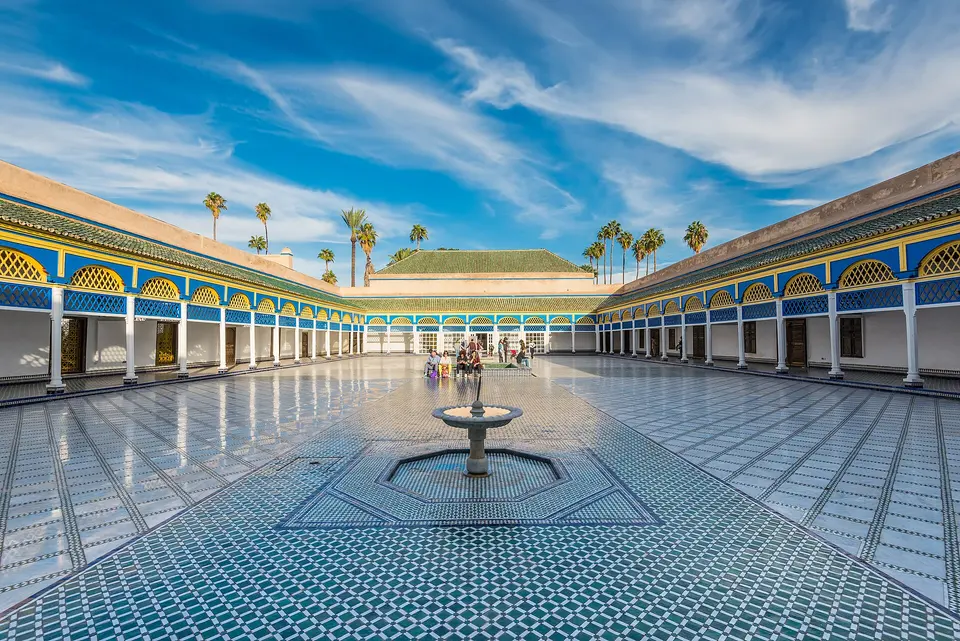
Bahia Palace

Built in the last decades of the 19th century for the grand viziers Si Moussa and his son Ba Ahmed, the Bahia is a labyrinth of eight hectares: 150 rooms around courtyards of orange trees and fountains, with painted cedar ceilings, carved stucco and zellij tiles covering every surface, and a marble grand court of 1,500 square metres. Only part is open, and it fills with tour groups by mid-morning; be at the gate at 9:00.

  • Plan about 1 h 15 min
  • 9:00–17:00 daily; 100 Dh, cash
230 m · about 4 min on foot
Dar Si Said (National Museum of Weaving and Carpets)
Photo: C messier, CC BY-SA 4.0
3Museum

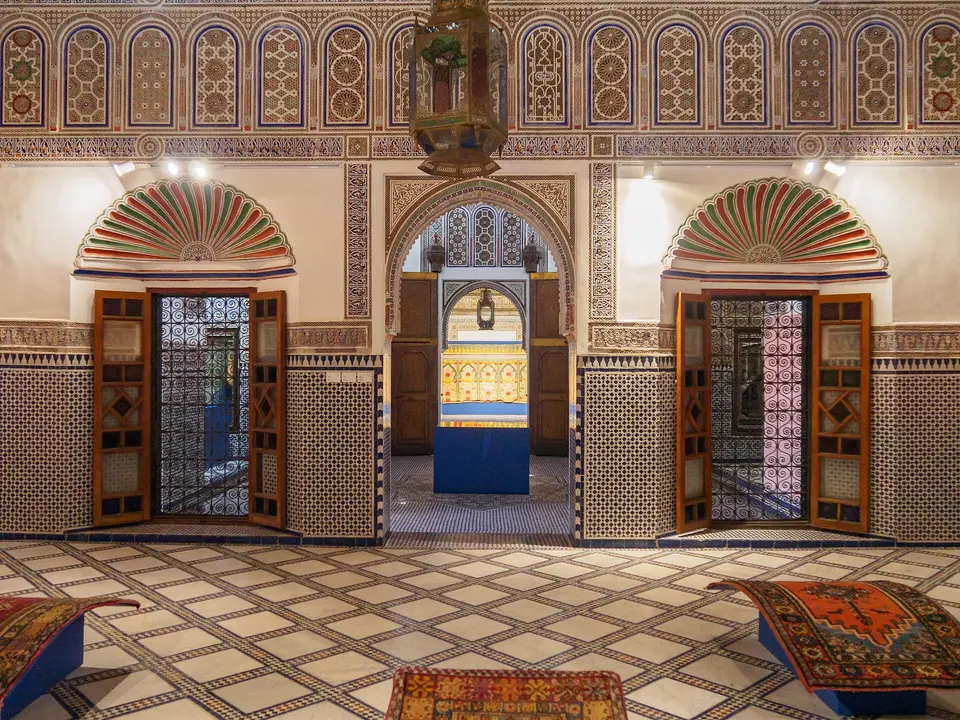
Dar Si Said (National Museum of Weaving and Carpets)

A hundred metres from the Bahia, the smaller palace of Ba Ahmed's brother Si Said is the finest of the two houses to look at, with a painted domed reception room on the first floor and a garden courtyard; since 2018 it has been the national carpet museum, hanging Berber, urban and Middle Atlas weavings by region, which is the best preparation for the souks.

  • Plan about 45 min
  • Tuesday to Sunday 10:00–18:00, closed Mondays; 30 Dh

Midday

LunchPlace des Ferblantiers, the tinsmiths' square between the Bahia and El Badi, has shaded café terraces and the spice market beside it; the rooftop restaurants around the square do tagines with a view of the storks' nests on the El Badi walls.

Afternoon

590 m · about 9 min on foot
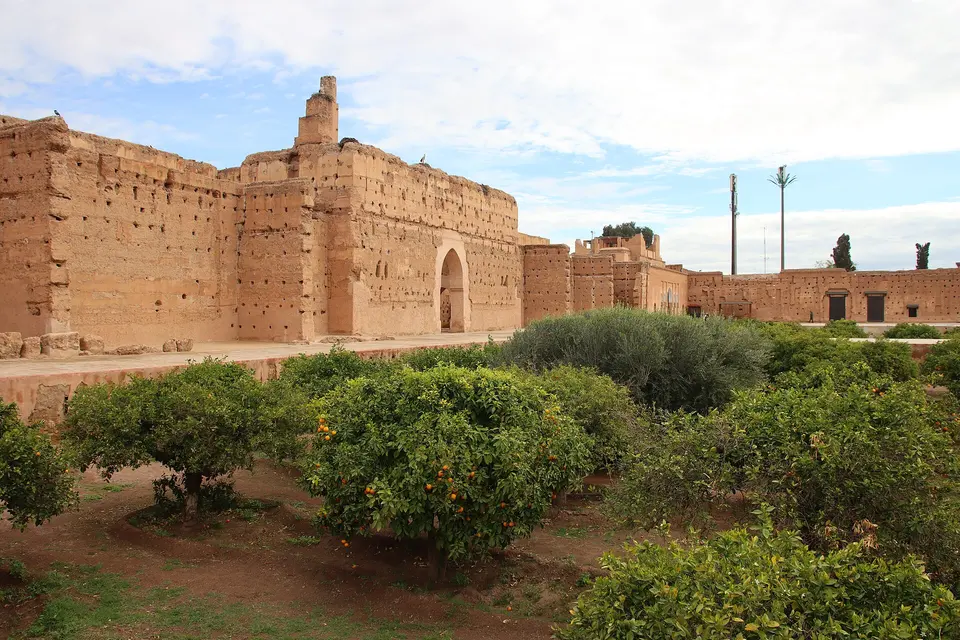
El Badi Palace
Photo: Draceane, CC BY-SA 4.0
4Palace ruins

El Badi Palace

The Saadian sultan Ahmad al-Mansur built 'the Incomparable' between 1578 and 1593 with the ransom of a Portuguese army and Italian marble paid for with sugar; a century later Moulay Ismail stripped it to decorate Meknes, and what is left is the skeleton, a vast court with a 90-metre pool, sunken orange gardens and red pisé walls topped with storks' nests. Climb to the terrace for the view, and see the carved 12th-century minbar of the Koutoubia, made in Córdoba, which is kept in a pavilion here.

  • Plan about 1 h
  • 9:00–17:00 daily; 100 Dh, cash
290 m · about 5 min on foot
Saadian Tombs
Photo: C messier, CC BY-SA 4.0
5Royal necropolis

Saadian Tombs

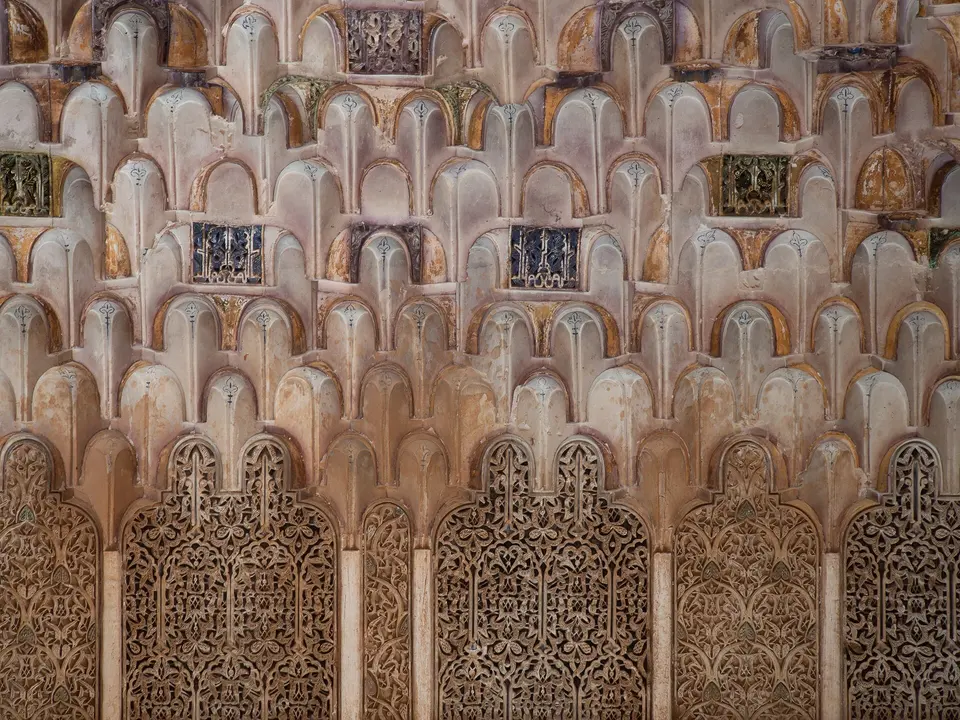
Moulay Ismail walled up the burial garden of the Saadian dynasty rather than destroy it, and it was forgotten until a French aerial survey found it in 1917; a narrow passage beside the Kasbah mosque now leads into a garden of graves and two mausoleums. The Chamber of the Twelve Columns, where Ahmad al-Mansur lies under a dome of carved cedar on Carrara marble pillars, is the most beautiful room in Marrakech and is seen from its doorway, one small group at a time, which is why the queue forms; go last thing before closing.

  • Plan about 45 min
  • 9:00–17:00 daily; 100 Dh, cash

Evening

970 m · about 15 min on foot
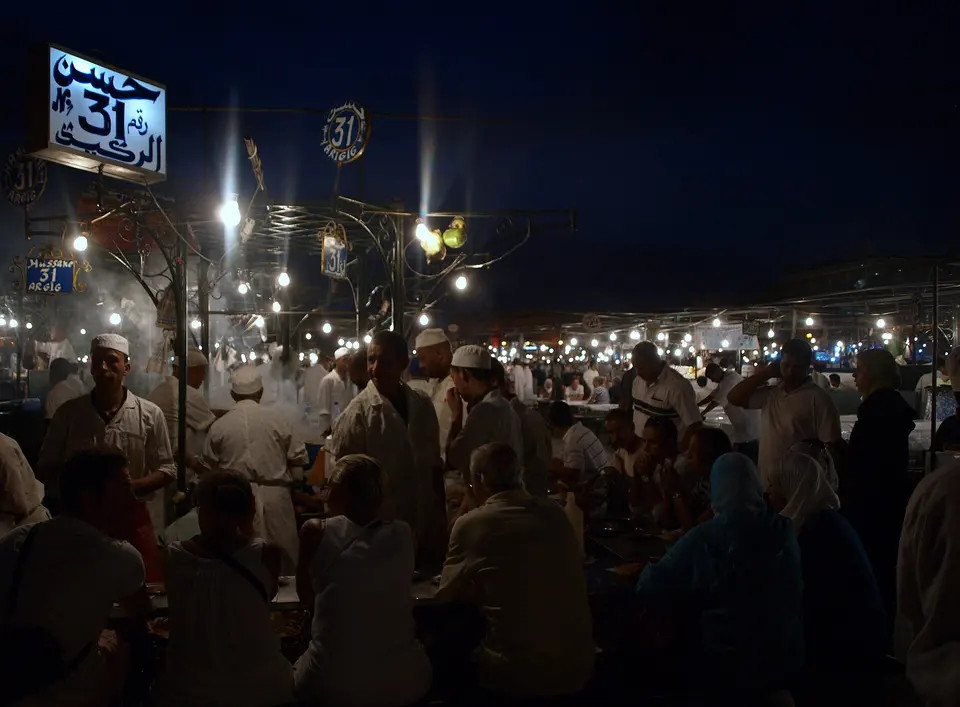
Jemaa el-Fna
Photo: Angela Stefanoni, CC BY 3.0
6Square and night market

Jemaa el-Fna

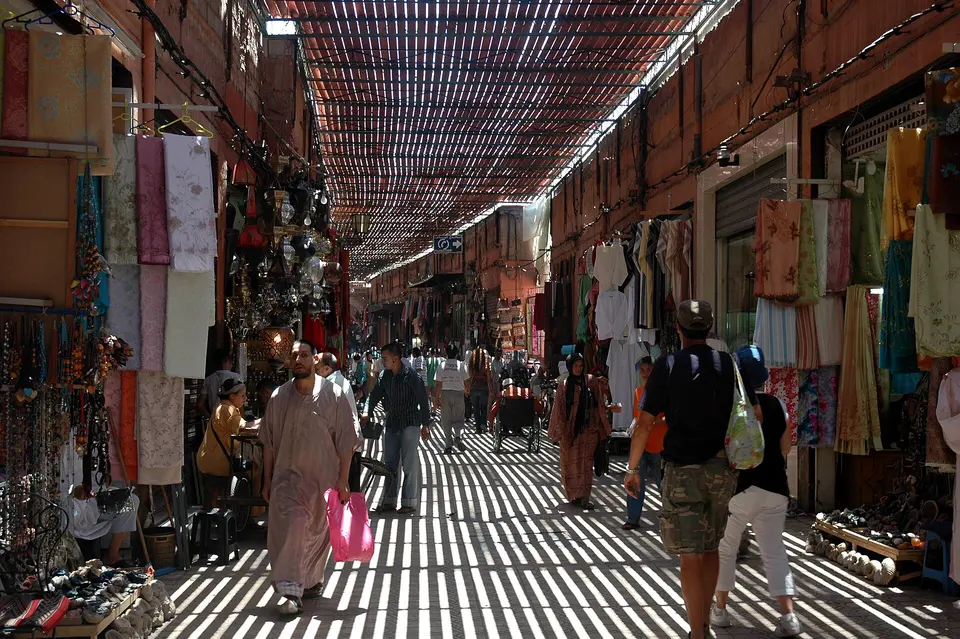
By day the great square is orange-juice carts, snake charmers, henna artists and water sellers; at dusk a hundred food stalls are wheeled into rows and lit, and the storytellers, Gnaoua musicians and drummers whose performances UNESCO inscribed as intangible heritage in 2008 draw their circles of listeners. Eat at the numbered stalls, grilled meats and merguez, snail soup, harira and fried fish, choosing the ones where Moroccans are eating, then take a mint tea on a rooftop café to watch the smoke rise over the whole thing.

  • Plan about 2 h

Day 2

Majorelle, the madrasa and the souks

Be at the Majorelle garden when it opens, see the Yves Saint Laurent museum next door, take a taxi back into the medina for the Ben Youssef Madrasa, the Almoravid Koubba and the roof of Le Jardin Secret, and spend the afternoon in the souks.

  • 6 sights
  • 690 m on foot
  • Longest walk 290 m
123456500 mN
Stops in order, straight-line distancesRoute in Google Maps ↗

Morning

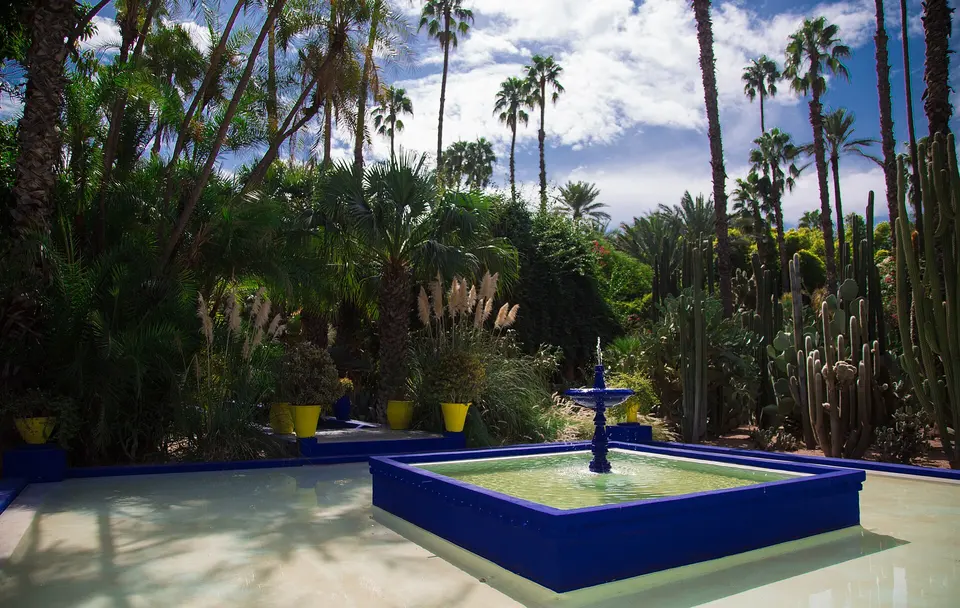
Jardin Majorelle
Photo: Belbachirkamal, CC BY-SA 4.0
1Botanical garden

Jardin Majorelle

The painter Jacques Majorelle laid out this garden of cactus, bamboo, palms and lily pools from 1923 around a studio he painted the cobalt blue that carries his name; Yves Saint Laurent and Pierre Bergé bought it in 1980 to save it from developers, and it has become the most visited place in Morocco. The studio holds the Berber Museum of jewellery, costume and carpets. It is small and it is crowded: book the first slot of the day online, because tickets are not sold at the gate.

  • Plan about 1 h 15 min
  • 8:00–18:30, last entry 18:00; online tickets only at tickets.jardinmajorelle.com
150 m · about 2 min on foot
Musée Yves Saint Laurent Marrakech
Photo: Sämisch, CC BY-SA 4.0
2Museum

Musée Yves Saint Laurent Marrakech

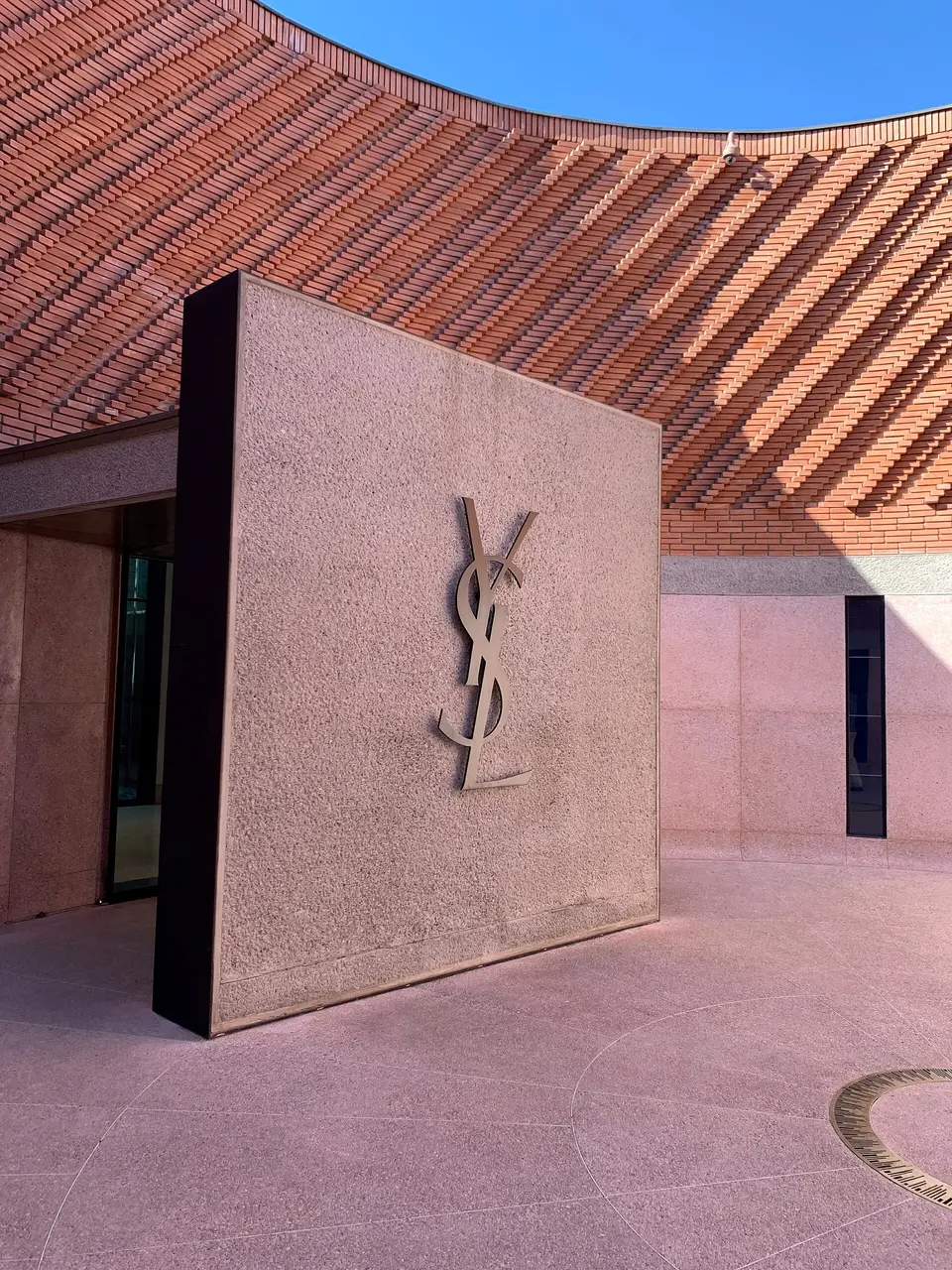
Next door to the garden, the terracotta-brick museum designed by Studio KO in 2017 shows the couturier's work in rotating selections from five thousand garments and accessories, with a hall on his forty years in Marrakech, a temporary exhibition space, a library and an auditorium; the café in the courtyard is a good one. Buy the combined ticket with the garden.

  • Plan about 1 h
  • 10:00–18:30 daily except Wednesdays, last entry 18:00; tickets online only

Midday

LunchLe Jardin Secret's café and the terraces around Place Ben Youssef cover lunch inside the medina; Nomad and Café des Épices on the spice square of Rahba Kedima are the best-known roofs for a salad or a tagine over the souks.

Afternoon

Petit taxi from the Majorelle gate to Bab Taghzout or Place Ben Youssef, about 10 minutes; on foot it is 2 km through Gueliz and the northern medina, about 30 minutes
Ben Youssef Madrasa
Photo: Marco Almbauer, CC BY-SA 4.0
3Islamic college

Ben Youssef Madrasa

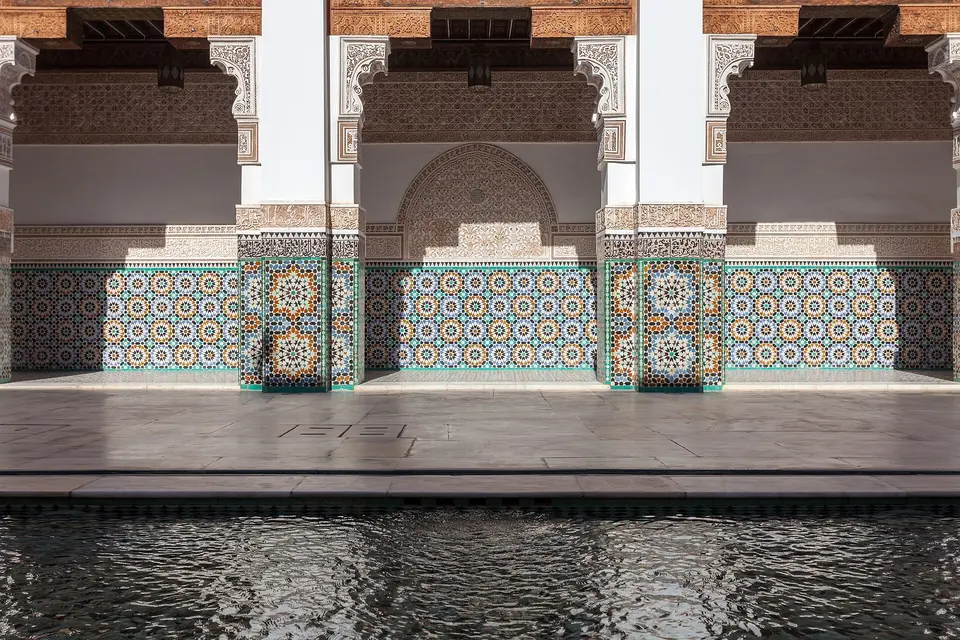
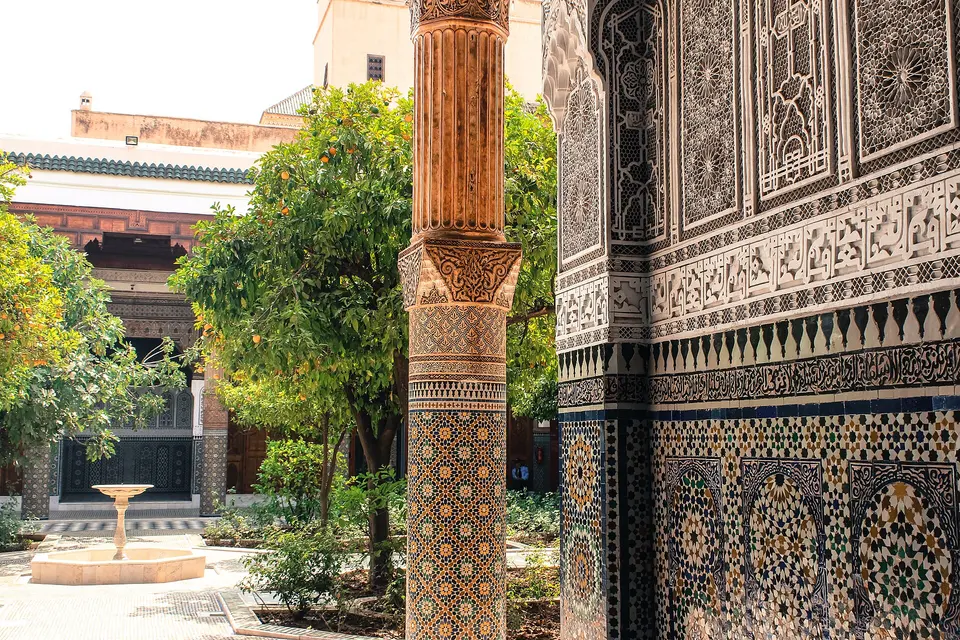
The largest Koranic college in Morocco, rebuilt by the Saadians in 1565 on Marinid foundations, is the medina's masterpiece: a marble courtyard around a long pool, walls rising through bands of zellij, carved stucco and cedar to a lattice of light, and 132 tiny student cells on two floors around the galleries, where up to 900 students lived until 1960. Restored and reopened in 2022, it is at its emptiest at 9:00 and at its best when the sun is high in the court.

  • Plan about 1 h
  • 9:00–19:00 daily (9:00–16:30 in Ramadan); 50 Dh
130 m · about 2 min on foot
Almoravid Koubba
Photo: Adam Harangozó, CC BY-SA 4.0
4Historic monument

Almoravid Koubba

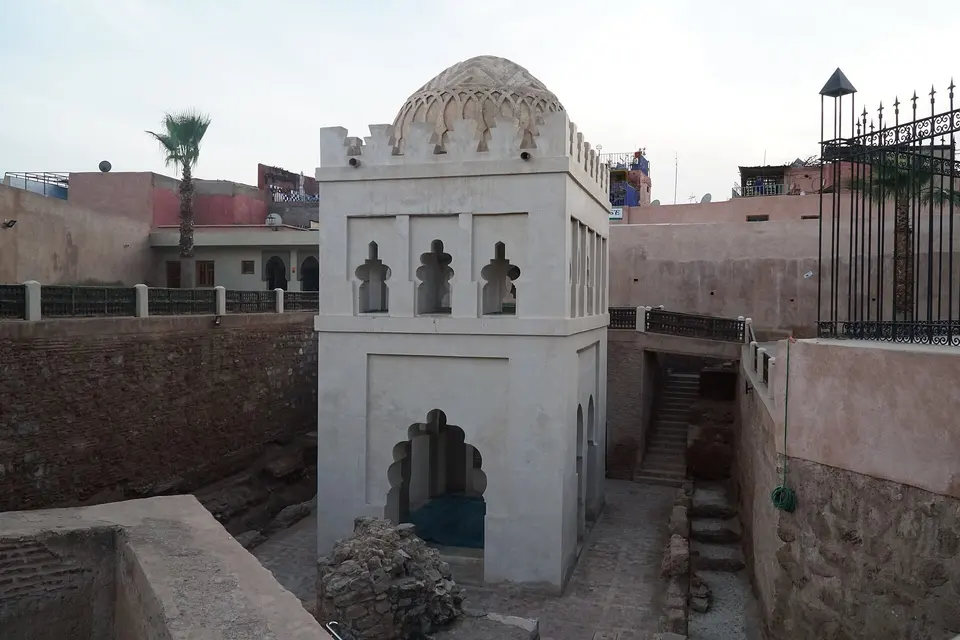
In the square below the madrasa, sunk several metres beneath today's street level, stands the only building of the Almoravid founders of the city to survive their Almohad successors: a small domed ablution kiosk of about 1120, plain outside, with a dome inside carved with the interlacing arches, palms and pinecones that every later Moroccan building copied. Look down into its enclosure from the railings on the way past.

  • Plan about 15 min
290 m · about 4 min on foot
Le Jardin Secret
Photo: Bernhard Holub, CC BY-SA 4.0
5Riad gardens

Le Jardin Secret

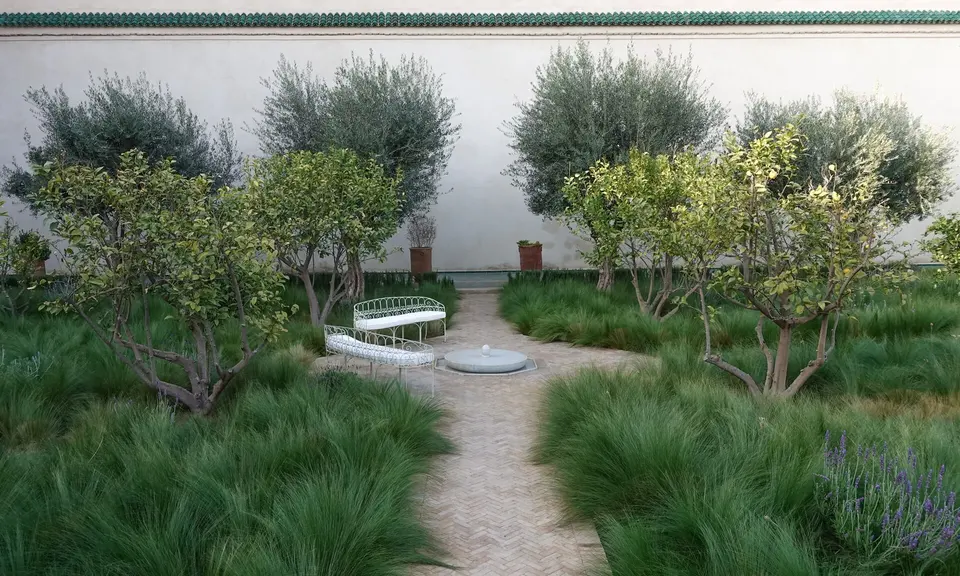
Two neighbouring riads of a 19th-century caid's palace, reopened in 2016 after restoration, hold the medina's two loveliest gardens: an exotic garden of cactus and palms and an Islamic garden laid out in four quarters around channels of water, with the pavilions and the café at either end. The extra ticket for the tower is worth it: from its roof you look over the whole northern medina to the Koutoubia and the Atlas.

  • Plan about 1 h
  • 9:30–19:30 in summer, to 18:30 or 18:00 in the darker months; 100 Dh, tower 40 Dh; cards accepted
130 m · about 2 min on foot
The souks and the Mouassine fountain
Photo: DimiTalen, CC0
6Market lanes

The souks and the Mouassine fountain

From the north side of Jemaa el-Fna the covered lane of Souk Semmarine runs into a kilometre of markets, each trade in its own alley: slippers and kaftans first, then the spice square of Rahba Kedima with its baskets and apothecaries, the carpet auction of the Criée Berbère, the dyers' souk with its skeins drying overhead, the ironworkers of Haddadine, the leather workers and the lantern makers. The 16th-century Mouassine fountain, with its carved cedar canopy, is the landmark at the western edge. Bargain from half the asking price and never let a guide take you to a cooperative.

  • Plan about 2 h

Evening

DinnerThe souks empty out towards 20:00; end on a terrace over Jemaa el-Fna, Café de France or Le Grand Balcon, for the drums and the smoke from the grills below, or eat at the stalls themselves a second time.

Day 3

Dar el Bacha, the Mellah and the Menara at sunset

See the pasha's palace of Dar el Bacha when it opens, walk down through the medina to the Mellah and its synagogue, lunch by the spice market, pass through the Almohad gate of Bab Agnaou, and take a taxi out to the Menara gardens for the olive groves, the pavilion and the Atlas at sunset.

  • 4 sights
  • 2.4 km on foot
  • Longest walk 1.6 km
12341 kmN
Stops in order, straight-line distancesRoute in Google Maps ↗

Morning

Dar el Bacha (Musée des Confluences)
Photo: YassirZek, CC BY-SA 4.0
1Palace museum

Dar el Bacha (Musée des Confluences)

The palace of Thami el Glaoui, the pasha who ruled Marrakech for France from 1912 to 1956 and entertained Churchill and Chaplin here, reopened in 2017 as a museum of the world's religions and crafts under the National Museums Foundation; the building is the reason to come, a hammam, a courtyard of cypresses and orange trees and reception rooms of painted cedar and zellij as fine as the Bahia's, with a fraction of the visitors. The Bacha Coffee house inside serves 200 coffees under the painted ceilings.

  • Plan about 1 h
  • Tuesday to Sunday 10:00–18:00, closed Mondays; 60 Dh
1.6 km · about 25 min on foot
The Mellah and the Lazama Synagogue
Photo: TomiValny, CC BY-SA 4.0
2Historic quarter

The Mellah and the Lazama Synagogue

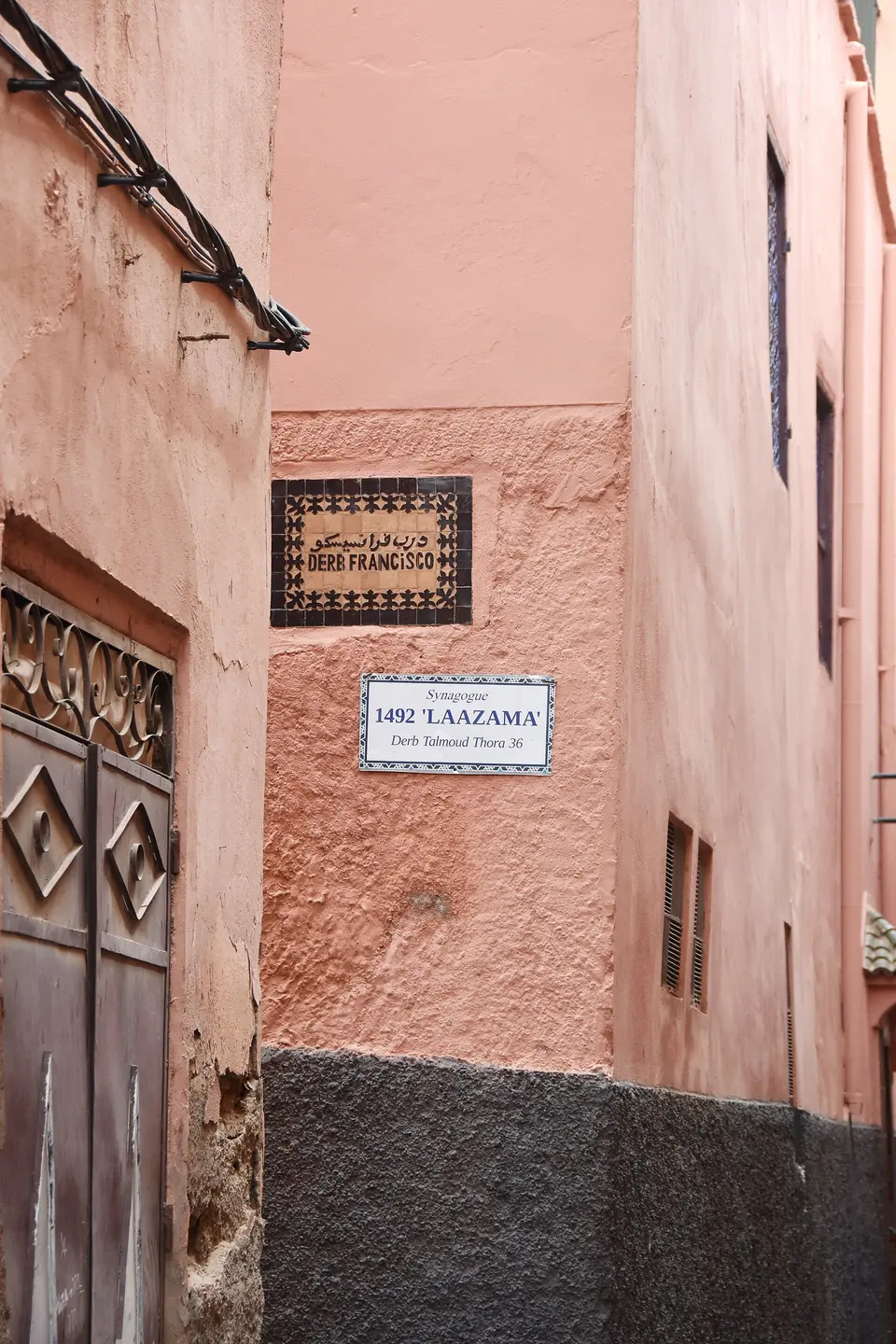
The Jewish quarter was walled off beside the royal kasbah in 1558 and held tens of thousands of people before the emigrations of the 1950s; its grid of narrow streets, balconied houses and the spice and fabric market by Place des Ferblantiers has been restored, and the Slat al-Azama synagogue, founded by refugees from Spain in 1492 and rebuilt around a blue-and-white courtyard, is open to visitors with a small museum of the community's history. The Miara cemetery, white tombs under the walls, is a few streets east.

  • Plan about 1 h 15 min

Midday

LunchThe Mellah's spice market and Place des Ferblantiers are a five-minute walk apart: a plate of grilled sardines or a bowl of harira at the market stalls, or the café terraces on the square.

Afternoon

830 m · about 13 min on foot
Bab Agnaou
Photo: Jakub Hałun, CC BY 4.0
3City gate

Bab Agnaou

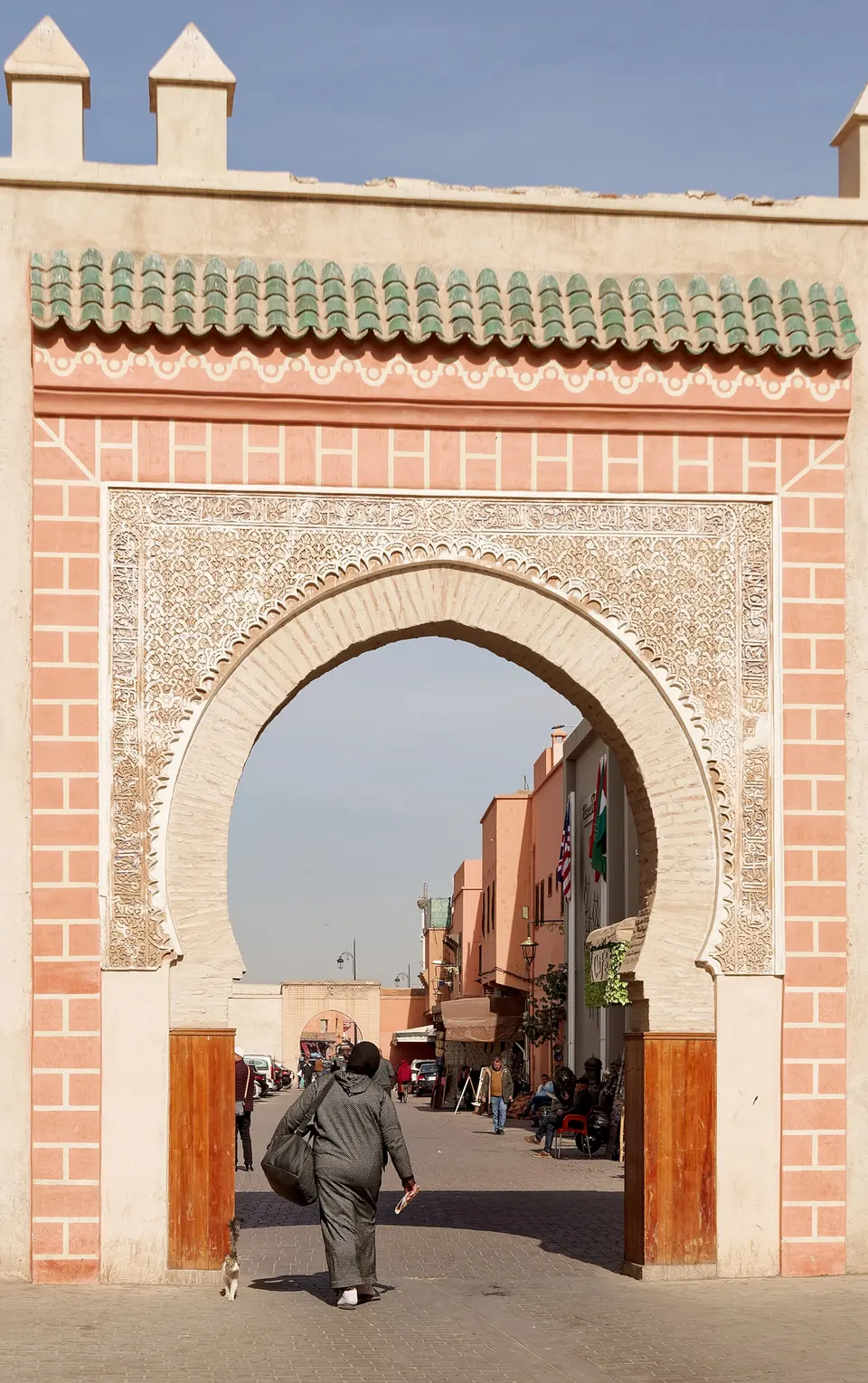
The finest of the medina's nineteen gates was built by the Almohads around 1188 as the ceremonial entrance to the kasbah: a horseshoe arch of grey-blue Guéliz stone carved with a frame of floral scrolls and a Koranic inscription, standing beside the Kasbah mosque and the lane to the Saadian Tombs. Pass through it to the outside of the walls, where the taxis wait for the Menara.

  • Plan about 20 min

Evening

Petit taxi from Bab Agnaou or the Koutoubia, about 10 minutes; the walk along Avenue de la Ménara is 3 km on a main road
Menara Gardens
Photo: Bernard Gagnon, CC BY-SA 3.0
4Historic gardens

Menara Gardens

The Almohads planted this hundred hectares of olive trees in the 12th century around a great stone basin fed by channels from the Atlas; the green-tiled pavilion on its edge, rebuilt in 1870 for the sultan's summer evenings, and the snow on the mountains behind it make the most photographed view in Marrakech. The groves and the basin are free, the pavilion is ticketed, and the light is best an hour before sunset.

  • Plan about 1 h 15 min
  • Gardens free; pavilion ticketed

Good to know in Marrakech

Tickets and opening days

  • The Bahia Palace is open 9:00–17:00; foreign adults pay 100 Dh and children aged 7–13 50 Dh (Moroccans 30 Dh, free on Fridays). Tickets are sold through the Ministry of Culture's e-ticketing portal and at the gate.Source: Ministry of Culture, Khadamat Culture e-tickets · checked Sep 2026
  • El Badi Palace is open 9:00–17:00; foreign adults pay 100 Dh and children aged 7–13 50 Dh. Entry is free for visitors with reduced mobility.Source: Ministry of Culture, Khadamat Culture e-tickets · checked Sep 2026
  • The Saadian Tombs are open 9:00–17:00; foreign adults pay 100 Dh and children aged 7–13 50 Dh.Source: Ministry of Culture, Khadamat Culture e-tickets · checked Sep 2026
  • The Ben Youssef Madrasa is open 9:00–19:00 every day, 9:00–16:30 during Ramadan. Foreign adults pay 50 Dh, children under 12 10 Dh; online booking is available on the madrasa's site.Source: Medersa Ben Youssef, official site · checked Sep 2026
  • Le Jardin Secret opens at 9:30 daily and closes at 19:30 from March to September, 18:30 in February and October, and 18:00 from November to January (16:30 in Ramadan); last entry is 30 minutes before closing. General admission is 100 dirhams, the tower 40 dirhams more; visitors under 24 pay 80 dirhams and children under 12 are free. Cash in dirhams or euros and all major cards are accepted.Source: Le Jardin Secret, official site · checked Sep 2026
  • The Jardin Majorelle is open every day 8:00–18:30 (last entry 18:00) and the Pierre Bergé Museum of Berber Arts inside it 8:30–18:00; tickets can only be bought online at www.tickets.jardinmajorelle.com, the only official ticket site.Source: Jardin Majorelle, official site · checked Sep 2026
  • The Musée Yves Saint Laurent Marrakech is open every day except Wednesday, 10:00–18:30 with last entry at 18:00; tickets are sold only through the same official ticketing site as the garden.Source: Musée Yves Saint Laurent Marrakech · checked Sep 2026
  • Dar El Bacha, the Musée des Confluences, is open Tuesday to Sunday 10:00–18:00 and closed on Mondays; foreign visitors pay 60 Dh, Moroccans 25 Dh.Source: Fondation Nationale des Musées · checked Sep 2026
  • Dar Si Saïd, the Musée National du Tissage et du Tapis, is open Tuesday to Sunday 10:00–18:00 and closed on Mondays; adults pay 30 Dh and children over 12 10 Dh.Source: Fondation Nationale des Musées · checked Sep 2026
  • At the Menara, the gardens and the olive grove are free to enter; only the pavilion has a ticket.Source: Fondation Nationale des Musées, Morocco Museum · checked Sep 2026
  • The cultural space of Jemaa el-Fna Square was inscribed on UNESCO's Representative List of the Intangible Cultural Heritage of Humanity in 2008: storytellers, poets, snake charmers, Berber musicians and Gnaoua dancers perform there, and traditional food, fruit and water are sold all day and into the night.Source: UNESCO Intangible Cultural Heritage · checked Sep 2026

3 days in Marrakech: quick answers

Is 3 days enough for Marrakech?

Three days cover the square, the palaces and tombs, the great madrasa, the souks, Majorelle and the Yves Saint Laurent museum, the Mellah and the Menara. A fourth day is the classic day trip: the Ourika valley or Imlil in the High Atlas, the Agafay desert, or the waterfalls of Ouzoud.

Which days should I plan around?

The Bahia and El Badi palaces, the Saadian Tombs, the madrasa, Majorelle and the gardens are open every day. Dar el Bacha and Dar Si Said, the two National Museums Foundation houses, are closed on Mondays, and the Yves Saint Laurent museum is closed on Wednesdays, so keep day one and day three off a Monday and day two off a Wednesday. Hours shorten in Ramadan.

How much do the tickets cost?

The Ministry of Culture charges foreign adults 100 dirhams each for the Bahia Palace, El Badi and the Saadian Tombs, cash at the door; the Ben Youssef Madrasa is 50, Le Jardin Secret 100, Dar el Bacha 60 and Dar Si Said 30. Majorelle and the YSL museum are sold only online at the garden's official ticket site, with a timed entry; the Menara gardens are free and its pavilion is ticketed.

How do I get around?

Everything inside the medina is on foot; the lanes are a maze, so use a map app and expect to be offered directions for a tip. For Majorelle and the Menara, outside the walls, take a petit taxi, the small beige cars: insist on the meter or agree a fare before you get in. Buses exist but are slow.

How much walking is this itinerary?

About 3 km in a straight line on day one, under 1 km plus one taxi on day two and about 2.5 km plus one taxi on day three, all flat; the real distance is longer because the medina's lanes never run straight.

Other Marrakech itineraries

Keep exploring

Where this connects

THE TRIPWOA APP

Go somewhere.
Make it yours.

Build days around what you love. Follow your route, find your next stop and keep the moments along the way.

Get it on Google PlayAvailable for Android
Free to start
Tripwoa home with a Paris trip and nearby places to explore
Tripwoa day plan for New York with a route map and Times Square stop

A day that feels like you.

Sources and method

Places and coordinates: Wikidata and Tripwoa's open-data place catalog (Overture Maps Foundation, © OpenStreetMap contributors). Photos: Wikimedia Commons, credited on each image. Practical rules: the official sources linked in each note, checked in September 2026.

How this plan was made: Tripwoa's planner drafted the day order from real coordinates and typical visit times. Each stop was then reviewed, reordered where needed and rewritten with AI assistance. Walking distances are straight-line estimates, so allow a little extra time on real streets.