3-day itinerary · France

3 Days in Marseille

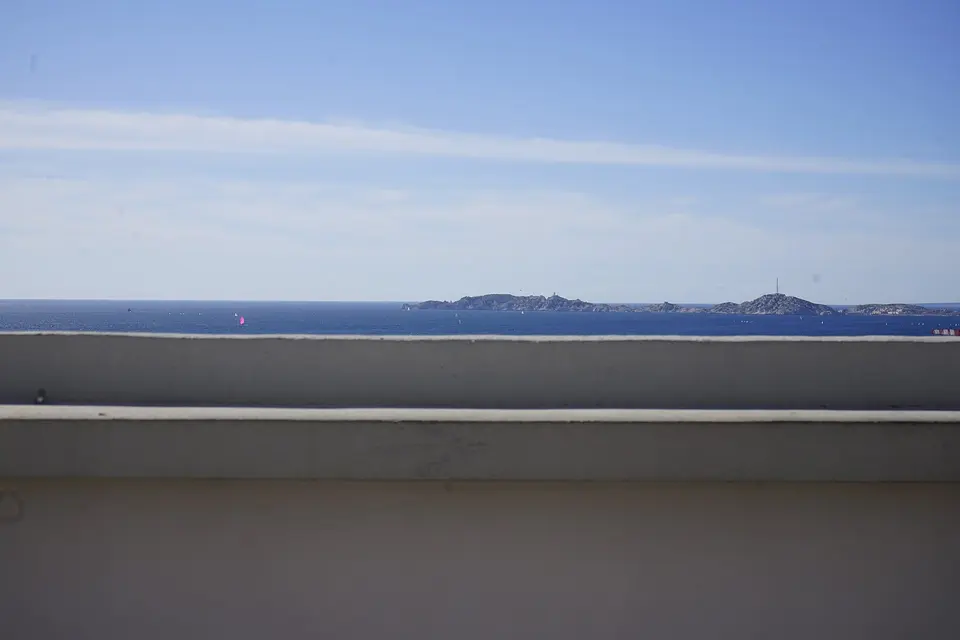
A realistic first-timer plan that climbs to the basilica of Notre-Dame de la Garde on day one for the view, comes down to the fish market of the Vieux-Port, the lanes of Le Panier and the baroque courtyard of the Vieille Charité, crosses the footbridge from the Fort Saint-Jean into the Mucem, and walks the Canebière at dusk; sails on day two to the Château d'If and the beaches of the Frioul islands, sees the 30,000-year-old horses of the Cosquer cave in their replica by the harbour, goes up to the roof of Le Corbusier's Cité radieuse and eats bouillabaisse at the fishing port of the Vallon des Auffes; and takes the train on day three to Cassis for the calanques, the fjord-like inlets of Port-Miou, Port-Pin and En-Vau, before the bars and murals of Cours Julien. Every stop comes with the transport, the summer fire-risk rules and the prices that matter in 2026.

  • 3days
  • 16sights
  • 3.9 kmon foot between sights

Updated 12 September 2026 · 6 official sources checked · report an error

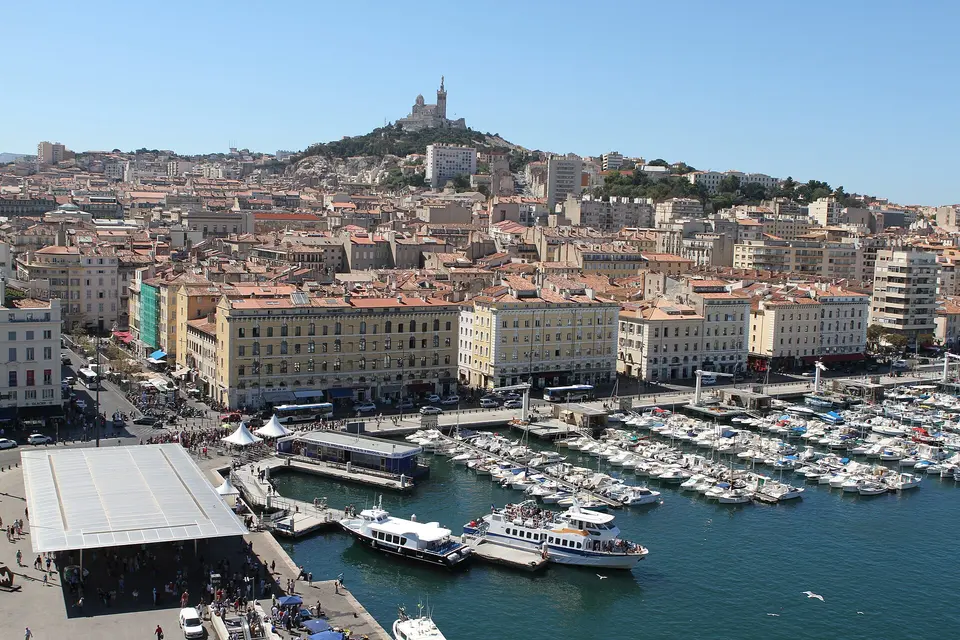
Vieux-Port
Photo: Georges Seguin (Okki), CC BY-SA 4.0

The hill and the old port, the islands and the modern city, then the calanques from Cassis

Marseille's centre is compact: the Vieux-Port, Le Panier and the Mucem are within a kilometre of each other, and only the basilica on its 150-metre hill needs the bus. Day one is walked from the top down. Day two is a boat from the Vieux-Port to the Château d'If and the Frioul islands, then the metro and a bus out to the Cité radieuse and back along the Corniche. Day three takes the 22-minute train to Cassis and the coastal path into the Calanques National Park, which from June to September is subject to daily fire-risk closures announced at 18:00 for the next day, so check the map the evening before and have the Cosquer cave or the Palais Longchamp as the rainy or red-day alternative. The Mucem closes on Tuesdays and is free on the first Sunday of the month; the Château d'If closes on Mondays from October to March and in bad weather; the basilica is open every day from 7:00.

At a glance

Ways to use these days

If it rains
2 of the stops are indoors — Notre-Dame de la Garde · Mucem and the Fort Saint-Jean
Lightest day on foot
Day 1 — 3.9 km between stops
Most walking
Day 3 — 17.4 km

Day 1

The hill and the old town: Notre-Dame de la Garde, the Vieux-Port, Le Panier, the Vieille Charité and the Mucem

Take the bus up to the basilica before the coaches, walk down to the fish market and the mirrored canopy of the Vieux-Port, climb into the lanes of Le Panier and the arcaded courtyard of the Vieille Charité, cross the footbridges from the Fort Saint-Jean into the Mucem, and walk the Canebière as the lights come on.

  • 6 sights
  • 3.9 km on foot
  • Longest walk 1.4 km
123456500 mN
Stops in order, straight-line distancesRoute in Google Maps ↗

Morning

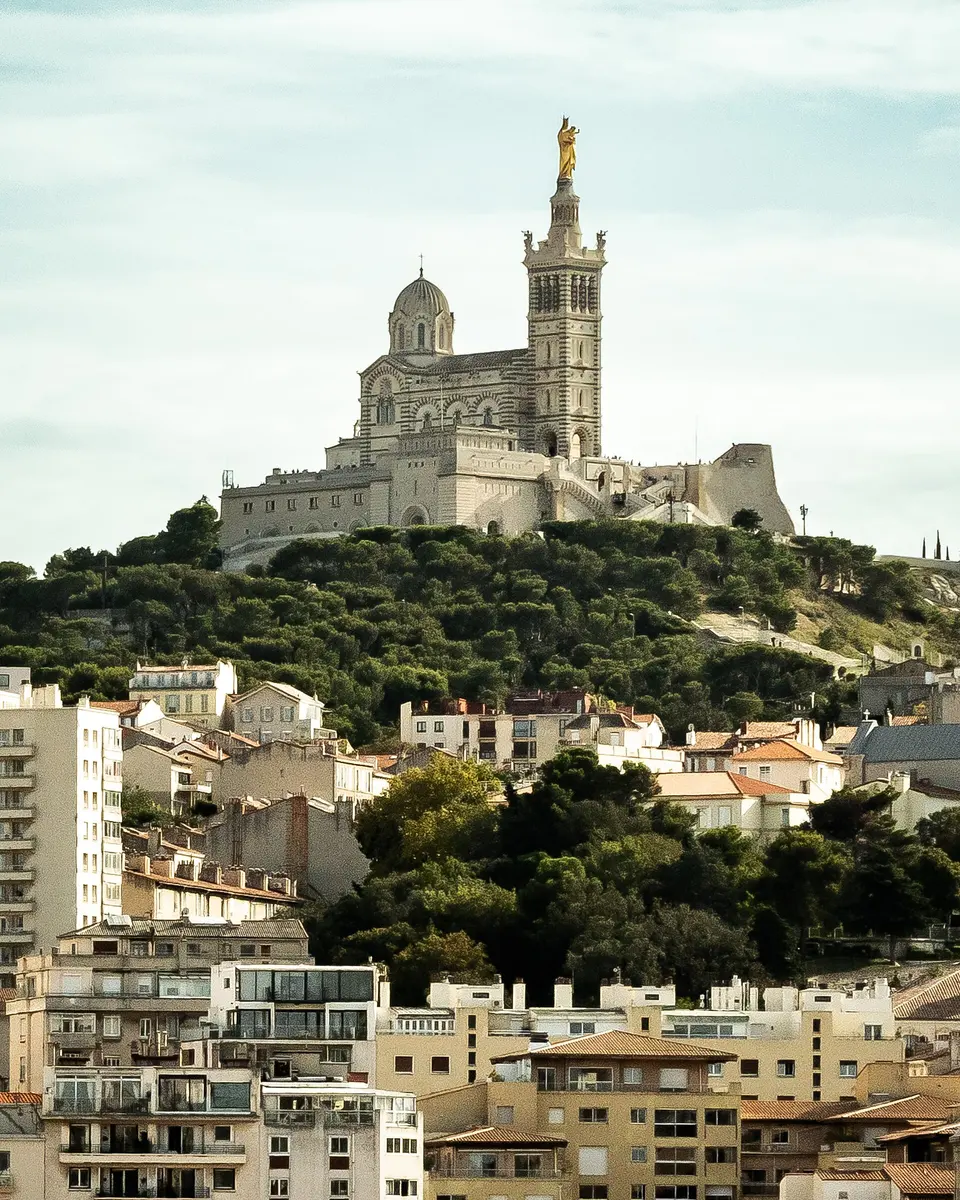
Notre-Dame de la Garde
Photo: Epgui, CC BY-SA 4.0
1Basilica

Notre-Dame de la Garde

The Bonne Mère, the basilica that Marseille looks up to, stands on a 150-metre limestone spur south of the port, a striped Romano-Byzantine church of 1853 to 1864 on top of a 16th-century fort, topped by a 11-metre gilded statue of the Virgin and child that sailors steer by; inside, the mosaics glitter and the walls hang with ex-votos, model ships, paintings of shipwrecks, football shirts and plaques from the survivors of two centuries of Marseille's disasters, and outside, the terrace gives the whole city, the islands and the calanques in one turn. The sanctuary is open every day from 7:00 to 18:00 and is free; the small museum of the basilica's history is open 9:00 to 17:00. Go first thing, before the coaches and the heat.

  • Plan about 1 h 30 min
  • Daily 7:00–18:00, free; bus 60 from the Vieux-Port every 20 minutes or a steep 30-minute walk; museum 9:00–17:00
1.2 km · about 19 min on foot
Vieux-Port
Photo: Georges Seguin (Okki), CC BY-SA 4.0
2Harbour

Vieux-Port

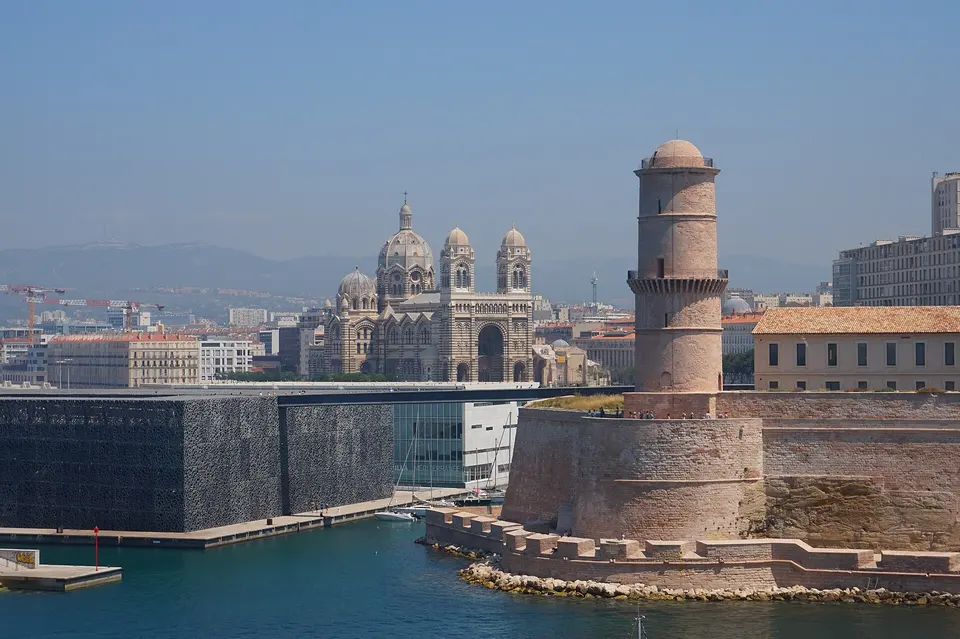
The rectangular harbour where the Greeks landed around 600 BC and the city has lived ever since is now a marina of 3,000 boats, but every morning the fishermen's wives still sell the night's catch, rascasse, sea bream, octopus and sea urchins in season, from trestle tables on the Quai des Belges under Norman Foster's Ombrière, the 46-metre mirrored canopy of 2013 that turns the crowd upside down, and the quays are lined with the cafés where pastis was born. The forts of Saint-Jean and Saint-Nicolas guard the entrance, the little ferry-boat crosses the water for a euro, and the boats to the islands and the calanques leave from the head of the port.

  • Plan about 1 h
  • Fish market every morning until about 13:00; the ferry boat across the port runs all day; boats to If and Frioul from the Quai des Belges

Midday

LunchLunch is in Le Panier or on the quays: the small restaurants around Place de Lenche and Place des Moulins do panisses, pieds-paquets and grilled sardines at fair prices, and the pizzerias of the quarter claim the oldest pizza tradition in France; the bars of the Quai du Port are pricier and for the view. A proper bouillabaisse is an evening affair, ordered a day ahead, so keep lunch light.

Afternoon

450 m · about 7 min on foot
Le Panier
Photo: Zairon, CC BY-SA 4.0
3Old quarter

Le Panier

The oldest quarter in France climbs the hill north of the port on the site of the Greek city, a village of steep lanes, stairways and small squares that was the working-class and immigrant heart of the city for centuries, half demolished by the Germans in 1943 and now painted with murals and street art, with soap-makers, ceramicists and the Place des Moulins at the top where the windmills stood. Go up the Montée des Accoules from the town hall, wander without a map, and come down by the Rue du Panier and the Rue du Petit-Puits for the Vieille Charité.

  • Plan about 1 h 15 min
  • Free; steep lanes and steps; the shops open from about 10:00 and the terraces fill at aperitif time
240 m · about 4 min on foot
La Vieille Charité
Photo: Ddeveze, CC BY-SA 3.0
4Baroque almshouse and museums

La Vieille Charité

At the top of Le Panier, the almshouse built between 1671 and 1749 by Pierre Puget, Marseille's baroque architect, to lock up the city's beggars is a three-storey rectangle of pink and white arcades around a courtyard, with an oval-domed chapel in the middle that is one of the finest baroque buildings in France, restored after decades as a slum and reopened in 1986 as a cultural centre; it houses the museum of Mediterranean archaeology, with an Egyptian collection second in France only to the Louvre, and the museum of African, Oceanic and Amerindian arts. The courtyard and chapel are free and worth the climb on their own.

  • Plan about 1 h
  • Courtyard and chapel free; museums Tue–Sun 10:00–18:00, closed Mon, ticketed
650 m · about 10 min on foot
Mucem and the Fort Saint-Jean
Photo: Olena Ilnytska, CC BY-SA 4.0
5Museum

Mucem and the Fort Saint-Jean

The Museum of European and Mediterranean Civilisations, opened in 2013 when Marseille was European Capital of Culture, is Rudy Ricciotti's black concrete cube wrapped in a lace of fibre-reinforced concrete on the J4 pier, joined by a 130-metre footbridge to the 17th-century Fort Saint-Jean, whose ramparts, gardens and towers are part of the museum and free to walk, with a second bridge over to the Panier by the church of Saint-Laurent; inside, the galleries on the making of the Mediterranean, farming, gods, cities and citizenship, sit alongside big temporary shows, and the roof terrace and the walk between the lattice and the glass at sunset are the reason to come even if you skip the collections. One ticket covers everything for the day, and the outdoor areas are free.

  • Plan about 2 h 30 min
  • Wed–Mon 10:00–19:00, closed Tue, May 1 and Dec 25; €11, €7.50 reduced, family €18, free under 18 and first Sunday of the month; fort and gardens free

Evening

1.4 km · about 22 min on foot
La Canebière
Photo: Chabe01, CC BY-SA 4.0
6Avenue

La Canebière

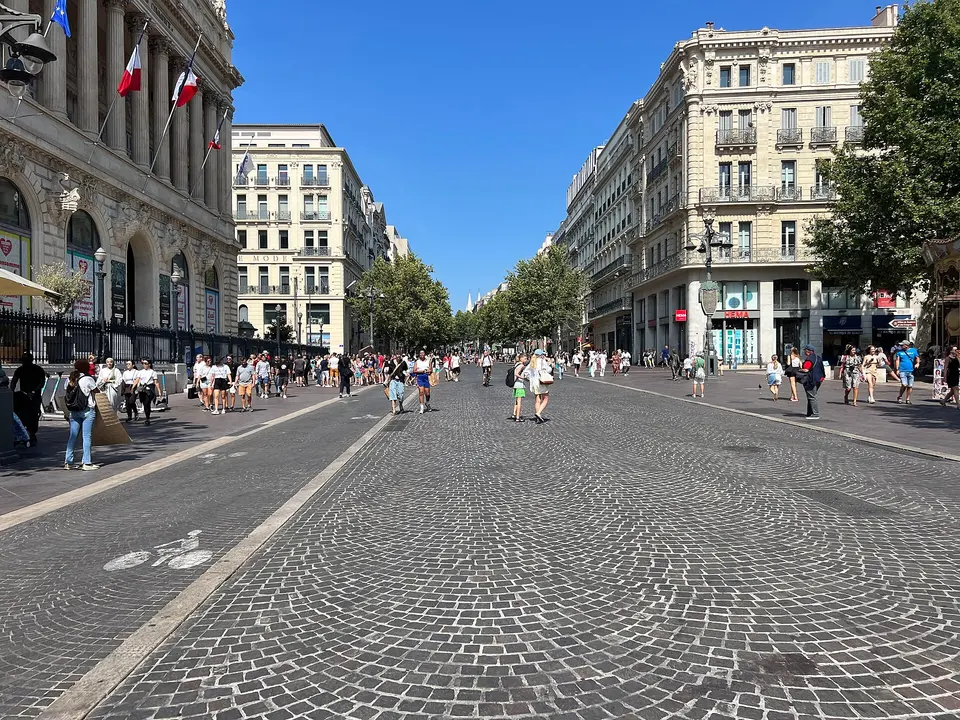
The city's great street runs a kilometre uphill from the head of the Vieux-Port, named for the hemp rope-walks that stood here, lined with the grand 19th-century façades of the stock exchange, the old Grand Hôtel and the Noailles department stores, shabby for decades and now revived by the tram and the pedestrianised lower end; a block south are the opera house and the shopping street of Saint-Ferréol, and a block north the Marché des Capucins in Noailles, the Arab and African market that is the most alive corner of the centre until it packs up around 19:00. Walk it as the lights come on, then turn down the Rue de Rome or up the stairs to Cours Julien for dinner.

  • Plan about 1 h
  • Free; the Noailles market runs until about 19:00 every day except Sunday; tram T2 and T3 run its length

Day 2

The islands and the modern city: the Château d'If, the Frioul, the Cosquer cave, the Cité radieuse and the Vallon des Auffes

Take the first boat out to the prison island of the Château d'If and on to the white rocks and coves of the Frioul islands, come back for the replica of the painted Cosquer cave beside the Mucem, ride out to the roof of Le Corbusier's Cité radieuse, and finish with the sunset and a fish supper in the tiny harbour of the Vallon des Auffes.

  • 5 sights
  • Transport between sights
123452 kmN
Stops in order, straight-line distancesDriving route in Google Maps ↗

Morning

Château d'If
Photo: Rémih, CC BY-SA 4.0
1Island fortress

Château d'If

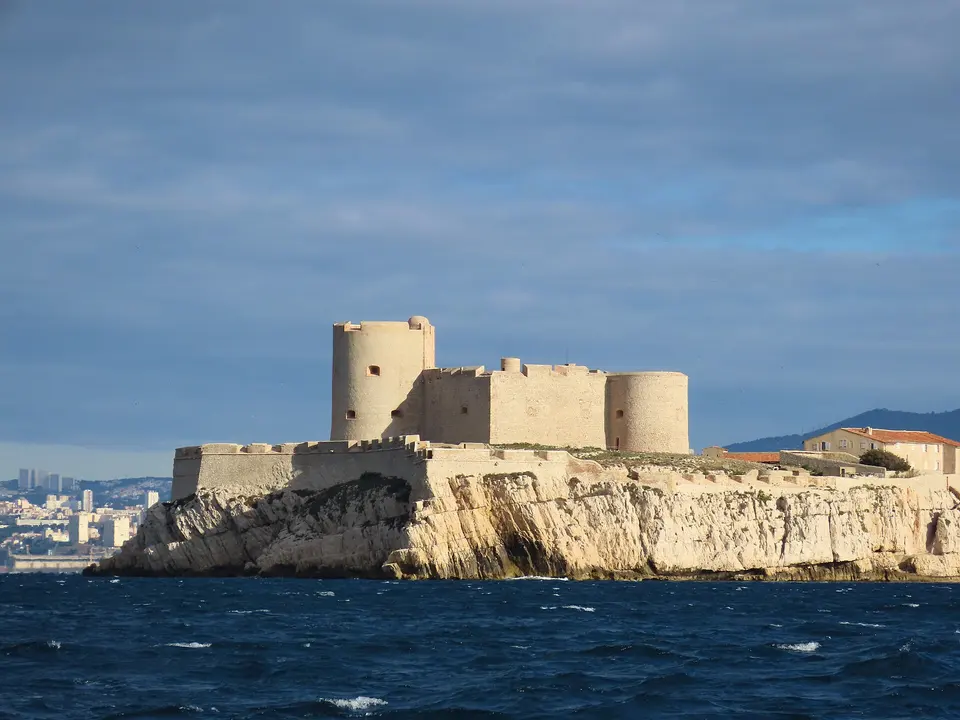
On a rock 3.5 km off the port, the fortress that François I built in 1527 to guard the harbour never fired a shot and became instead a prison for Protestants, republicans and the Man in the Iron Mask of legend, and above all the prison from which Edmond Dantès escapes in The Count of Monte Cristo, whose cell the guides will show you although he never existed; the courtyard, the three round towers and the terrace with the city laid out across the water take an hour, and the island's rocks are a good place to swim from in summer. The Centre des monuments nationaux runs it: €7, closed on Mondays from late September to March and, importantly, closed whenever the sea is too rough for the boats.

  • Plan about 1 h 30 min
  • Apr–late Sep daily 10:00–18:00, otherwise Tue–Sun 10:00–17:15, closed Jan 1, May 1, Dec 25 and in bad weather; €7, free under 18 and EU residents 18–25, free first Sundays Nov–Mar; boat extra
The same boat continues to Port Frioul on Ratonneau in about 15 minutes; walk from there
Frioul islands
Photo: Jeanne Menjoulet, CC BY 2.0
2Archipelago

Frioul islands

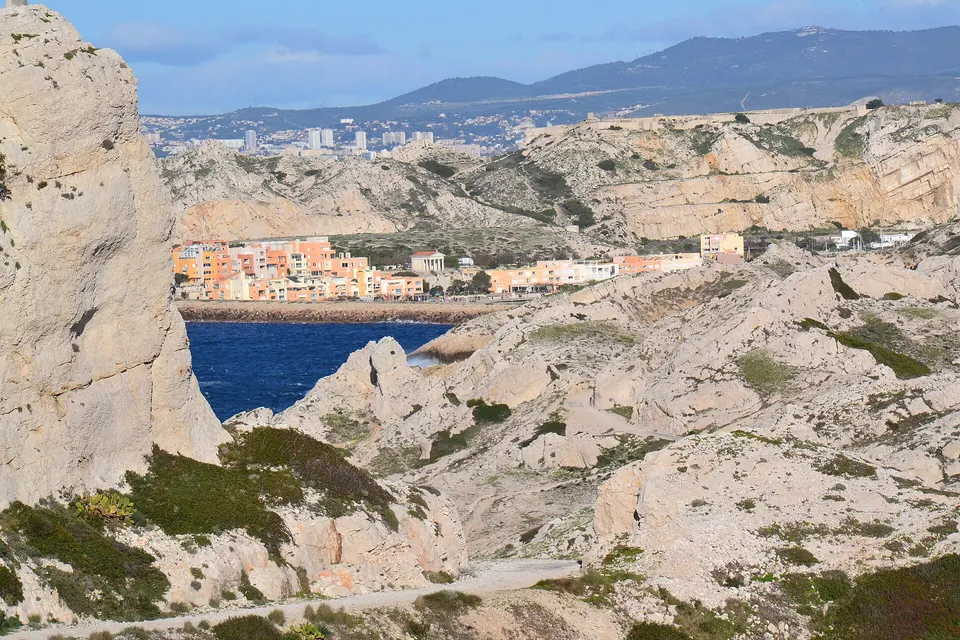
The two larger islands beyond If, Ratonneau and Pomègues, joined by a dyke that holds the little port of Frioul, are 200 hectares of white limestone, wild thyme and gulls in the Calanques National Park, with a quarantine hospital of 1828 in ruins on the hill, gun batteries from every war, and a dozen coves of clear water, the Calanque de Morgiret and the Plage de Saint-Estève the easiest for swimming, reached by unshaded paths of 20 to 40 minutes from the port; there is no sand and no shop beyond the harbour, so take water, shoes and a hat. The boats run back through the afternoon and the last one in summer is late.

  • Plan about 3 h
  • Free; boats from the Vieux-Port all year, about 30 minutes; no shade, no water sources on the paths

Midday

LunchEat on the islands: the restaurants of Port Frioul on Ratonneau do grilled fish, mussels and salads on terraces over the harbour and are open through the season, or carry a picnic from the Vieux-Port market and eat it on the rocks of the Calanque de Morgiret. Boats back run through the afternoon, so there is no hurry.

Afternoon

Boat back to the Vieux-Port, then a 10-minute walk along the quay to the J4 esplanade beside the Mucem
Cosquer Méditerranée
Photo: Kleber Rossillon & Région Sud, CC BY-SA 4.0
3Replica cave

Cosquer Méditerranée

In 1985 the diver Henri Cosquer found a tunnel 37 metres below the sea in the Calanque de la Triperie that led up into a cave painted 33,000 to 19,000 years ago with horses, bison, ibex, penguins, seals and hundreds of hand stencils, the only decorated cave in the world with marine animals, now slowly drowning as the sea rises; the original can never be visited, so in 2022 the region opened this replica in the Villa Méditerranée, the cantilevered building beside the Mucem, where you ride a slow vehicle through 1,750 square metres of reconstructed cave with an audio guide, then climb to a gallery on the Ice Age Mediterranean and the cave's future. Book a time slot; summer weekends sell out.

  • Plan about 2 h
  • Mon–Fri and school holidays 9:30–18:00, weekends and holidays 9:30–19:30, July–August 9:00–20:30, last entry 1.5 hours before; €18, €11 ages 10–17, €6 ages 6–9; booking advised
Metro M2 from Vieux-Port to Rond-Point du Prado, then bus 21 or B1 to the Le Corbusier stop, about 30 minutes in all; a taxi is 15 minutes
Cité radieuse
Photo: Carl Ha, CC BY-SA 4.0
4Le Corbusier housing block

Cité radieuse

Le Corbusier's Unité d'Habitation of 1947 to 1952 on the Boulevard Michelet, a 337-apartment concrete block on pilotis with an internal shopping street, a hotel, a school and a rooftop of sculptural chimneys, a running track and a paddling pool, was the prototype for a century of housing and is on the UNESCO list since 2016; residents still call it the Maison du Fada, the madman's house. The hall, the third-floor street with its bakery and bookshop, and the roof terrace, now home to the MAMO art centre, are open to visitors during the day, and the tourist office runs guided tours that add a listed apartment. The view from the roof runs from the Vélodrome to the islands.

  • Plan about 1 h 15 min
  • Public areas and roof free during opening hours; tourist office guided tours with an apartment about €15, booking required; metro Rond-Point du Prado then bus 21, B1 or 22 to Le Corbusier

Evening

Bus 83 from the Rond-Point du Prado along the Corniche Kennedy to the Vallon des Auffes stop, about 20 minutes, or a taxi in 10
Vallon des Auffes
Photo: Zairon, CC BY-SA 4.0
5Fishing harbour

Vallon des Auffes

A pocket of fishing port tucked under the arches of the Corniche Kennedy, a hundred metres of quay with cabanons, drying nets, pointu boats and three of the city's most famous restaurants, Chez Fonfon for bouillabaisse and the pizzeria Chez Jeannot for everything else, the Vallon des Auffes is where Marseille comes for the sunset over the islands with a pastis on the rocks, and the walk from here along the Corniche to the Plage des Catalans at dusk, past the Malmousque coves, is the best free thing in the city. Bouillabaisse is ordered a day ahead and costs what a good dinner costs; the pizza needs no booking.

  • Plan about 1 h 30 min
  • Free; bus 83 along the Corniche; bouillabaisse by reservation, pizzerias open evenings, closed some Mondays

Day 3

The calanques from Cassis: Port-Miou, Port-Pin and En-Vau, then Cours Julien

Take the early train to Cassis, walk out of the harbour along the coast into the Calanques National Park, first the long yacht-filled inlet of Port-Miou, then the pine-shaded beach of Port-Pin and, if legs and the season allow, the white cliffs and turquoise water of En-Vau, swim, walk back for the train, and end the trip among the murals, bars and terraces of Cours Julien.

  • 5 sights
  • Transport between sights
123455 kmN
Stops in order, straight-line distancesDriving route in Google Maps ↗

Morning

Cassis
Photo: Jean-Christophe BENOIST, CC BY 3.0
1Harbour town

Cassis

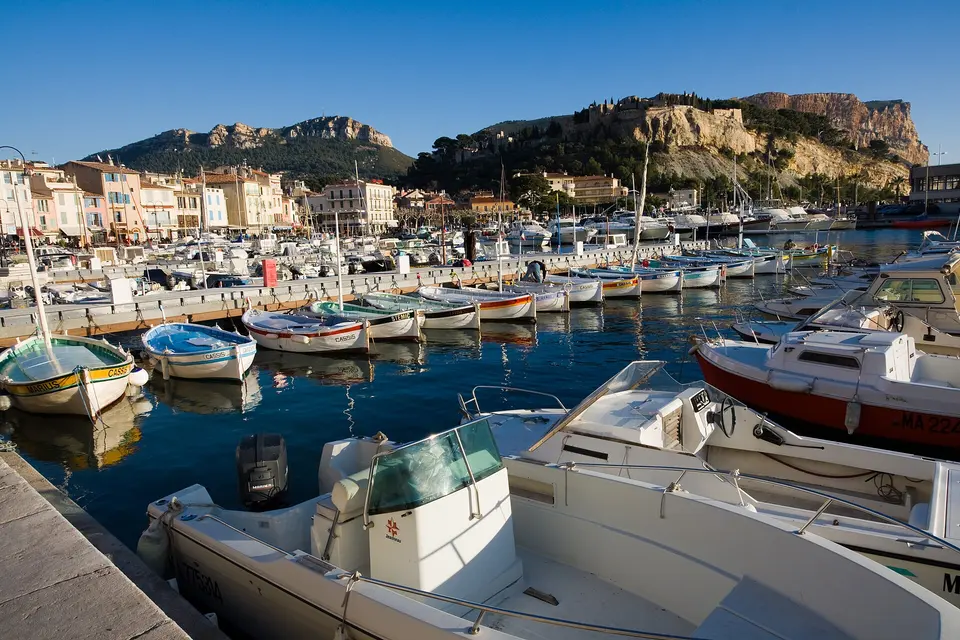
The fishing port under the 394-metre cliff of Cap Canaille, the highest sea cliff in France, is a pastel harbour of café terraces, a Wednesday and Friday market, a small beach and the white wine that the whole coast drinks, and it is the eastern gate of the Calanques National Park, reached from Marseille in 22 minutes by train to a station 3 km up the hill and the M01 shuttle bus down to the port. The boat companies on the quay run 45-minute to 2-hour trips into the calanques for those who would rather see En-Vau from the water than walk to it; in summer the free Gorguettes park-and-ride and its shuttle replace the closed roads.

  • Plan about 1 h
  • Train from Saint-Charles about 22 minutes, then bus M01 to the port; market Wed and Fri mornings; boat trips from the quay
A 30-minute walk west from the port along Avenue des Calanques to the park entrance, the presqu'île car park and the head of the inlet
Calanque de Port-Miou
Photo: Chabe01, CC BY-SA 4.0
2Calanque

Calanque de Port-Miou

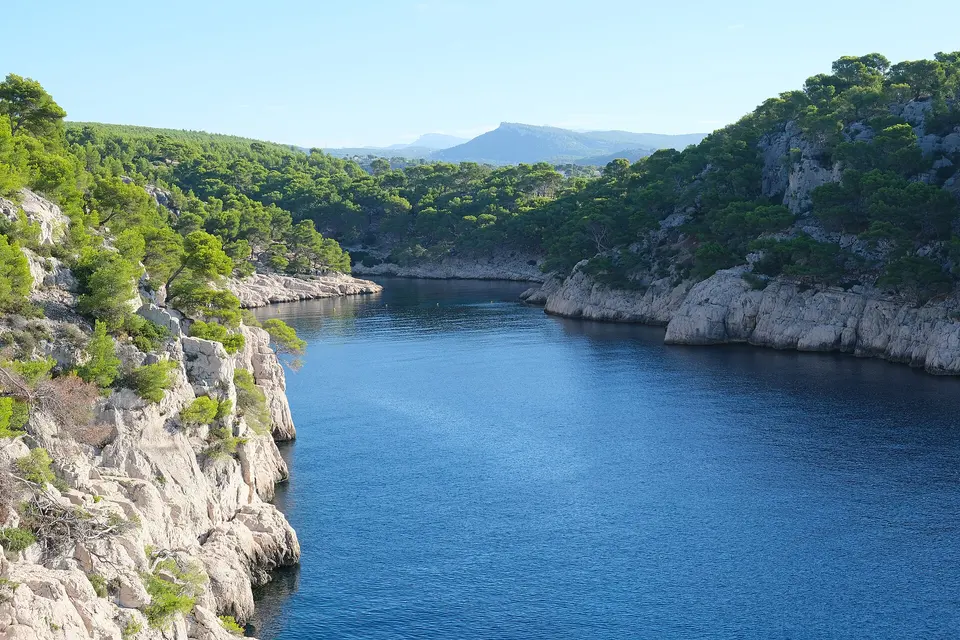
The first and longest of the Cassis calanques, a 1.4-kilometre inlet as narrow as a canal between limestone walls that was a quarry until 1981 and is now a natural marina of 500 yachts, is the flat, easy introduction: a 30-minute walk from the port along the Avenue des Calanques brings you to its head and the park entrance, and the path along its north bank, under the pines with the masts below, is where the national park begins and the first swimmers get in. The Sentier du Petit Prince, a marked loop of an hour from here, is the accessible version for families.

  • Plan about 45 min
  • Free; 30 minutes' walk from Cassis port; the coastal path continues to Port-Pin
The coastal path along the north side of Port-Miou and over the ridge, about 30 minutes on rock and pine needles
Calanque de Port-Pin
Photo: kallerna, CC BY-SA 4.0
3Calanque

Calanque de Port-Pin

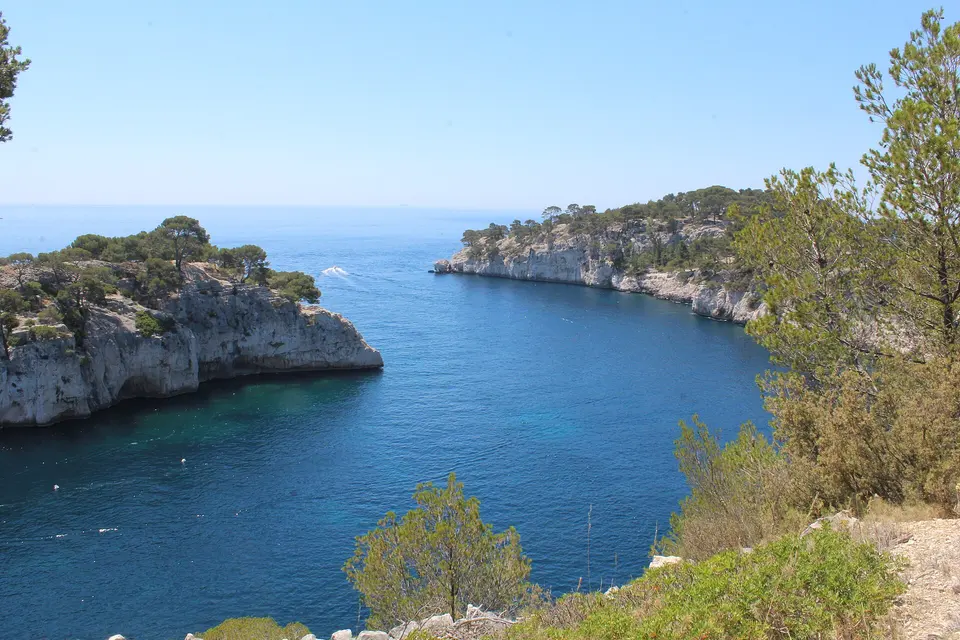
Over the ridge from Port-Miou, a further 30 minutes on a path of rock and roots, the second calanque is a small crescent of pebbles and sand at the end of a short inlet, shaded by the Aleppo pines that give it its name, with clear water for swimming and enough room to sit; it is the good place for lunch and the turning point for anyone not going on to En-Vau, and it is busy by 11:00 on summer weekends. There is no shop, no shade beyond the trees and no lifeguard.

  • Plan about 1 h 30 min
  • Free; about 1 hour from Cassis port on foot; sandy beach, swimming, no facilities

Midday

LunchThere is nothing to buy in the calanques, so carry lunch from Cassis, where the bakeries on Rue Brémond and the Wednesday and Friday market on Place Baragnon sell fougasse, tapenade and fruit before 9:00, and eat it on the rocks at Port-Pin with your feet in the water. If you skip En-Vau, the harbour restaurants of Cassis do bourride and grilled fish under the cliff of Cap Canaille for a late lunch.

Afternoon

The marked path from Port-Pin climbs over the headland and drops steeply to the beach, about 45 minutes each way; proper shoes, water and the fire-risk check are essential
Calanque d'En-Vau
Photo: kallerna, CC BY-SA 4.0
4Calanque

Calanque d'En-Vau

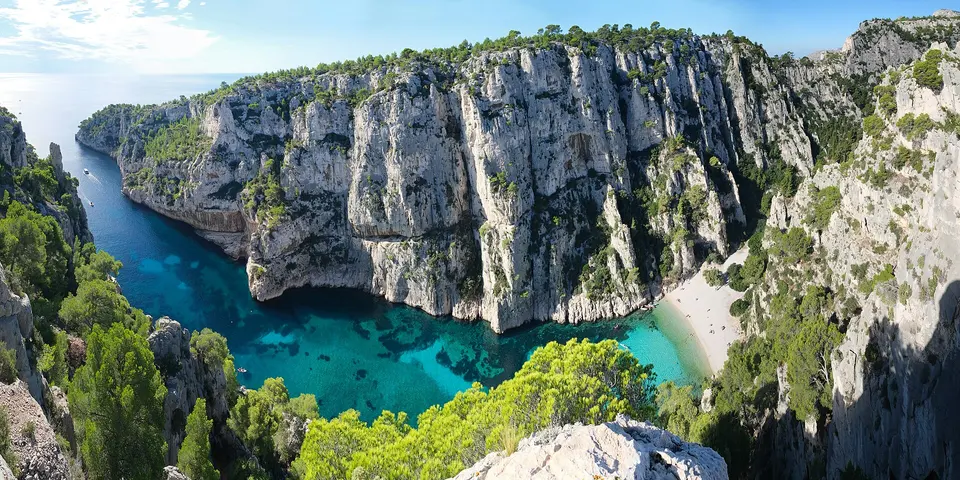
The postcard calanque, a fjord of sheer 100-metre white walls dropping into water the colour of a swimming pool with a wedge of pebble beach at the end, reached from Port-Pin by a path that climbs over the headland and then drops down a steep, rocky gully with a short scramble, about 45 minutes each way with good shoes, or by boat from Cassis that cannot land; the beach is small and full by midday in summer, the water is cold and deep, and the climbers on the walls are part of the view. Start back by mid-afternoon to make the train, and check the fire-risk map the evening before from June to September, when the park may be closed.

  • Plan about 2 h 30 min
  • Free; about 45 minutes from Port-Pin, steep and rocky; check the daily fire-risk closure map Jun–Sep; no facilities

Evening

Walk back to Cassis port, about 1.5 hours from En-Vau, the M01 bus to the station and the train to Saint-Charles; then metro M2 or a 15-minute walk to Notre-Dame-du-Mont
Cours Julien
Photo: Mike is Michi, CC BY-SA 4.0
5Bohemian quarter

Cours Julien

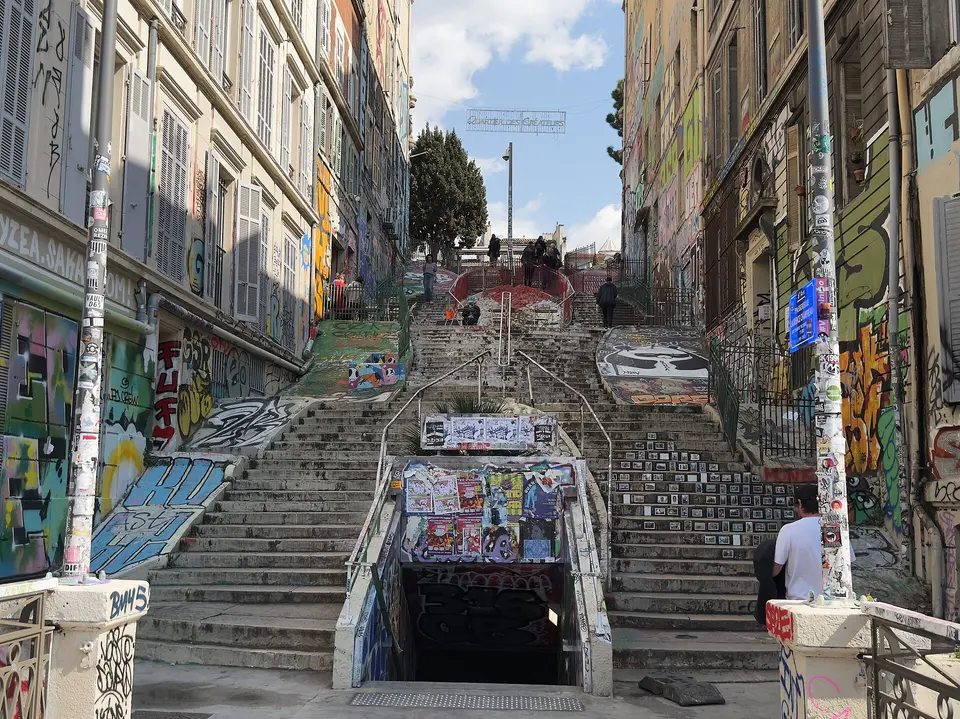
The Cours Ju, a long plane-shaded square on the plateau above the Canebière, reached by the painted stairs of the Rue Estelle, is the bohemian heart of the city: every wall in the surrounding streets is a mural, the square is fountains, bookshops, concept stores and a Wednesday organic market, and the terraces of bars and restaurants from Comorian to Corsican fill every night of the week, with music at La Maison Hantée and the Espace Julien. It is the place to end the trip with a drink and a plate of something from the other side of the Mediterranean, then walk down to the port.

  • Plan about 2 h
  • Free; bars and restaurants open late every night; metro M2 Notre-Dame-du-Mont; the stairs and murals are best photographed in late afternoon light

Good to know in Marseille

Tickets and opening days

  • The Mucem's J4 building and the Fort Saint-Jean are open 10:00 to 19:00 every day except Tuesday, May 1 and December 25; a single same-day ticket for all permanent and temporary exhibitions is €11 full, €7.50 reduced and €18 for a family of two adults and up to five children under 18, with free entry on the first Sunday of each month and for under-18s, jobseekers and disabled visitors with a companion; the outdoor spaces are free. The lift linking the fort's Vieux-Port entrance to the Place d'Armes is currently out of service.Source: Mucem, infos pratiques · checked Sep 2026
  • The Château d'If is open daily 10:00 to 18:00 from April 1 to September 27 and 10:00 to 17:15 from September 28 to March 31, closed on Mondays in that winter period and on January 1, May 1 and December 25, and does not open in bad weather; the full ticket is €7, free for under-18s, EU citizens aged 18 to 25, disabled visitors with a companion, jobseekers and on the first Sunday of the month from November to March. Two boat companies serve the island from the Vieux-Port, Calanques If from February to November and the Frioul If boat all year, with the crossing charged separately.Source: Château d'If, practical information · checked Sep 2026
  • The sanctuary of Notre-Dame de la Garde is open every day from 7:00 to 18:00; its museum is open 9:00 to 17:00 with last entry at 17:00 and closing at 17:45; bus 60 from the Vieux-Port, the Mucem and the town hall runs every 20 minutes to the basilica's car park, and the free car parks are open 7:00 to 18:00.Source: Basilique Notre-Dame de la Garde, horaires et accès · checked Sep 2026
  • Cosquer Méditerranée on the J4 esplanade is open 9:30 to 18:00 on weekdays outside school holidays, 9:30 to 19:30 at weekends, on public holidays and during school holidays, and 9:00 to 20:30 in July and August, with the last visit slot 1.5 hours before closing; tickets are €18 for adults, €11 for ages 10 to 17, €6 for ages 6 to 9 and free under 6, and the visit includes the cave tour with an audio guide in six languages and the documentary.Source: Cosquer Méditerranée, practical information · checked Sep 2026
  • From June 1 to September 30 access to the forest massifs of the Bouches-du-Rhône, including the Calanques National Park, is regulated by prefectural order: every day between 17:00 and 18:00 the prefecture assesses the fire risk massif by massif for the following day, and on a red day access to the park by land is forbidden, the Route des Crêtes is closed and boats may visit but may not land, while the Frioul archipelago remains open; the daily status is published in the Mes Calanques app and on the prefecture's website.Source: Parc national des Calanques, accès et risque incendie · checked Sep 2026
  • The Cité radieuse's roof terrace and the inner streets are open to visitors during opening hours, with private residential areas closed, and the Marseille Tourist Office runs an exclusive guided tour that includes a flat listed as a historic monument; access is by metro M2 to Rond-Point du Prado and bus B1, 19 or 22 to the Le Corbusier stop on Boulevard Michelet.Source: Office de Tourisme de Marseille, Cité radieuse · checked Sep 2026

3 days in Marseille: quick answers

Is 3 days enough for Marseille?

Three days cover the old town, the museums on the port, the islands, the modern city and the calanques. A fourth day is Aix-en-Provence, 30 minutes by train, or the Sormiou and Morgiou calanques on the Marseille side by bus and foot, or the Palais Longchamp with its fine-arts and natural-history museums and the covered market of Noailles, or the fishing quarter of L'Estaque that Cézanne painted, or a swim at the Plage des Catalans and the Prado beaches. The Stade Vélodrome tour is the football pilgrimage.

Which days should I plan around?

The Mucem is closed on Tuesdays and open 10:00 to 19:00 the rest of the week, free on the first Sunday of the month. The Château d'If opens 10:00 to 18:00 from April to late September and 10:00 to 17:15 otherwise, closed on Mondays from late September to March and in bad weather when the boats do not run. The Vieille Charité's museums close on Mondays. The basilica is open every day 7:00 to 18:00. From June 1 to September 30 the calanques may be closed for fire risk on any given day, decided by the prefecture around 18:00 the evening before; in July and August the Sugiton calanque needs a free reservation. The fish market on the Vieux-Port is every morning until about 13:00.

How much do the tickets cost?

The basilica is free. The Mucem is €11, €7.50 reduced and €18 for a family, free under 18 and on first Sundays, and the outdoor areas of the Fort Saint-Jean are free. The Château d'If is €7 and free under 18 and for EU residents under 26, plus about €11 for the boat with the Frioul stop. Cosquer Méditerranée is €18, €11 for ages 10 to 17 and €6 for 6 to 9. The Cité radieuse's public areas and roof are free; the tourist office's guided tour with an apartment is about €15. The Vieille Charité's courtyard and chapel are free. The calanques are free. The train to Cassis is about €5 each way.

How do I get around?

On foot in the centre and by RTM metro, tram and bus elsewhere: a single ticket is about €1.70 from a machine or the app, €2 from the driver, and 24-hour and 72-hour passes about €5.20 and €10.80 cover the metro, buses including the 60 up to the basilica and the 83 along the Corniche, and the Frioul boats are separate. The airport is 25 km northwest, 25 minutes by shuttle bus to Saint-Charles. Cassis is a 22-minute train. A car is a liability in the centre and cannot reach the calanques in summer, when the roads to Sormiou, Morgiou and Callelongue are closed.

What about the fire-risk closures in the calanques?

Every day from June 1 to September 30 the Bouches-du-Rhône prefecture assesses the fire risk massif by massif between 17:00 and 18:00 and publishes a colour map for the next day; on a red day the whole Calanques National Park is closed by land, the Route des Crêtes above Cassis is closed and boats may sail but not land, while the Frioul islands stay open. Check the Mes Calanques app or the prefecture's map the evening before, and on a red day do the Cassis harbour and the boat trip from its port instead, or swap day three for the Palais Longchamp and the beaches. Fires, camping and drones are banned all year and the paths must be kept to.

How much walking is this itinerary?

About 6 km on day one, downhill from the basilica then flat, on cobbles in Le Panier; about 5 km on day two, most of it on the rough paths of the Frioul islands; and about 10 km on day three, from Cassis to En-Vau and back on rocky coastal paths with two steep sections, less if you stop at Port-Pin. The calanques need proper shoes, a hat, two litres of water each and a start before the heat; the mistral can make the boats and the cliff paths uncomfortable on windy days.

Other Marseille itineraries

Keep exploring

Where this connects

THE TRIPWOA APP

Go somewhere.
Make it yours.

Build days around what you love. Follow your route, find your next stop and keep the moments along the way.

Get it on Google PlayAvailable for Android
Free to start
Tripwoa home with a Paris trip and nearby places to explore
Tripwoa day plan for New York with a route map and Times Square stop

A day that feels like you.

Sources and method

Places and coordinates: Wikidata and Tripwoa's open-data place catalog (Overture Maps Foundation, © OpenStreetMap contributors). Photos: Wikimedia Commons, credited on each image. Practical rules: the official sources linked in each note, checked in September 2026.

How this plan was made: Tripwoa's planner drafted the day order from real coordinates and typical visit times. Each stop was then reviewed, reordered where needed and rewritten with AI assistance. Walking distances are straight-line estimates, so allow a little extra time on real streets.