3-day itinerary · United States

3 Days in Portland

A plan that walks downtown and the Pearl on the first day, gives Washington Park the full day its four attractions need, and spends the third on the oldest scenic highway in America and the waterfalls along it. Official 2026 hours, closed days, ticket prices and the Multnomah Falls permit rule are in the stops.

  • 3days
  • 14sights
  • 0.0 kmon foot between sights

Updated 13 September 2026 · 4 official sources checked · report an error

Multnomah Falls
Photo: Ross kramerov, CC BY-SA 4.0

Powell's and downtown, then Washington Park's gardens and the zoo, then Vista House and the Gorge waterfalls

Portland is a city of about 650,000 at the meeting of the Willamette and the Columbia in northern Oregon, hemmed in by hills to the west and looking east at Mount Hood on any clear day. It was named on a coin toss in 1845, the loser having wanted to call it Boston, and it grew as the port that shipped the Willamette Valley's wheat and Oregon's timber. What makes it unusual now is a series of civic decisions: an urban growth boundary that stopped the sprawl in 1979, a riverside expressway torn out in 1974 and replaced with a park, a light rail network built when no other American city its size was building one, and no sales tax at all. The result is a compact, walkable centre with one of the largest urban forests in the country behind it, and the Columbia River Gorge, seventy-seven waterfalls along one stretch of cliff, forty kilometres east.

At a glance

Ways to use these days

For the view
Vista House at Crown Point
Outdoors
Pioneer Courthouse Square · Lan Su Chinese Garden · Tom McCall Waterfront Park
Lightest day on foot
Day 2 — 3.8 km between stops
Most walking
Day 3 — 11.2 km

Day 1

Downtown: a bookshop the size of a city block, the city's living room and a Ming garden

Start in the Pearl at a bookshop that needs a map, cross to the brick square where everyone in Portland eventually stands, give the afternoon to the art museum's Northwest collections and a walled Suzhou garden, and finish on the river bank where a motorway used to be.

  • 5 sights
  • Transport between sights
12345500 mN
Stops in order, straight-line distancesWalking route in Google Maps ↗

Morning

The Pearl District and Powell's City of Books
Photo: Michael Barera, CC BY-SA 4.0
1Neighbourhood

The Pearl District and Powell's City of Books

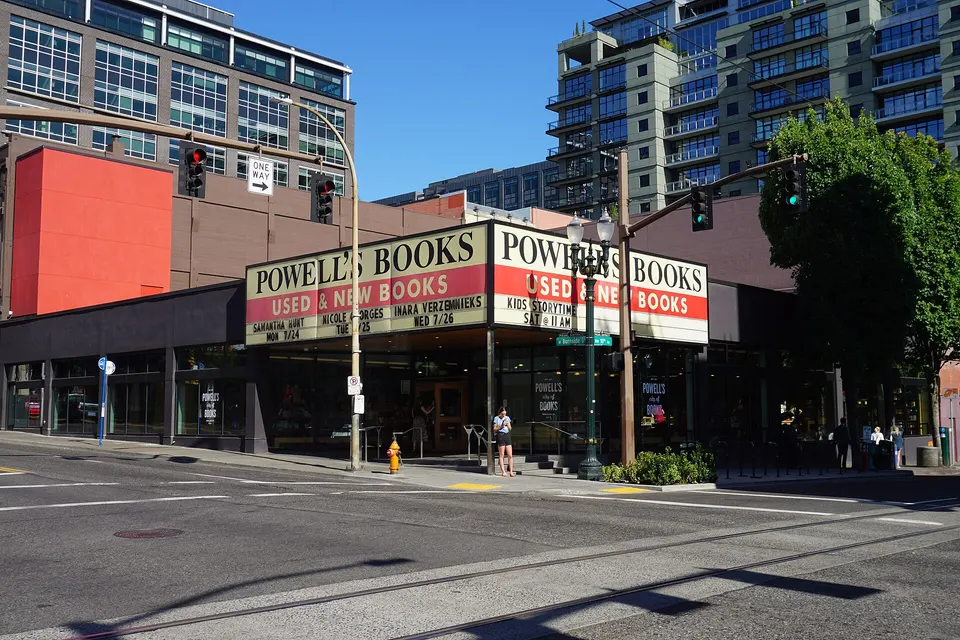
Rail yards and warehouses filled this part of Portland until the 1980s, when artists took the cheap space and a developer gave the area a name, and it is now the city's densest neighbourhood of galleries, breweries and converted loft buildings, stitched together by two small parks and the streetcar. At its southern corner stands Powell's City of Books, which occupies an entire city block, keeps more than a million new and used volumes shelved side by side on the same subject, and prints a colour-coded map because people get lost. It calls itself the largest independent new and used bookstore in the world and no one has seriously disputed it. The Rare Book Room upstairs is worth asking about.
  • Plan about 2 h 30 min
  • Powell's is open daily, generally 10:00 to 21:00, and admission to the Pearl is free; Oregon charges no sales tax, so the price on a book is the price you pay; the streetcar loops the district and is cheap
800 m south-east, about 10 minutes on foot; the MAX Blue and Red lines stop on the square
Pioneer Courthouse Square
Photo: William Beutler, CC BY 2.0
2Square

Pioneer Courthouse Square

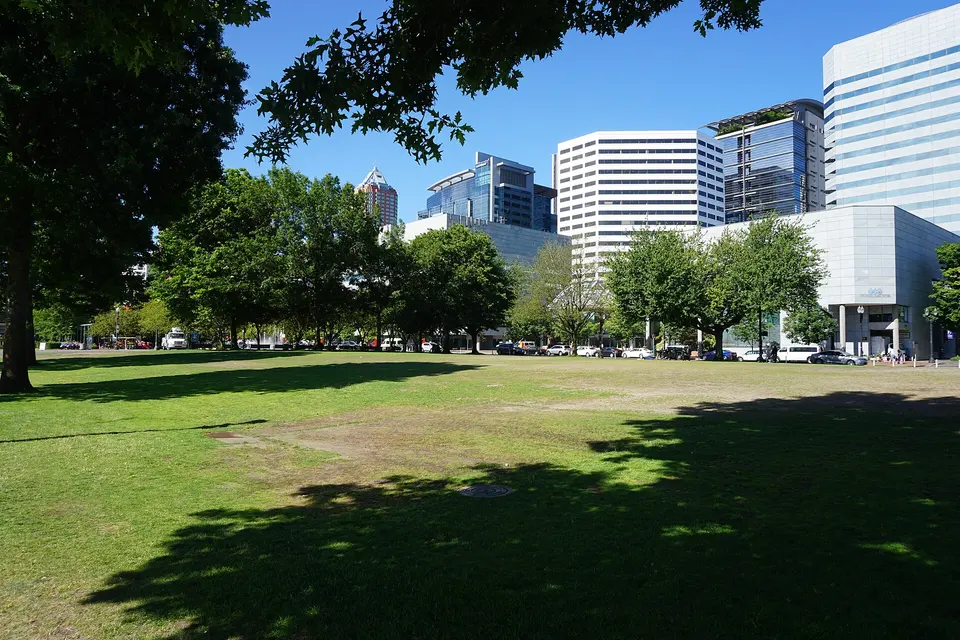
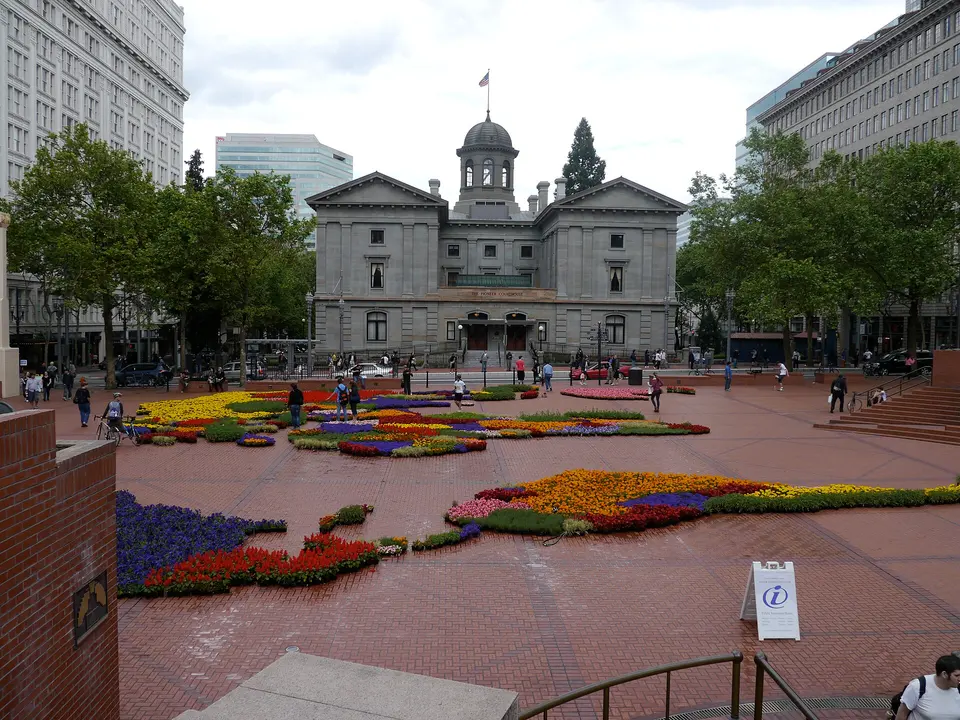
Portland calls this its living room and means it. The block held a hotel, then a car park, and in 1984 became a brick amphitheatre stepping down to a small stage, paid for in part by 65,000 personalised bricks that citizens bought for $15 each and whose names are underfoot. There is a weather machine that sounds a fanfare at noon and produces a sun, a dragon or a heron depending on the forecast, a bronze figure of a man holding an umbrella called Allow Me that everyone photographs, and an echo chamber marked on the paving. Light rail lines cross two sides of it, so everyone in the city passes through eventually. The Christmas tree goes up here.

  • Plan about 30 min
  • Free and always open; the weather machine performs at noon; the MAX Blue and Red lines stop on the square and the visitor information centre is on the lower level

Midday

LunchPortland invented the modern food cart pod and the downtown blocks still have several: a few dozen trailers round the edge of a car park, each doing one thing, with prices that have not caught up with the restaurants. The city's other contributions are worth a detour: Voodoo Doughnut and Blue Star for doughnuts, Salt & Straw for ice cream in flavours that should not work, and coffee roasted to a standard that Portland will lecture you about at any opportunity.

Afternoon

600 m south-west along the South Park Blocks, about 8 minutes on foot
Portland Art Museum
Photo: M.O. Stevens, Public domain
3Art museum

Portland Art Museum

The oldest art museum in the Pacific Northwest, founded in 1892, and housed in a Pietro Belluschi building of 1932 and the former Masonic temple next door, joined in 2025 by a glass Rothko Pavilion between them. The collections that matter are regional and specific: Native American art of the Northwest Coast and the Columbia Plateau, assembled from 1948 and among the most important anywhere; Asian art with strong Japanese and Chinese holdings; and Northwest modernism. There are also European paintings from the Renaissance to the Impressionists, a Rothko gallery that reflects the painter's Portland childhood, and a serious graphic arts centre. The film programme runs in its own building.

  • Plan about 2 h
  • Open Tuesday to Sunday 10:00 to 17:00 and closed Monday, and closed on 1 January, 4 July, Thanksgiving and 25 December; admission is $27.50 for adults with concessions at $24.50 and $22.50, and entry is free from 10:00 to 19:00 on the first Thursday of the month
1.3 km north-east into Old Town, about 17 minutes on foot or two stops on the streetcar
Lan Su Chinese Garden
Photo: Daderot, CC0
4Garden

Lan Su Chinese Garden

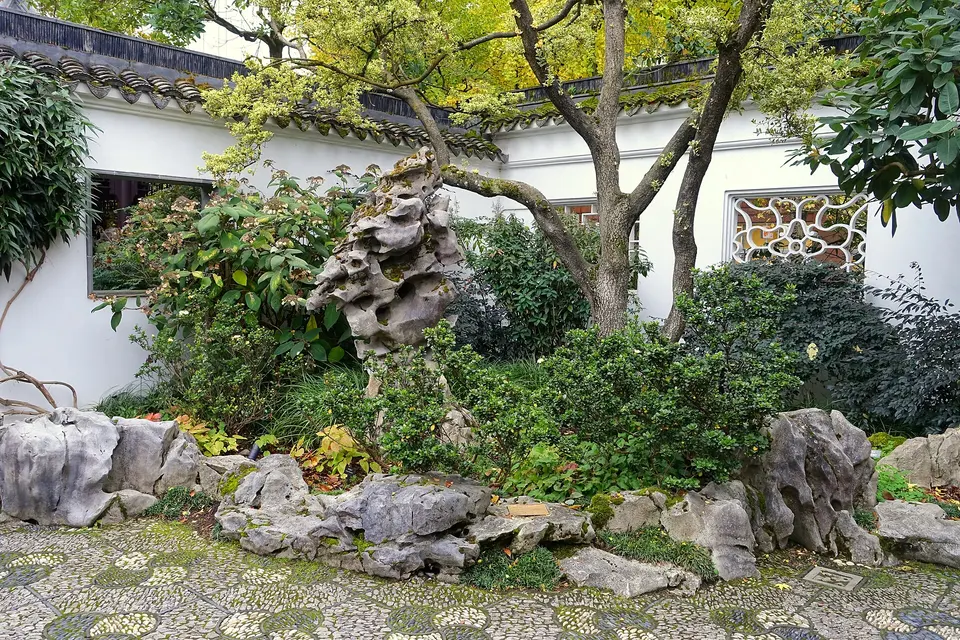
A walled Ming-dynasty scholar's garden occupying one city block of Old Town, built in 2000 by sixty-five artisans from Suzhou, Portland's sister city, using stone, tile and timber shipped from China and traditional methods throughout. The point of a garden like this is that it is never seen whole: walls, moon gates, latticed windows and a covered walkway frame partial views so that the same pond, rockery and pavilions recompose themselves at every step, and the plants, more than four hundred species from China, are chosen for what they do in each season rather than for a summer display. There is a teahouse on the upper floor of one pavilion serving properly brewed Chinese tea. It is the most complete garden of its kind outside China.

  • Plan about 1 h 15 min
  • Open daily 10:00 to 17:30 with adult admission $18, seniors $17, students $15 and a $5 rate for EBT and WIC cardholders; allow an hour, take the free guided introduction, and stop at the teahouse

Evening

700 m south-east to the river bank, about 9 minutes on foot
Tom McCall Waterfront Park
Photo: Michael Barera, CC BY-SA 4.0
5Park

Tom McCall Waterfront Park

A six-lane expressway ran along the west bank of the Willamette until Governor Tom McCall had it torn out in 1974, and the 1.2 km of riverbank lawn that replaced it is still the most-cited example in America of a city removing a motorway. It holds the Japanese American Historical Plaza, a memorial of inscribed stones to the Oregonians interned in 1942; the Salmon Street Springs fountain, which cycles through patterns and is full of children all summer; a hundred cherry trees that flower in late March; and the Saturday Market at its northern end, an open-air craft market running since 1974 that is the largest continuously operating one in the country. The Eastbank Esplanade opposite completes a 4 km loop over two bridges.

  • Plan about 1 h
  • Free and open daily; the Portland Saturday Market runs Saturdays and Sundays from March to December under the Burnside Bridge; the cherry blossom in the Japanese American Historical Plaza peaks in the last week of March

Day 2

Washington Park: the best Japanese garden outside Japan, ten thousand roses and a newspaperman's house

Spend the day in the hills immediately west of downtown, where a single park holds a Japanese garden that Japan itself calls the finest abroad, a working rose trial ground, an arboretum of 2,300 species and a zoo, with a 1914 mansion on the bluff above for the sunset.

  • 5 sights
  • Transport between sights
12345500 mN
Stops in order, straight-line distancesDriving route in Google Maps ↗

Morning

Portland Japanese Garden
Photo: King of Hearts, CC BY-SA 4.0
1Garden

Portland Japanese Garden

Laid out from 1963 on the site of the old zoo in the hills above the city, designed by Professor Takuma Tono, and generally reckoned the finest Japanese garden outside Japan; the Japanese ambassador said so publicly in 1988 and the phrase has followed it since. Five separate garden styles occupy 5 hectares: a flat garden, a strolling pond garden, a tea garden with a ceremony house, a natural garden and a dry landscape garden of raked gravel. Kengo Kuma added a cultural village of three pavilions in 2017, built into the hillside with deep overhanging eaves. On a clear day Mount Hood appears over the trees from the flat garden, framed deliberately. It is best in the rain, which Portland can usually supply.

  • Plan about 2 h
  • Open daily with seasonal hours, generally 10:00 to 17:30 in summer and shorter in winter, with member-only hours from 08:00; buy timed tickets online to skip the queue, and the shuttle from the park entrance saves a steep walk
300 m downhill, four minutes on foot; the two gardens share a car park
International Rose Test Garden
Photo: Vulturesong, CC0
2Garden

International Rose Test Garden

Portland is the City of Roses and this is why: an official test garden founded in 1917, partly to keep European rose varieties safe from the bombing of the First World War, and still an accredited trial ground where new cultivars are grown for two years and judged on fragrance, colour, disease resistance and habit. There are about 10,000 bushes of more than 610 varieties on three terraces cut into the hillside, including a Shakespeare garden of roses named for the plays, a miniature rose test area and a Gold Medal garden of past winners. It is free, it is never closed, and from the top terrace the city, the river and Mount Hood line up in one view. Peak bloom is late May to June.

  • Plan about 1 h
  • Free and open daily from 07:30 to 21:00; late May to early June is the peak and September gives a good second flush; free guided tours run daily in summer and the car park fills by mid-morning at weekends

Midday

LunchThe Japanese garden's Umami Café serves tea and light Japanese food on a terrace over the trees and is the pleasant option; the zoo and the arboretum have ordinary cafés. If you would rather come down the hill, Northwest 21st and 23rd Avenues are five minutes east and hold a long run of restaurants in converted Victorian houses, which is where Portland ate before the Pearl existed.

Afternoon

1.5 km west along the ridge, about 20 minutes on foot or five by car
Hoyt Arboretum
Photo: sunoochi, CC BY 2.0
3Arboretum

Hoyt Arboretum

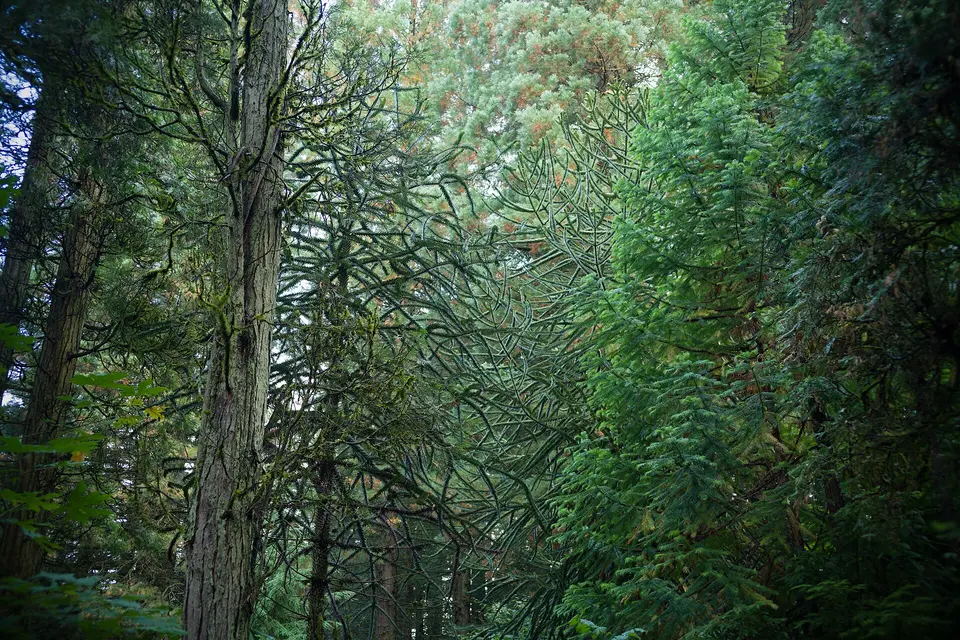
76 hectares along the ridge of Washington Park, planted from 1928 as a living museum of trees and now holding more than 2,300 species from six continents, including one of the largest conifer collections in the United States and a number of species that are endangered or extinct in the wild. Twenty kilometres of trail run through it, arranged so that you walk from the magnolias into the maples into the redwoods; the Redwood Deck stands among coast redwoods planted in the 1930s that are already impressive, and the Winter Garden is designed to be at its best in January. The Wildwood Trail passes through on its way from the zoo up into Forest Park, which at 2,000 hectares is one of the largest urban forests in America.

  • Plan about 1 h 30 min
  • Free and open daily from 05:00 to 22:00, with the visitor centre open shorter hours; trail maps are at the centre and the trails are steep and muddy in winter; the MAX Red and Blue lines stop at Washington Park, 80 metres underground, and a lift brings you up
1 km south, about 4 minutes by car or one stop on the park shuttle
Oregon Zoo
Photo: Stuart Seeger, CC BY 2.0
4Zoo

Oregon Zoo

Founded in 1888 when a pharmacist gave the city two bears he kept behind his shop, which makes it the oldest zoo west of the Mississippi. It has spent the last fifteen years rebuilding on a bond measure passed by voters, and the results are among the better American zoo habitats: Elephant Lands gives an Asian elephant herd two and a half hectares with deep sand and a bathing pool, Polar Passage and Primate Forest opened recently, and the Great Northwest section covers black bears, cougars, sea otters and a walk-through aviary of the region's own species. The zoo runs serious conservation work on the California condor and the Oregon silverspot butterfly. Summer concerts are held on the lawn.

  • Plan about 2 h 30 min
  • Open daily with seasonal hours: about 09:30 to 17:30 in summer with last entry 16:30, and 09:30 to 15:30 in winter with last entry 14:30, dropping to Friday-to-Monday opening in the deepest part of winter; buy tickets in advance online; the MAX train stops at the zoo

Evening

3 km north, about 10 minutes by car; the Wildwood Trail also connects on foot in about an hour
Pittock Mansion
Photo: Steven Pavlov, CC BY-SA 4.0
5Historic house

Pittock Mansion

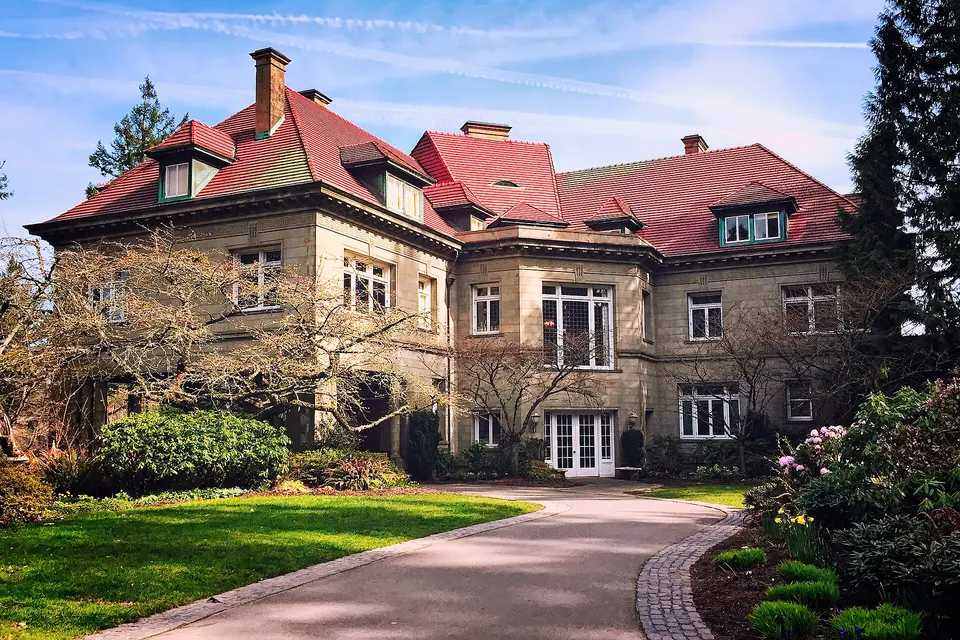
Henry Pittock arrived in Oregon on the trail in 1853 with nothing, built the Oregonian into the region's newspaper, and in 1914 finished this 46-room French Renaissance house on a 300-metre bluff above the city. It was extraordinarily modern for its date: a central vacuum system, intercoms, indirect lighting, refrigeration and a walk-in shower with multiple heads. The family sold it in 1958, the Columbus Day Storm of 1962 damaged it badly, and it was heading for demolition when the city bought it in 1964 after a public campaign. The rooms are furnished to 1914 and the real draw is outside: the lawn looks straight down the city with five Cascade volcanoes on the skyline, Mount Hood among them.

  • Plan about 1 h 30 min
  • Open 09:00 to 16:00 with the last admission 30 minutes before closing and a noon opening on Tuesdays; adults $17.00, visitors over 65 and students $15.00 and youth aged 6 to 18 $14.00; closed on New Year's Day, Martin Luther King Jr. Day, Juneteenth, Thanksgiving, Christmas and January maintenance days

Day 3

The Columbia River Gorge: a 1916 scenic highway and four waterfalls

Drive east on the oldest scenic road in America, stand on a basalt promontory 220 metres above the Columbia, and work along a stretch of cliff that carries more waterfalls in fifteen kilometres than anywhere else in the country.

  • 4 sights
  • Transport between sights
12342 kmN
Stops in order, straight-line distancesDriving route in Google Maps ↗

Morning

Vista House at Crown Point
Photo: Mark Rosengarten, CC BY-SA 4.0
1Viewpoint

Vista House at Crown Point

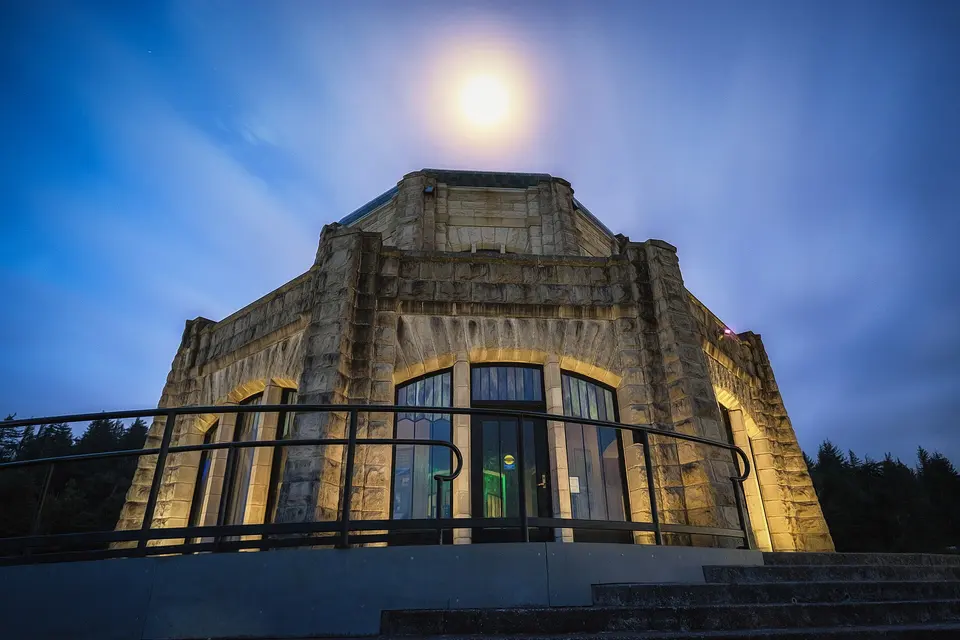
The Historic Columbia River Highway was finished in 1916 as the first planned scenic road in the United States, engineered with Italian stonemasons to a gradient no steeper than five per cent so that early cars could climb it, and Vista House was built two years later on a basalt promontory 220 metres above the river as, officially, a comfort station for travellers. It is an octagonal art nouveau rotunda of grey sandstone with a green tiled dome, marble floors and opalised glass, and it cost so much that the county was criticised for years. From the parapet the Columbia River Gorge opens east and west in both directions, the river a kilometre wide below and the Washington cliffs opposite. Wind speeds of 100 km/h are routine.

  • Plan about 45 min
  • Free and open daily from about 09:00 to 18:00 between March and October, and weekends only in winter; there is a small museum and café inside; hold onto hats and car doors, because the wind on the point is not a joke
5 km east on the Historic Highway, about 8 minutes; the car park is small
Latourell Falls
Photo: Steven Pavlov, CC BY-SA 4.0
2Waterfall

Latourell Falls

The first of the great waterfalls on the old highway and the one most people drive past, which is a mistake. It drops 76 metres in a single plunge straight off an overhanging basalt cliff, and the rock behind it is a textbook colonnade of hexagonal columns stained bright yellow-green with lichen, so the fall is framed by something that looks engineered. A paved path reaches the base in two minutes from the car park; a 3.5 km loop climbs to the top, crosses the creek and comes back past Upper Latourell Falls, which is quieter and just as good. The whole thing sits in Guy W. Talbot State Park, a gift from the family whose estate this was.

  • Plan about 1 h
  • Free with a small car park that fills early at weekends; the lower viewpoint is a two-minute walk on pavement and the upper loop takes about an hour; it is the first stop east of Vista House on the Historic Columbia River Highway

Midday

LunchThe Multnomah Falls Lodge of 1925 has a restaurant at the base of the falls and it is the only substantial place to eat on this stretch, so book it or bring lunch. Twenty minutes further east, Hood River is a windsurfing town with several good breweries and a view up to Mount Hood, and it makes a better stop if you are continuing along the gorge rather than turning back.

Afternoon

10 km east, about 12 minutes; parking is limited and fills early
Wahkeena Falls
Photo: m01229, CC BY-SA 2.0
3Waterfall

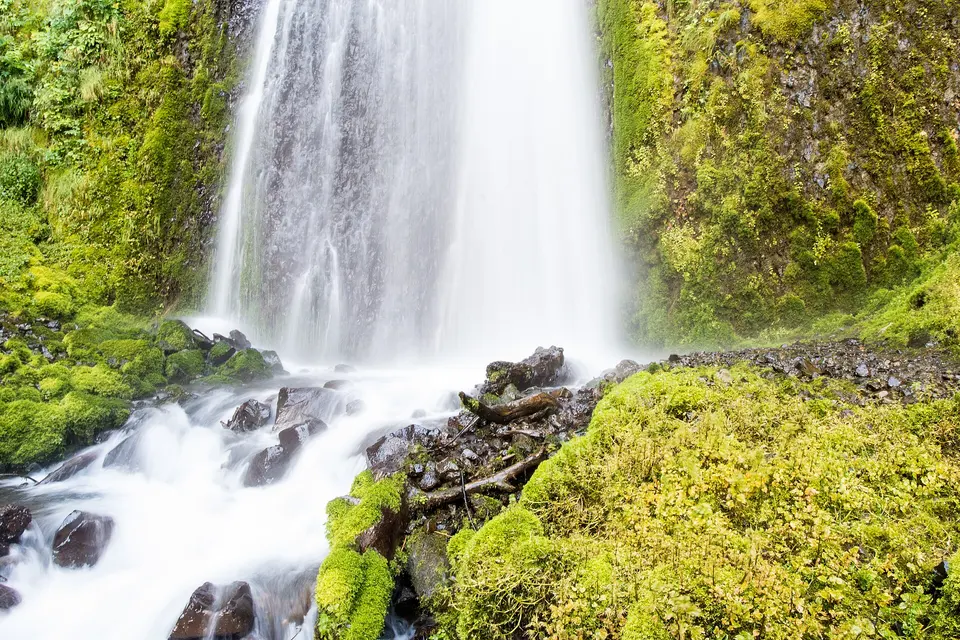
Wahkeena Falls

Wahkeena is a Yakama word meaning most beautiful, which is a large claim on a road with seventy-seven waterfalls, and the fall earns it by not being a single drop at all: the creek comes down 74 metres in a series of cascades, chutes and a final plunge into a mossy amphitheatre, so it is all movement rather than one curtain. A paved path climbs to a stone footbridge across the base in about five minutes. From there the trail keeps climbing in switchbacks and can be linked to Multnomah Falls along a 8 km loop through the forest, which is the best way to see both without fighting the car park. The 2017 Eagle Creek Fire burned through here and the regrowth is visible.

  • Plan about 45 min
  • Free with a small car park between Latourell and Multnomah; the bridge is a five-minute walk up a paved but steep path; the loop trail to Multnomah Falls takes about three hours and is the way to avoid the crowds
1 km east, about 3 minutes; the Historic Highway lot is usually easier than the Interstate 84 exit
Multnomah Falls
Photo: Ross kramerov, CC BY-SA 4.0
4Waterfall

Multnomah Falls

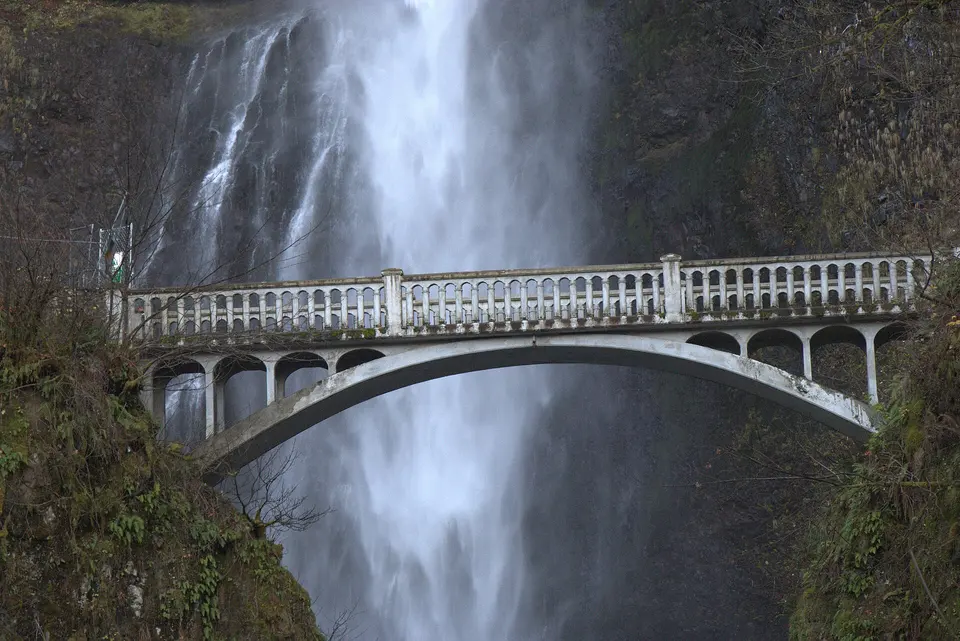
The tallest waterfall in Oregon at 189 metres in two drops, fed by underground springs so that it runs hard all year rather than drying to a trickle in August, and by a long way the most visited natural attraction in the state. Benson Bridge crosses the pool between the upper and lower falls at 32 metres, built in 1914 and the shot everybody takes. A paved switchback trail of 1.8 km climbs to a viewing platform at the top, gaining 210 metres, and it is steep but manageable. The 1925 lodge at the base, built of every kind of stone found in Multnomah County, holds a restaurant and the visitor centre. In hard winters the whole fall freezes.

  • Plan about 1 h 30 min
  • Free to visit, but in peak season a timed-use permit is required for the site and for parking, booked in advance online; the Interstate 84 exit fills first and the Historic Highway lot is often easier; the top viewpoint is an hour return

Evening

DinnerBack in Portland, the east side is where most of the good restaurants have moved: Division Street, Alberta Street and Mississippi Avenue each hold a dense run of them, and none of them takes bookings far ahead. Oregon wine is the thing to order, Pinot Noir from the Willamette Valley an hour south-west, which competes seriously with Burgundy and is priced accordingly.

Good to know in Portland

Downtown museums and gardens

  • The Portland Art Museum is open Sunday and Tuesday to Saturday from 10:00 to 17:00 and is closed on Mondays, as well as on 1 January, 4 July, Thanksgiving and 25 December. Admission is $27.50 for adults, $24.50 and $22.50 for concessions, and entry is free from 10:00 to 19:00 on the first Thursday of each month.Source: Portland Art Museum — Hours and admission · checked Sep 2026
  • Lan Su Chinese Garden is open daily from 10:00 to 17:30. Admission is $18.00 for adults, $17.00 for seniors and $15.00 for students, with a $5.00 rate for EBT and WIC cardholders covering up to four tickets per cardholder; members enter free during regular hours except at special ticketed events.Source: Lan Su Chinese Garden — Visit · checked Sep 2026

Washington Park: the zoo and Pittock Mansion

  • The Oregon Zoo runs seasonal daytime hours: open daily 09:30 to 17:30 with last entry at 16:30 in the summer season, and 09:30 to 15:30 with last entry at 14:30 in the winter season, dropping to Friday-to-Monday opening in the quietest winter weeks. It closes on 25 December and on selected days for private events, and asks that tickets be purchased in advance online.Source: Oregon Zoo — Hours and Tickets · checked Sep 2026
  • Pittock Mansion is open 09:00 to 16:00 with the last admission 30 minutes before closing, and opens at noon on Tuesdays. Admission covers the mansion, the Gate Lodge and the current special exhibit, and costs $17.00 for adults, $15.00 for visitors 65 and over and for students, and $14.00 for youth aged 6 to 18. It closes on New Year's Day, Martin Luther King Jr. Day, Juneteenth, Thanksgiving, Christmas and its January maintenance days, and hikers using the main car park must also pay for parking.Source: Pittock Mansion — Visit · checked Sep 2026

3 days in Portland: quick answers

Is 3 days enough for Portland?

Three days is a good fit: one for downtown and the Pearl, one for Washington Park, and one for the Columbia River Gorge, which is the reason many people come to Oregon at all. What gets left out is Mount Hood, 90 km east with Timberline Lodge at 1,800 metres and skiing into summer; the Willamette Valley wine country an hour south-west; and the coast at Cannon Beach, an hour and a half west. Any of the three makes a strong fourth day, and all three need a car.

What is the best time of year to visit Portland?

June to September, without much argument. Portland's summers are dry, sunny and around 26 to 28°C, which surprises people who only know the reputation. The rain is real but it is a winter thing: from November to April it drizzles persistently rather than pouring, the sky stays grey for weeks, and the total rainfall is actually less than New York's. Late May and June bring the roses and the Rose Festival. Autumn is beautiful in the Gorge. Winter is mild at about 8°C and the waterfalls are at their fullest.

Do you need a car in Portland?

For the first two days, no. The MAX light rail runs from the airport into the middle of downtown in 38 minutes, the streetcar loops the Pearl and the east side, and Washington Park has its own underground MAX station with a free shuttle to the gardens and the zoo. The Gorge is the exception: the waterfalls are strung along a highway with small car parks and no useful transit, though a seasonal shuttle bus runs from Gateway Transit Center. Hire a car for day three or take a tour.

How much does Portland cost per day?

Oregon charges no sales tax at all, which quietly takes 8 to 10 per cent off everything you buy compared with most American cities. A hostel bed runs $40 to $60, a mid-range hotel $160 to $250. The gardens are the main tickets: the Japanese Garden about $22, Lan Su $18, the art museum $27.50, Pittock Mansion $17. Against that the rose garden, the arboretum, the waterfront and all the Gorge viewpoints are free. Food carts do lunch for $10 to $15 and a good dinner runs $50 to $80 a head.

Do you need a permit for Multnomah Falls?

In peak season, yes. The Forest Service runs a timed-use permit system for the Multnomah Falls site and separately for parking, booked in advance online through recreation.gov, and the dates and details change from year to year, so check before you drive out. Outside the permit season the limit is simply the car park, which fills by mid-morning at weekends. The Historic Columbia River Highway lot is usually easier than the Interstate 84 exit, and the shuttle bus removes the problem entirely.

Is Powell's City of Books worth the hype?

Yes, and not only for readers. It fills an entire city block over several floors, holds more than a million volumes, and shelves new and used copies of the same title side by side, which is unusual and changes how you browse. Colour-coded rooms and a printed map are necessary rather than a gimmick. The Rare Book Room upstairs is open to anyone who asks. Combined with Oregon having no sales tax, it is the one shop in America where visitors routinely have to buy an extra bag.

Other Portland itineraries

Keep exploring

Where this connects

THE TRIPWOA APP

Go somewhere.
Make it yours.

Build days around what you love. Follow your route, find your next stop and keep the moments along the way.

Get it on Google PlayAvailable for Android
Free to start
Tripwoa home with a Paris trip and nearby places to explore
Tripwoa day plan for New York with a route map and Times Square stop

A day that feels like you.

Sources and method

Places and coordinates: Wikidata and Tripwoa's open-data place catalog (Overture Maps Foundation, © OpenStreetMap contributors). Photos: Wikimedia Commons, credited on each image. Practical rules: the official sources linked in each note, checked in September 2026.

How this plan was made: Tripwoa's planner drafted the day order from real coordinates and typical visit times. Each stop was then reviewed, reordered where needed and rewritten with AI assistance. Walking distances are straight-line estimates, so allow a little extra time on real streets.