3-day itinerary · Cambodia

3 Days in Siem Reap

A realistic first-timer plan that spends day one on the small circuit, from sunrise over the towers of Angkor Wat to the 200 stone faces of the Bayon, the terraces of Angkor Thom, the strangler figs of Ta Prohm and the quiet of Banteay Kdei, and ends it on the hill of Phnom Bakheng; goes out on day two to the carvings of Banteay Srei and the Landmine Museum, then round the grand circuit through Preah Khan and the island shrine of Neak Pean to the sunset temple of Pre Rup, and sits down for the circus at Phare; and keeps day three for the town, with the workshops of Artisans Angkor, the Old Market and the murals of Wat Bo, before a boat through the flooded forest to Kampong Phluk on the Tonlé Sap. Every stop comes with the tuk-tuk logistics and the rules that matter in 2026.

  • 3days
  • 15sights
  • 0.0 kmon foot between sights

Updated 12 September 2026 · 2 official sources checked · report an error

Angkor Wat
Photo: Christophe95, CC BY-SA 4.0

The small circuit at dawn, the far temples and the grand circuit, then the town and the lake

Everything at Angkor is done by tuk-tuk, hired by the day, and the 3-day Angkor Pass, valid on any three days within ten, is the ticket for days one and two; buy it online from Angkor Enterprise or at the ticket office on the Apsara road the afternoon before, because the office is the only seller and tickets are checked at every temple. Day one is the classic small circuit with a 5:00 start for sunrise; day two goes 35 km north to Banteay Srei before the grand circuit, so it is the longer tuk-tuk day; day three needs no pass, only a car or tuk-tuk for the 30 km to Kampong Phluk, where the boat price depends on the season and the water. Shoulders and knees must be covered inside the temples, and the top tier of Angkor Wat and the Bakheng summit turn away anyone who is not. The rains run from May to October and make the lake trip its best; the dry months from November to March are cool and busy; April and May are the hottest.

At a glance

Ways to use these days

If it rains
5 of the stops are indoors — Angkor Wat · Ta Prohm · Banteay Srei
Lightest day on foot
Day 1 — 12.4 km between stops
Most walking
Day 2 — 37.9 km

Day 1

The small circuit: sunrise at Angkor Wat, the Bayon, Ta Prohm and Phnom Bakheng

Leave town at 5:00 for the reflecting pool at Angkor Wat, walk the galleries when the crowd thins, go in through the south gate of Angkor Thom to the faces of the Bayon and the Terrace of the Elephants, eat by the reservoir, and take the afternoon for the tree-wrapped Ta Prohm and the quiet Banteay Kdei before the climb to Phnom Bakheng for sunset.

  • 5 sights
  • Transport between sights
123451 kmN
Stops in order, straight-line distancesDriving route in Google Maps ↗

Morning

Angkor Wat
Photo: Christophe95, CC BY-SA 4.0
1Temple

Angkor Wat

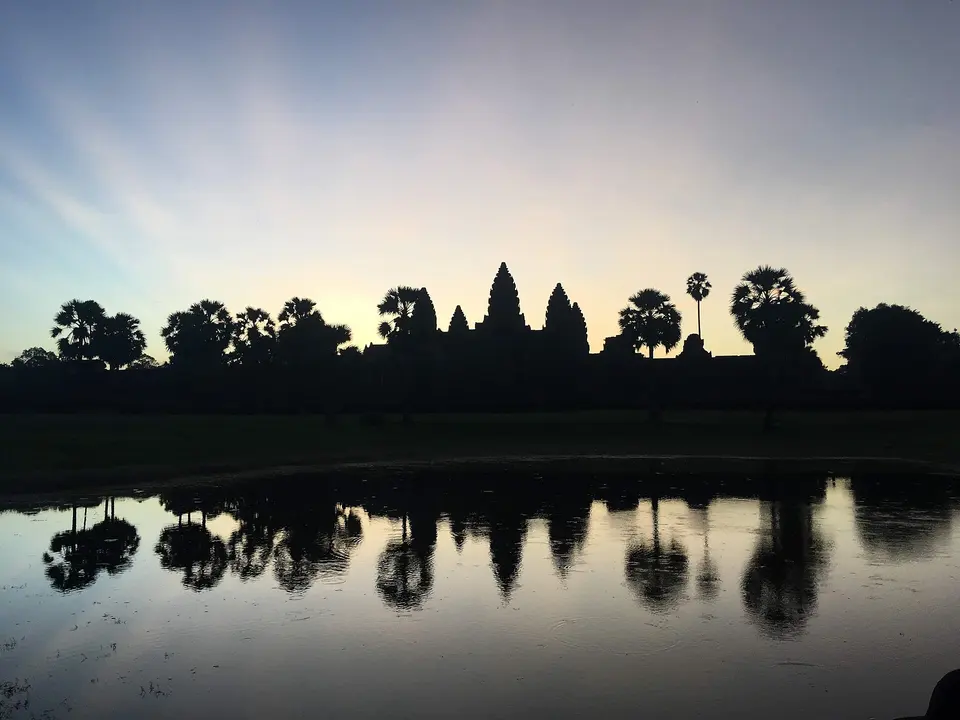
The largest religious monument on earth, built by Suryavarman II in the first half of the 12th century as a Hindu temple to Vishnu and his own mausoleum and turned Buddhist a century later, is a stone mountain of five towers inside a 1.5-kilometre moat, approached over a causeway from the west so that the sun rises behind it, which is why the crowd gathers at the northern reflecting pool before 5:30. After the light, walk the outer gallery, 800 metres of bas-reliefs of the Churning of the Sea of Milk and the battles of the Mahabharata, then the courtyards of the second level and, if the queue and your dress allow, the steep stairs to the Bakan, the top tier. By 8:30 the tour groups arrive and it is time to leave for Angkor Thom.
  • Plan about 3 h
  • Open from 5:00; 3-day Angkor Pass about US$62; shoulders and knees covered, the Bakan closed on Buddhist holy days
Tuk-tuk 10 minutes north through the south gate; the driver waits at the Bayon and moves you between the terraces
Angkor Thom and the Bayon
Photo: Satdeep Gill, CC BY-SA 4.0
2Walled city and temple

Angkor Thom and the Bayon

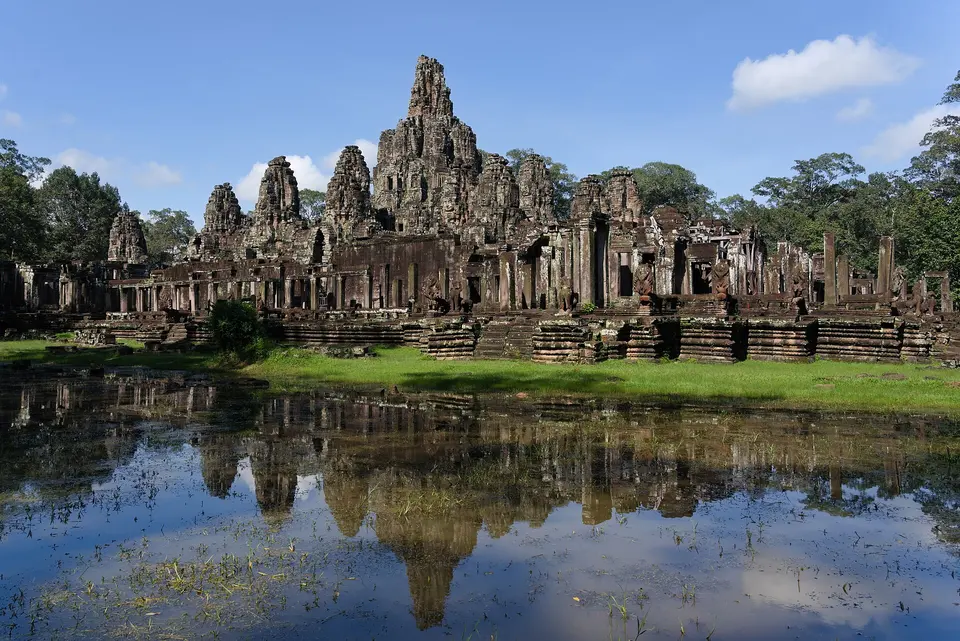
The last capital of the empire, a walled square of 9 square kilometres laid out by Jayavarman VII around 1200, is entered through the south gate over a causeway of gods and demons pulling a serpent, and its centre is the Bayon, a temple whose 54 towers carry more than 200 serene stone faces, probably the king's own, looking in every direction over galleries of reliefs of everyday Khmer life, markets, cockfights and the naval battle on the Tonlé Sap. North of it are the Baphuon, an 11th-century pyramid with a reclining Buddha built into its west wall, the royal enclosure of Phimeanakas and the 350-metre Terrace of the Elephants, from which the kings reviewed their armies, with the Terrace of the Leper King's hidden wall of carvings beside it.

  • Plan about 2 h 30 min
  • Opens about 7:30; on the Angkor Pass; the Bayon is emptiest right after opening and again after 15:00

Midday

LunchThe stalls and restaurants opposite Angkor Wat's moat and along Srah Srang, the royal reservoir beside Banteay Kdei, do fish amok, lok lak and fried rice for a few dollars each and open before most visitors have breakfasted; your driver has a favourite and eats free if you eat there. Coconuts and cold water are everywhere. Eat early, around 11:30, and rest in the shade until the heat breaks.

Afternoon

Tuk-tuk 15 minutes east from Angkor Thom, past Ta Keo; the driver drops you at the west gate and collects you at the east
Ta Prohm
Photo: lumoplank, CC0
3Temple

Ta Prohm

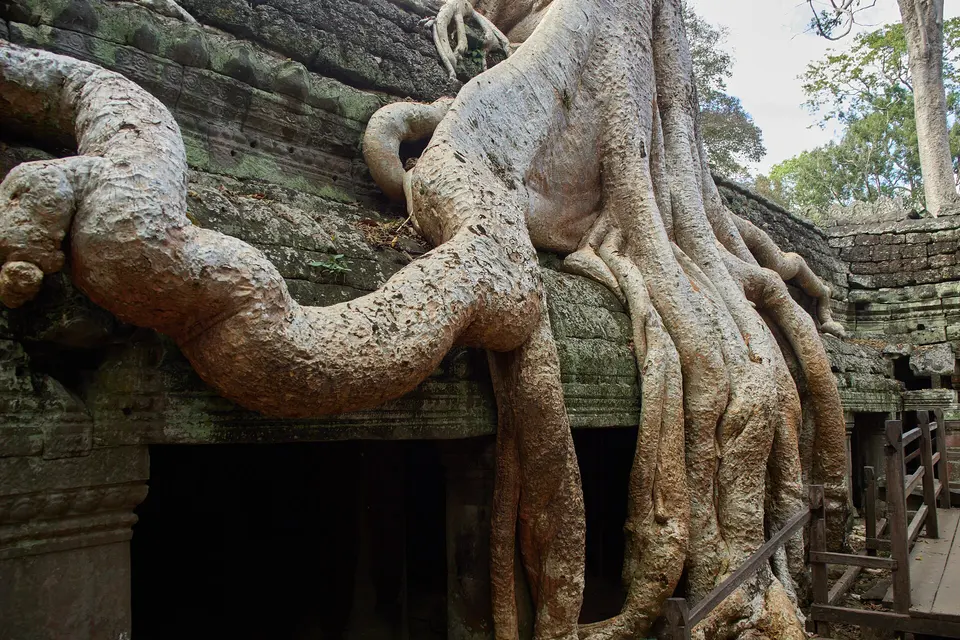
Jayavarman VII's monastery of 1186, dedicated to his mother and once home to 12,500 people according to its own inscription, was deliberately left as the French found it, with the roots of silk-cotton and strangler fig trees pouring over the walls and prising apart the galleries, and it is the picture of Angkor that everyone knows, helped by Tomb Raider being filmed here in 2000. Wooden walkways now steer the crowd through the collapsed courtyards in one direction, west to east, past the most photographed tree at the Hall of Dancers; go in the early afternoon when the morning groups have gone and the light comes sideways through the canopy.

  • Plan about 1 h 30 min
  • Opens about 7:30, closes about 17:30; on the Angkor Pass; one-way route, allow 45 minutes to an hour inside
Tuk-tuk 5 minutes south, or a 15-minute walk from the east gate of Ta Prohm
Banteay Kdei and Srah Srang
Photo: Diego Delso, CC BY-SA 3.0
4Temple and reservoir

Banteay Kdei and Srah Srang

A smaller, quieter Buddhist monastery of the same reign and style as Ta Prohm, entered through gates with the same four faces as the Bayon, with a long, half-ruined sequence of courtyards and a Hall of Dancers carved with apsaras, which most tours skip and which is therefore the place to be alone with the stones in the late afternoon. Opposite its east gate is Srah Srang, the 10th-century royal bathing pool, 700 metres long, with a landing stage of lions and nagas that is a fine place to sit with a coconut before the drive to the hill.

  • Plan about 1 h
  • On the Angkor Pass; 30 to 45 minutes; the stalls at Srah Srang sell drinks and snacks

Evening

Tuk-tuk 20 minutes back west; be at the foot of the hill by 16:30 for the 15-minute climb, as only 300 people are allowed on top
Phnom Bakheng
Photo: Helt, CC BY-SA 3.0
5Hilltop temple

Phnom Bakheng

The first temple-mountain of Angkor, built by Yasovarman I around 900 on the only real hill between Angkor Wat and Angkor Thom, is a stepped pyramid of 108 towers whose top terrace looks west over the West Baray and south to the towers of Angkor Wat rising from the forest, which is why it has been the sunset spot for a century. The park limits the summit to 300 people at a time and closes the stairs when the count is reached, so the queue starts forming at the foot around 16:30; the walk up the elephant path takes 15 minutes, and the temple closes shortly after the sun goes. The view is better than the sunset itself on most evenings.

  • Plan about 1 h 30 min
  • Climb from 16:30, 300 people limit, closed about 19:00; on the Angkor Pass; shoulders and knees covered, no climbing after dark

Day 2

Banteay Srei, the Landmine Museum and the grand circuit to Pre Rup, then Phare

Drive 35 km north early to see the pink sandstone carvings of Banteay Srei before the tour buses, stop at the Landmine Museum on the way back, take the grand circuit through the jungle-shaded corridors of Preah Khan and the island shrine of Neak Pean, climb Pre Rup for the sunset, and end with the acrobats and the story of Phare, the Cambodian circus.

  • 6 sights
  • Transport between sights
1234565 kmN
Stops in order, straight-line distancesDriving route in Google Maps ↗

Morning

Banteay Srei
Photo: Dennis G. Jarvis, CC BY-SA 2.0
1Temple

Banteay Srei

The Citadel of the Women, 35 km north of town, is a miniature temple of 967 built not by a king but by a Brahmin counsellor, in a pink sandstone that took carving so finely that the lintels and pediments, scenes of Shiva, Vishnu and the burning of the Khandava forest, are the most detailed at Angkor and look as though they were cut last year; André Malraux was arrested in 1923 for trying to steal them. The central towers are roped off, so the visit is a slow walk round the enclosures with a good camera, best done before 9:00 when the light is soft and the buses have not yet arrived, and the small interpretation centre at the entrance is worth ten minutes.

  • Plan about 1 h 30 min
  • Opens about 7:30, closes about 17:30; on the Angkor Pass; allow an hour on the road each way by tuk-tuk
On the Banteay Srei road, 7 km south of the temple; every tuk-tuk passes it
Cambodia Landmine Museum
Photo: Jwslubbock, CC BY-SA 4.0
2Museum

Cambodia Landmine Museum

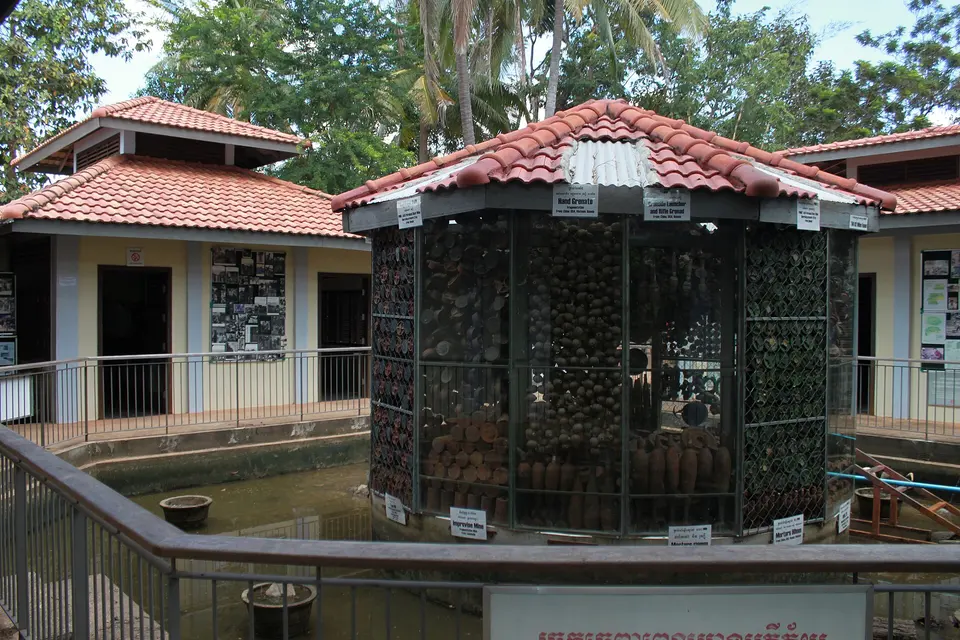
On the road back from Banteay Srei, the museum founded by Aki Ra, a former child soldier of the Khmer Rouge who spent decades defusing by hand the mines he had once laid, shows thousands of the decommissioned mines and bombs he collected, explains the war that left Cambodia one of the most mined countries on earth, and funds the relief centre next door for children hurt by them. It is small and plain, an hour's stop at most, and it changes how you see the fields you have been driving through all morning.

  • Plan about 45 min
  • Daily 7:30–17:30; US$7 foreign adults, free under 13

Midday

LunchThe restaurants at the Banteay Srei car park and the family places along the road back serve Khmer curries, grilled fish and samlor soups and are used to tuk-tuk timing; eat there before the drive south so the afternoon at Preah Khan starts in the hottest hour under trees rather than on the road. Pack water; the grand-circuit temples have only small stalls.

Afternoon

Tuk-tuk 30 minutes south to the north edge of Angkor Thom; walk the temple west to east, about 45 minutes, and have the driver meet you at the east gate
Preah Khan
Photo: Satdeep Gill, CC BY-SA 4.0
3Temple

Preah Khan

The Sacred Sword, Jayavarman VII's monastery-university of 1191 on the site of his victory over the Chams, is a flat, forest-covered complex of 56 hectares laid out on two axes, with a kilometre-long processional route of corridors and gates that grow smaller as you walk toward the central stupa, a two-storey building of round columns that looks Greek and is unique at Angkor, a Hall of Dancers, trees that have taken the northern galleries as at Ta Prohm, and far fewer people. Walk it from the west gate to the east, where the causeway of gods and demons meets the driver, and give it the better part of an hour.

  • Plan about 1 h 30 min
  • Opens about 7:30, closes about 17:30; on the Angkor Pass; walk west to east so the tuk-tuk can collect you
Tuk-tuk 5 minutes east; a wooden causeway across the flooded baray leads to the shrine
Neak Pean
Photo: Diego Delso, CC BY-SA 3.0
4Island temple

Neak Pean

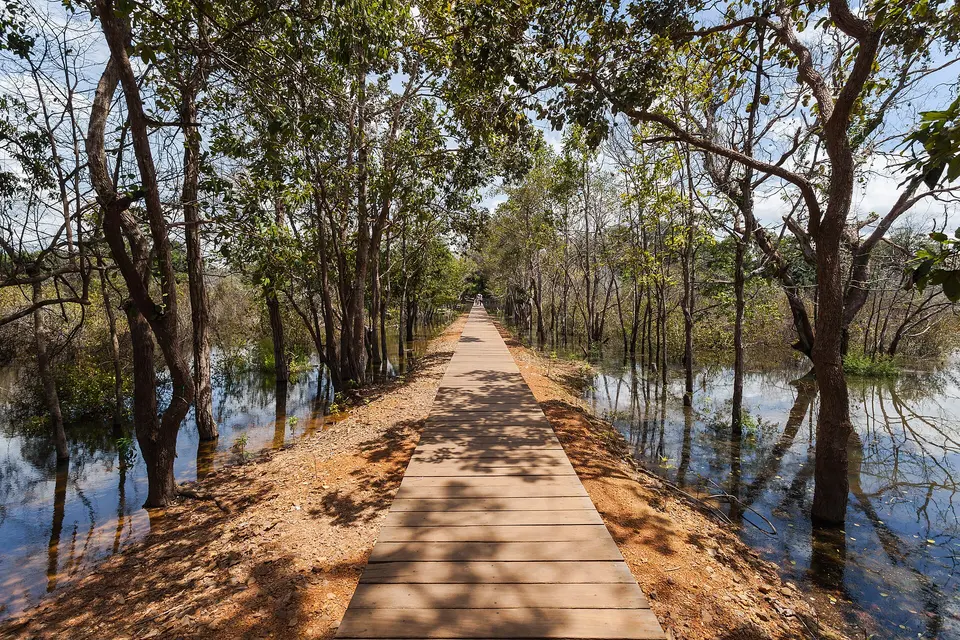
A single tower on a round island in the middle of a square pool, ringed by two stone serpents and surrounded by four smaller pools fed through the mouths of a lion, an elephant, a horse and a man, Neak Pean was a hospital of the late 12th century, a model of the Himalayan lake Anavatapta whose waters were believed to cure, and a wooden causeway now takes you across the flooded Jayatataka reservoir, full of lotus and dead trees, to see it from the edge. It takes half an hour and is at its most beautiful in the wet season when the baray is full.

  • Plan about 45 min
  • On the Angkor Pass; 30 minutes; the causeway is closed when the water is too high
Tuk-tuk 20 minutes south past Ta Som and East Mebon; be on the terrace by 17:15
Pre Rup
Photo: Shyamal, CC BY-SA 3.0
5Temple-mountain

Pre Rup

A brick and laterite pyramid of 961, built by Rajendravarman II as his state temple and named for a cremation rite, Pre Rup glows orange in the last light, its five towers and the lions on its stairs standing over the rice fields of the eastern plain, and its upper terrace is the alternative to Phnom Bakheng for sunset, with no limit on numbers and a wider sky. The stairs are steep; go up with time to spare, sit on the top step facing west and watch the buses leave first.

  • Plan about 1 h 15 min
  • Kept open for sunset until about 19:00; on the Angkor Pass; steep stairs, take a torch for the way down

Evening

Tuk-tuk 30 minutes back to town; the big top is on the ring road south of the centre and the show starts at 20:00
Phare, the Cambodian Circus
Photo: flowcomm, CC BY 2.0
6Circus

Phare, the Cambodian Circus

Under a red big top on the ring road south of town, the graduates of Phare Ponleu Selpak, the arts school founded in 1994 in a Battambang refugee camp, perform an hour of acrobatics, contortion, juggling and live music that tells a Cambodian story, of village life, of ghosts, of the Khmer Rouge years, without animals and without a word of English needed, and it is the best night out in Siem Reap by a distance. Doors open at 17:30 with street food, a bar and a shop whose profits go back to the school; the show starts at 20:00 all year, with 17:00 matinees three days a week in the high season, and the front sections sell out days ahead.

  • Plan about 2 h
  • Nightly 20:00, about 1 hour; matinees Wed, Fri and Sun 17:00 Nov–Mar; US$38 section A, US$28 B, US$18 C, children 5–11 US$18/15/10

Day 3

The town and the lake: Artisans Angkor, the Old Market, Wat Bo and Kampong Phluk

Sleep in, watch stone and silk being carved and woven at the Artisans Angkor workshops, cross the river for the Old Market and the pagoda murals of Wat Bo, then drive to the edge of the Tonlé Sap for a boat through the stilt houses and the flooded forest of Kampong Phluk, back in town for dinner.

  • 4 sights
  • Transport between sights
12345 kmN
Stops in order, straight-line distancesDriving route in Google Maps ↗

Morning

Artisans Angkor
Photo: Jakub Hałun, CC BY-SA 4.0
1Craft workshops

Artisans Angkor

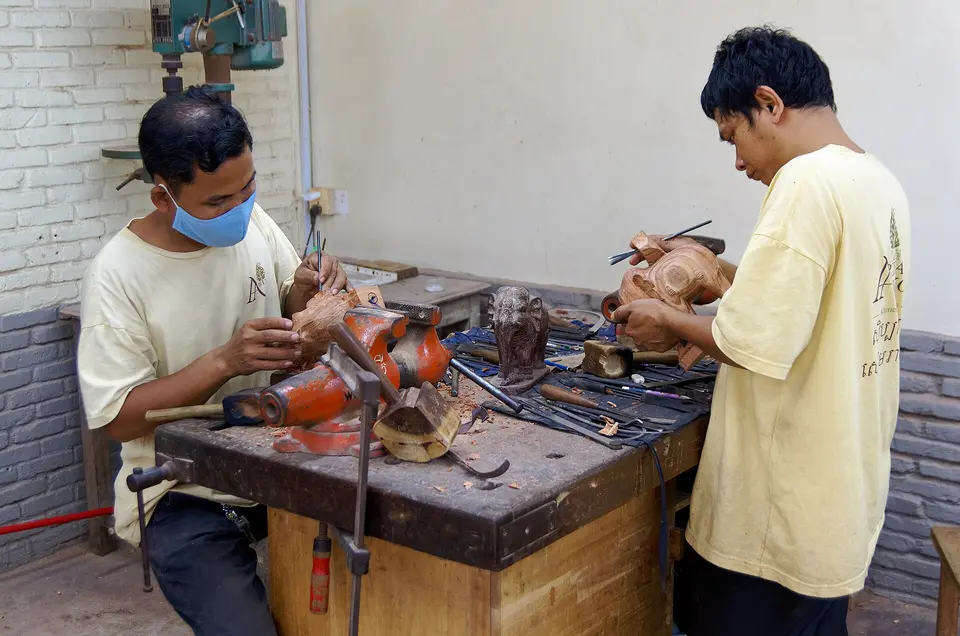
A social enterprise that began in 1992 as a training school for young rural Cambodians and now employs more than a thousand craftspeople, Artisans Angkor opens its Siem Reap workshops every day for free guided visits, where you watch sandstone and wood being carved into the same apsaras and Buddhas you saw on the temples, silk being painted and lacquer being layered, and the shop sells what is made here at fair prices with the maker's name; its silk farm 15 km out of town runs its own free tours. It is a good hour before the heat, and an antidote to the copies sold on Pub Street.

  • Plan about 1 h
  • Workshops open daily, free guided tours; about 7:30–18:30
A 10-minute walk east along Street 9; the market is best before 11:00 when the produce side is still busy
Old Market (Psar Chas)
Photo: Marcin Konsek, CC BY-SA 4.0
2Market

Old Market (Psar Chas)

The town's central market by the river is two markets in one: the food side, where the stalls of river fish, prahok paste, jackfruit, dried snakes and lotus seeds are busiest at dawn and done by mid-morning, and the tourist side, an indoor grid of silk scarves, silver, spices, krama cloths and carvings where the first price is double the last. Around it are the streets that fill at night, Pub Street with its neon and 50-cent beer and the quieter lanes, the Passage and the Lane, with better restaurants; by day the cafés of Kandal Village a block west are the place for coffee.

  • Plan about 1 h
  • Food side from about 6:00, best before 11:00; souvenir stalls until evening; bargain politely
A 10-minute walk across the river by the Old Stone Bridge and up Wat Bo Road
Wat Bo
Photo: No(0)GoodNamesLeft, CC BY-SA 4.0
3Buddhist pagoda

Wat Bo

The oldest and most beautiful of the town's living pagodas, across the river from the market, is an 18th-century monastery where the walls of the old vihara are painted with scenes of the Reamker, the Khmer Ramayana, and of 19th-century life with Chinese merchants and French officers, and the monks study in the yard under the frangipani; ask a novice before going in and leave a small donation. The quiet streets around it, Wat Bo Road and its lanes, are the town's best area for small guesthouses and restaurants.

  • Plan about 45 min
  • Grounds open from morning to evening, free; dress modestly and remove shoes in the vihara

Midday

LunchThe Old Market's food stalls and the Khmer kitchens around it do num banh chok noodles, grilled pork and rice and Khmer curry for a couple of dollars; the cafés of Kandal Village, two streets west, do the town's best coffee and a lighter lunch. Eat by 12:30 and set off for the lake.

Afternoon

Tuk-tuk about 1 hour or car 40 minutes east through Roluos, then the community boat from the pier at the end of the causeway; leave town by 13:30 in the wet season, earlier in the dry season when the last stretch is by road
Kampong Phluk
Photo: Krzysztof Golik, CC BY-SA 4.0
4Stilt village

Kampong Phluk

On the north shore of the Tonlé Sap, the lake that swells to five times its size every monsoon when the Mekong pushes back up its own tributary, Kampong Phluk is a village of about 3,000 people whose wooden houses stand on stilts eight metres high, so that in the wet season, from about August to November, the boat passes at the level of the doorways and then into a flooded forest of mangrove-like trees that you can paddle through in a canoe with a local woman rowing, and in the dry season the same houses tower over mud streets and the boat goes out from a landing far below. Go in the afternoon, for the light on the water and the sunset over the lake, and take the community boat from the pier rather than a tour that stops at a crocodile farm.

  • Plan about 3 h
  • Community boat about US$20 a person plus a small entry fee, canoe through the flooded forest about US$5 extra; best Aug–Nov at high water; bring sun cover

Evening

DinnerBack in town by about 19:00, eat along Wat Bo Road or in Kandal Village rather than on Pub Street: the family restaurants there do fish amok, beef lok lak and Khmer barbecue at half the price, and the bars of the market streets are ten minutes away for a last drink.

Good to know in Siem Reap

Tickets and opening days

  • Phare, the Cambodian Circus performs at 20:00 year-round, a one-hour show followed by photos with the performers, with seasonal 17:00 matinees on Wednesdays, Fridays and Sundays from November 2026 to March 2027; tickets are US$38 (section A, reserved), US$28 (section B) and US$18 (section C) for adults and US$18, 15 and 10 for children aged 5 to 11, and the grounds open at 17:30 for street food, drinks and shopping.Source: Phare, the Cambodian Circus · checked Sep 2026
  • The Cambodia Landmine Museum on the road to Banteay Srei is open every day 7:30 to 17:30; admission is US$7 for foreign adults and US$2.50 for Khmer adults, free for children under 13.Source: Cambodia Landmine Museum · checked Sep 2026

3 days in Siem Reap: quick answers

Is 3 days enough for Siem Reap?

Three days cover the two circuits of Angkor, Banteay Srei, the town and the lake, which is what the 3-day pass is designed for. A fourth day is the jungle temple of Beng Mealea, 65 km east and covered by the same pass, or the carved riverbed of Kbal Spean and the waterfall of Phnom Kulen, which needs a separate ticket, or the Roluos group of 9th-century temples on the way to the lake. The Angkor National Museum on the road to the park is the best use of a rainy afternoon.

Which days should I plan around?

The temples open every day of the year, so the planning is about hours and light: Angkor Wat opens at 5:00 for sunrise and the small-circuit temples close around 17:30, with Phnom Bakheng and Pre Rup kept open for sunset. Phare performs every night at 20:00 and adds 17:00 matinees on Wednesdays, Fridays and Sundays from November to March. The Landmine Museum is open daily 7:30 to 17:30. The Old Market is a morning place. Khmer New Year in mid-April and the Water Festival in November fill the town and close the shops for days.

How much do the tickets cost?

The Angkor Pass is about US$37 for one day, US$62 for three days within ten and US$72 for seven days within a month, free under 12 with a passport, sold only by Angkor Enterprise online or at the ticket office on the Apsara road, open from 4:30 to 17:30, with a photo taken at the counter. The Landmine Museum is US$7 and free under 13. Phare is US$38, 28 or 18 depending on the section, half for children. Artisans Angkor's workshop tours are free. The Kampong Phluk boat is around US$20 a person plus a small community fee, more if you add the mangrove canoe. Angkor National Museum is about US$12.

How do I get around?

By tuk-tuk hired by the day: around US$20 to 30 for the small circuit, US$25 to 35 for the grand circuit and about US$10 to 15 more for Banteay Srei, a little more for a sunrise start, agreed the evening before and paid at the end, with the driver waiting at each temple. Cars with air conditioning cost about twice that. The Grab and PassApp apps give fixed prices for town rides. Bicycles and e-bikes are rented in town for the flat 6 km to Angkor Wat but the circuits are 20 to 30 km in the heat. The airport is 40 km west of town, about an hour by taxi.

What are the rules inside the temples?

Shoulders and knees covered for everyone, checked at Angkor Wat, the Bayon and Banteay Srei and enforced at the stairs to the Bakan, the top tier of Angkor Wat, where a scarf over a vest does not count; no climbing on the stones, no touching the carvings, no drones without a permit, and the pass shown at every checkpoint. The Bakan is closed on Buddhist holy days. Only 300 people at a time are allowed on Phnom Bakheng, so sunset there means being at the foot of the hill by 16:30.

How much walking is this itinerary?

About 6 km on day one, most of it inside Angkor Wat, Angkor Thom and Ta Prohm plus the 15-minute climb of Phnom Bakheng; about 5 km on day two, with the long corridors of Preah Khan and the stairs of Pre Rup; and about 3 km on day three in town before the boat. The walking is on stone, sand and steep temple stairs, in heat, so hats, water and closed shoes matter more than distance.

Other Siem Reap itineraries

Keep exploring

Where this connects

THE TRIPWOA APP

Go somewhere.
Make it yours.

Build days around what you love. Follow your route, find your next stop and keep the moments along the way.

Get it on Google PlayAvailable for Android
Free to start
Tripwoa home with a Paris trip and nearby places to explore
Tripwoa day plan for New York with a route map and Times Square stop

A day that feels like you.

Sources and method

Places and coordinates: Wikidata and Tripwoa's open-data place catalog (Overture Maps Foundation, © OpenStreetMap contributors). Photos: Wikimedia Commons, credited on each image. Practical rules: the official sources linked in each note, checked in September 2026.

How this plan was made: Tripwoa's planner drafted the day order from real coordinates and typical visit times. Each stop was then reviewed, reordered where needed and rewritten with AI assistance. Walking distances are straight-line estimates, so allow a little extra time on real streets.