3-day itinerary · Italy

3 Days in Siena

A plan that gives the first day to the Campo and the government frescoes, the second to the cathedral complex on one ticket, and the third to Catherine's quarter and a walled village Dante used in the Inferno. Official 2026 hours are in the stops.

  • 3days
  • 14sights
  • 0.0 kmon foot between sights

Updated 13 September 2026 · 2 official sources checked · report an error

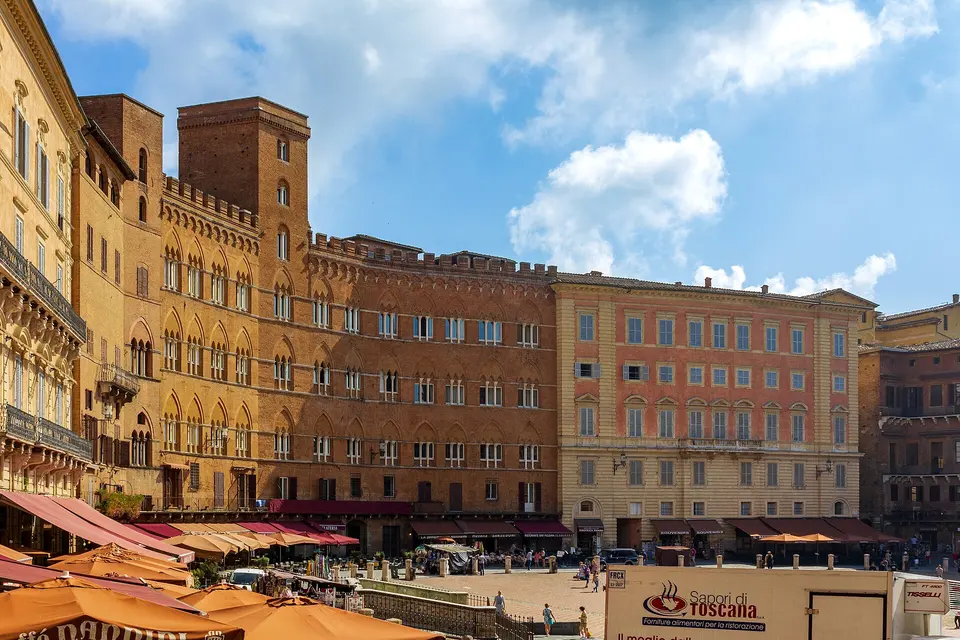
Piazza del Campo
Photo: Perituss, CC0

The Campo and Good Government, then the Duomo complex and Santa Maria della Scala, then Monteriggioni

Siena is a city of about 54,000 on three ridges in southern Tuscany, and for four hundred years it was an independent republic that beat Florence in the field at Montaperti in 1260 and lost the long argument anyway. The Black Death killed perhaps half the population in 1348, the great nave the city had begun for its cathedral was abandoned half-built, and the Medici siege of 1554–55 ended the republic for good. What that history left is a centre that essentially stopped growing in the fourteenth century: brick streets too narrow for buses, a square shaped like a shell, and a set of paintings by Duccio, Simone Martini and the Lorenzetti that were made for these rooms and are still in them. The whole historic centre has been a UNESCO World Heritage Site since 1995.

At a glance

Ways to use these days

If it rains
6 of the stops are indoors — Palazzo Pubblico · Siena Cathedral · Piccolomini Library
For the view
Torre del Mangia
Lightest day on foot
Day 2 — 0.4 km between stops
Most walking
Day 3 — 10.5 km

Day 1

The shell-shaped square and the room where good government was painted

Spend the day in and around the Campo: the fresco that shows a well-run city and a tyranny side by side, 400 steps up a tower built to match the cathedral, the fountain the tunnels feed, and the Medici fort on the ridge at sunset.

  • 5 sights
  • Transport between sights
12345200 mN
Stops in order, straight-line distancesWalking route in Google Maps ↗

Morning

Piazza del Campo
Photo: Perituss, CC0
1Square

Piazza del Campo

A shell-shaped hollow where three hills meet, paved in 1349 in herringbone brick divided into nine segments by travertine lines — one for each member of the Government of the Nine, the merchant oligarchy that ran Siena through its best century and laid the square out as a piece of political argument. It slopes towards the Palazzo Pubblico at the bottom, so the whole space tips towards the government rather than the church, which was the point. Twice a summer they lay sand over the perimeter and run the Palio round it. The rest of the year people sit on the brick and lean back.

  • Plan about 1 h 15 min
  • Free and always open; sitting on the paving is what it is for and nobody moves you on. It is at its emptiest before 09:00 and its best about an hour before sunset, when the Torre throws its shadow across the shell
At the bottom of the Campo, one minute on foot
Palazzo Pubblico
Photo: Mr.Ajedrez, CC BY-SA 3.0
2Museum

Palazzo Pubblico

Built from 1297 as the seat of the Nine and still the town hall, with the Museo Civico upstairs in the state rooms. Two things in it are among the most important paintings in Europe. Simone Martini's Maestà of 1315 fills one wall of the council chamber; opposite, in the Sala dei Nove, Ambrogio Lorenzetti painted the Allegory of Good and Bad Government in 1338 — a wraparound fresco showing a well-run city with dancers and builders and traders, and beside it a tyranny with murder in the streets and the countryside burned. It is the first large secular landscape in Western art and it was painted for the men who governed, to look at while they governed.

  • Plan about 2 h
  • Ticketed; a combined ticket with the Torre del Mangia and Santa Maria della Scala is better value than singles. Allow two hours, and give the Sala dei Nove half of them

Midday

LunchSienese food is peasant food that got famous: pici, a thick hand-rolled spaghetti, usually with garlic and breadcrumbs or with wild boar; pappa al pomodoro; ribollita in winter; and panforte and ricciarelli from the bakeries, which have been made here since the Middle Ages. The osterie in the lanes off Via di Città and Via del Porrione do it properly and cheaply; the restaurants with tables on the Campo charge for the brick. Brunello from Montalcino and Chianti Classico are both twenty minutes away.

Afternoon

The entrance is in the Palazzo Pubblico courtyard, beside the museum
Torre del Mangia
Photo: Jordiferrer, CC BY-SA 4.0
3Tower

Torre del Mangia

A 102-metre bell tower finished in 1348, built to exactly the height of the cathedral on the hill above so that church and state should stand equal — a deliberate statement, and a rare one. It is named after its first bell-ringer, Giovanni di Balduccio, nicknamed Mangiaguadagni, the eater of profits, for what he did with his wages. There are 400-odd steps up a narrowing stone spiral to a stone crown at the top, and from there Siena reads as what it is: a small red-brown city on three ridges with the Crete Senesi rolling away in every direction.

  • Plan about 1 h
  • Ticketed separately or on the combined municipal ticket, with a strict limit on how many people are on the stair at once, so queues build from mid-morning; the last climb is well before closing and the stairs are narrow, steep and not for anyone unsteady
At the top of the Campo, two minutes on foot
Fonte Gaia
Photo: Petar Milošević, CC BY-SA 4.0
4Fountain

Fonte Gaia

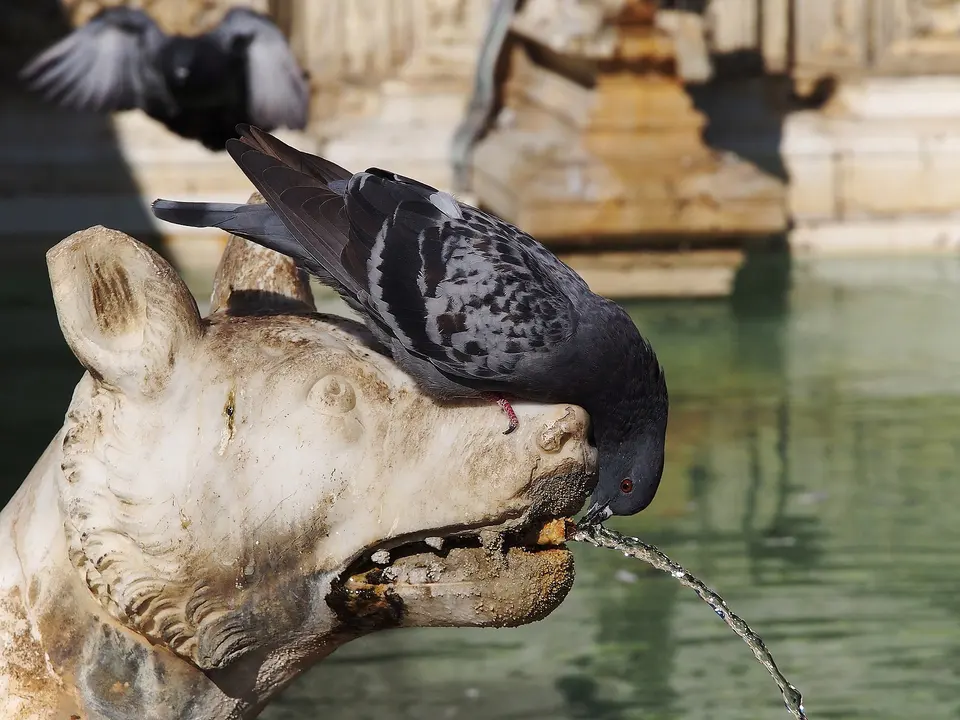
Water reached the Campo in 1346 through twenty-five kilometres of tunnels dug by hand under the hills — the bottini, which are still there and can be visited on a booked tour — and the city was so pleased that it called the fountain the joyful one. Jacopo della Quercia carved the marble surround between 1409 and 1419 with the Virgin, the Virtues, and the Creation of Adam; what you see in the square now is a nineteenth-century copy, because the weathered originals were moved indoors and are in Santa Maria della Scala. The she-wolves spouting the water are Siena's own founding myth, not Rome's.

  • Plan about 30 min
  • Free; it stands at the top of the Campo and takes ten minutes. The originals are in the museum at Santa Maria della Scala, and the bottini tunnels are visited on guided tours booked in advance

Evening

900 m north-west, about twelve minutes on foot uphill
Fortezza Medicea
Photo: LigaDue, CC BY-SA 4.0
5Fortress

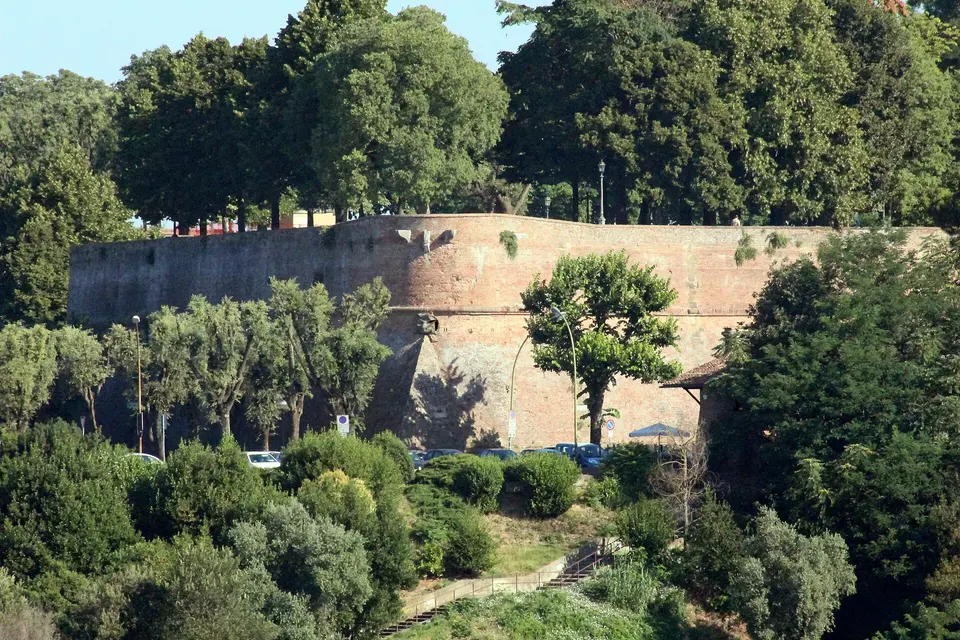
Fortezza Medicea

Cosimo I de' Medici built this in 1561 to hold down a city he had just conquered, on the site of an earlier Spanish fort the Sienese had torn down in fury. Siena had been an independent republic for four hundred years; the siege of 1554–55 starved it into surrender, several thousand people died, and the last of the republic went into exile at Montalcino. The fortress is now a public park with the Enoteca Italiana in its cellars, and the walk along the top of the ramparts at dusk gives the best free view in the city — the cathedral, the Torre and San Domenico all on one line.

  • Plan about 1 h
  • Free and always open; the ramparts are a ten-minute walk from the Campo and are where Siena goes to run and to watch the sunset. La Lizza park beside it holds a large market every Wednesday morning

Day 2

The cathedral hill: a striped marble church, a painted library and a thousand-year hospital

Give the whole day to the Duomo complex on one ticket and the buildings around it — the inlaid floor, Pinturicchio's room, the font three sculptors made together, the hospital across the square, and the best collection of Sienese painting anywhere.

  • 5 sights
  • Transport between sights
12345100 mN
Stops in order, straight-line distancesWalking route in Google Maps ↗

Morning

Siena Cathedral
Photo: Spike, CC BY-SA 4.0
1Cathedral

Siena Cathedral

Black and white marble in horizontal bands, inside and out, because those are the colours of the city. Built through the thirteenth century and given a facade by Giovanni Pisano, it has Nicola Pisano's octagonal pulpit of 1268, a Donatello bronze, Michelangelo's early saints on the Piccolomini altar, and Bernini in the Chigi chapel. The floor is the extraordinary thing: fifty-six inlaid marble panels laid down over two centuries, showing sibyls, allegories and Old Testament massacres, normally covered by boards and uncovered for a few weeks in late summer and autumn. In 1339 the city began an enormous new nave to make this the transept; the plague of 1348 stopped it and the shell still stands.

  • Plan about 2 h
  • One Opa Si Pass ticket covers the cathedral, the Piccolomini Library, the Gate of Heaven roof walk, the Baptistery, the Crypt, the Museo dell'Opera and the panorama from the unfinished facade, and the operator says the circuit takes about two hours
Entered from inside the cathedral's north aisle
Piccolomini Library
Photo: sailko, CC BY-SA 3.0
2Library

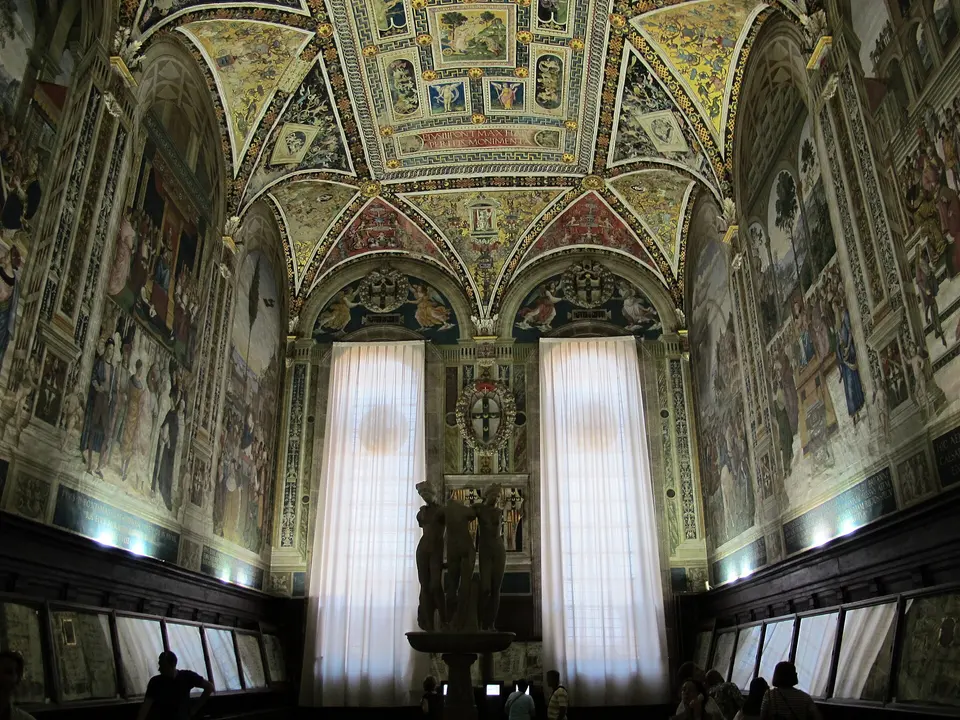
Piccolomini Library

A single room off the cathedral's north aisle, built in 1492 by Cardinal Francesco Piccolomini to hold his uncle's books — the uncle being Aeneas Silvius Piccolomini, the humanist, traveller and novelist who became Pope Pius II. Pinturicchio frescoed the walls between 1502 and 1508 with ten enormous panels of that life: the journey to the Council of Basel, the meeting with the emperor, the coronation, the failed crusade. The colours have barely faded because the room has almost no direct light, and the effect on walking in is of stepping into a full-scale illuminated manuscript. The choir books on the stands are the originals.

  • Plan about 45 min
  • Included in the Opa Si Pass; it is entered from inside the cathedral and is small, so it fills up — go first thing or in the last hour, and look up at the ceiling as well as at the walls

Midday

LunchThe streets immediately around the Duomo are the most touristed in Siena and priced accordingly. Walk five minutes south into the Città or east towards Pispini and the prices halve. A Sienese lunch is often just a plate of salumi and pecorino from the Crete Senesi with bread that has no salt in it — a habit the city explains with a story about a Florentine salt blockade — and a glass of red at eleven in the morning is entirely normal here.

Afternoon

Down the steps behind the cathedral apse, about three minutes on foot
Baptistery of San Giovanni
Photo: Zairon, CC BY 4.0
3Baptistery

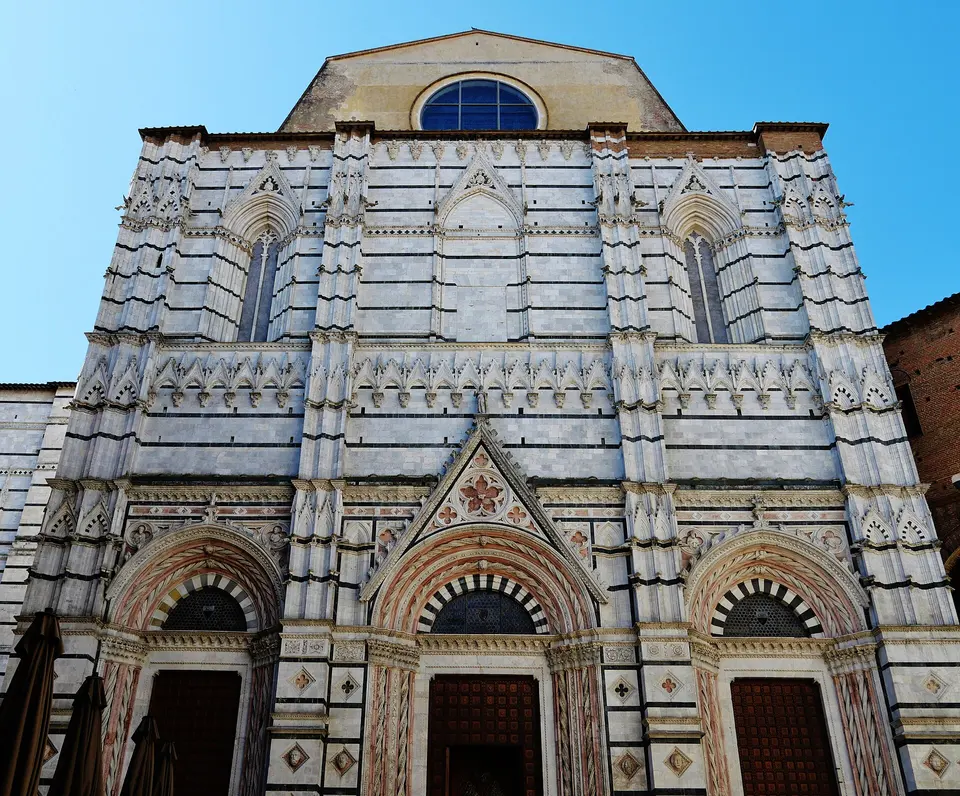
Baptistery of San Giovanni

Tucked under the east end of the cathedral, because the ground falls away so steeply there that the builders put a baptistery in the undercroft rather than waste the space — which is why its unfinished marble facade faces a small square well below the Duomo's own. The hexagonal font in the middle was made between 1417 and 1431 by the best sculptors then alive working at once: Jacopo della Quercia, Lorenzo Ghiberti, and Donatello, whose bronze panel of the Feast of Herod is one of the first works in Western art to use mathematical perspective properly. The vault above is frescoed from end to end.

  • Plan about 45 min
  • Included in the Opa Si Pass; it is reached down the steps behind the cathedral rather than from inside it, which catches people out. The operator notes that the Baptistery, Crypt and Museum have no step-free access
Directly across the cathedral square, two minutes on foot
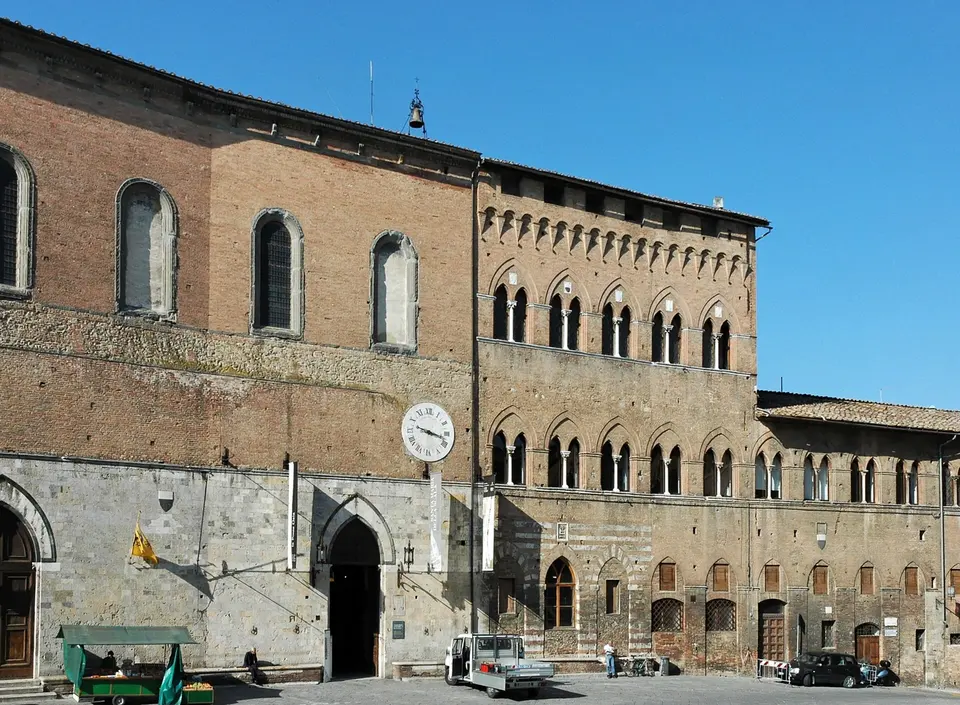
Santa Maria della Scala
Photo: Jastrow, Public domain
4Museum

Santa Maria della Scala

A hospital that opened on the square facing the cathedral in the ninth century and went on taking patients until the 1990s — more than a thousand years of continuous use — and is now a museum of itself. The Pellegrinaio, the pilgrims' ward, is frescoed along both walls with scenes of the hospital at work in the 1440s: nurses, foundlings, the sick being fed and washed, all painted as civic propaganda and now the best surviving picture of medieval welfare anywhere. Below it the building goes down four levels into the hill, with an Etruscan collection, the original Fonte Gaia sculptures and a chapel holding a relic of the Virgin's girdle.

  • Plan about 2 h 30 min
  • Open Monday, Wednesday, Thursday and Friday 10:00 to 17:00 with the last entry at 16:15, Saturdays, Sundays and holidays 10:00 to 19:00 with the last entry at 18:15, and closed on Tuesdays; it closes on 25 December

Evening

400 m south-east on Via San Pietro, about six minutes on foot
Pinacoteca Nazionale
Photo: Sailko, CC BY 3.0
5Art museum

Pinacoteca Nazionale

Two Gothic palaces on Via San Pietro holding the single best collection of Sienese painting in the world, hung in rough chronological order so that you can watch a school invent itself and then refuse to change. Duccio, whose Maestà was carried through the streets in 1311; Simone Martini; the Lorenzetti brothers, both of whom probably died in the plague of 1348; then Sassetta, Giovanni di Paolo and Sano di Pietro carrying the gold ground and the elongated saints forward for another century while Florence went off to invent the Renaissance. It is quiet, it is rarely crowded, and it explains the city.

  • Plan about 1 h 30 min
  • Ticketed and state-run, so hours differ from the municipal museums and it generally closes early on Sundays and Mondays; it is five minutes south of the Campo and an hour and a half is enough unless you know the period

Day 3

Catherine's quarter, and the walled ring Dante used to describe giants

Walk down into the Goose contrada for the Dominican barn that holds Catherine's relics, the house she grew up in and the fountain that fed the dyers, then drive out to a thirteenth-century garrison village with fourteen towers.

  • 4 sights
  • Transport between sights
12342 kmN
Stops in order, straight-line distancesDriving route in Google Maps ↗

Morning

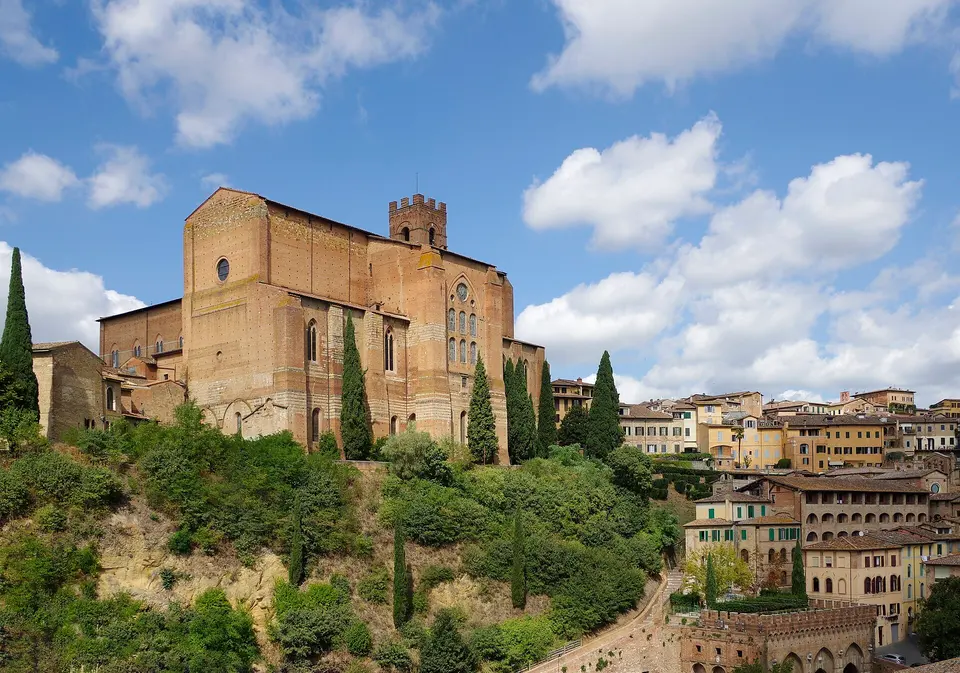
Basilica of San Domenico
Photo: Berthold Werner, CC BY-SA 4.0
1Basilica

Basilica of San Domenico

A huge brick barn of a Dominican church begun in 1226 on the ridge above Fontebranda, with almost no decoration on the outside and a single vast aisle-less nave inside — the preaching order building a room for a voice rather than a shrine. It is where Catherine Benincasa took the habit, and it holds her relics: her head and a thumb, in a reliquary in a chapel painted by Sodoma with scenes of her ecstasies. The terrace behind the church looks straight across the valley to the cathedral, which is the view every photograph of Siena is taken from.

  • Plan about 1 h
  • Free and generally open through the day; the Cappella di Santa Caterina is on the right of the nave and the Sodoma frescoes are worth a coin in the light box. The terrace outside is the classic view of the Duomo
250 m downhill, four minutes on foot
Sanctuary of Santa Caterina
Photo: Palickap, CC BY-SA 4.0
2Sanctuary

Sanctuary of Santa Caterina

Catherine of Siena was the twenty-fourth child of a dyer, never learned to write properly, dictated hundreds of letters, told the Pope to his face to return from Avignon to Rome, and died at thirty-three; she is a Doctor of the Church and one of the two patron saints of Italy. This is the family house on the hill above Fontebranda, bought by the city in 1466 and turned into a series of chapels and oratories built around and into the rooms she lived in — the kitchen, the cell with the stone she used as a pillow, the little garden. It is quiet, free, and a good deal more moving than its architecture suggests.

  • Plan about 1 h
  • Free and generally open through the day with a midday break; it is a five-minute walk downhill from San Domenico, and the oratory of the Contrada dell'Oca next door is opened by the contrada on its own days
200 m further down the valley, three minutes on foot and a steep climb back
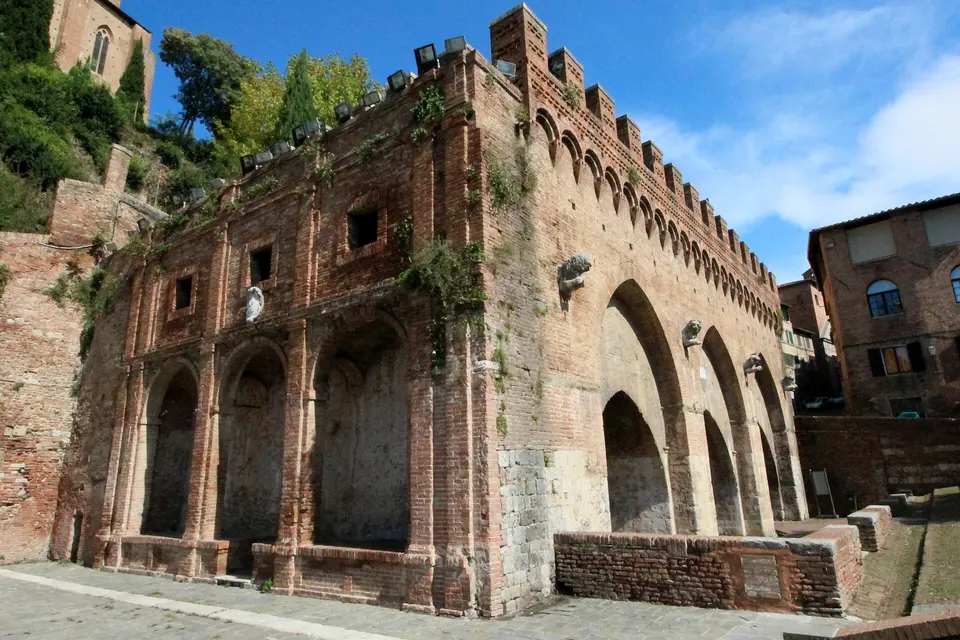
Fontebranda
Photo: LigaDue, CC BY-SA 4.0
3Fountain

Fontebranda

The oldest and largest of Siena's public fountains, recorded from 1081 and given its present three brick arches in 1246, standing at the bottom of the valley below San Domenico. It is fed by the bottini, the hand-dug aqueduct tunnels under the city, and it fed everything: drinking troughs at the front, then the animals, then the wool-washers and the tanners and the dyers of the quarter — including Catherine's father — and finally the mills below. Dante mentions it. The Contrada dell'Oca, the Goose, holds this district, and its symbols are on the walls all the way down the hill.

  • Plan about 30 min
  • Free and always open; it is a steep five-minute walk down from San Domenico and a steeper one back, and the lane down to it is one of the few corners of the centre with almost nobody in it

Midday

LunchThe Contrada dell'Oca's own quarter around Fontebranda has small trattorie that feed the neighbourhood rather than visitors, and they are among the best value in the city. If you are going straight on to Monteriggioni, hold out: the piazza inside the walls has two or three restaurants doing Sienese food at Sienese prices, and eating in a walled village of two streets with nobody driving past is worth the wait.

Afternoon

20 km north-west, about 25 minutes by car; buses run from Siena's Piazza Gramsci several times a day
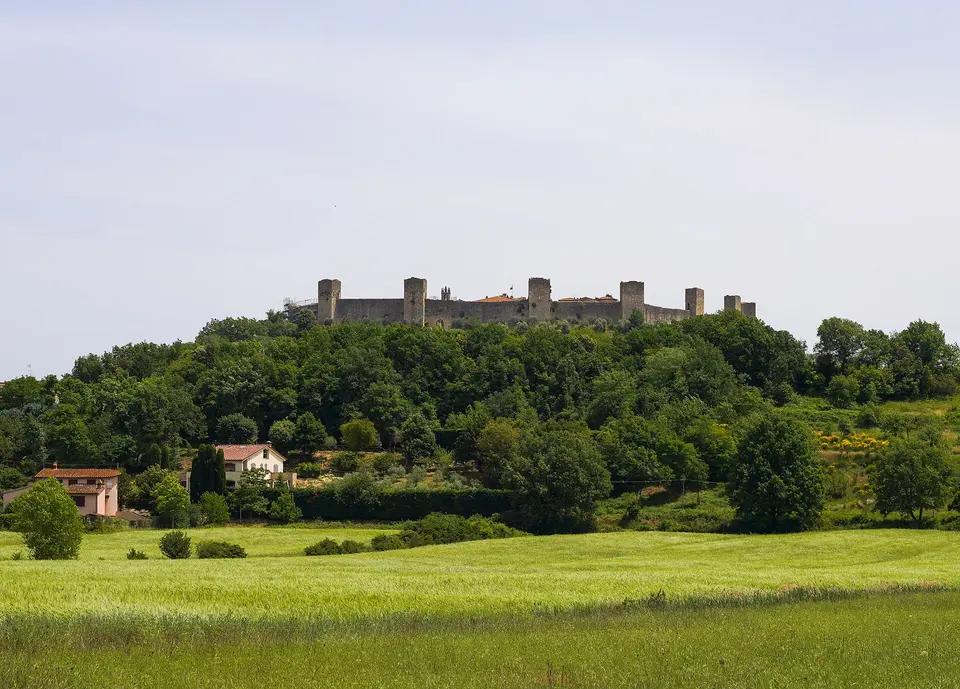
Monteriggioni
Photo: WikiRomaWiki, CC BY-SA 4.0
4Walled town

Monteriggioni

Siena built this on a low hill in 1214 to watch the road from Florence, and it is still exactly that: a ring of wall 570 metres round with fourteen square towers, and inside it a single piazza, a Romanesque church and two streets. Dante saw the towers from a distance and used them in the Inferno to describe the giants standing in the pit of hell, their heads showing over the rim — which is the line every guide quotes and which is genuinely what it looks like from the motorway. You can walk two stretches of the wall walk. It takes an hour and a half including the climb and it is the best short trip from Siena.

  • Plan about 2 h
  • The village is free to enter; the wall walk and the small armour museum are ticketed together. Park below and walk up, as the gate is closed to cars, and come on a weekday if you can — coaches from Florence arrive mid-morning

Good to know in Siena

The cathedral complex: one ticket, seven places

  • The Opera della Metropolitana sells a single ticket, the Opa Si Pass, for the whole monumental complex: the Cathedral, the Piccolomini Library, the Gate of Heaven, the Baptistery, the Crypt, the Museo dell'Opera and the panorama from the unfinished facade. The Opera states that the Opa Si Pass itinerary can be completed in about two hours, and that the version including access to the cathedral roof costs €21.00.Source: Opera della Metropolitana di Siena — Visiting · checked Sep 2026
  • Tickets can be bought online, through the call centre, and at the ticket offices at Piazza Duomo 7 and the “Dear Guests” Visitor Center at Via di Città 48 near Piazza del Campo, which are open every day. Mass is celebrated at 9:30 in the Madonna del Voto Chapel, and when the cathedral's marble inlay floor is uncovered mass moves to the church of the Santissima Annunziata. The Opera notes that the Museum, Crypt and Baptistery currently have no facilities for disabled access.Source: Opera della Metropolitana di Siena — Visiting · checked Sep 2026

Santa Maria della Scala: the closed day is Tuesday

  • Santa Maria della Scala opens Monday, Wednesday, Thursday and Friday from 10:00 to 17:00, with the ticket office closing and last entry at 16:15; on Saturdays, Sundays and public holidays it opens 10:00 to 19:00 with last entry at 18:15. It is closed on Tuesdays, and closed on 25 December.Source: Santa Maria della Scala — Organizza la tua visita · checked Sep 2026

3 days in Siena: quick answers

Is 3 days enough for Siena?

Three days is generous for the city itself, which you can walk across in twenty minutes, and that is deliberate: the point of the third day is to get out into the province, because Siena's countryside is as much the reason to come as its paintings. Monteriggioni here is the short version. With more time, San Gimignano is 28 km north-west, Montalcino and the Val d'Orcia 35 km south, and the Abbey of San Galgano — roofless, with a sword in a stone — is 25 km south-west.

What is the best time of year to visit Siena?

April to early June and September to October, when the light is good, the hills are green or gold and it is warm without being punishing. July and August are hot and full. The two Palio dates — 2 July and 16 August — are extraordinary and also the worst time to try to see anything else: the Campo fills to capacity, hotel prices treble and the city thinks about nothing else for a week. November to March is cold and quiet and the museums are yours; the marble floor of the cathedral is uncovered for a few weeks in late summer and autumn.

What is the Palio and can you watch it?

A bareback horse race three times round the Campo, run on 2 July and 16 August between ten of the city's seventeen contrade — the neighbourhood associations that Sienese are born into and belong to for life. It lasts about ninety seconds and the year is organised around it. The centre of the square is free and packed from hours before; you cannot leave once it fills, there is no shade, and you will see very little. Balcony seats cost hundreds of euros and sell out long in advance. The trial races in the days before are easier.

How much does Siena cost per day?

Less than Florence and considerably less in the low season. A room in a small hotel inside the walls runs €90 to €170 outside the Palio weeks, an agriturismo outside the city less. The Opa Si Pass covering the whole cathedral complex is the main museum expense, the municipal combined ticket covers the Palazzo Pubblico and the Torre, and the Pinacoteca is cheap. A plate of pici and a glass of wine at an osteria is €14 to €20, and dinner with Brunello a good deal more.

Do you need a car in Siena?

Not for the city — the historic centre is a limited-traffic zone with camera enforcement, and driving into it by mistake produces a fine that arrives months later. Park in one of the ring car parks and use the escalators up. For the countryside a car transforms things: Monteriggioni, San Gimignano, the Val d'Orcia and the wine towns are all under an hour and poorly served by bus. Siena has no useful railway station for tourism; the bus from Florence is faster than the train.

Is the cathedral floor uncovered when I visit?

Probably not, unless you come in late summer or autumn. The fifty-six inlaid marble panels are protected by boarding for most of the year and uncovered for a few weeks, usually from about late June to late July and again from mid-August to mid-October; the exact dates are announced each year by the Opera della Metropolitana. When they are uncovered the ticket costs more and it is worth it. When they are not, the panels in the presbytery and under the dome are usually still visible.

Other Siena itineraries

Keep exploring

Where this connects

THE TRIPWOA APP

Go somewhere.
Make it yours.

Build days around what you love. Follow your route, find your next stop and keep the moments along the way.

Get it on Google PlayAvailable for Android
Free to start
Tripwoa home with a Paris trip and nearby places to explore
Tripwoa day plan for New York with a route map and Times Square stop

A day that feels like you.

Sources and method

Places and coordinates: Wikidata and Tripwoa's open-data place catalog (Overture Maps Foundation, © OpenStreetMap contributors). Photos: Wikimedia Commons, credited on each image. Practical rules: the official sources linked in each note, checked in September 2026.

How this plan was made: Tripwoa's planner drafted the day order from real coordinates and typical visit times. Each stop was then reviewed, reordered where needed and rewritten with AI assistance. Walking distances are straight-line estimates, so allow a little extra time on real streets.