3-day itinerary · Turkey

3 Days in Antalya

A realistic first-timer plan that spends day one inside the walls of Kaleiçi, from the marble arches of Hadrian's Gate and the fluted minaret that is the city's emblem through the Ottoman lanes to the Roman harbour, the restored houses of the Kaleiçi Museum, the Hıdırlık Tower on the cliff and the sunset from Karaalioğlu Park; drives east on day two along the Pamphylian plain to the colonnaded streets of Perge, the 15,000-seat theatre of Aspendos and the columns of Apollo's temple on the point at Side; and climbs on day three into the Taurus to the eagle's-nest ruins of Termessos before the two Düden waterfalls, the upper one in a park of caves and the lower one falling 40 metres off the cliff into the sea, and an evening on the pebbles of Konyaaltı. Every stop comes with the transport, the ticket prices and the rules that matter in 2026, including the fact that the archaeological museum is closed for rebuilding.

  • 3days
  • 14sights
  • 2.0 kmon foot between sights

Updated 12 September 2026 · 5 official sources checked · report an error

Hadrian's Gate
Photo: Bernard Gagnon, CC BY-SA 3.0

Kaleiçi on foot, then the Roman cities to the east, then the mountain city, the waterfalls and the beach

Antalya's old town is walked; everything else is a drive. Day one is on foot inside and around the walls of Kaleiçi, where cars cannot go anyway, with the nostalgic tram along the boulevard above it. Day two is the classic Perge, Aspendos and Side loop, 150 km round trip east along the coast, by hired car, taxi for the day or a tour, since no useful bus links the three sites. Day three is Termessos, 35 km northwest up a mountain road with no public transport, then back through the city to the two waterfalls and the beach. The Antalya Archaeological Museum, the city's great collection of Perge sculpture, closed in July 2025 to be demolished and rebuilt on the same site and is not expected to reopen before the end of 2026, so it is not in the plan. The ministry's sites are open every day and priced in euros for foreign visitors; the MuseumPass Türkiye at €165 for 15 days or the regional Mediterranean pass covers all of them. July and August are hot beyond walking; April to June and September to October are the months.

At a glance

Ways to use these days

Lightest day on foot
Day 1 — 2.0 km between stops
Most walking
Day 2 — 56.1 km

Day 1

Kaleiçi: Hadrian's Gate, the Yivli Minare, the old town and harbour, the Kaleiçi Museum, Hıdırlık Tower and Karaalioğlu Park

Enter the old town through Hadrian's Gate, look up at the fluted minaret and the clock tower at the top of the hill, lose yourself in the Ottoman lanes down to the Roman harbour, see how the old houses were lived in at the Kaleiçi Museum, walk the cliff to the Hıdırlık Tower, and watch the sun go down behind the Bey Mountains from Karaalioğlu Park.

  • 6 sights
  • 2.0 km on foot
  • Longest walk 600 m
123456200 mN
Stops in order, straight-line distancesRoute in Google Maps ↗

Morning

Hadrian's Gate
Photo: Bernard Gagnon, CC BY-SA 3.0
1Roman gate

Hadrian's Gate

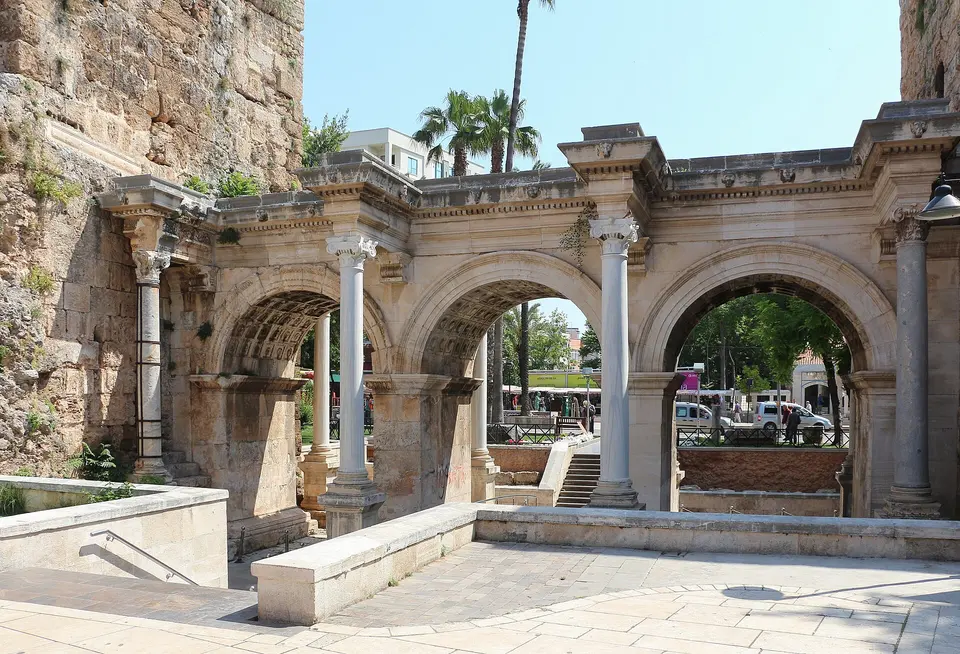
The triple arch of white marble on Atatürk Caddesi, built in AD 130 for the visit of the emperor Hadrian and the only surviving gate of the Roman walls, is the grandest entrance to Kaleiçi: three barrel-vaulted openings between two towers, one Roman and one Seljuk, with carved coffered ceilings of rosettes and a worn marble threshold that shows the ruts of two thousand years of carts, and a myth that the Queen of Sheba passed through it. Walk through it at 9:00, when the guides' groups have not arrived, and you are in the old town; the nostalgic tram stops outside at Üçkapılar, the Three Gates.
  • Plan about 30 min
  • Open all the time, free; tram stop Üçkapılar
370 m · about 6 min on foot
Yivli Minare and the Kale Kapısı
Photo: Bernard Gagnon, CC BY-SA 3.0
2Seljuk mosque

Yivli Minare and the Kale Kapısı

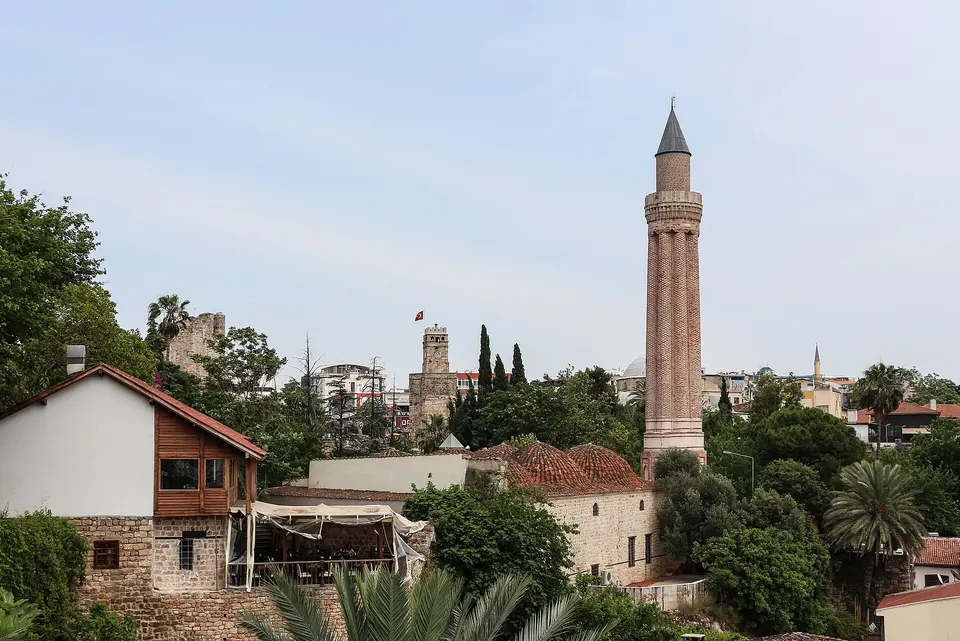
The Fluted Minaret, 38 metres of brick and turquoise tile on a stone base built by the Seljuk sultan Alaeddin Keykubad in 1230, is the emblem of the city on every sign and bottle, standing at the top of the old town beside a mosque of 1373 with six domes on twelve columns, two madrasas, a Mevlevi dervish lodge that is now a museum of the whirling order and two tombs; a few steps up the hill are the Kale Kapısı square, with the Ottoman clock tower of 1901 on a Roman tower base and the Tekeli Mehmet Paşa mosque of the 1600s, where the nostalgic tram and the old town meet. The mosque is open outside prayer times; dress modestly.

  • Plan about 45 min
  • Mosque open outside prayer times, free; Mevlevihane museum in the complex; the square is the start of the lanes down to the harbour
600 m · about 9 min on foot
Kaleiçi and the old harbour
Photo: Qubated, CC BY-SA 4.0
3Old town

Kaleiçi and the old harbour

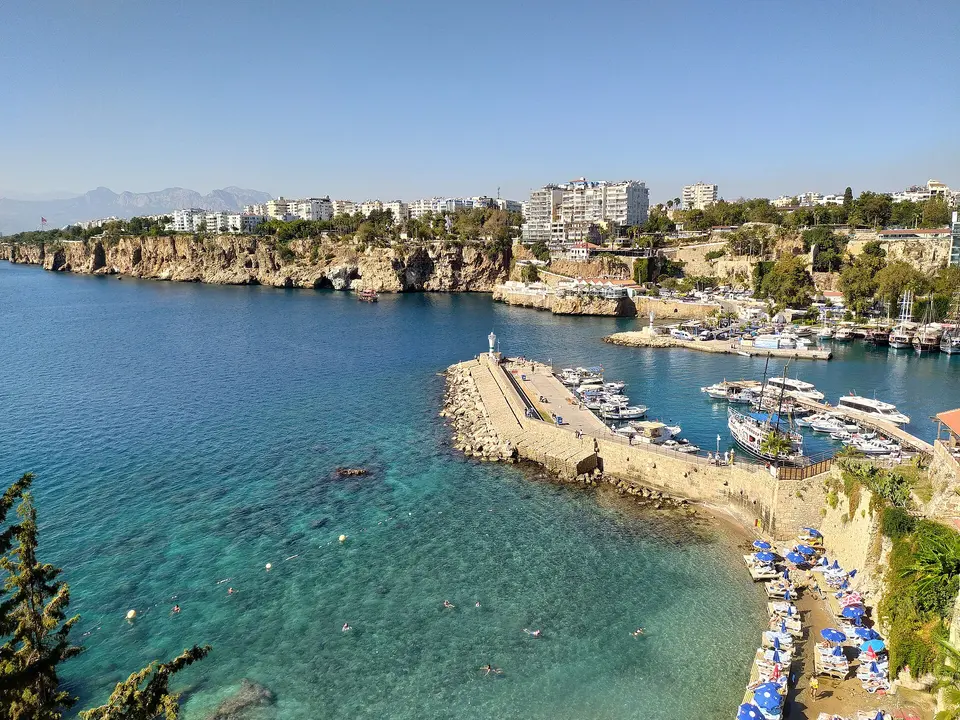
Inside the walls, the old town founded as Attaleia by King Attalos II of Pergamon around 150 BC is a warren of Ottoman houses with wooden balconies over cobbled lanes, restored into pensions, carpet shops and courtyard bars since it was protected in 1972, dropping in stairs and hairpins to the Roman harbour, a horseshoe of yachts and excursion boats under the cliff where the city's trade came in for two thousand years; on the way down are the Kesik Minare, a Roman temple that became a Byzantine church, a mosque and then a ruin when its wooden minaret burned in 1896, restored and reopened as a mosque in 2021, the Mermerli beach on the rocks below the harbour and the sea gate in the walls. The boats on the quay do hour-long trips along the cliffs to the Lower Düden falls.

  • Plan about 2 h
  • Free to walk; the harbour boats run through the day, about an hour to the falls and back; the Mermerli beach is the swim inside the walls

Midday

LunchLunch is in the lanes: the courtyard restaurants of Kaleiçi do piyaz, the white-bean salad with tahini that is Antalya's own dish, şiş köfte, grilled sea bass and meze under vines, and the harbour terraces charge for the view; for something cheaper and more local, the lokantas around the clock tower and along Atatürk Caddesi serve a plate of the day for a few euros. Eat late, after 13:30, when the morning coach groups have left.

Afternoon

480 m · about 7 min on foot
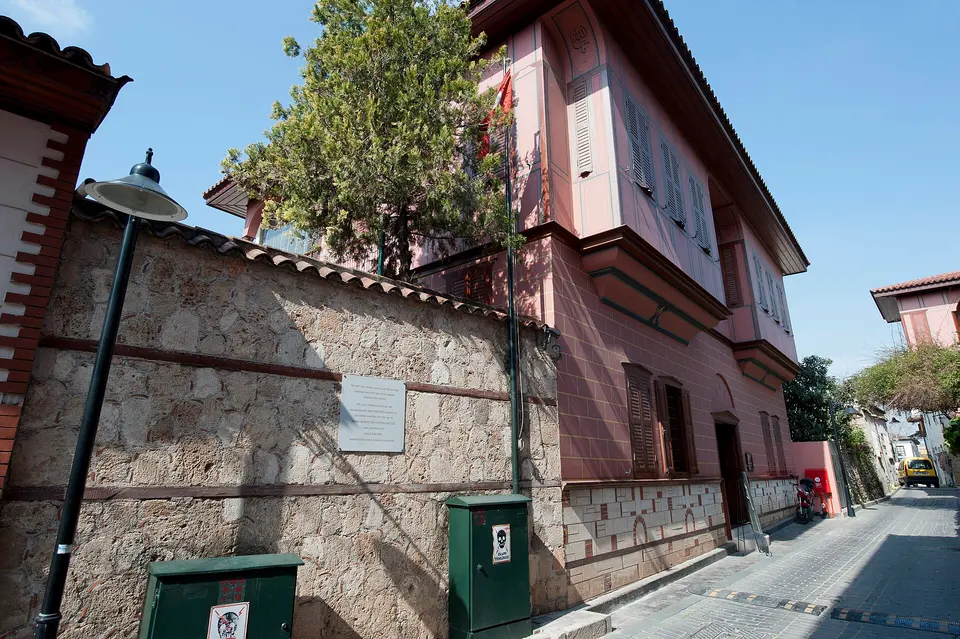
Suna & İnan Kıraç Kaleiçi Museum
Photo: Dosseman, CC BY-SA 4.0
4Museum

Suna & İnan Kıraç Kaleiçi Museum

Two restored Ottoman houses and the former Greek Orthodox church of Ayios Yorgos in the middle of the old town, opened in 1996 by the Vehbi Koç Foundation's Mediterranean research institute, show how a wealthy Antalya family lived in the 19th century, with rooms of mannequins in costume, a bride's henna night, a coffee ceremony and a barber, and in the church a collection of Çanakkale ceramics, kilims and folk art under a painted ceiling; it is a small, cool hour in the heat of the day and one of the few museums in the city still open. It closes one day a week, so check before you go.

  • Plan about 1 h
  • Open about 9:00–18:00, closed one day a week (check Monday or Wednesday); small entry fee, a few euros; Kocatepe Sokak 25
450 m · about 7 min on foot
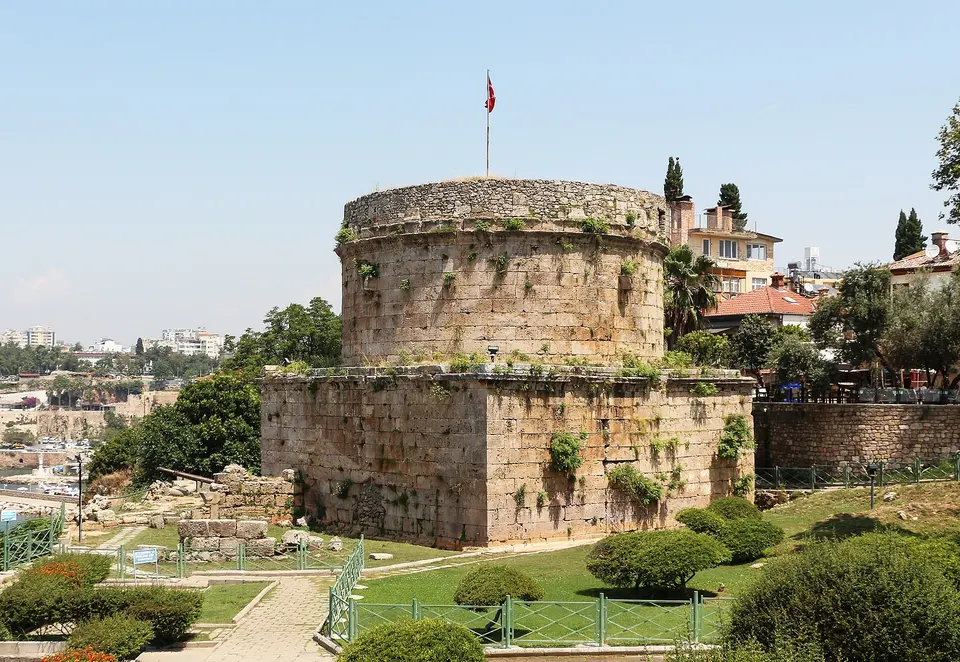
Hıdırlık Tower
Photo: Bernard Gagnon, CC BY-SA 3.0
5Roman tower

Hıdırlık Tower

At the southern end of the walls, where the old town meets the cliff, the 14-metre round tower on a square base was built in the 2nd century, as a mausoleum, a lighthouse or a bastion depending on whom you ask, and has watched the harbour ever since; the terrace around it is the old town's balcony over the sea, with the Bey Mountains across the gulf and the cliffs of Konyaaltı below, and the cafés on the wall beside it are where Antalya sits with a tea at sunset. Come along the cliff path from the harbour and continue into the park.

  • Plan about 30 min
  • Open all the time, free; the terrace and cafés around it are the sunset spot

Evening

Right next door
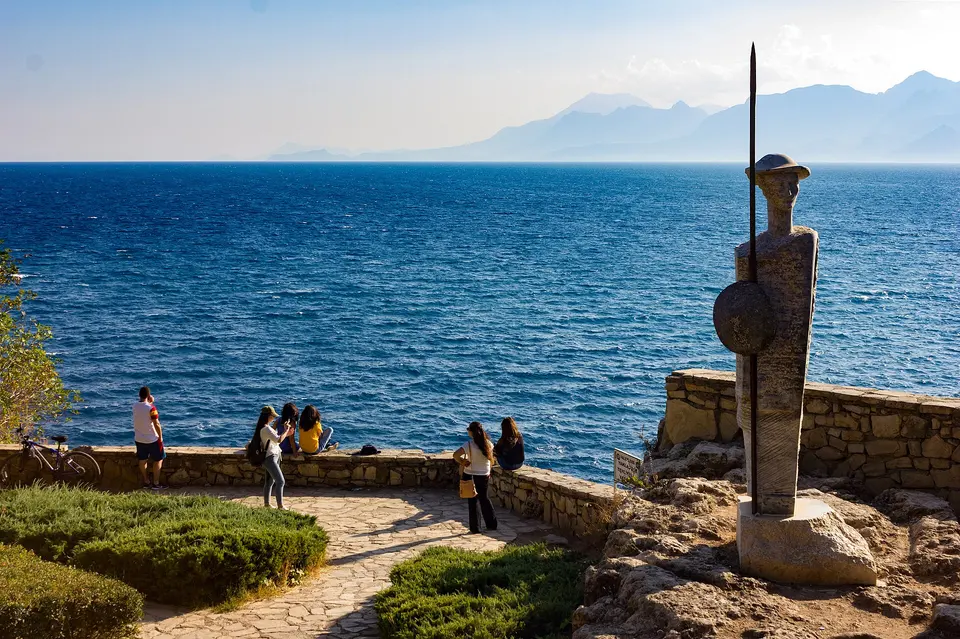
Karaalioğlu Park
Photo: Bestalex, CC BY-SA 4.0
6Clifftop park

Karaalioğlu Park

Seven hectares of palms, pines and flowerbeds along the top of the cliff south of Kaleiçi, laid out in the 1940s, with tea gardens, a statue of Atatürk, the Hıdırlık Tower at its northern end and a long balustraded promenade where the whole city comes in the evening to watch the sun drop behind the Bey Mountains across the bay while the excursion boats come home below; on summer nights the open-air café plays music and the lanes back into the old town fill up. It is the end of day one, and it costs nothing.

  • Plan about 1 h
  • Open all the time, free; tea gardens open late in summer

Day 2

The Roman cities of Pamphylia: Perge, Aspendos and Side

Drive east to Perge for the stadium, the baths and the colonnaded street with the water channel down its middle, on to Aspendos to stand on the stage of the best-preserved Roman theatre anywhere, and end at Side, a Roman city that became a holiday village, where the temple of Apollo stands on the point over the sea for the sunset.

  • 4 sights
  • Transport between sights
12345 kmN
Stops in order, straight-line distancesDriving route in Google Maps ↗

Morning

Perge
Photo: Saffron Blaze, CC BY-SA 3.0
1Roman city

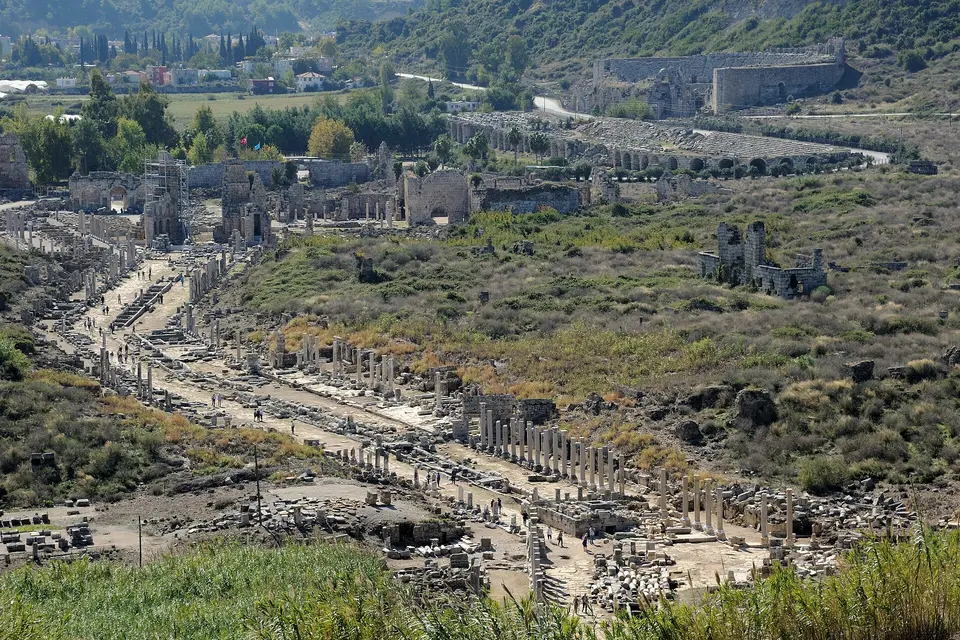
Perge

The capital of Pamphylia, 18 km east of the city, is a Roman town of the 2nd century AD walked in the round: through the Hellenistic gate of two round towers and the Roman gate behind it, along a 300-metre colonnaded street with a water channel running down the middle and the shops' mosaic floors still in place, to the nymphaeum at the foot of the acropolis, then back through the great baths with their marble pools, the agora and the stadium for 12,000 outside the walls, one of the best preserved anywhere; the theatre across the road is closed for restoration, and the famous statues dug up here are in the closed museum's stores. There is no shade; go first.

  • Plan about 2 h
  • Daily 8:00–20:00, ticket office closes 19:30 (shorter in winter); about €11, on the MuseumPass; the theatre is temporarily closed for restoration
Car 30 km further east on the D400 and 5 km north at Serik, about 35 minutes; there is no bus to the theatre
Aspendos
Photo: Saffron Blaze, CC BY-SA 3.0
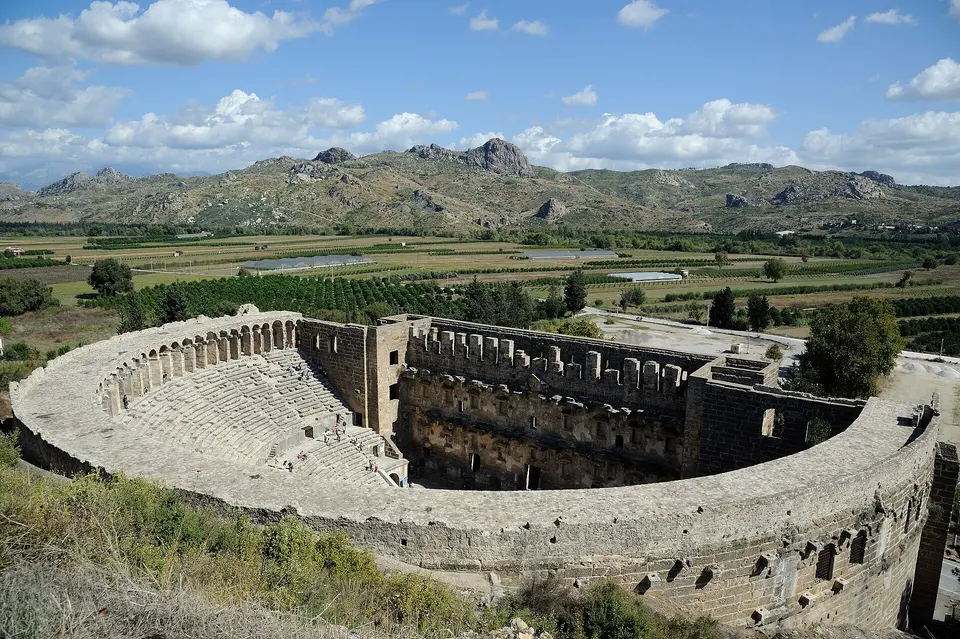
2Roman theatre

Aspendos

The theatre built around AD 155 by the architect Zenon for the emperor Marcus Aurelius is the most complete Roman theatre in the world: 15,000 seats in a perfect half-circle, the two-storey stage wall standing to its full 24 metres with its niches and columns, an acoustic that carries a dropped coin to the top row, and a Seljuk restoration that kept it in use as a caravanserai and a palace; the ministry still fills it for the opera and ballet festival in September and the state ballet in summer. Above it on the acropolis are the basilica, the agora and the arches of the aqueduct that ran to the town, worth the 15-minute climb for the view of the theatre from behind.

  • Plan about 1 h 30 min
  • Daily 8:00–19:00, ticket office closes 18:30; about €15, on the MuseumPass; the opera and ballet festival uses the theatre in September

Midday

LunchThe restaurants at the Aspendos car park and the trout farms along the Köprüçay river north of it serve grilled trout, gözleme and salads under the plane trees, and are the natural stop between the theatre and Side; at Side, the harbour front is lined with fish restaurants that are dearer and the back streets with pide houses that are not. Eat before 14:00 so Side gets its afternoon and the temple its sunset.

Afternoon

Car 30 km east on the D400 and south at Manavgat into the old town, about 40 minutes; park at the entrance to the peninsula, since the centre is pedestrian
Side and its theatre
Photo: Dosseman, CC BY-SA 4.0
3Roman city and resort

Side and its theatre

The port that the Greeks founded in the 7th century BC and the pirates and slave-traders made rich is a peninsula of Roman ruins with a holiday village grown through them: the theatre for 15,000, freestanding on vaults rather than cut into a hill, was a church and then a fortress and is the ticketed heart of the site, beside the agora where the slaves were sold, the great gate and the colonnaded street that leads, past the museum in the Roman baths, through the pedestrian old town of shops and restaurants to the harbour and the temples on the point. The theatre and the museum take a ticket; the rest of the city is walked free.

  • Plan about 2 h
  • Theatre and museum ticketed, about €10 each, on the MuseumPass; open daily about 8:00–19:00 in summer; the ruins and the old town are free

Evening

A 10-minute walk from the theatre through the old town to the harbour and the point
Temple of Apollo
Photo: Saffron Blaze, CC BY-SA 3.0
4Roman temple

Temple of Apollo

On the tip of the peninsula beyond the harbour, five Corinthian columns of white marble with a fragment of their frieze of Medusa heads, re-erected in the 1980s from the 2nd-century temple to Apollo that stood beside a twin temple to Athena, frame the sea and, at the end of the day, the sun going down behind the mountains of Alanya; it is the most photographed thing on the coast and the reason the day ends here. The harbour restaurants behind it are open late, and the drive back to Antalya is about 75 minutes on the D400.

  • Plan about 1 h
  • Open all the time, free; sunset is the moment; restaurants on the harbour behind

Day 3

The mountain and the waterfalls: Termessos, the Upper and Lower Düden falls and Konyaaltı

Drive up into the Taurus early for the theatre of Termessos, the mountain city that Alexander could not take, walk its tombs and ridges before the heat, come back to the city for the caves and cascades of the Upper Düden park, drive out to Lara to watch the Lower Düden fall off the cliff into the sea, and end on the pebbles of Konyaaltı.

  • 4 sights
  • Transport between sights
12345 kmN
Stops in order, straight-line distancesDriving route in Google Maps ↗

Morning

Termessos
Photo: Ingo Mehling, CC BY-SA 3.0
1Mountain city

Termessos

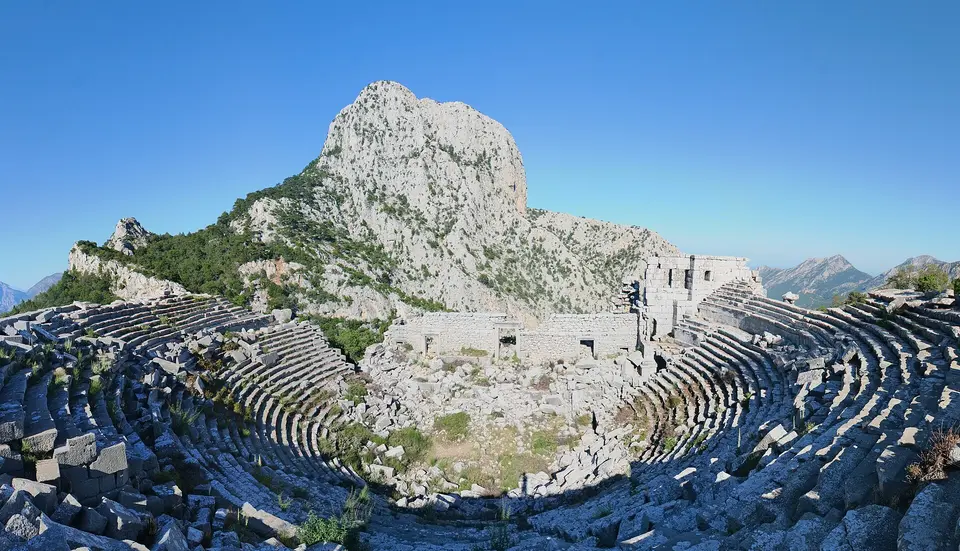
In a saddle of the Güllük mountain at 1,050 metres, 35 km northwest of the city inside a national park of pine and cedar, the city of the Pisidians that Alexander the Great besieged in 333 BC and gave up on is the most dramatic ruin in Turkey and one of the least excavated: a 30-minute climb from the car park on a stone path brings you to the gymnasium and the colonnaded street, then the theatre of 4,000 seats hanging over a gorge with the Taurus peaks behind, the odeon, the temples and the agora, and beyond them a hillside of hundreds of rock-cut and sarcophagus tombs tumbled by earthquakes, with ibex on the cliffs and eagles above. There is no shade on the path, no water and no one else early in the morning.

  • Plan about 3 h
  • Daily about 8:00 to dusk; about €3 at the site plus the national park entry per person and car; on the MuseumPass; 30-minute steep climb from the car park, proper shoes

Midday

LunchThere is nothing at Termessos but a kiosk at the car park, so either carry a picnic up the mountain and eat it in the theatre, or come down to the village restaurants at Yenice and Döşemealtı on the Korkuteli road for gözleme, grilled lamb and ayran under the trees; the fish restaurants at the Upper Düden park are the alternative for a late lunch by the water.

Afternoon

Car 40 km back through the city to Düdenbaşı in Kepez, about 50 minutes; from the centre, bus KL08 or a taxi in 20 minutes
Upper Düden Waterfalls
Photo: Saffron Blaze, CC BY-SA 3.0
2Waterfall park

Upper Düden Waterfalls

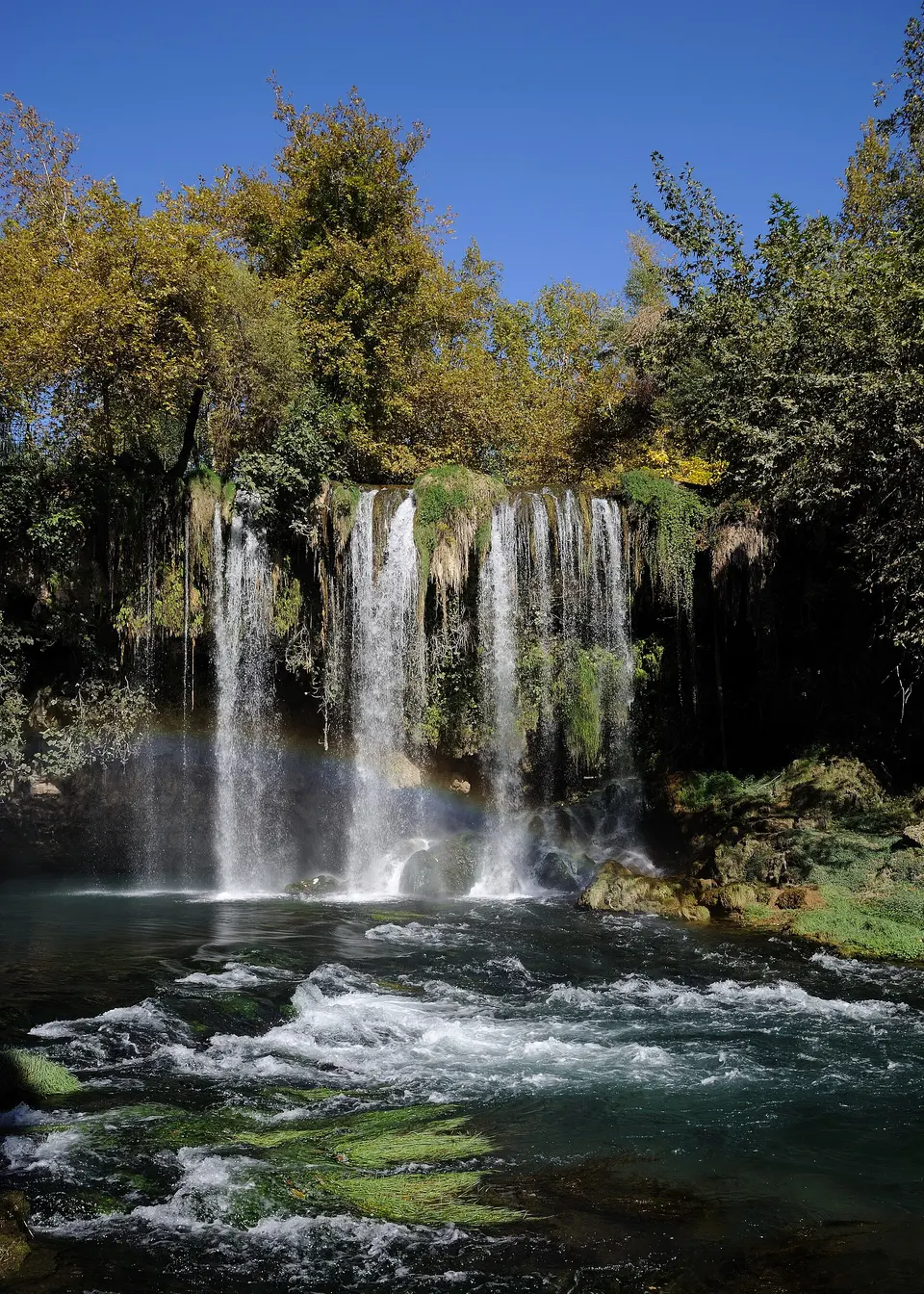
The Düden river surfaces from the limestone at Düdenbaşı, 10 km north of the centre in Kepez, and drops 20 metres into a green pool in a park of plane trees, tea gardens and picnic tables, with a path that goes behind the curtain of water into the caves the falls have cut and along the channels that the Seljuks dug to power the city's mills; it is where Antalya's families come on a Sunday, cool in the worst of the summer, and it takes an hour with the tea. The municipality charges a small entry fee at the gate.

  • Plan about 1 h 15 min
  • Daily, about 8:00–20:00 in summer; small entry fee, around 100 lira, plus parking; bus KL08 from the centre
Car 12 km southeast through the city to the Düden park on the Lara cliffs, about 25 minutes; from the centre the tram to Lara or a taxi
Lower Düden Waterfall
Photo: Saffron Blaze, CC BY 3.0
3Waterfall

Lower Düden Waterfall

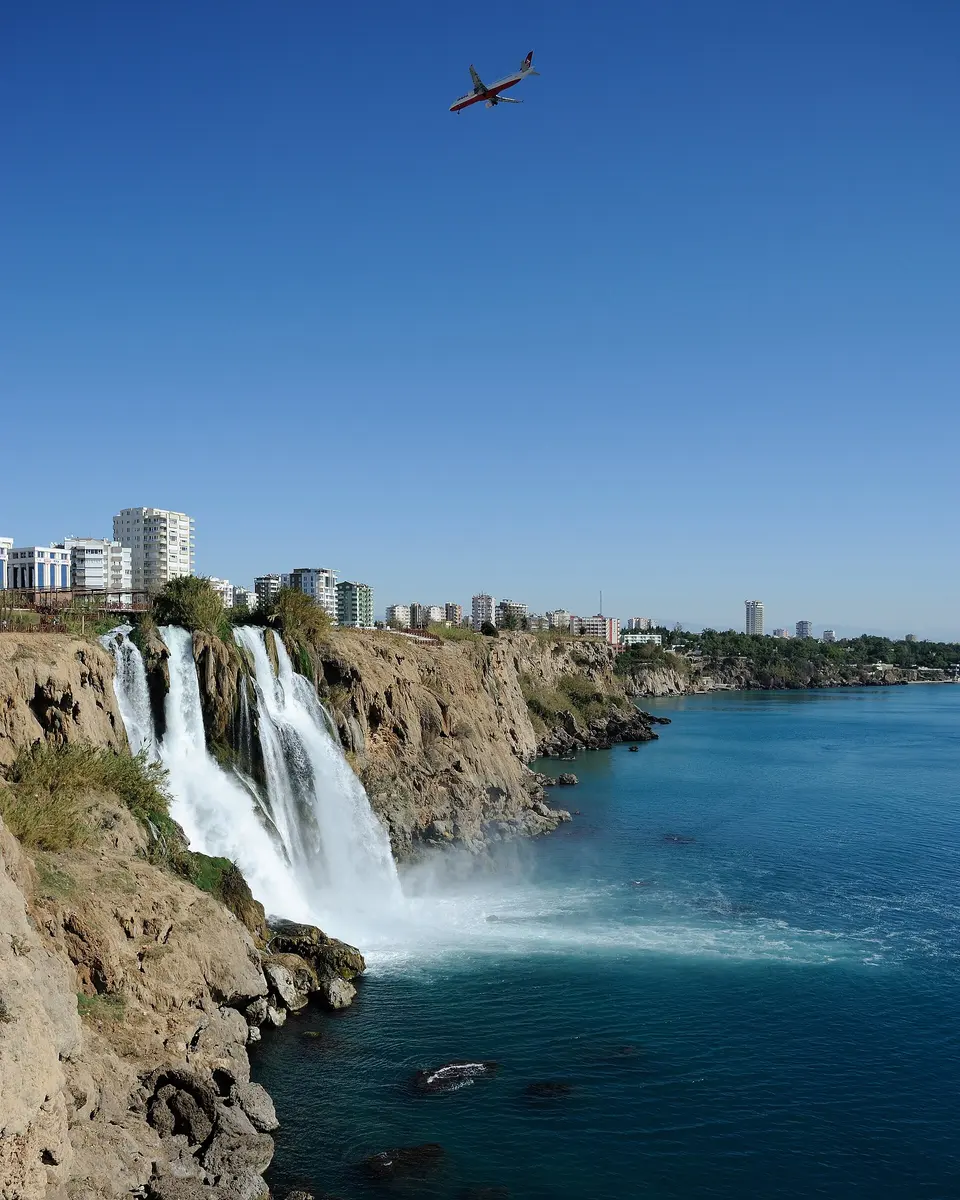
Twelve kilometres on, the same river reaches the edge of the Lara cliffs and falls 40 metres straight into the sea, a white column against the travertine that is the picture of Antalya on every postcard and is seen two ways: from the Düden Park on the cliff top above, a free public park of lawns, cafés and a viewing platform where the spray blows back on a windy day, or from the excursion boats that leave the old harbour and hold off the cliff below the falls. Come in the late afternoon when the sun is behind you and the boats are still out.

  • Plan about 1 h
  • Free public park, open all the time; boats from the old harbour view it from the sea; tram to Lara or a taxi from the centre

Evening

Car 15 km west along the coast road to Beach Park, about 25 minutes; from the centre the nostalgic tram to the Museum stop and a 10-minute walk down, or the tram T1 to Konyaaltı
Konyaaltı Beach
Photo: Mike like0708, CC BY-SA 4.0
4Beach

Konyaaltı Beach

West of the cliffs, the city's beach runs for seven kilometres of fine pebbles and clear water along the foot of the Bey Mountains, with a promenade of lawns, cafés, beach clubs and a cycle path from Beach Park below the museum all the way to the Boğaçayı river, the Tünektepe cable car rising from its far end and the sunset falling behind the 2,000-metre peaks across the bay; entry is free, sunbeds are rented, the water is warm from May to November and the evening promenade is the city's habit. It is the last stop, and it needs nothing but a towel.

  • Plan about 2 h 30 min
  • Free beach, sunbeds and clubs paid; tram T1 or the nostalgic tram to the Museum stop; the Tünektepe cable car at the western end runs about 10:00–18:00

Good to know in Antalya

Tickets and opening days

  • The Aspendos archaeological site is open every day from 8:00 to 19:00 with the ticket window closing at 18:30; Turkish citizens may enter with the Müzekart, and night-museum tickets are sold at 200 lira in addition to the card.Source: Müze Kart (T.C. Kültür ve Turizm Bakanlığı), Aspendos Örenyeri · checked Sep 2026
  • The Perge archaeological site is open every day from 8:00 to 20:00 with the ticket window closing at 19:30; the ancient theatre is temporarily closed for restoration work.Source: Müze Kart (T.C. Kültür ve Turizm Bakanlığı), Perge Örenyeri · checked Sep 2026
  • The MuseumPass Türkiye e-card costs €165 and is valid for 15 days from the first museum visit, giving one entry to each of more than 350 museums and archaeological sites of the Ministry of Culture and Tourism; it is not valid for night museums after 19:00.Source: Müze Kart, MuseumPass Türkiye E-Kart · checked Sep 2026
  • The Antalya Museum page of the Ministry's museum portal lists the museum as closed to visits ("Ziyarete kapatılmıştır"), with no opening hours or prices published; the museum was closed on 16 July 2025 to be demolished and rebuilt on the same site.Source: Müze Kart (T.C. Kültür ve Turizm Bakanlığı), Antalya Müzesi · checked Sep 2026
  • Kaleiçi, the walled old town founded as Attaleia around the 2nd century BC, has been a protected heritage zone since 1972; Hadrian's Gate was built in AD 130 with three barrel-vaulted openings entirely of white marble except for the columns, the Yivli Minare of the 13th-century Seljuk complex is 38 metres tall with eight flutes, and the Kesik Minare began as a 2nd-century temple, became a Byzantine basilica and then a mosque whose wooden minaret top was destroyed by fire in the 19th century.Source: T.C. Antalya Valiliği, Kaleiçi · checked Sep 2026

3 days in Antalya: quick answers

Is 3 days enough for Antalya?

Three days cover the old town, the three great Roman sites and the mountain city, the waterfalls and the beach. A fourth day is the Olympos cable car up the 2,365-metre Tahtalı from Kemer with the ruins of Phaselis on the beach below, or the Tünektepe cable car and the Konyaaltı cliffs closer to town, or the Kurşunlu waterfall and Alanya's castle to the east, or a boat along the cliffs from the old harbour. When the new Antalya Archaeological Museum opens, planned for the end of 2026, its Perge sculpture gallery becomes the first thing to see.

Which days should I plan around?

The ministry's archaeological sites are open every day: Aspendos 8:00 to 19:00 with the ticket office closing at 18:30 and Perge 8:00 to 20:00 with the office closing at 19:30 in the summer season, shorter in winter; Termessos, run as a national park, opens from about 8:00 to dusk. The Kaleiçi Museum is closed one day a week, usually Monday or Wednesday, so check before going. Hadrian's Gate, the towers, the parks, the waterfalls' viewpoints and the beaches are open all the time. Friday is market day in many districts and prayer time at the mosques around midday. Aspendos hosts the opera and ballet festival in the theatre in September.

How much do the tickets cost?

Foreign visitors pay in euros at the ministry's sites: currently about €15 at Aspendos, €11 at Perge and €3 at Termessos, with Side's theatre and museum ticketed separately and most of Side's ruins free; the MuseumPass Türkiye covers all of them for €165 over 15 days, and the MuseumPass Mediterranean, about €90 for 7 days, covers the sites of Antalya, Mersin, Adana and Denizli. The Kaleiçi Museum charges a small entry fee of a few euros. The Upper Düden park charges a small fee, around 100 lira, and the Lower Düden park in Lara is free. Hadrian's Gate, the minaret and the towers, Karaalioğlu Park and the beaches are free.

How do I get around?

On foot in Kaleiçi; by the AntRay tram, the nostalgic tram along the boulevard above the old town and the buses elsewhere, paid with an Antalyakart or a contactless card at about 35 to 40 lira a ride; and by car, taxi or tour for the days outside the city, since neither Aspendos, Side's old town nor Termessos has a useful bus. Car hire from the airport is cheap and the D400 coast road is easy; a taxi for the Perge–Aspendos–Side day is negotiated in the morning. The airport is 13 km east, 45 minutes by tram to the centre with one change or 20 by taxi.

What about the archaeological museum?

The Antalya Archaeological Museum, home to the Perge sculptures, the Herakles Farnese and the sarcophagi, was closed on 16 July 2025 by the Ministry of Culture and Tourism because of earthquake risk and lack of storage, its 100,000 objects moved to stores in the garden, and the building demolished in September 2025 to be rebuilt on the same site; the ministry's target for the new museum is the end of 2026. Until it opens, the finest Perge pieces are out of view, which is one more reason to see Perge itself.

How much walking is this itinerary?

About 6 km on day one, on the cobbles and slopes of Kaleiçi and the cliff path; about 5 km on day two across the three sites, mostly flat but on ancient paving in full sun; and about 6 km on day three, with the steep 30-minute climb from the Termessos car park to the theatre at 1,000 metres and the paths of the two waterfall parks. Perge and Aspendos have no shade at all; a hat, water and an early start matter more than distance. Termessos needs proper shoes.

Other Antalya itineraries

Keep exploring

Where this connects

THE TRIPWOA APP

Go somewhere.
Make it yours.

Build days around what you love. Follow your route, find your next stop and keep the moments along the way.

Get it on Google PlayAvailable for Android
Free to start
Tripwoa home with a Paris trip and nearby places to explore
Tripwoa day plan for New York with a route map and Times Square stop

A day that feels like you.

Sources and method

Places and coordinates: Wikidata and Tripwoa's open-data place catalog (Overture Maps Foundation, © OpenStreetMap contributors). Photos: Wikimedia Commons, credited on each image. Practical rules: the official sources linked in each note, checked in September 2026.

How this plan was made: Tripwoa's planner drafted the day order from real coordinates and typical visit times. Each stop was then reviewed, reordered where needed and rewritten with AI assistance. Walking distances are straight-line estimates, so allow a little extra time on real streets.