3-day itinerary · India

3 Days in Chennai

A plan that walks the colonial core on the first day, gives the second to the bronze gallery and Mylapore, and the third to the Pallava rock-cut shore at Mahabalipuram. Official ASI and metro rules are in the stops.

  • 3days
  • 14sights
  • 0.0 kmon foot between sights

Updated 13 September 2026 · 2 official sources checked · report an error

Shore Temple
Photo: Vyacheslav Argenberg, CC BY 4.0

Fort St. George and the Marina, then the Chola bronzes and Mylapore, then Mahabalipuram

Chennai is the capital of Tamil Nadu and a metropolitan area of around eleven million on the Coromandel coast. It exists because the East India Company bought a strip of beach in 1639 and built Fort St. George on it, making this the first English foothold in India and the place where the whole colonial apparatus was first assembled. But the older city is the Tamil one: Mylapore, with its temple and its tank, was a port when Madras was sand, and the apostle Thomas is said to have been buried on this shore in the first century. What the city runs on now is cars, software, cinema and a deep, unshowy conservatism about music, food and religion — and in December it turns itself over to a six-week festival of Carnatic concerts that has no equivalent anywhere.

At a glance

Ways to use these days

If it rains
6 of the stops are indoors — Vivekanandar Illam (Ice House) · Government Museum, Egmore · Kapaleeshwarar Temple
Outdoors
Marina Beach · Elliot's Beach
Lightest day on foot
Day 3 — 2.7 km between stops
Most walking
Day 2 — 11.0 km

Day 1

Where British India began, and the beach the whole city walks on

Start in George Town with the courthouse that carried a lighthouse and the fort the East India Company built in 1644, look at the corporation that has run the city since 1688, then spend the evening on thirteen kilometres of sand.

  • 5 sights
  • Transport between sights
123451 kmN
Stops in order, straight-line distancesDriving route in Google Maps ↗

Morning

Madras High Court
Photo: Yoga Balaji, CC BY 3.0
1Historic building

Madras High Court

A red Indo-Saracenic pile of 1892 in the middle of George Town, with domes, minarets and onion-shaped cupolas over a courtroom complex said to be among the largest judicial buildings in the world after the Courts of Justice in London. The style was the empire's attempt to build in an Indian idiom and it rarely came off better than here. One of the towers carried the Madras lighthouse from 1894 until 1977, which is why a courthouse has a lamp room: ships coming into the roadstead took their bearing from the law. The compound also holds the older 1760s tomb-like memorials and a working bazaar of typists and notaries outside the gate.
  • Plan about 45 min
  • A working court, so the interior is not a visitor attraction and security is tight; the exterior and the compound can be walked on weekdays, and High Court metro station is at the gate
1 km south, about twelve minutes on foot down Rajaji Salai
Fort St. George
Photo: Pinakpani, CC BY 4.0
2Fort

Fort St. George

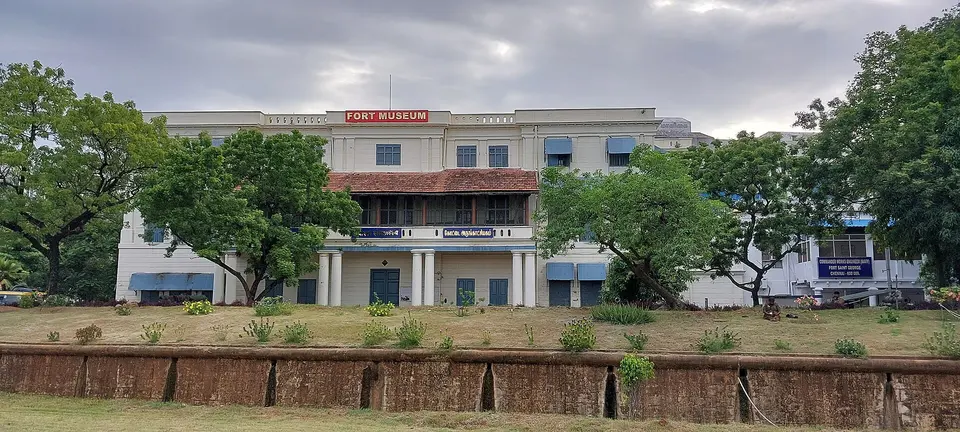
The East India Company bought a strip of sand here in 1639 and finished a fort on it in 1644; the settlement that grew outside the walls became Madras and then Chennai, which makes this the point from which British India begins. Inside the walls, still in use as the seat of the Tamil Nadu legislature and secretariat, stand St. Mary's Church of 1680 — the oldest Anglican church east of Suez, where Robert Clive was married and Elihu Yale was a vestryman before he endowed a college in Connecticut — and the Fort Museum in the 1795 Exchange Building, full of Company silver, uniforms and portraits.

  • Plan about 2 h
  • The Fort Museum is an Archaeological Survey of India site with a small admission and is generally closed on Fridays; the fort is an active government complex, so carry photo identification and expect a bag check

Midday

LunchChennai's defining meal is a plate of idli, a vada and a filter coffee, and the places that do it best are old and plain: Murugan Idli Shop, Ratna Café in Triplicane for the sambar, Saravana Bhavan everywhere. For lunch proper, the banana-leaf meals of a Tamil vegetarian hotel — rice, five or six vegetables, sambar, rasam, curd — cost almost nothing and come with refills. Non-vegetarian Chennai means Chettinad: pepper chicken, fried fish, and a great deal of black pepper.

Afternoon

2 km north-west, about eight minutes by car or a short metro hop from High Court to Central
Ripon Building
Photo: Saiphani02, CC BY-SA 4.0
3Historic building

Ripon Building

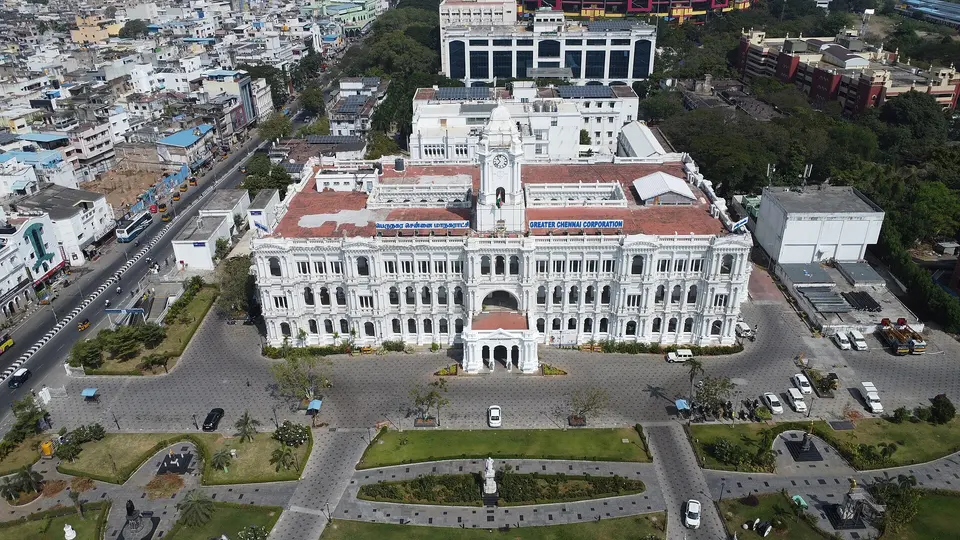
A long white Neoclassical building of 1913 with a clock tower in the middle, named for Lord Ripon, the viceroy who pushed local self-government in India, and still the headquarters of the Greater Chennai Corporation — which dates from 1688 and claims to be the oldest municipal corporation outside Britain. The clock plays the Westminster quarters. It is not a museum and you will not go inside, but standing in front of it with the traffic of Poonamallee High Road behind you is the clearest single statement of what the Victorians thought a city government should look like.

  • Plan about 30 min
  • Seen from outside; it faces the Periyar EVR Salai and is a five-minute walk from Chennai Central station, so it pairs with an arrival or a departure

Evening

3 km south along the seafront, about twelve minutes by car
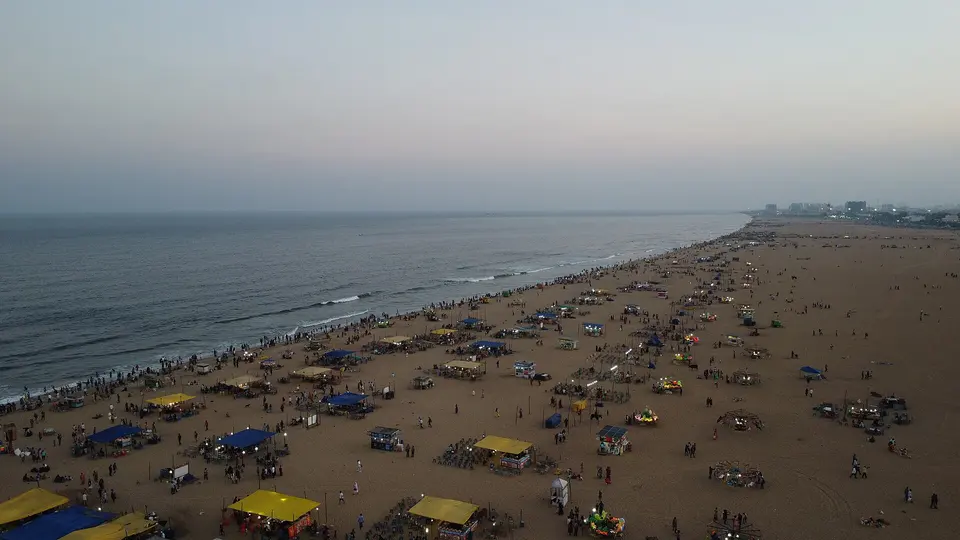
Marina Beach
Photo: Saiphani02, CC BY-SA 4.0
4Beach

Marina Beach

Thirteen kilometres of sand along the Bay of Bengal, said to be one of the longest urban beaches in the world, laid out as a promenade by Governor Mountstuart Elphinstone Grant Duff in the 1880s. In the evening the whole city comes: families, hawkers selling sundal and murukku, horse rides, kite sellers, and a line of statues and memorials along Kamarajar Salai including the samadhis of the Tamil Nadu chief ministers Anna, MGR and Jayalalithaa, which are political shrines as much as monuments. The water is not for swimming — the undertow is genuinely dangerous and people drown here every year.

  • Plan about 1 h 30 min
  • Free and always open; do not swim, and treat the warnings seriously. Come after 17:00 when the heat drops and the beach fills, and eat the sundal from a stall rather than a restaurant
1 km south along Kamarajar Salai, about five minutes by car or fifteen on foot
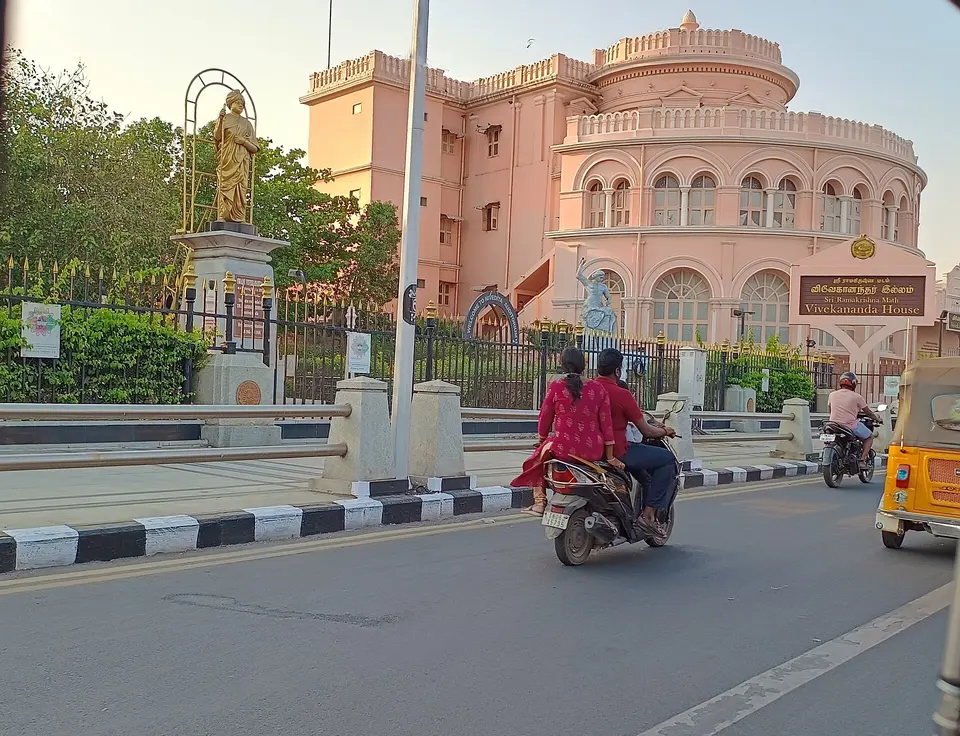
Vivekanandar Illam (Ice House)
Photo: N. Vivekananthamoorthy, CC BY 4.0
5Museum

Vivekanandar Illam (Ice House)

A circular cream building on the Marina, built in 1842 to store ice. The Tudor Ice Company of Boston cut blocks from New England ponds, packed them in sawdust, shipped them round the Cape and sold them in Madras, and this was the warehouse — a business that collapsed once refrigeration arrived. In 1897 Swami Vivekananda stayed here for nine days after returning from his triumph at the Parliament of Religions in Chicago, and the Ramakrishna Math now runs it as a museum of his life and of Indian spiritual history, with a room kept as he used it. The building itself is the oddest thing on the seafront.

  • Plan about 1 h
  • A small admission, generally open in the morning and again in the late afternoon with a long midday closure; shoes come off at the door and photography inside is not allowed

Day 2

Chola bronzes in the morning, Mylapore in the afternoon

Give the middle of the day to the second oldest museum in India and its bronze gallery, look at the stone chariot built for a two-thousand-year-old poem, then walk the temple quarter and the church over an apostle's tomb.

  • 5 sights
  • Transport between sights
123452 kmN
Stops in order, straight-line distancesDriving route in Google Maps ↗

Morning

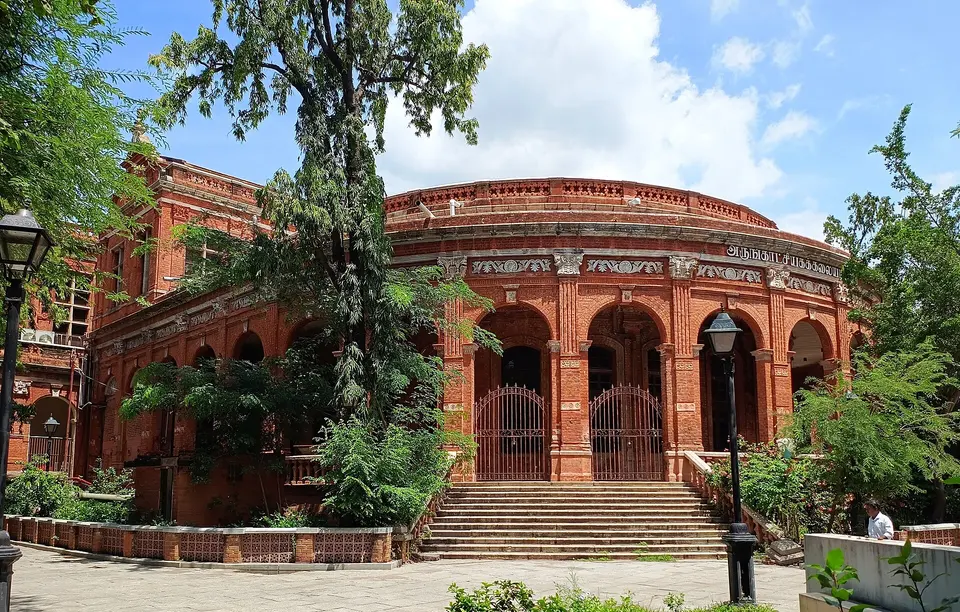
Government Museum, Egmore
Photo: N. Vivekananthamoorthy, CC BY-SA 4.0
1Museum

Government Museum, Egmore

Founded in 1851 and the second oldest museum in India, spread over a campus of Indo-Saracenic buildings in Egmore including the Museum Theatre. Two collections make it essential. The bronze gallery holds the finest group of Chola bronzes anywhere — the lost-wax Nataraja of the tenth and eleventh centuries, Shiva dancing in a ring of fire, together with Parvati, Rama and the saints, in a room that rewards an hour on its own. The other is the Amaravati gallery: carved limestone panels from the great Buddhist stupa in Andhra Pradesh, second century AD, among the most refined narrative relief in Indian art.

  • Plan about 2 h 30 min
  • Ticketed, with separate camera charges, and generally closed on Fridays and public holidays; the bronze gallery is in a separate block from the main building, so ask at the gate rather than assuming
2 km south-west, about ten minutes by car
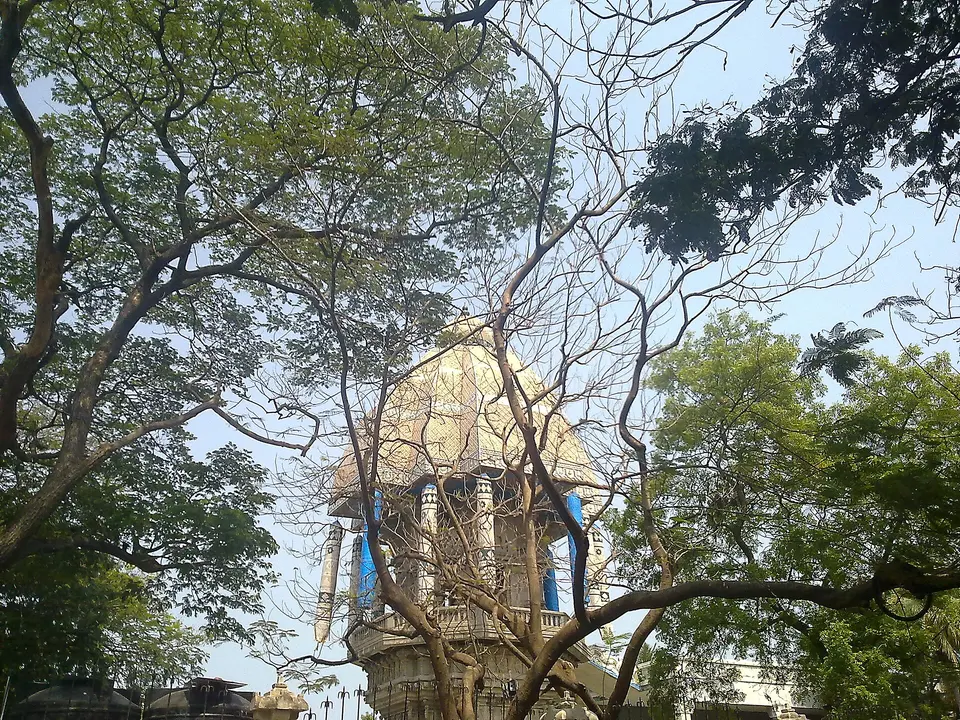
Valluvar Kottam
Photo: RAJUKHAN SR RAJESH, CC BY-SA 3.0
2Monument

Valluvar Kottam

A memorial of 1976 to Tiruvalluvar, the Tamil poet who wrote the Tirukkural some two thousand years ago, built as a full-size stone temple chariot 33 metres high with a statue of the poet in it. Around the courtyard, all 1,330 couplets of the Kural are carved on granite panels — a text that Tamils quote the way the English quote Shakespeare, and which is startlingly secular and practical for its age. Behind the chariot is an auditorium said to be one of the largest in Asia. The whole thing was built without steel or cement, in the old way, which is the point it is making.

  • Plan about 45 min
  • A small entry fee, generally open through the day; it is in Nungambakkam near the junction of Village Road and Kodambakkam High Road, and half an hour is enough unless you read Tamil

Midday

LunchMylapore is the right place to eat this day. The streets around the Kapaleeshwarar tank have old vegetarian messes doing rice plates at midday and a row of stalls selling sundal, murukku and filter coffee from six in the morning. Karpagambal Mess on North Mada Street has been at it since 1946. In the evening, the cafés along Elliot's Beach do the other Chennai — cold coffee, ice cream and a great many college students.

Afternoon

4 km south-east into Mylapore, about twenty minutes by car in traffic
Kapaleeshwarar Temple
Photo: N. Vivekananthamoorthy, CC BY 4.0
3Temple

Kapaleeshwarar Temple

The heart of Mylapore and the temple that the neighbourhood is arranged around. A shrine has stood here since at least the seventh century — the Shaivite saints sang about it — though the Portuguese destroyed the original on the shore and the present building is a sixteenth-century Vijayanagara rebuild a few streets inland. The east gopuram rises about 37 metres in tiers of painted figures; inside, Shiva is Kapaleeshwarar and Parvati is Karpagambal, and in the tank outside the whole quarter does its washing and its gossiping. In March or April the Arupathimoovar festival brings the bronze saints out into the streets.

  • Plan about 1 h 15 min
  • Free, open early morning to midday and again from late afternoon to about 21:00; shoes come off at the gate, non-Hindus may enter the outer precincts but not the inner sanctum, and the tank and the surrounding streets are as much the point as the temple
1 km east towards the sea, about twelve minutes on foot
San Thome Basilica
Photo: Pinakpani, CC BY 4.0
4Basilica

San Thome Basilica

Tradition holds that the apostle Thomas came to India in AD 52, preached on this coast and was killed near Chennai in AD 72, and that he was buried here. That makes San Thome one of only three churches in the world built over the tomb of an apostle, with St Peter's in Rome and Santiago de Compostela. The Portuguese built the first church over the grave in the sixteenth century; the present white neo-Gothic basilica with its 47-metre spire dates from 1896, and the tomb chapel is in the crypt below, reached by stairs from the side. Pope Pius XII made it a minor basilica in 1956.

  • Plan about 45 min
  • Free and open through the day; the underground tomb chapel and the small museum are entered from the south side of the church, and services run in Tamil and English. It is a ten-minute walk from the Kapaleeshwarar temple

Evening

4 km south along the coast, about fifteen minutes by car
Elliot's Beach
Photo: N. Vivekananthamoorthy, CC BY 4.0
5Beach

Elliot's Beach

The southern end of the same sand, in Besant Nagar, and a completely different beach from the Marina: quieter, cleaner, younger, with a line of cafés and ice-cream places along the front and students from the nearby colleges filling them after dark. At the north end stands the Karl Schmidt memorial, a small stone arch commemorating a Dutch sailor who drowned in 1930 saving a swimmer, and the Ashtalakshmi temple sits on the shore a few hundred metres away. The same warning applies about the water. This is where Chennai comes to sit rather than to parade.

  • Plan about 1 h 15 min
  • Free and always open; the cafés along the front open in the late afternoon and stay busy until midnight, and the Ashtalakshmi temple on the shore is a five-minute walk north

Day 3

The day at Mahabalipuram: a granite shore carved by the Pallavas

Drive an hour south down the coast road to a seventh-century port where temples were cut out of the rock rather than built on it, and spend the day among monolithic shrines, a hundred-figure relief and a tower standing in the surf.

  • 4 sights
  • Transport between sights
1234500 mN
Stops in order, straight-line distancesDriving route in Google Maps ↗

Morning

Mahabalipuram
Photo: Matthew T Rader, CC BY-SA 4.0
1Archaeological site

Mahabalipuram

A port of the Pallava kings in the seventh and eighth centuries, where a stretch of granite outcrop along the shore was carved into temples rather than built into them — some cut down into the rock as caves, some carved out of standing boulders as free-standing shrines, some assembled from blocks. The whole group went onto the UNESCO World Heritage list in 1984. Beyond the famous monuments there are cave temples with fine relief panels, Krishna's Butterball balancing absurdly on a slope, a lighthouse you can climb, and a working stone-carving trade in the town that has never stopped since the Pallavas.

  • Plan about 3 h
  • The Group of Monuments is an Archaeological Survey of India site with a single ticket for the Shore Temple and the Pancha Rathas; the open-air reliefs and cave temples are free. Allow a full day with the 56 km drive, and go early — the granite is punishing by midday
In the middle of the village, a five-minute walk from the main car park
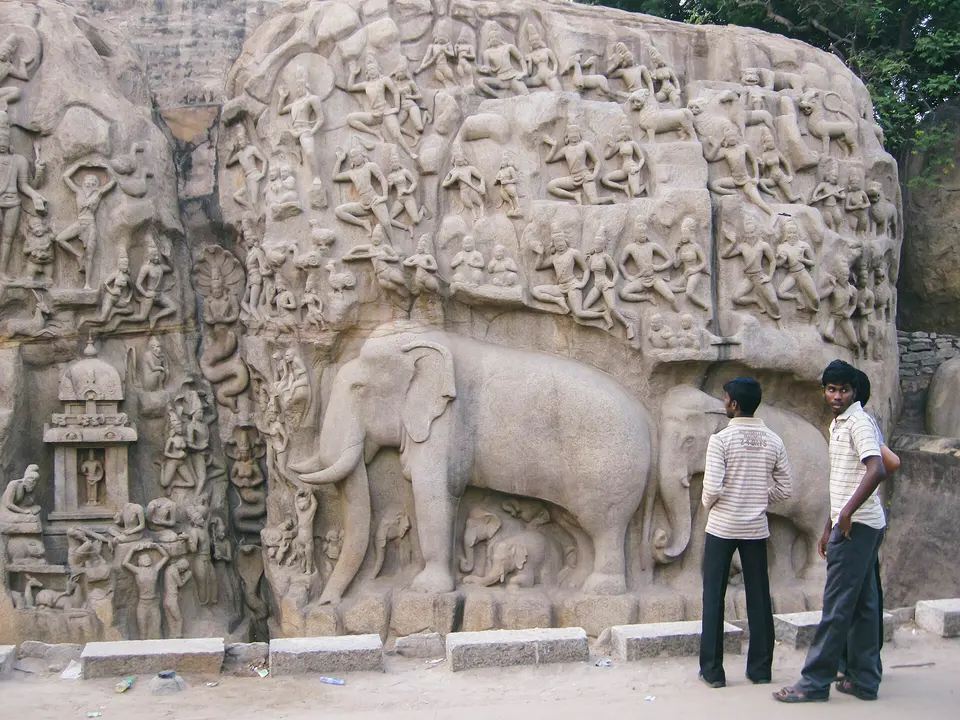
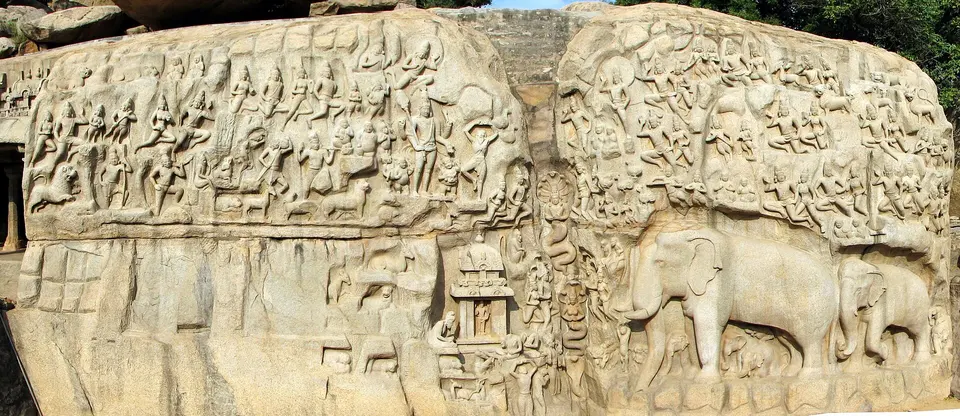
Descent of the Ganges
Photo: Bernard Gagnon, CC BY-SA 3.0
2Rock relief

Descent of the Ganges

A relief 27 metres long and 13 metres high carved across the face of two great boulders with a natural cleft between them, and the largest open-air rock relief in the world. More than a hundred figures — gods, sages, celestial couples, a family of elephants carved life-size, and a famous cat standing on its hind legs imitating an ascetic's penance while the mice look on unafraid. Scholars argue whether it shows the Ganges coming down to earth through Shiva's hair or Arjuna doing penance for a weapon, and the cleft in the middle, which once carried water, supports the first reading.

  • Plan about 45 min
  • Free and always accessible in the middle of the village; go in the morning when the low sun rakes across the carving, and take fifteen minutes to find the cat and the mice on the right-hand boulder

Midday

LunchMahabalipuram village lives on visitors and the seafood shacks along the beach road know it, but the fish is landed locally and a whole grilled pomfret or a plate of prawns with rice is still the right lunch. Inland, the village has plain Tamil messes at a third of the price. On the drive back, DakshinaChitra at Muttukadu and the artists' village at Cholamandal are both on the East Coast Road and both worth a stop if the light holds.

Afternoon

1 km south, about three minutes by car or a fifteen-minute walk
Pancha Rathas
Photo: Vyacheslav Argenberg, CC BY 4.0
3Temple

Pancha Rathas

Five shrines cut from a single ridge of granite in the seventh century, each carved downwards from the top like a sculpture rather than built up like a building, and each finished in a different architectural style — so the group works as a catalogue of South Indian temple forms in their first generation. They are named for the five Pandava brothers and Draupadi, which has nothing to do with their purpose; none was ever consecrated, and the whole set was probably left incomplete when the king died. A life-size elephant, a lion and a Nandi stand among them, carved from the same rock.

  • Plan about 1 h
  • Covered by the combined ticket with the Shore Temple; it is a ten-minute walk or a two-minute drive south of the main village, and the site is small enough to do properly in an hour

Evening

1 km east to the sea, about four minutes by car
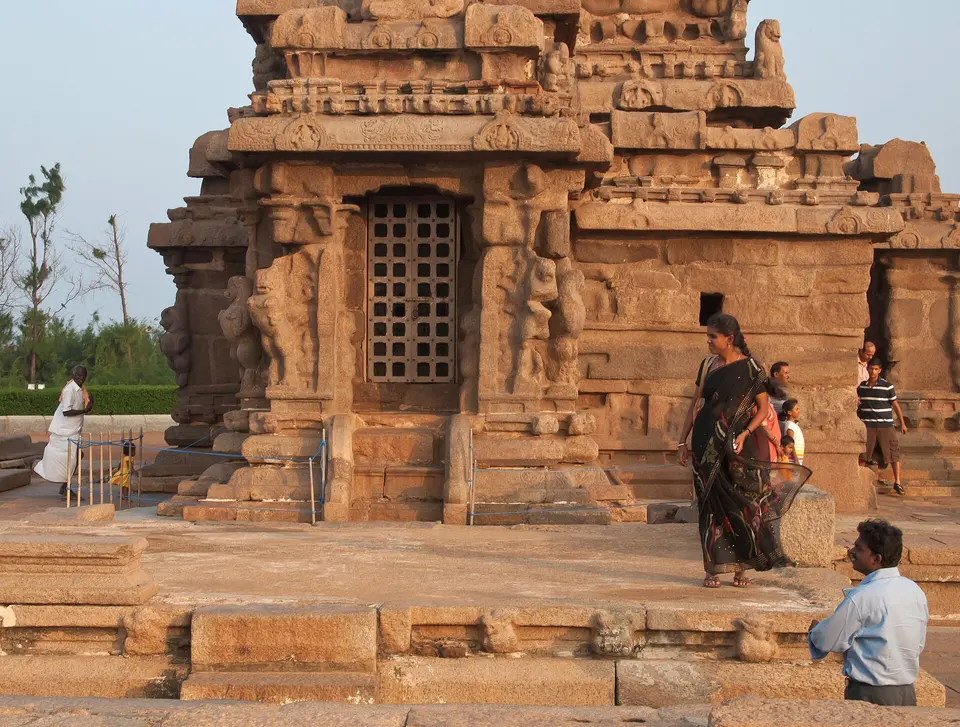
Shore Temple
Photo: Vyacheslav Argenberg, CC BY 4.0
4Temple

Shore Temple

Built about 700 to 728 under Narasimhavarman II, and one of the oldest structural stone temples in South India — everything before it here was carved out of the rock rather than assembled from it. Two Shiva shrines and a Vishnu shrine share a compound wall lined with seated Nandi bulls, and the taller tower steps up in five tiers directly above the surf. Thirteen centuries of salt wind have rounded the carving into something softer than it was, which is part of its effect. The 2004 tsunami briefly pulled the water back and exposed other structures offshore, confirming the old local story of seven pagodas.

  • Plan about 1 h
  • Covered by the combined Mahabalipuram ticket with the Pancha Rathas; the compound is exposed and the best light is the first hour after opening or the last before closing

Good to know in Chennai

Archaeological Survey of India sites: the rules

  • The Archaeological Survey of India states that an entry fee applies at certain monuments, that still photography is generally permitted at monuments, and that separate permission is required for filming operations. The Group of Monuments at Mahabalipuram and the Fort Museum at Fort St. George are both ASI sites.Source: Archaeological Survey of India — Monuments · checked Sep 2026

Getting around: the metro

  • Chennai Metro Rail Limited publishes a fare table offering a 20 per cent discounted fare, and issues the Singara Chennai Card as its travel card; the fare table notes that fares were last updated on 22 February 2021.Source: Chennai Metro Rail Limited — CMRL Fare Table · checked Sep 2026

3 days in Chennai: quick answers

Is 3 days enough for Chennai?

Three days covers the colonial core, the temple quarter and a full day at Mahabalipuram, which is what most visitors want. Chennai is not a city that performs for tourists — it is large, hot, and organised around work, temples and food rather than sights — so a longer stay is about eating better and moving slower rather than seeing more. If you have a fourth day, Kanchipuram's temples are 70 km west and Pondicherry is three hours south down the coast road.

What is the best time of year to visit Chennai?

December to February, without much argument. Those months are dry and sit around 25 to 29°C, and December is also the Margazhi season, when the city fills with Carnatic music and Bharatanatyam concerts in dozens of sabhas, most of them cheap or free. March to June is genuinely difficult — May regularly passes 40°C with high humidity — and the north-east monsoon brings heavy rain and occasional flooding from October to early December.

How do you get around Chennai?

The metro is clean, cheap and air-conditioned, and its two lines reach the airport, Central and Egmore stations, High Court and the western suburbs; Chennai Metro Rail offers a 20 per cent discounted fare and issues the Singara Chennai travel card. Suburban trains run down the coast towards Mylapore and beyond. Autorickshaws are everywhere and the ride-hailing apps are easier than negotiating. For Mahabalipuram, hire a car for the day or take a bus from Koyambedu.

How much does Chennai cost per day?

Very little by the standards of a city this size. A hostel bed is 500 to 1,000 rupees, a decent mid-range hotel 3,000 to 6,000, and the seafront business hotels far more. A full banana-leaf meal costs 150 to 300 rupees and a plate of idli under 100. Museum and monument entry is small but foreign-visitor rates at Archaeological Survey of India sites are several times the Indian rate, and cameras usually cost extra. A car with driver for the Mahabalipuram day runs 2,500 to 4,000 rupees.

What should you know before visiting the temples?

Shoes come off before you enter any temple precinct, not just the building, and there is usually a stand at the gate. Shoulders and knees covered is expected, and at some Tamil temples men remove their shirts to enter the inner shrine. Non-Hindus may walk the outer precincts at Kapaleeshwarar but not enter the sanctum. Photography inside is generally not allowed. Temples close for several hours in the middle of the day, typically about 12:00 to 16:00, which shapes the plan above.

Can you swim at the beaches in Chennai?

No, and this is not over-caution. Marina Beach and Elliot's Beach both have strong rip currents and a steep shelf, there are no lifeguards on most of the shore, and people drown every year. The beaches are for walking, sitting and eating in the evening, which is exactly what the city uses them for. If you want to swim, the resort hotels south of the city along the East Coast Road have pools and supervised stretches of beach.

Other Chennai itineraries

Keep exploring

Where this connects

THE TRIPWOA APP

Go somewhere.
Make it yours.

Build days around what you love. Follow your route, find your next stop and keep the moments along the way.

Get it on Google PlayAvailable for Android
Free to start
Tripwoa home with a Paris trip and nearby places to explore
Tripwoa day plan for New York with a route map and Times Square stop

A day that feels like you.

Sources and method

Places and coordinates: Wikidata and Tripwoa's open-data place catalog (Overture Maps Foundation, © OpenStreetMap contributors). Photos: Wikimedia Commons, credited on each image. Practical rules: the official sources linked in each note, checked in September 2026.

How this plan was made: Tripwoa's planner drafted the day order from real coordinates and typical visit times. Each stop was then reviewed, reordered where needed and rewritten with AI assistance. Walking distances are straight-line estimates, so allow a little extra time on real streets.