3-day itinerary · Turkey

3 Days in Pamukkale

A plan that gives the first day to the white cliff and the Roman city on it, the second to the Lycus valley and Denizli, and the third to Aphrodisias. Official 2026 hours and the Antique Pool's fee table are in the stops.

  • 3days
  • 14sights
  • 0.0 kmon foot between sights

Updated 13 September 2026 · 1 official sources checked · report an error

Pamukkale Travertines
Photo: Irdelix, CC BY-SA 4.0

The travertines and Hierapolis, then Laodicea and the red springs, then Aphrodisias

Pamukkale is a village in Denizli province in south-western Turkey, sitting under a white cliff 2,700 metres long that hot calcium-rich springs have been building for something like fourteen thousand years. On the plateau above it stand the ruins of Hierapolis, a spa city founded by the kings of Pergamon in the second century BC and rebuilt by Rome after an earthquake, with a theatre, a colonnaded street and a necropolis of more than a thousand tombs; the two together went onto the UNESCO World Heritage list in 1988 as a single mixed natural and cultural site. Around them the Lycus valley holds Laodicea, one of the seven churches of Revelation, and an hour and a half south-west is Aphrodisias, the Carian marble town that carved statues for the whole Roman empire.

At a glance

Ways to use these days

If it rains
2 of the stops are indoors — Hierapolis Archaeology Museum · Aphrodisias Museum
Lightest day on foot
Day 1 — 1.9 km between stops
Most walking
Day 2 — 66.6 km

Day 1

The white cliff and the Roman city on top of it

Walk the travertine terraces barefoot, spend the middle of the day in Hierapolis and its theatre, swim among fallen columns in the Antique Pool, look into the gas vent that the ancients called a door to the underworld, and finish in the museum in the Roman baths.

  • 5 sights
  • Transport between sights
12345250 mN
Stops in order, straight-line distancesWalking route in Google Maps ↗

Morning

Pamukkale Travertines
Photo: Irdelix, CC BY-SA 4.0
1Natural site

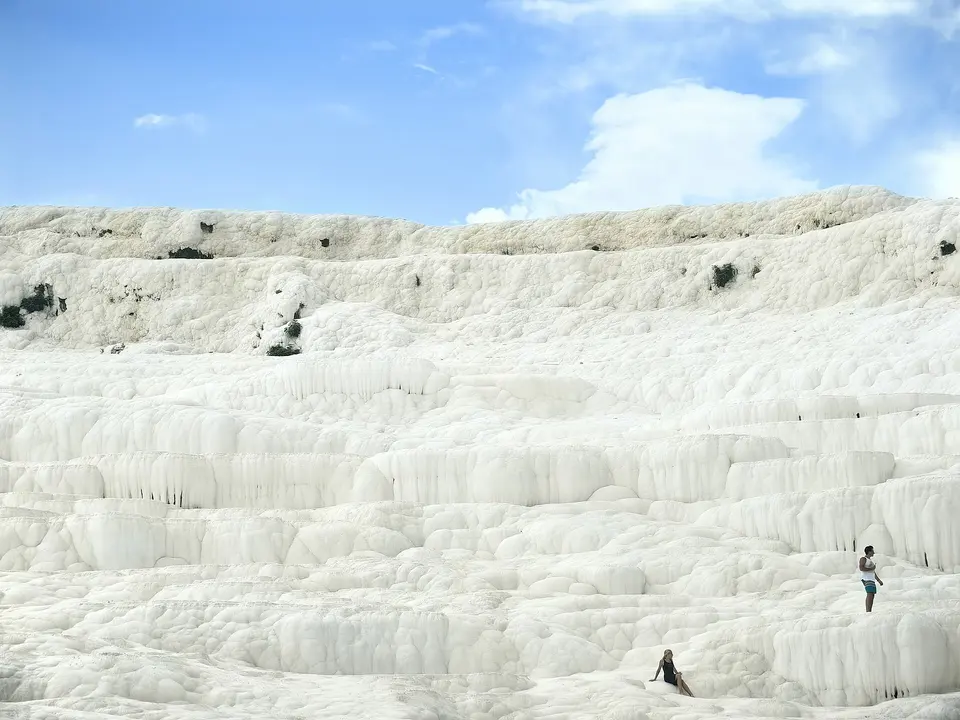
Pamukkale Travertines

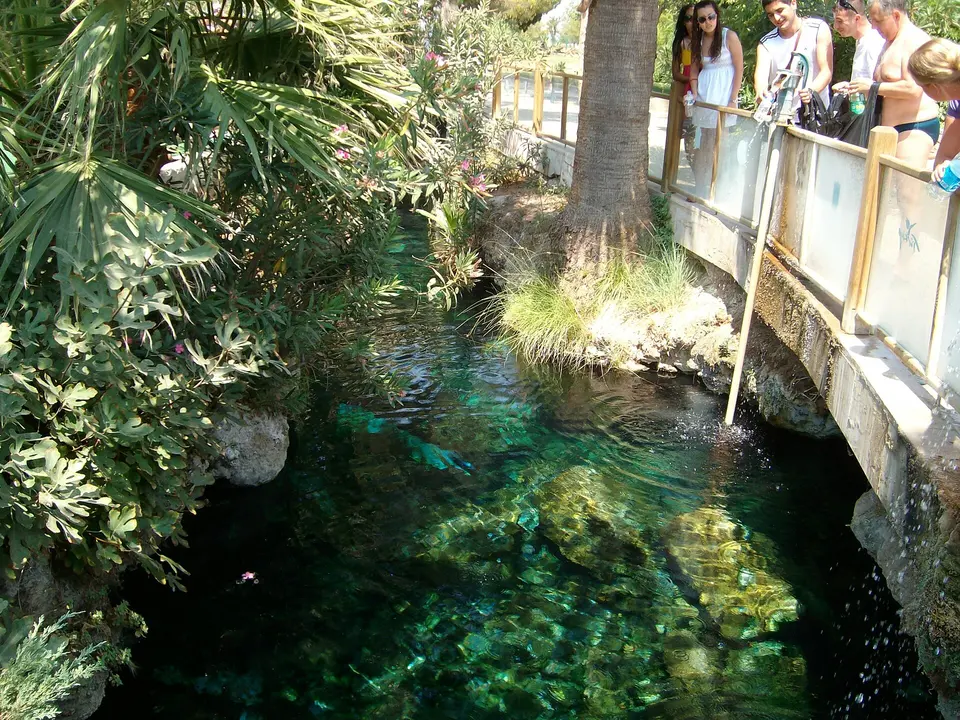
Water at about 35°C comes out of the ground here carrying dissolved calcium bicarbonate, loses its carbon dioxide as it runs down the hillside, and leaves calcium carbonate behind. Over something like fourteen thousand years that has built a white cliff 2,700 metres long and 160 metres high, terraced into basins that hold shallow warm water. The Turkish name means cotton castle. Until the 1990s hotels stood on top of it and cars drove up; those were demolished, the water is now rotated between sections to keep them white, and visitors walk the marked path barefoot, which is the condition of the place surviving at all.
  • Plan about 2 h 30 min
  • Shoes must come off for the whole walk down the travertine path and the surface is sharp in places, so carry a bag for them; the pedestrian path between Pamukkale and Hierapolis is open 08:00 to 18:00 and the light on the white terraces is best in the last hour
The terrace path ends at the top of the cliff inside Hierapolis, about 25 minutes on foot
Hierapolis
Photo: Giorgio Galeotti, CC BY-SA 4.0
2Archaeological site

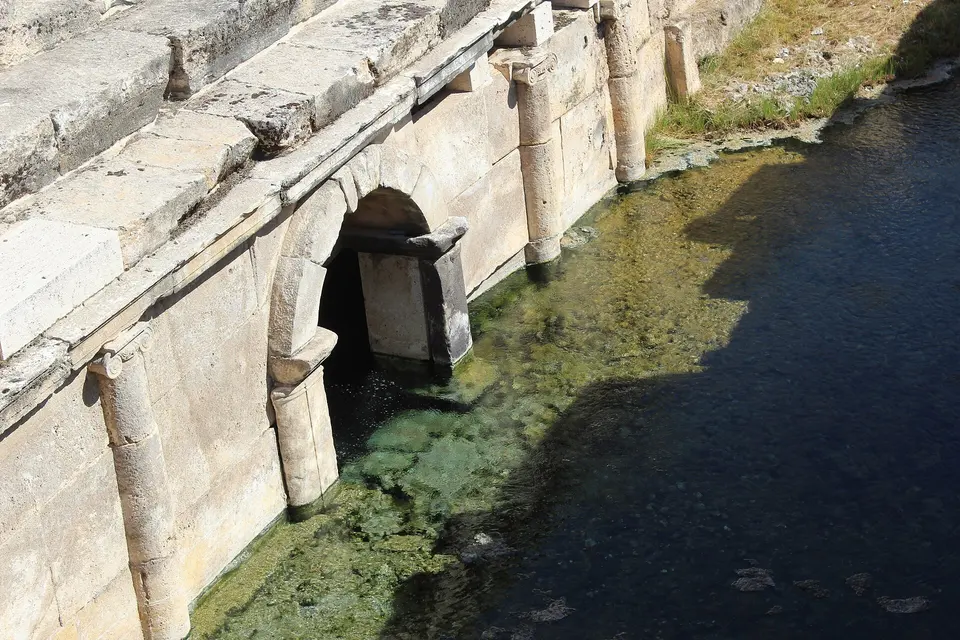
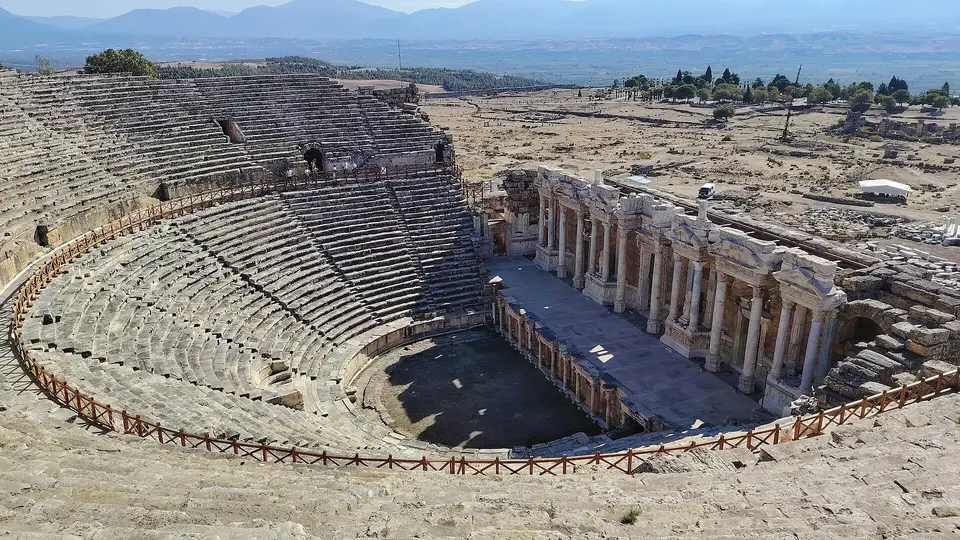
Hierapolis

A city founded by the Attalid kings of Pergamon in the second century BC on top of the springs, because hot mineral water was a health industry then as now. Rome took it in 133 BC, an earthquake flattened it under Nero, and the Hierapolis you walk through is the Roman rebuild: a colonnaded main street more than a kilometre long, monumental gates, baths, and a theatre cut into the hillside whose stage building still stands two storeys high with its carved friezes in place. Beyond the north gate lies a necropolis of well over a thousand tombs, one of the largest in Anatolia, in every form from tumulus to house-tomb.

  • Plan about 3 h
  • Ticketed together with the travertines; allow three hours and take water and a hat, as there is almost no shade. The theatre and the north necropolis are at opposite ends of the site and a kilometre apart

Midday

LunchPamukkale village is a row of pensions and restaurants that exist entirely for the site, and the food follows: kebabs, pide, and a set menu in three languages. It is perfectly decent and it is not why you came. The better eating is in Denizli, where the kebapçıs do the local Denizli kebabı, lamb cooked slowly in a pot, and the covered bazaar has a row of tripe soup places that open at dawn. In the village itself, look for the places away from the main street that put the day's pots in the window.

Afternoon

500 m north through the site, about seven minutes on foot
The Agora and the Antique Pool
Photo: Maxim Karpinskiy, CC BY-SA 3.0
3Archaeological site

The Agora and the Antique Pool

The agora of Hierapolis was a rectangle of about 280 by 170 metres, one of the largest public squares in the Roman East, closed on its east side by a basilica-stoa with Ionic and Corinthian orders stacked above each other; the earthquake of the seventh century brought it down and the blocks lie where they fell. A few minutes south, an earthquake did something better: it dropped a colonnade into the spring pool, and the fallen marble columns still lie on the bottom of what is now the Antique Pool, where you can swim among them in mineral water at about 36°C. It is separately ticketed and it is the single most-photographed swim in Turkey.

  • Plan about 1 h 30 min
  • The Antique Pool is open 08:00 to 20:00 in the summer season and charges its own admission on top of the site ticket; the official 2026 rate is 600 lira for foreign visitors over twelve and 300 lira for foreign children aged seven to twelve
300 m south to the Temple of Apollo, four minutes on foot
Ploutonion (Pluto's Gate)
Photo: Interfase, CC BY-SA 4.0
4Archaeological site

Ploutonion (Pluto's Gate)

Strabo described a doorway into the underworld at Hierapolis that killed any animal led into it while the eunuch priests of Cybele walked in unharmed, and in 2013 an Italian team under Francesco D'Andria found it: a small arched chamber over a fissure, with tiered seating for spectators and a temple of Apollo above. The explanation is carbon dioxide, which pools heavy and lethal at ground level at night and disperses in the day — which is exactly why the priests, who were taller than the birds and the bulls and knew the hours, survived. Measurements at the site have recorded concentrations high enough to kill in minutes.

  • Plan about 45 min
  • Fenced off for obvious reasons and viewed from the walkway above; it sits immediately below the Temple of Apollo, a two-minute walk from the theatre path, and the information board explains the gas

Evening

200 m west inside the site, three minutes on foot
Hierapolis Archaeology Museum
Photo: Carole Raddato from FRANKFURT, Germany, CC BY-SA 2.0
5Museum

Hierapolis Archaeology Museum

Installed in the second-century Roman bath complex, which means the sarcophagi stand in rooms that were once the frigidarium and the caldarium and the architecture is half the exhibit. The collection is the output of sixty years of excavation at Hierapolis, Laodicea and the smaller Lycus valley sites: Roman portrait sculpture, the theatre's relief friezes of Apollo and Artemis, an extraordinary series of carved sarcophagi from the necropolis, tomb stelae with the trades of the dead on them, and small finds from the Phrygian period onwards. It is a small museum and an unusually good one.

  • Plan about 1 h 15 min
  • Open 08:00 to 20:00 in the summer season according to the provincial culture directorate; it is inside the site, a couple of minutes from the Antique Pool, and is covered by its own ticket

Day 2

Red water, a refused earthquake and the underground Pamukkale

The second springs north of town run rust red instead of white; then south to the city that rebuilt itself without imperial help, a Seljuk caravanserai nobody stops at, a cave that grows travertine underground, and the working city that the whole region revolves around.

  • 5 sights
  • Transport between sights
123455 kmN
Stops in order, straight-line distancesDriving route in Google Maps ↗

Morning

Karahayıt
Photo: Сарапулов, CC BY 4.0
1Village

Karahayıt

Five kilometres north of Pamukkale, a second set of springs comes out of the ground with iron in the water instead of pure calcium, and the travertine it builds is rust red rather than white. The Kırmızı Su, the Red Spring, is a small terrace in the middle of the village, free and completely unceremonious — a public fountain with a stain the colour of terracotta running away from it, people filling bottles, and a row of thermal hotels that fill with Turkish visitors taking the cure. It takes twenty minutes to see and it is the natural counterpoint to the white cliff down the road.

  • Plan about 1 h
  • Free and always open; the spring is in the middle of the village next to the market, and the Monday market in Karahayıt is a proper local one rather than a tourist bazaar
14 km south, about twenty minutes by car; the site entrance is off the Denizli–Pamukkale road
Laodicea on the Lycus
Photo: Biologg, CC BY-SA 4.0
2Archaeological site

Laodicea on the Lycus

Antiochus II founded it around 260 BC and named it after his wife Laodice; it grew rich on black wool and banking, and when an earthquake destroyed it in AD 60 it famously refused imperial aid and rebuilt itself. It is also one of the seven churches of Revelation, and the line about being neither cold nor hot is usually read as a dig at a city whose aqueduct delivered water that arrived lukewarm. What makes it worth the ten-kilometre drive is scale and pace: two theatres, a stadium, a 300-metre colonnaded street, and one of the largest ongoing re-erection programmes in Turkey, so every year more of it is standing up.

  • Plan about 2 h
  • Ticketed and open 08:00 to 21:00 in the summer season according to the provincial culture directorate; the site is very large and very exposed, so go early or late, and the car park is at the north end by the Syria Street

Midday

LunchLaodicea has a canteen at the entrance and nothing else, so plan lunch around it. Kaklık has village restaurants doing gözleme and trout. If you are back in Denizli for the middle of the day, the covered bazaar and the streets around Delikliçınar square are where the city eats: Denizli kebabı, tandır, and the sweet shops selling the local walnut and grape köfte.

Afternoon

9 km south-east on the D320, about fifteen minutes by car
Akhan Caravanserai
Photo: Christian1311, CC BY-SA 4.0
3Caravanserai

Akhan Caravanserai

A Seljuk caravanserai of 1253 to 1254 on the old road east out of Denizli, built of white marble — which is where the name, the White Han, comes from — with a carved portal, an open courtyard and a covered hall behind it. The inscription over the door names the builder and the date, which is rarer than it sounds. Caravanserais were the motorway services of the thirteenth century, spaced a day's march apart, and travellers got three days of free lodging, food and stabling at the state's expense. This one is intact enough to read as a building rather than a ruin and almost nobody stops at it.

  • Plan about 30 min
  • Free and unstaffed, on the D320 road about 12 km from Pamukkale; it takes half an hour, the gate is usually open during the day, and there is space to pull off the road
20 km east, about twenty-five minutes by car on the Afyon road
Kaklık Cave
Photo: Ahmet KAYNARPUNAR, CC BY-SA 3.0
4Cave

Kaklık Cave

A collapsed cave with a hole in its roof, sulphurous water running through it and travertine growing on every surface, which has earned it the nickname of the underground Pamukkale. It is small — you are through it in half an hour — but the effect of daylight coming down into a chamber of white terraces and stalactites with the smell of sulphur in the air is genuinely strange, and there is a walkway and a bridge over the pools. The municipality has built a park and a small thermal pool around it. It is 24 km east of Pamukkale on the Afyon road and gets a fraction of the visitors.

  • Plan about 1 h
  • A small entry charge, generally open through the day; the floor is wet and slippery and the sulphur smell is strong in the lower chamber, which children find either brilliant or unbearable

Evening

30 km west, about thirty-five minutes by car back into the city
Denizli
Photo: Aziz Akbiyik, CC BY-SA 3.0
5City

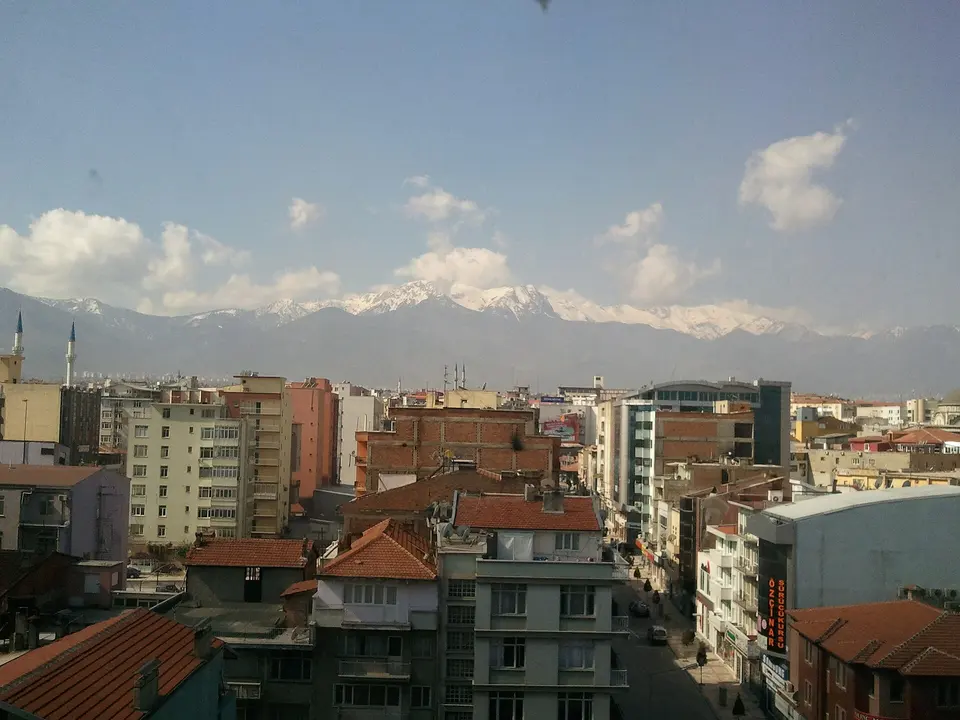
Denizli

The city the region actually runs on: a million people in the metropolitan area, the centre of Turkey's towelling and bathrobe industry, and the place where you will change buses. Its symbol is a rooster — the Denizli horozu is a local breed prized for a crow that can last half a minute — and there is a bronze one on the main square that everybody photographs. There is a bazaar, an Atatürk and Ethnography Museum, a city museum, a cable car up to the Bağbaşı plateau on the flank of Honaz for the view back over the plain, and the ordinary pleasure of a Turkish provincial city that is not performing for anyone.

  • Plan about 2 h
  • The Atatürk and Ethnography Museum and the Denizli City Museum both open 08:00 to 17:00 in the summer season according to the provincial culture directorate; the intercity bus station and the train to İzmir are here, and dolmuşes to Pamukkale run every few minutes

Day 3

The day at Aphrodisias: a marble town that carved for the empire

Drive an hour and a half south-west to a Carian city built next to its own quarry, walk the stadium and the re-erected gateway, stand under the columns of the temple that named it, and finish in the museum with eighty imperial relief panels in one hall.

  • 4 sights
  • Transport between sights
1234250 mN
Stops in order, straight-line distancesDriving route in Google Maps ↗

Morning

Aphrodisias
Photo: Bernard Gagnon, CC BY-SA 3.0
1Archaeological site

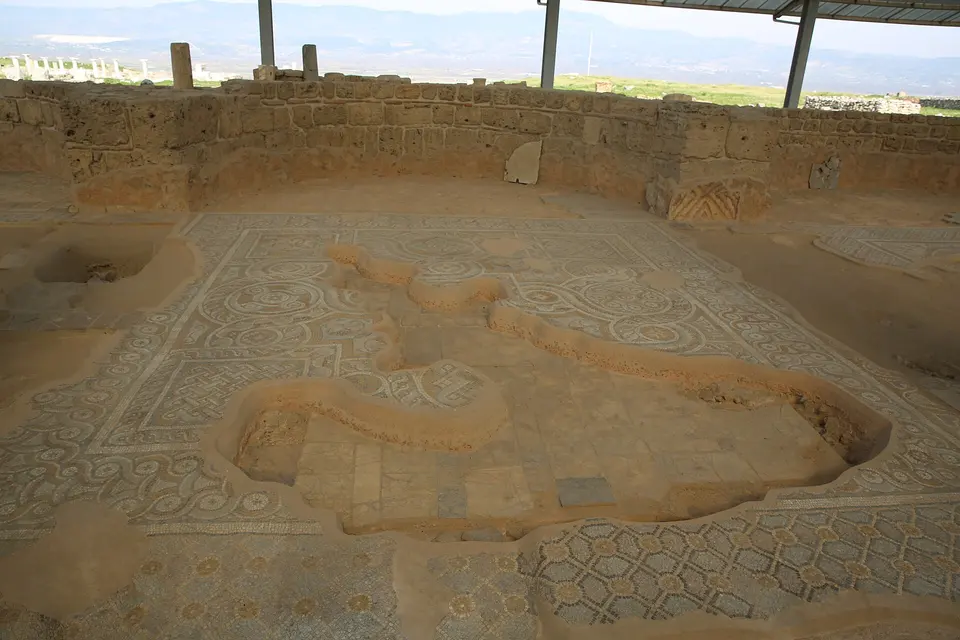
Aphrodisias

A Carian city built next to a marble quarry, which decided everything about it: Aphrodisias ran the best sculpture school in the Roman world, exported statues and sculptors across the empire, and built itself in the material it sold. The stadium at the north end seated about thirty thousand and is among the best preserved anywhere; the Tetrapylon, the monumental gateway re-erected in the 1990s, is the image on every poster. Excavation has been continuous since 1961, first under Kenan Erim and now under New York University, and the site went onto the UNESCO World Heritage list in 2017. It is 100 km by road and worth every minute.

  • Plan about 3 h
  • Ticketed and open through the day; allow three hours for the site and one for the museum, wear proper shoes as the circuit is about 3 km on rough ground, and a shuttle tractor runs from the car park to the entrance
Inside the site at the north end, about fifteen minutes on foot from the entrance
Sanctuary of Aphrodite
Photo: Bernard Gagnon, CC BY-SA 3.0
2Archaeological site

Sanctuary of Aphrodite

The temple that gave the city its name and its living: an Ionic building of the first century BC on the site of an older sanctuary, whose Aphrodite was not the Greek goddess of love so much as a local Anatolian mother deity in Greek dress, shown in a stiff, sheath-like garment covered in registers of carved symbols. Fourteen columns still stand. In about AD 500 the temple was converted into a Christian basilica, which is why the columns are in a rectangle rather than a peristyle — the builders moved them to lengthen the nave, and you can see the joins. The cult statue is in the museum.

  • Plan about 1 h
  • Inside the main site and included in its ticket; it stands at the north end of the circuit near the Sebasteion, and the morning light on the standing columns is the reason to arrive early

Midday

LunchGeyre, the village at the gate, has a couple of tea gardens under plane trees doing gözleme, ayran and salad, and that is the whole menu and the right one. Karacasu, eight kilometres away, is the market town and has proper lokantas with trays in the window. Take water with you onto the site: the circuit is about three kilometres and there is one drinks stand.

Afternoon

400 m back at the site entrance, six minutes on foot
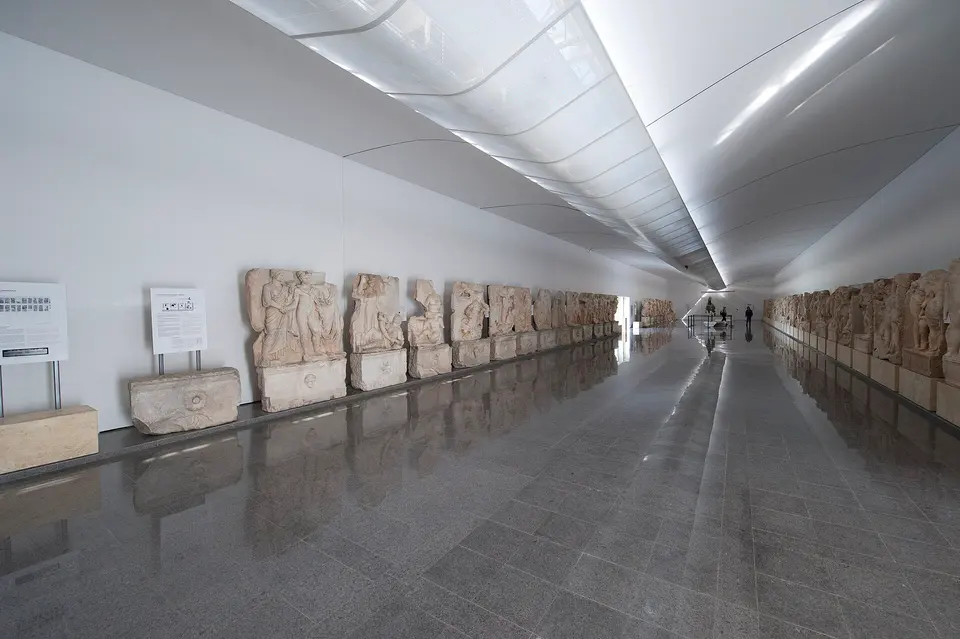
Aphrodisias Museum
Photo: Dosseman, CC BY-SA 4.0
3Museum

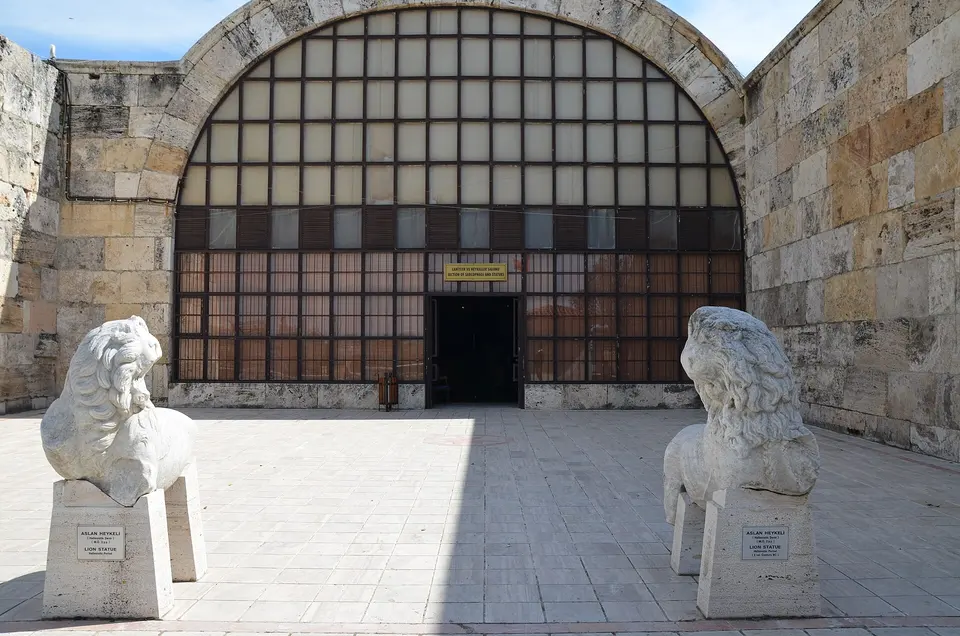
Aphrodisias Museum

A site museum with a collection that belongs in a capital city, because the sculpture school worked here and left its stock. The centrepiece is the Sebasteion hall: around eighty relief panels from a temple complex dedicated jointly to Aphrodite and the Julio-Claudian emperors, carved in the first century AD, showing Claudius subduing Britannia, Nero and Agrippina, and a run of mythological scenes — the single most important group of Roman imperial relief sculpture found anywhere. Around it are the cult statue of Aphrodite, portrait heads, and unfinished pieces that show exactly how a marble workshop worked.

  • Plan about 1 h 15 min
  • At the entrance to the site and covered by the same ticket; go after the site rather than before, so you have seen where the Sebasteion stood, and allow a full hour for the relief hall alone

Evening

1 km west of the site entrance, three minutes by car or fifteen on foot
Geyre
Photo: Nihat1988, CC BY 3.0
4Village

Geyre

The village at the gate of Aphrodisias, and a small lesson in what archaeology costs. Geyre stood on top of the ruins — houses built into the theatre, a mosque in the agora — until earthquakes in 1956 and the excavation together moved it about a kilometre west in stages through the 1960s and 1970s. What is there now is an ordinary Aegean village of low houses, plane trees and a tea garden, with the old stone spolia still built into a few walls. It is where you eat lunch on the Aphrodisias day, and the gözleme at the tea garden under the trees is better than anything on the main road.

  • Plan about 45 min
  • Free; the village is a kilometre from the site entrance and the shuttle passes through it. There is no bank or pharmacy, so bring what you need from Karacasu or Denizli

Good to know in Pamukkale

Pamukkale and Hierapolis: the official summer hours

The Antique Pool: what it costs

  • Official 2026 admission to the Pamukkale Antique Pool: children aged 0 to 6 free; foreign children aged 7 to 12, 300 lira; foreign visitors over 12 and adults, 600 lira; Turkish citizens aged 7 to 18, 125 lira; Turkish adults holding a Müzekart, 235 lira; TÜRSAB agency group purchase, 500 lira.Source: Denizli İl Kültür ve Turizm Müdürlüğü — Antik Havuz Giriş Ücretleri · checked Sep 2026

3 days in Pamukkale: quick answers

Is 3 days enough for Pamukkale?

More than enough for the site itself — the travertines and Hierapolis are a single long day — and about right if you also want Laodicea and Aphrodisias, which are the reason to stay rather than come on a bus for four hours from Kuşadası. Most visitors give Pamukkale half a day and leave, and most visitors never see the stadium at Aphrodisias or the sarcophagi in the Hierapolis museum. Three days turns a photo stop into a proper look at the Lycus valley.

What is the best time of year to visit Pamukkale?

April to early June and September to October. July and August are genuinely hot — regularly over 35°C on a site with no shade — and the terraces are crowded from mid-morning. Winter is cold and can be grey, but the terraces are almost empty and the warm water is more appealing than in August. Whenever you come, be at the gate at opening or in the last two hours: the site is at its worst between 11:00 and 15:00, when the coach groups and the sun arrive together.

Can you swim at Pamukkale?

In two places. The travertine terraces themselves have shallow warm pools along the walking path that you may wade in, barefoot, where the signs allow it — this is included in the site ticket and it is ankle to knee deep. The Antique Pool, also called Cleopatra's Pool, is a proper swim in mineral water at about 36°C over fallen Roman columns, it is separately ticketed, and the official 2026 rate for foreign visitors over twelve is 600 lira. Bring a towel and swimwear; there are lockers and changing rooms.

How much does Pamukkale cost per day?

Less than the coastal resorts. A pension in Pamukkale village runs 900 to 2,000 lira, a thermal hotel in Karahayıt more, and Denizli is cheaper than either. The combined Hierapolis and travertine ticket is the main fixed cost, the Antique Pool is extra at 600 lira for foreign adults, and Laodicea and Aphrodisias each charge their own admission. A Museum Pass covering the Aegean sites pays for itself if you do all four. Meals in the village run 300 to 600 lira.

Do you need a car in Pamukkale?

For the first day, no: everything is walkable from the village and dolmuşes run to Denizli every few minutes and to Karahayıt almost as often. For Laodicea, Akhan and Kaklık a car makes a scattered day possible that public transport does not. For Aphrodisias a car or an organised tour is effectively required — it is 100 km by road, the bus connections involve a change at Karacasu and do not fit a day trip. Car hire is available in Denizli and at Denizli Çardak airport.

How do you get to Pamukkale?

Denizli Çardak airport is 65 km east with domestic flights from Istanbul and Ankara, and a shuttle meets them. Denizli's bus station has overnight coaches from Istanbul, Ankara and İzmir and frequent services along the coast, and the train from İzmir takes about five hours through the Meander valley and is the pleasant way to arrive. From Denizli, dolmuşes to Pamukkale leave every fifteen minutes and take half an hour. Day tours also run from Kuşadası, Selçuk and Marmaris, but they are long days.

Other Pamukkale itineraries

Keep exploring

Where this connects

THE TRIPWOA APP

Go somewhere.
Make it yours.

Build days around what you love. Follow your route, find your next stop and keep the moments along the way.

Get it on Google PlayAvailable for Android
Free to start
Tripwoa home with a Paris trip and nearby places to explore
Tripwoa day plan for New York with a route map and Times Square stop

A day that feels like you.

Sources and method

Places and coordinates: Wikidata and Tripwoa's open-data place catalog (Overture Maps Foundation, © OpenStreetMap contributors). Photos: Wikimedia Commons, credited on each image. Practical rules: the official sources linked in each note, checked in September 2026.

How this plan was made: Tripwoa's planner drafted the day order from real coordinates and typical visit times. Each stop was then reviewed, reordered where needed and rewritten with AI assistance. Walking distances are straight-line estimates, so allow a little extra time on real streets.